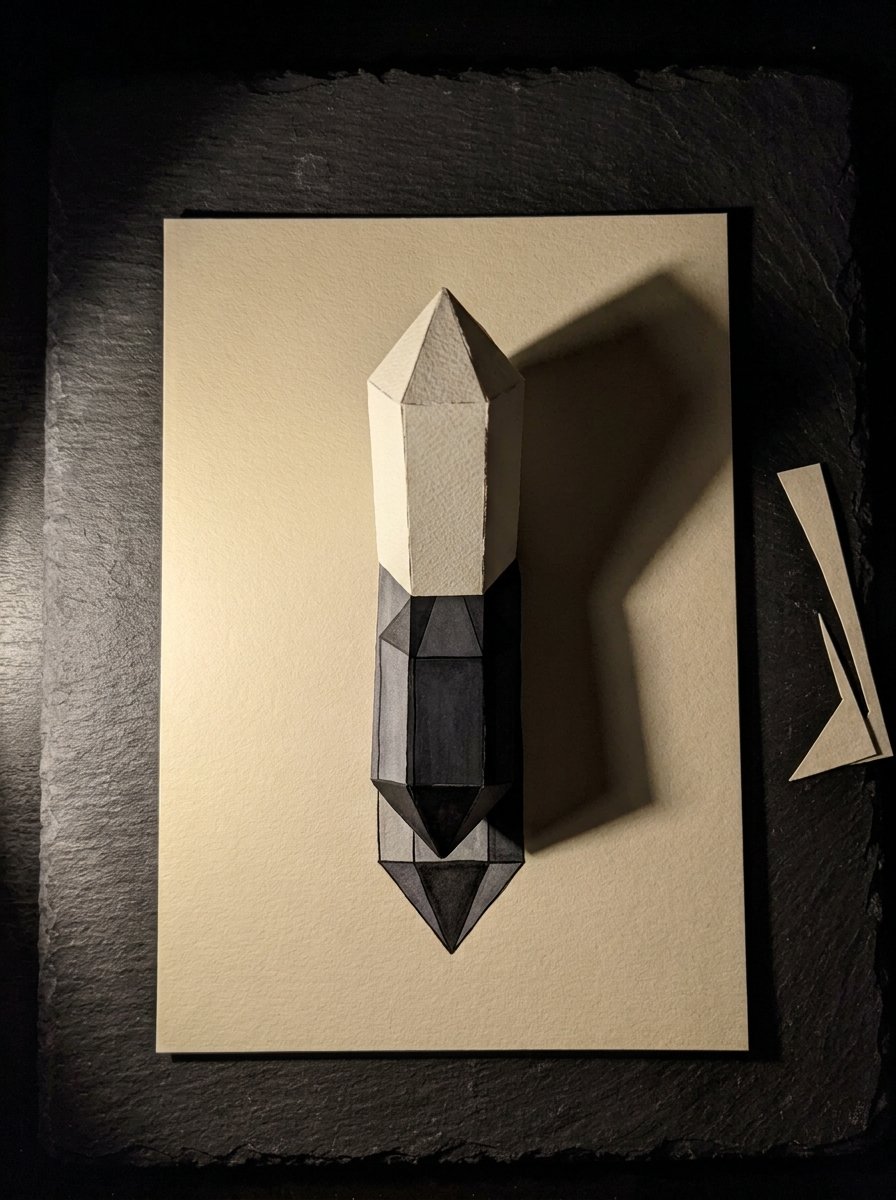
A crystal is the one natural object with no curve anywhere in it. Which makes crystal drawing a ruling job, not a shading job.
Those are 2 facets. Shade one mid-grey, leave the other white, and the paper has a crystal on it.
Nothing there was drawn. It was ruled. Crystal drawing has no curves in it anywhere. That is why it is the easiest hard-looking thing you can put on a page.
I avoided it for years because it looked complicated. (Complicated and difficult are not the same word. I had them filed under the same heading for most of my adult life.)
Below is the whole argument, and the sheet that settles it.
Download the free facet guide →
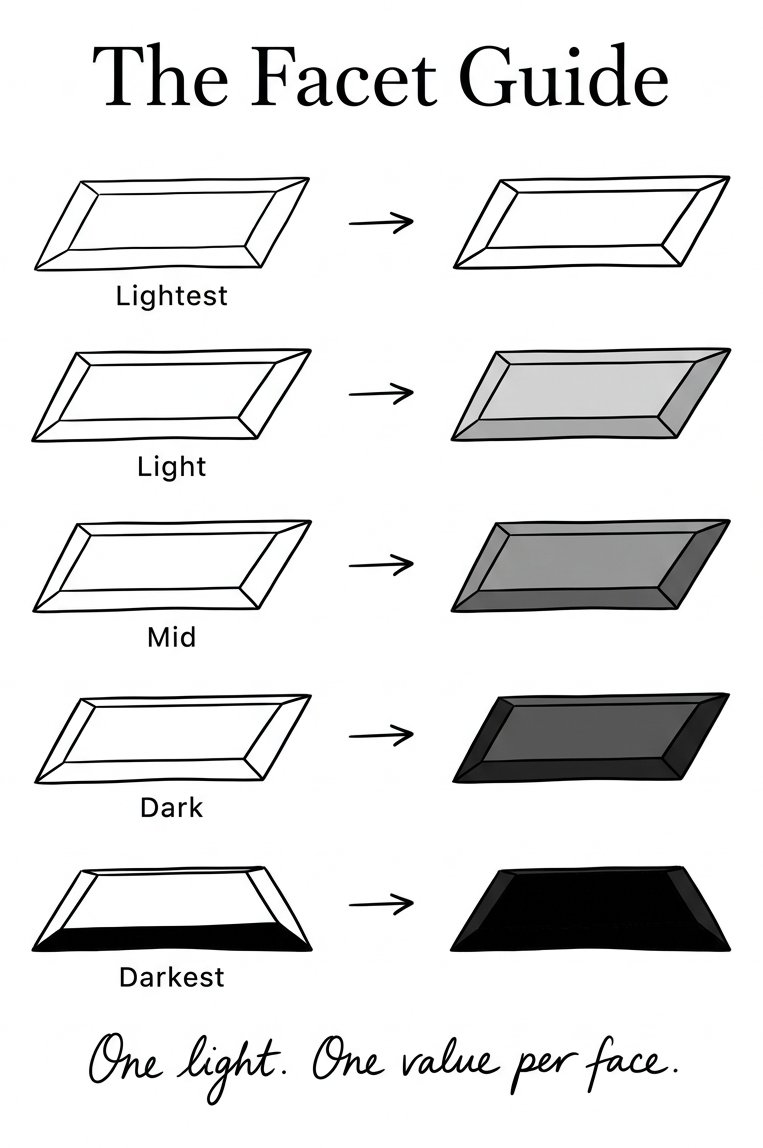
It is called The Facet Guide. It carries 5 steps: Lightest, Light, Mid, Dark, Darkest.
Print it at 100%, and turn the fit-to-page option off. (Printers hold firm views about margins and produce no evidence for any of them.)
The line at the bottom of the sheet is the whole method. One light. One value per face.
Pick a lamp or a window and do not move it. Faces turned towards it take Lightest. Faces turned away take Darkest. The rest take a step in between.
There is no blending in crystal drawing. There are flat tones beside flat tones, and a hard edge between every pair.
That is the part nobody says out loud. You are not shading a stone at all. You are handing each flat shape one tone and then leaving it alone.
The sheet works for a quartz point, a lump of amethyst, a glass paperweight and the stopper off a decanter. Same job every time.
Straight lines outside, a flat choice inside. That is the shape of this whole problem, and it is also how a mandala is built. The Complete Mandala Creation Toolkit is the collection this post came out of, and it hands you the ruled part.
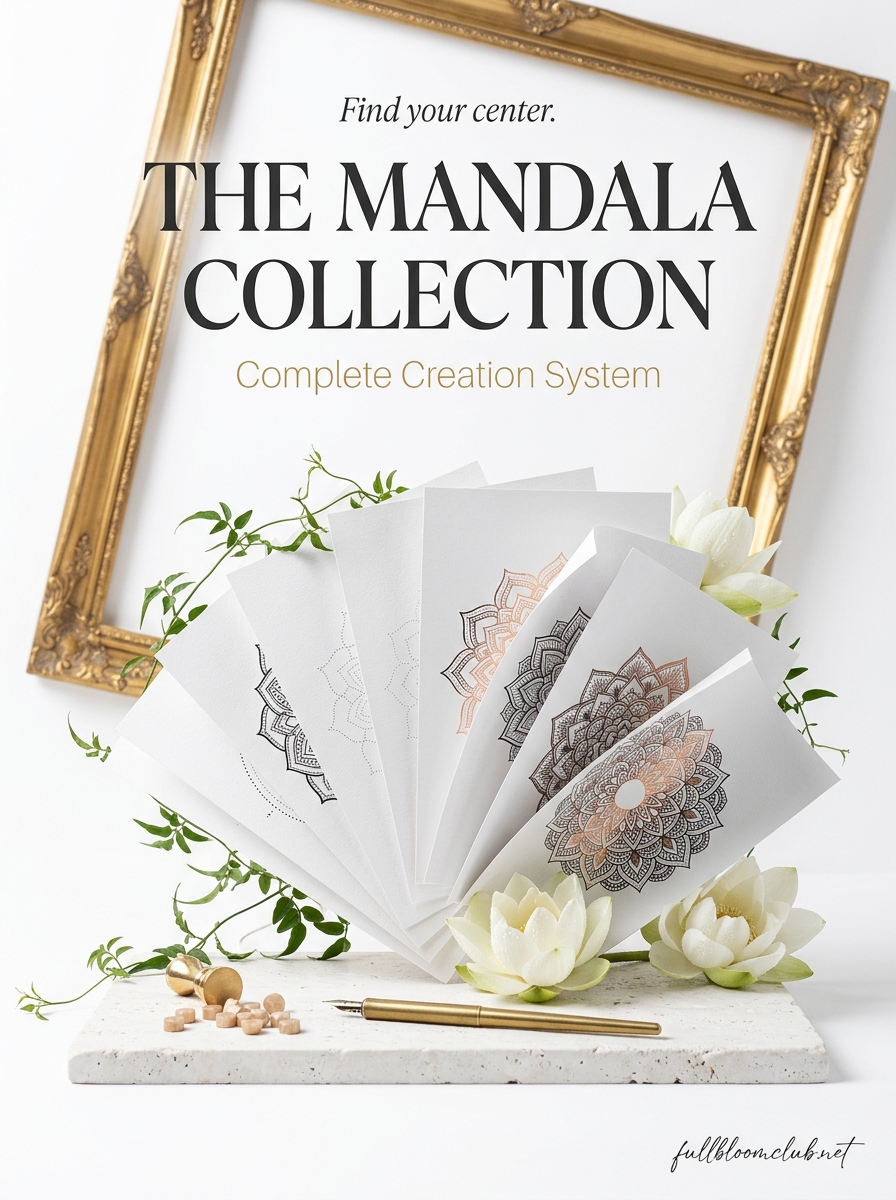
The Collection
8 master grids, so the straight lines are already ruled
THE MANDALA TOOLKIT. Rings, wedges, and 88 small parts to drop in. For the evening you want a ruled structure instead of a blank page. (I have started more mandalas than I have finished. The grid is why any of them got finished.) What you get: an hour that is not scrolling, and a page that looks planned.
Back to the argument, because the argument is the useful half.
Crystal drawing looks hard because it looks complicated
Put a photograph of a cut stone beside a photograph of a rose. The stone looks worse.
It has more edges. It has white flashes, dark wedges, and things that look like reflections of other things. The eye reads all that as difficulty and the hand puts the pen down.
Now count what is actually on the stone. Straight lines, and shapes with straight sides. That is the entire inventory.
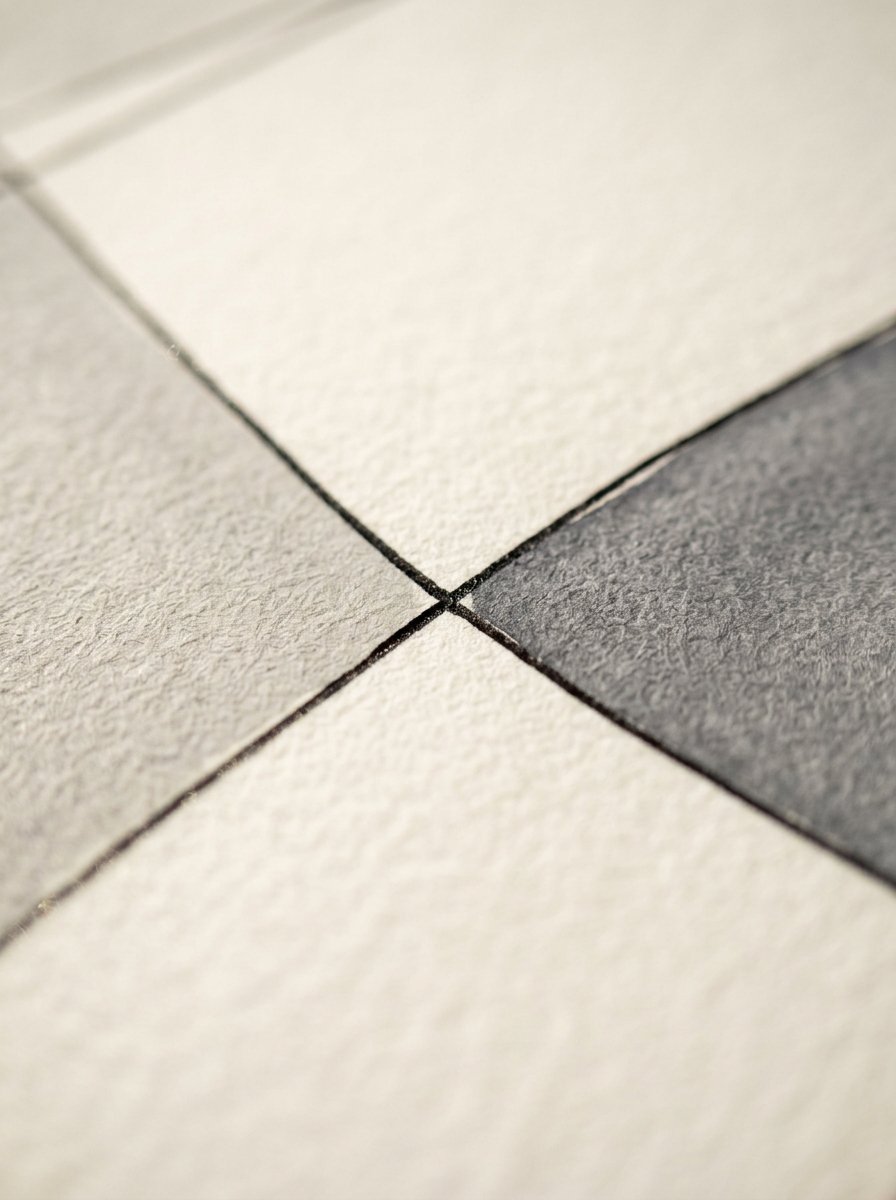
A rose has curves that change direction twice inside one petal. A crystal has none. Not one. (I have checked this more times than is dignified, mostly while avoiding the rose.)
Complicated means there are more pieces. Difficult means each piece is hard.
Crystal drawing is the first of those and not the second.
The complication is straight lines, and straight lines are the easy part
Here is the test against the claim. It takes about 8 minutes.
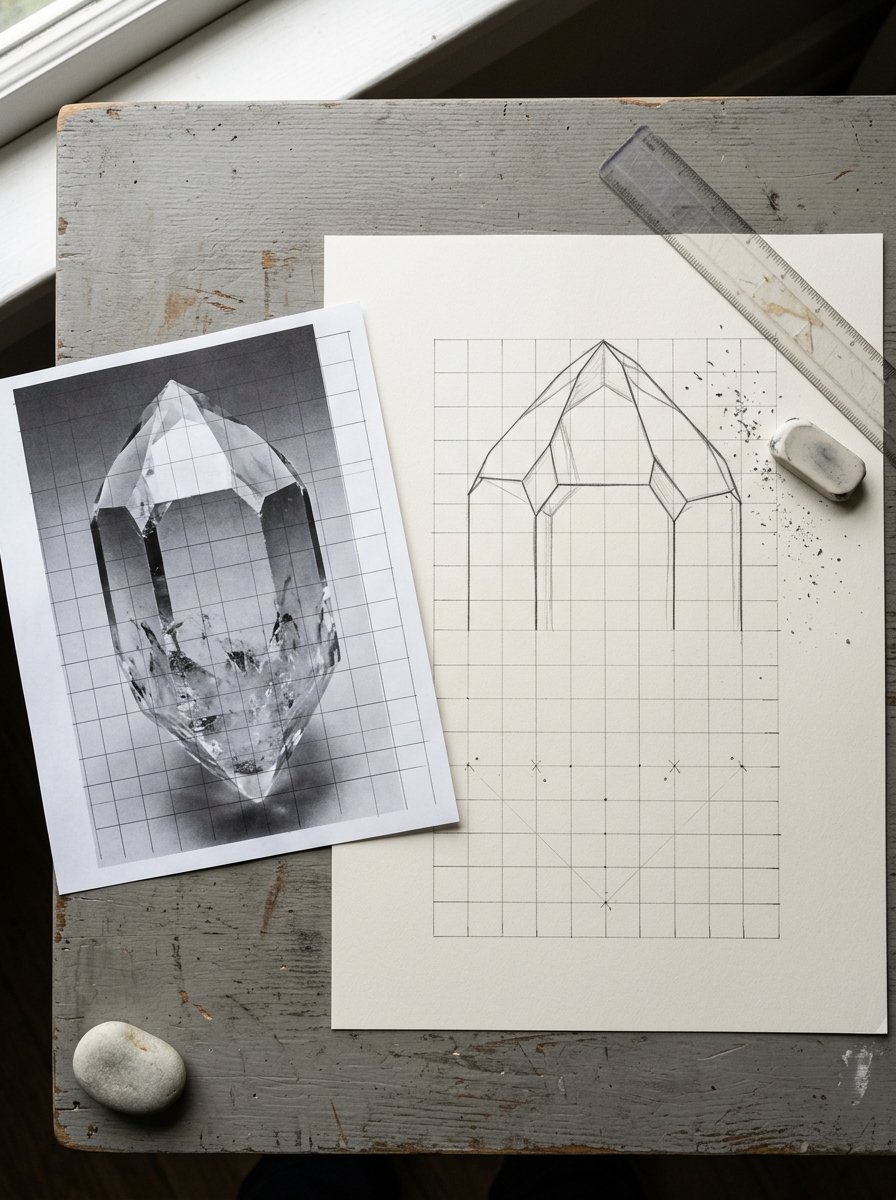
Draw the top facet first. It is a flat shape seen at an angle, so it is squashed. A hexagon becomes a flattened hexagon. A square becomes a lozenge.
Then drop one straight line from every corner of it. Lean them all roughly the same way. Stop them at different heights.
Then join the bottoms. Not with a curve. With 2 or 3 straight lines that meet at points.
What you will see is a shape that reads as a crystal and looks lifeless. That is correct at this stage. It is a wire model and there is no light on it yet.
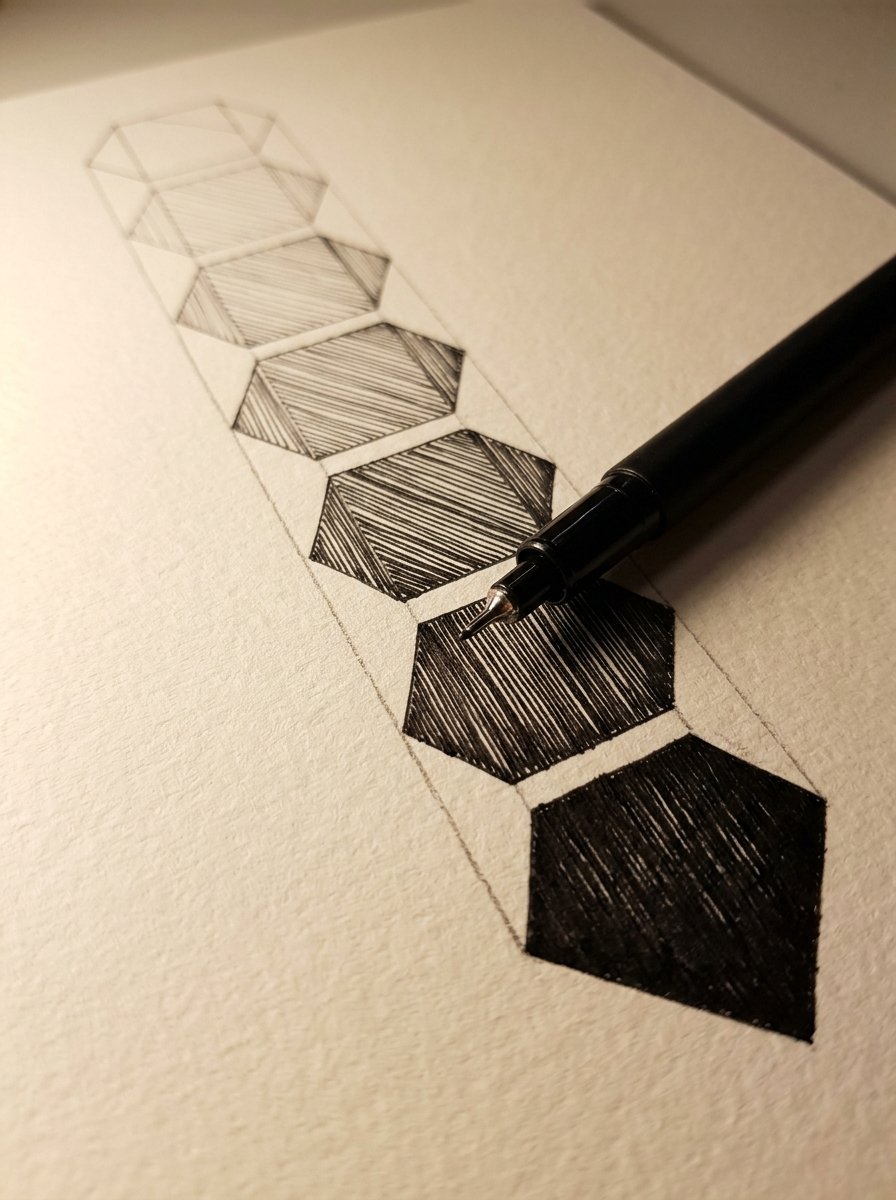
The fix is one decision, not a skill. (Which is the sentence I would have liked somebody to say to me in about 2019.)
One light source decides every value in a crystal drawing
Choose which side the light is on. Say the left.
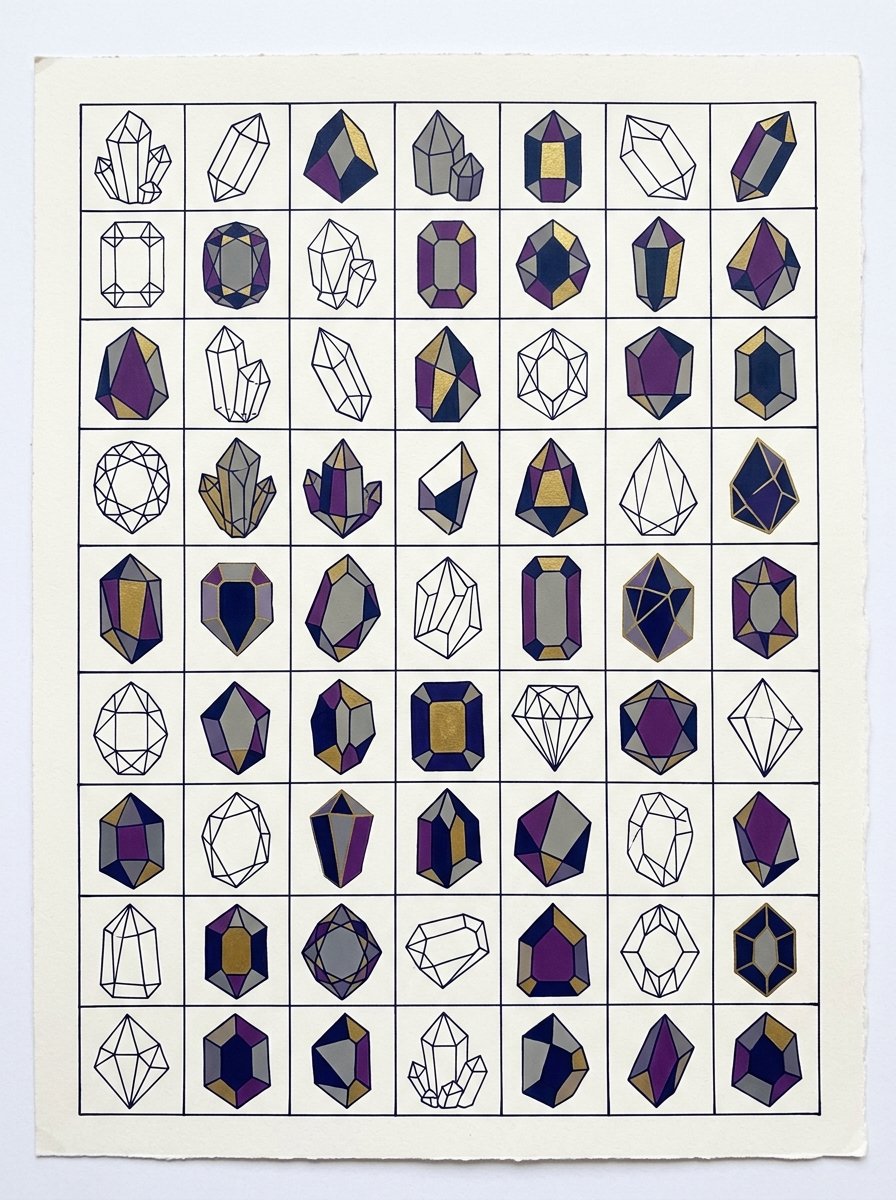
Every facet now belongs to one of 5 groups. The group is decided by which way the face points. Not by how pretty it would look. By where it faces.
Faces turned hard towards the lamp get nothing at all. Leave one face white. Faces turned hard away take your darkest tone, laid flat and even.
Lay tone with straight parallel strokes and keep them inside the shape. Do not soften the join. Hard edges only.
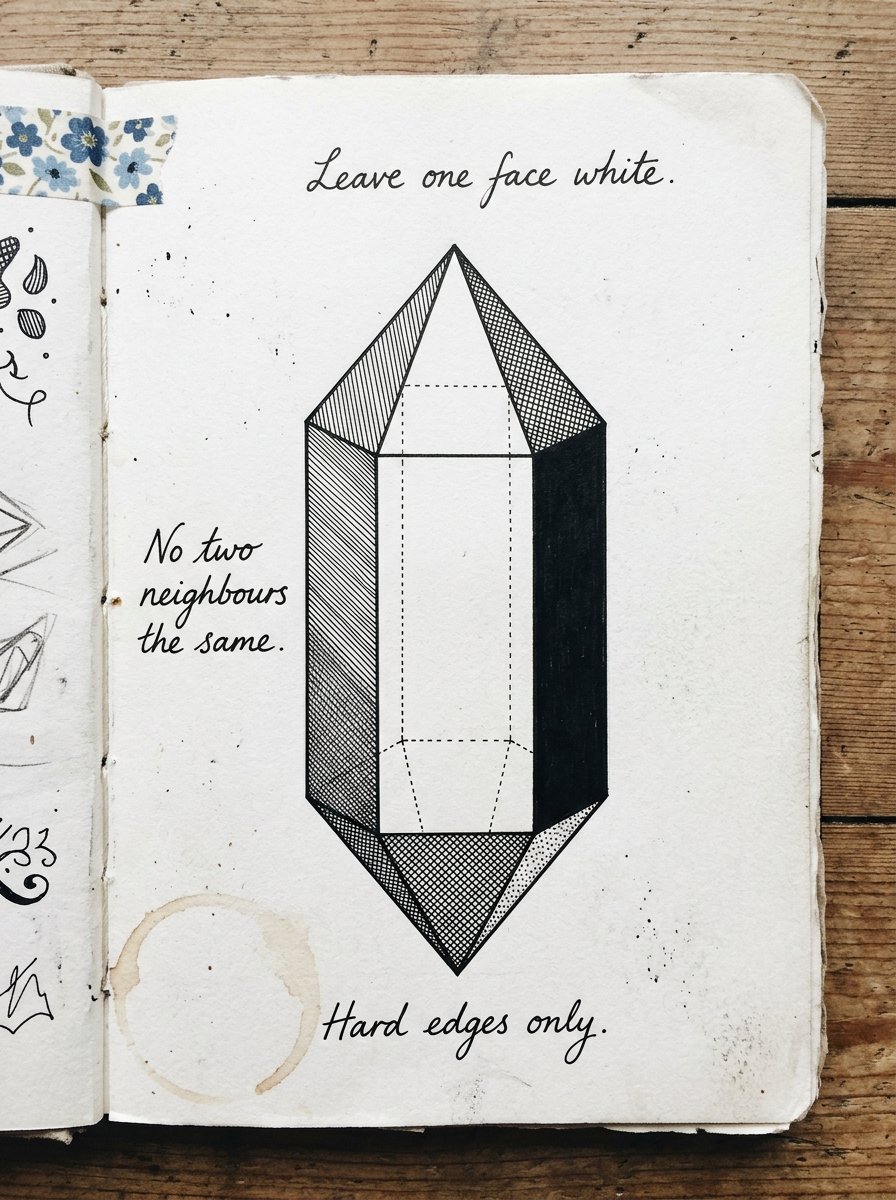
Two neighbouring faces must never take the same value. If they do, they melt into one shape and the stone goes papery.
When mine goes wrong, that is what has happened. Every time. The repair is to darken one of the pair by a single step.
(I keep a lamp clamped to the edge of the desk for this. It has not moved since March, and the drawings are measurably better for it.)
A crystal is not rendered. It is sorted.
The first person to draw these properly made them see-through on purpose
In Milan, in 1498, a mathematician called Luca Pacioli finished a book about proportion. He handed the drawings to the man he had been teaching maths to.
That man was Leonardo da Vinci, and he did something nobody had done. He drew the solids hollow. Edges only, as if the faces had been lifted out.
You can see the back of the shape straight through the front of it. They are thought to be the first drawings of skeletal solids anywhere.
Why it matters is unglamorous. Before them, nobody looking at a drawn solid could tell which end was nearer. The printed edition of 1509 is scanned on the Internet Archive and you can turn the pages.
What that buys your hand is an order of work. Draw the whole shape as wire first, back edges and all, before you fill anything.
It feels like wasting time. Then the tones go on and every facet sits right. You already know what is behind what.
I skip this step whenever I am in a hurry. I have never once got away with it.
Flat planes were a furniture trade before they were a drawing lesson
In 1567 a painter in Augsburg published a set of 11 woodcuts. The title page says who they were for: broken buildings, for the cabinetmaker, in inlaid work.
Lorenz Stoer had drawn collapsing architecture with mathematical solids strewn through it. He sold it as a pattern book to furniture makers.
They were cutting inlay. Small flat pieces of different woods, fitted edge to edge, with no blending available to anybody.
That is the joke and the lesson at once. A trade that physically could not blend anything spent a century making flat things look solid. His set is scanned and readable, and it is worth 5 minutes for the nerve of it.
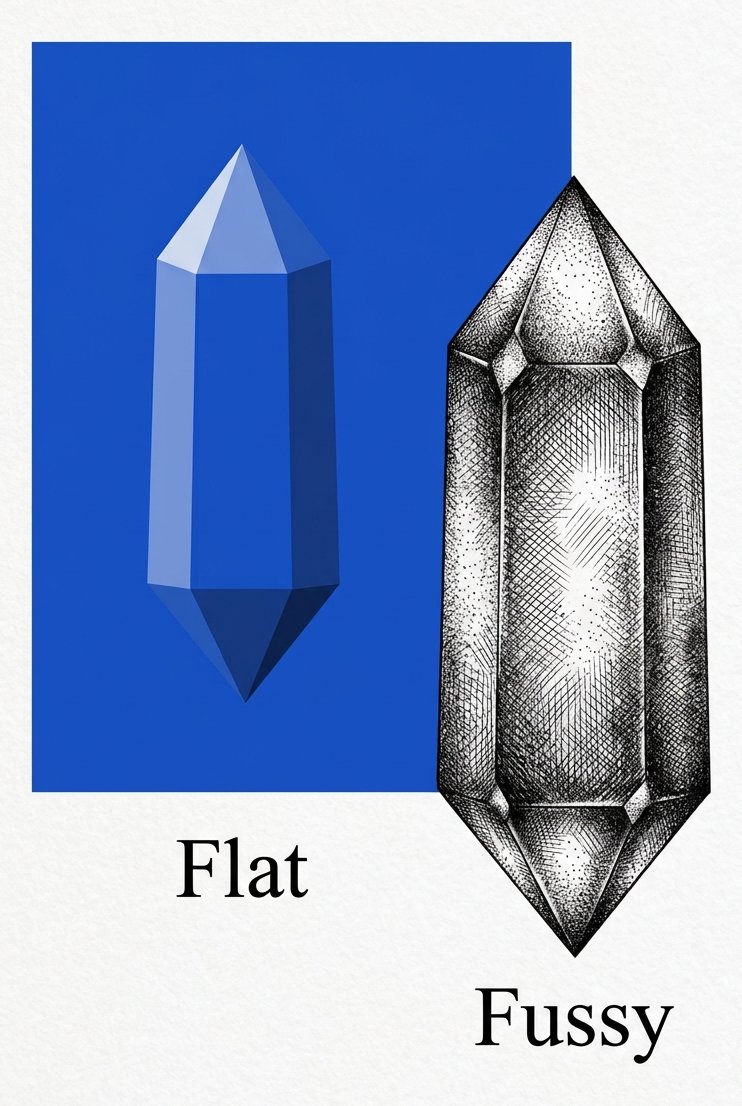
Take the same limit to your page on purpose. Give yourself 4 tones and no more. Flat, not fussy.
With 4 flat tones and hard edges it reads as glass. With soft gradients the same drawing reads as a grey bag.
I think about those cabinetmakers every time I reach for a blending stump. They managed a century of solid-looking work without one.
Which is the same problem a blank panel gives you. A flat shape, and a decision about what goes flat inside it.
Free Starter Pack
10 pattern templates, for the faces you left blank.
Sent tonight. Small flat fills, each one cut to sit inside a straight-sided shape.
Unsubscribe in 1 click, no hard feelings
Where crystal drawing goes wrong is the soft edge
The failure arrives in the same order every time.
You will finish the tones, look at it, and want to soften the joins so it looks more real. Do not.
A soft edge tells the eye the surface curves. The moment the eye believes a curve, the stone becomes a pebble.
The second urge is to add a sparkle, a small white star where the light lands. Not yet. The white is already there, in the face you left blank.
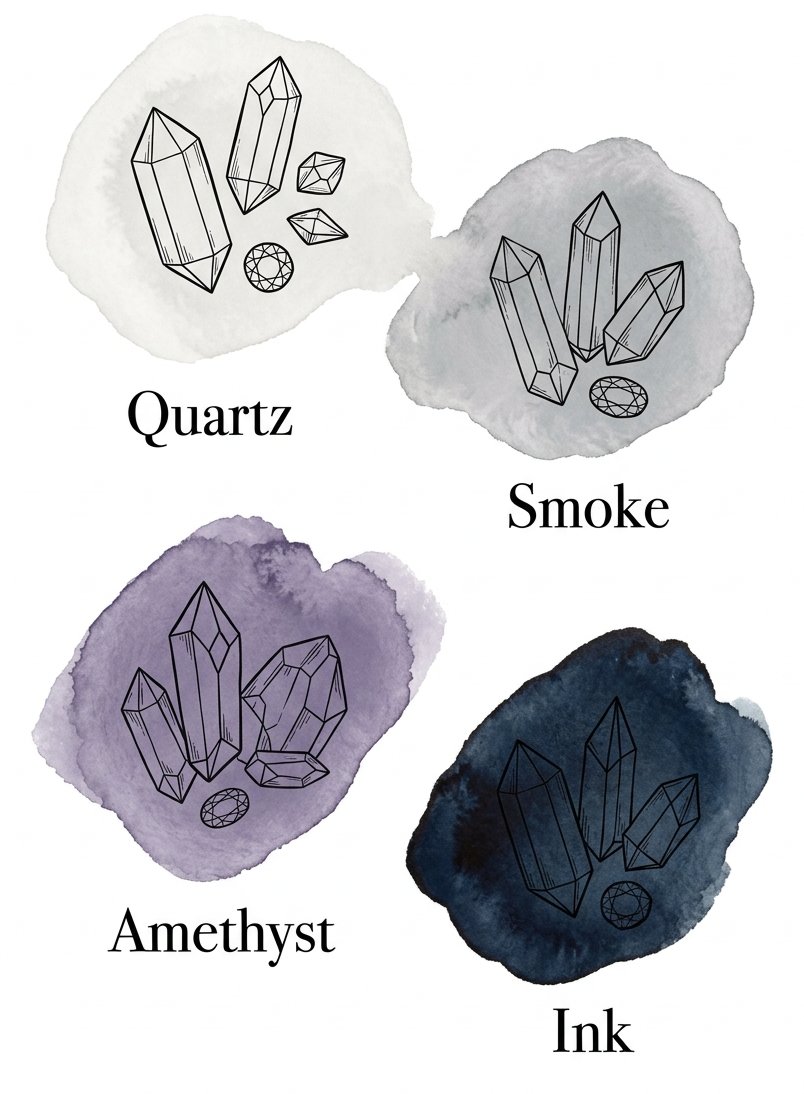
When you want colour, keep it to one family and keep it flat. Quartz for the palest, Smoke for the greys, Amethyst for the one warm note, Ink for the deepest wedge.
Four names, four flat tones, and it still reads as a solid. (I once gave a perfectly good amethyst 11 tones on the theory that more was more. It came out looking like a weather map.)
An American movement drew the whole world as planes of light
In the United States in the 1920s a group of painters began treating buildings and bridges as flat planes. It is exactly what you are about to do to a stone.
Precisionism reduced its subjects to their essential geometric shapes and dropped the detail. It used planes of light to hold everything in focus.
Charles Sheeler was the best known of them. He was a photographer as well as a painter. That is probably why he trusted a flat plane over a pretty mark.
His conte drawing Geraniums, Pots, Spaces was made in 1923 and hangs at the Art Institute of Chicago. It is pots, shadows and gaps. All of it is flat tonal shapes with clean edges.
Before you tone anything, ask which way each face is pointing.
That question does all the work, and it is the only question in this post.
Try it once on something that is not a crystal. A folded envelope, a book seen from the corner, a stack of tins. Same question, same 5 steps.
(I did the tins. They came out looking like a small industrial town, which I had not expected and have not entirely recovered from.)
How to use the free facet guide tonight
The sheet at the top of this page is the short version of all of it. One light. One value per face.
Print it at 100% again. Draw the top facet, drop the sides, join the bottom with straight lines. Then match each face you have drawn to one of the 5 steps.
Leave one face white. No two neighbours the same. Hard edges only. Those 3 lines are the entire method and they fit on a sticky note.
Do a page of small ones rather than one big one. Small ones are quick enough that you will try the light from the other side.
Seeing the same stone lit twice is the thing that makes it click. It is also the only drawing exercise I know where being impatient helps.
For straight lines already ruled, the mandala guide starts from a traced saucer and works outward.
I ruled my first facet sheet on the back of a gas bill. It is still in the drawer, and it beats the 3 careful ones that came after it.
The facet sorts the shape. The Complete Mandala Creation Toolkit takes over where the sorting stops. Inside are 8 master grids that hold the straight lines, and 88 elements to drop in once the structure is settled.
88 elements that drop straight into a ruled ring
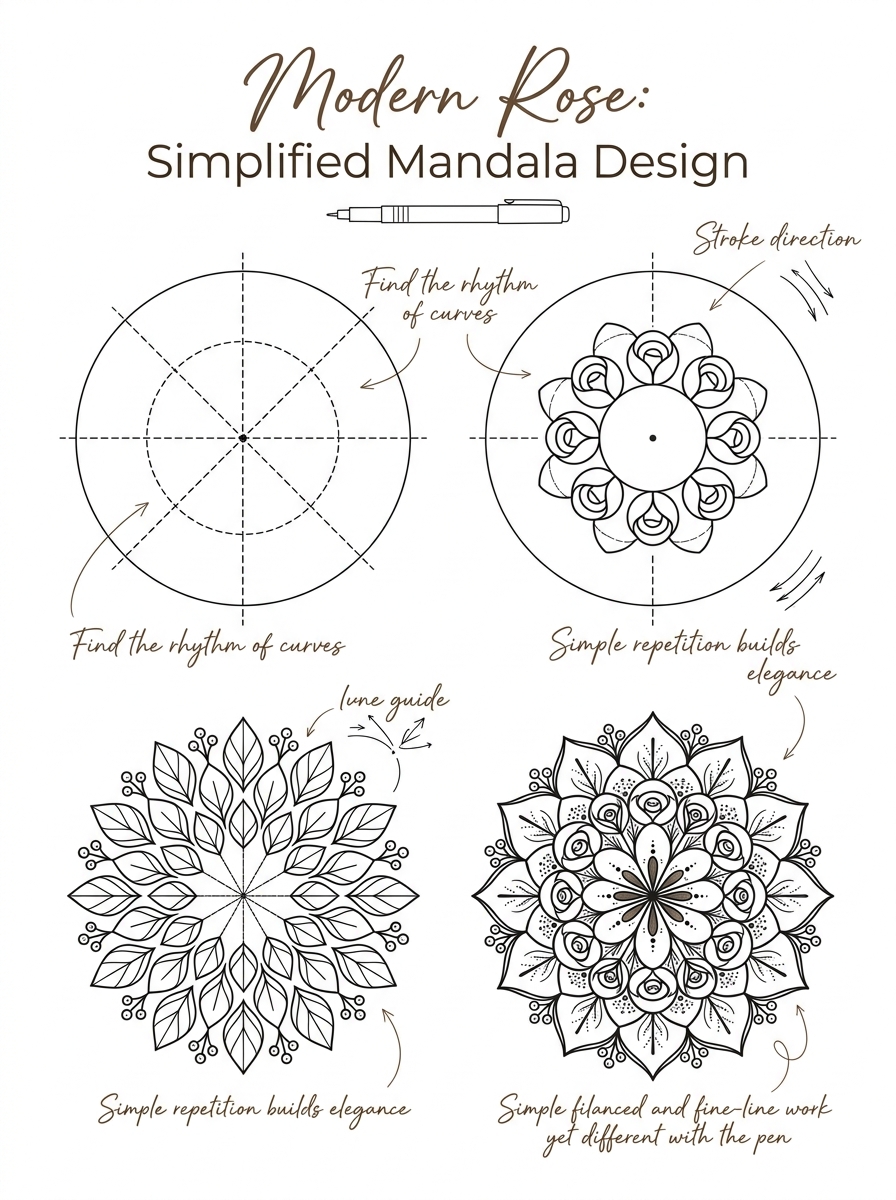
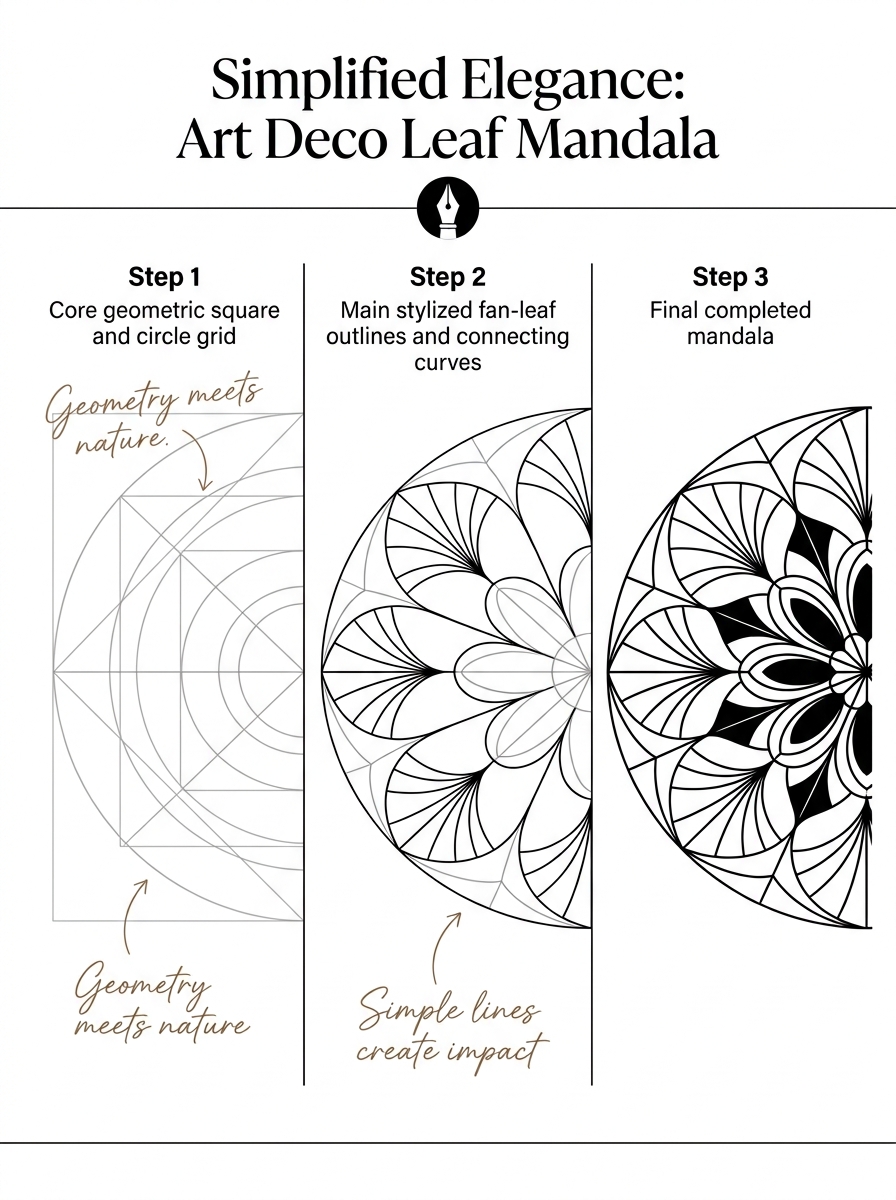
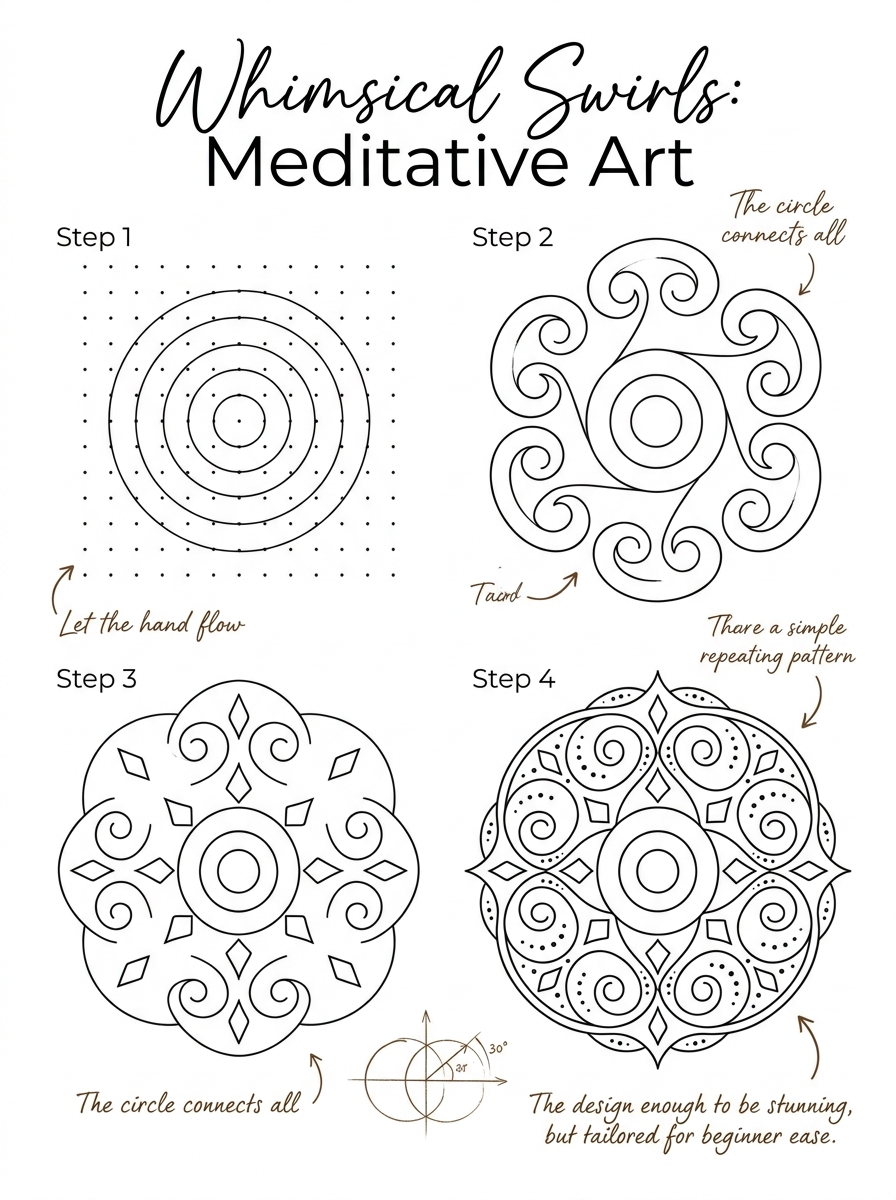
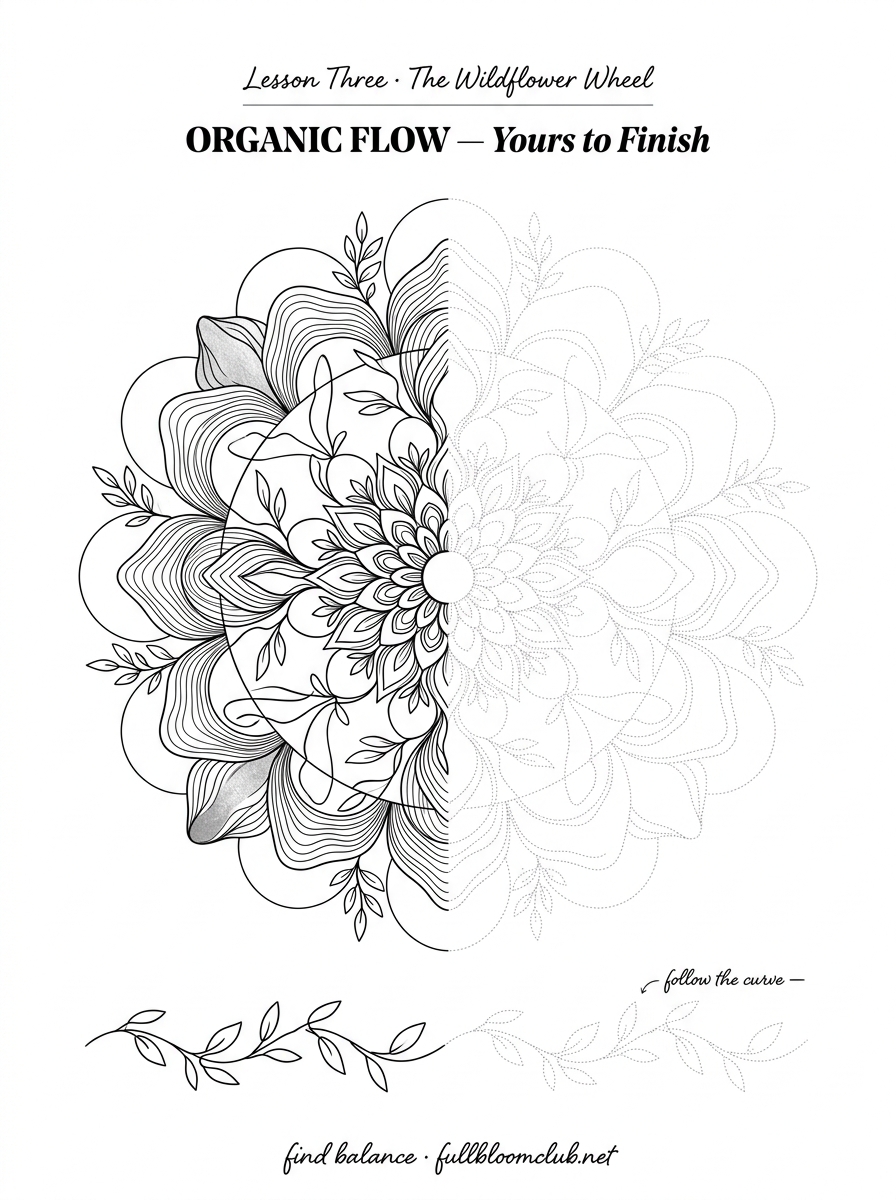
Rule the grid tonight, then start at the centre. Inside: 8 master grids, 88 elements and 8 short videos. Each grid holds the straight lines for you, so the only decision left is what goes in each wedge. I print mine, and I also copy them freehand. The freehand copies are the ones still on my wall.
Instant download · reprint it whenever you like
A pen has no opinion about how hard a thing looks. It knows where straight is, and it will go there with you for as long as the lamp stays put.
Mirabelle wrote this. No training, strong opinions, many pens. Peer reviewed by a cat who batted one facet flat and called it an improvement.