A psychiatrist in Switzerland spent the end of the First World War in charge of a camp of interned British soldiers, and every morning before the day started he drew a circle.
Not as a hobby. Carl Jung wrote later, in Memories, Dreams, Reflections, that he “sketched every morning in a notebook a small circular drawing” — and that the drawing told him where he actually was that day, in a way that no amount of thinking about it had. He was a man professionally equipped to talk about his own mind, and he had discovered that a pen and a circle got there faster. He kept doing it for the rest of his life, and he borrowed a Sanskrit word for the thing he was making. Mandala. It just means circle.
Which is the first useful fact about how to draw a mandala: it is not a picture of anything. There is no likeness to get wrong. A mandala is a set of rings, and inside each ring the same small shape repeats until the ring closes. That is the whole architecture. Everything that looks intricate about the finished thing is just a simple shape that had the patience to go round.
What is below:
- The mechanism — why a mandala is a counting job, not a drawing job
- The compass problem — four things already in your kitchen that draw a better circle than a compass
- The twelve-ring build — centre outward, in the order the pen actually moves
- The four mistakes — in the order you will make them, with the fix for each
- The free wildflower wheel — half drawn, yours to finish — start there
 Save
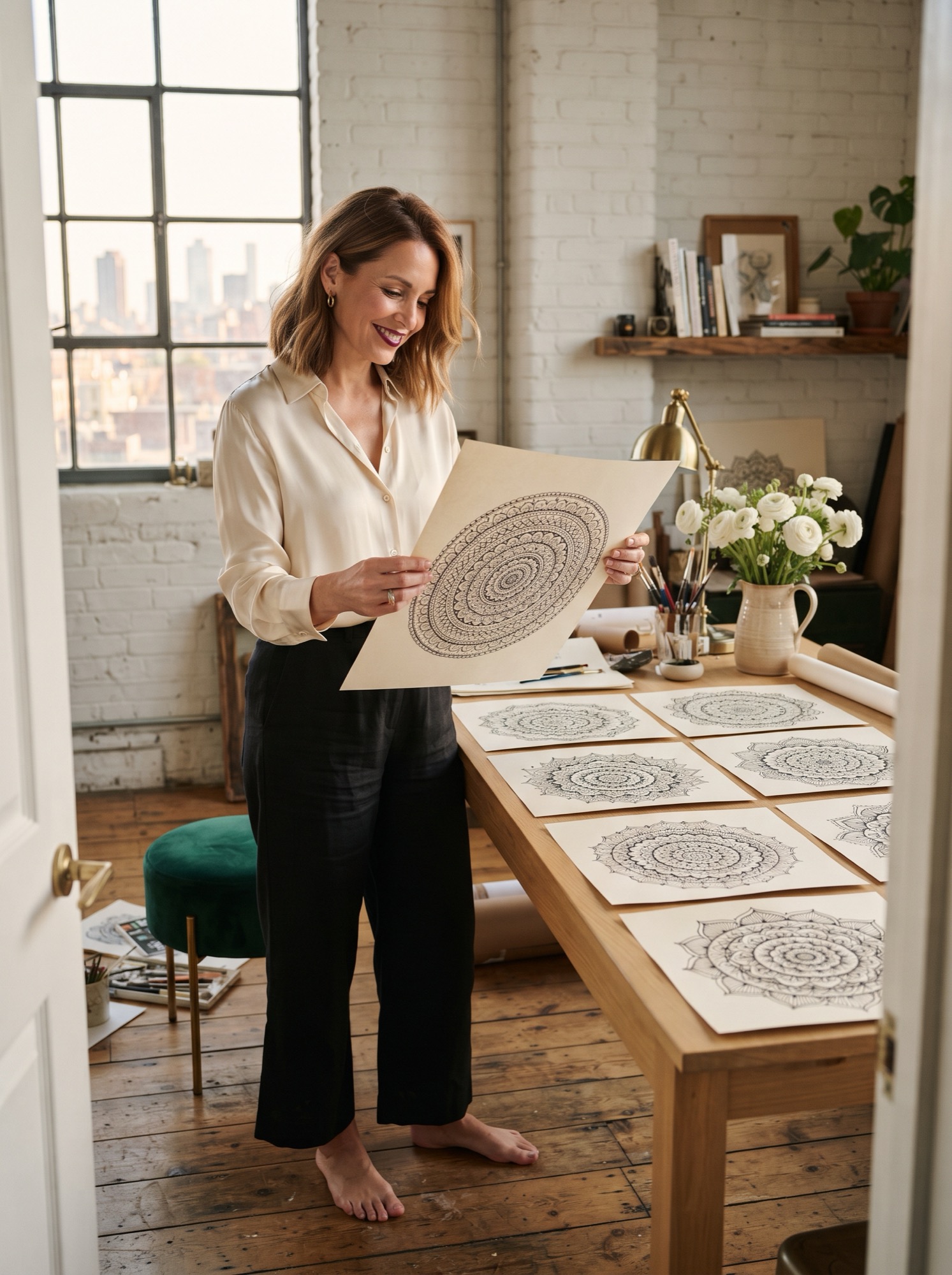
SaveThat is what twelve rings looks like once you have a few of them. Not one masterpiece — a set, all built the same way, differing only in what went in the rings.
The Collection
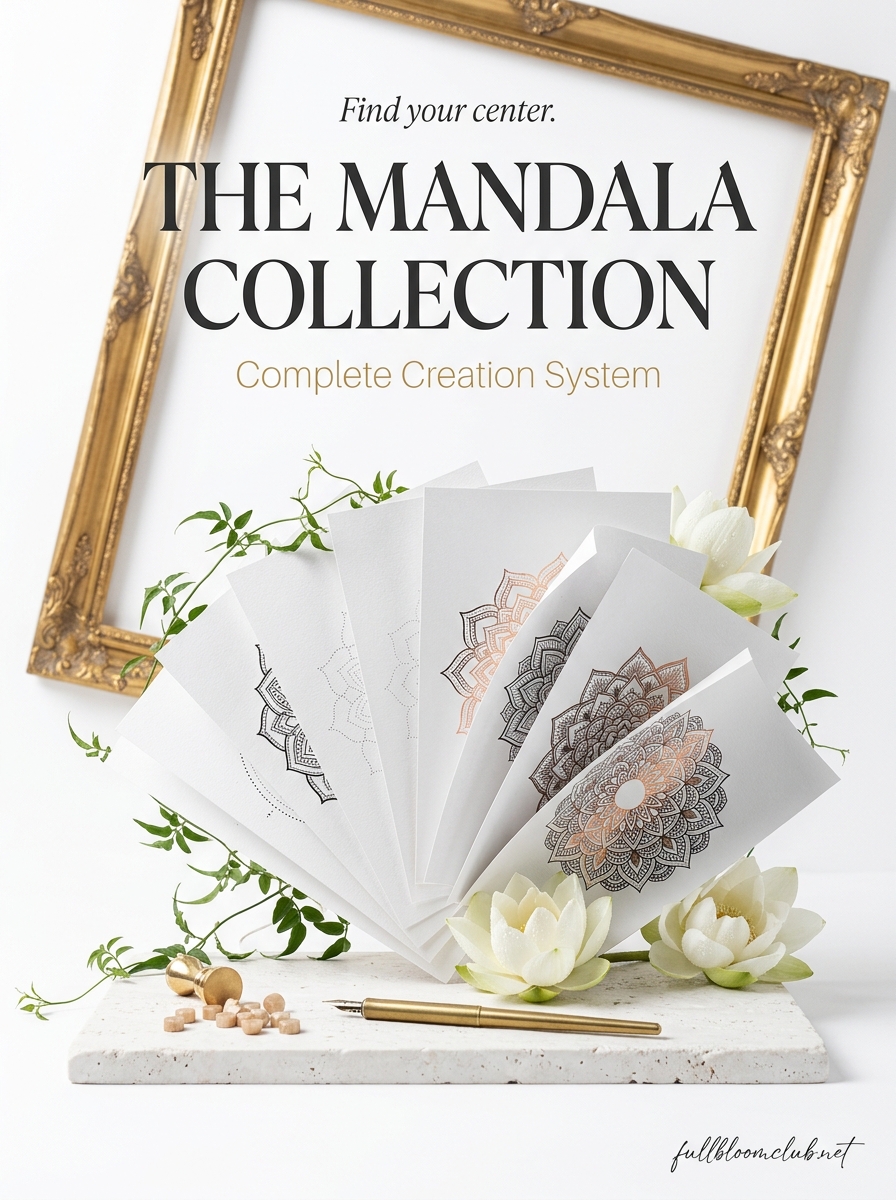
THE MANDALA COLLECTION — Rings, repeats, and the quiet arithmetic of a good evening.
The set for the evening that got away from you — when the day was all interruption and you would like one thing that finishes. What you get: something to do with your hands that has a visible end, and a piece of pattern work good enough that people assume you bought it.
What a mandala actually is, mechanically
Take a compass, or a mug, and draw four circles inside each other. You now have four rings and a centre. Pick a small shape — a petal, a teardrop, a scallop, a dot. Draw it eight times around the first ring, spaced evenly. Pick a different small shape. Draw it sixteen times around the next ring. Keep going outward, doubling as the rings get longer.
That is a mandala. Not a simplified mandala, not a beginner mandala. That is the mechanism the intricate ones use too, they just have more rings and smaller shapes. The difficulty in a mandala is not artistic and it never was. It is arithmetic, and arithmetic is patient with you.
The intricacy is not skill. It is a simple shape that was willing to go round the circle eleven more times than felt necessary.
This is why how to draw a mandala is the question that absorbs people who describe themselves, loudly and often, as unable to draw. There is nothing in a mandala to fail at drawing. A tulip can look wrong. Eight identical teardrops in a ring cannot look wrong, because there is no correct teardrop to fall short of. The only thing that can go astray is the spacing, and the spacing is fixable with a pencil and a ruler before any ink happens at all.
 Save
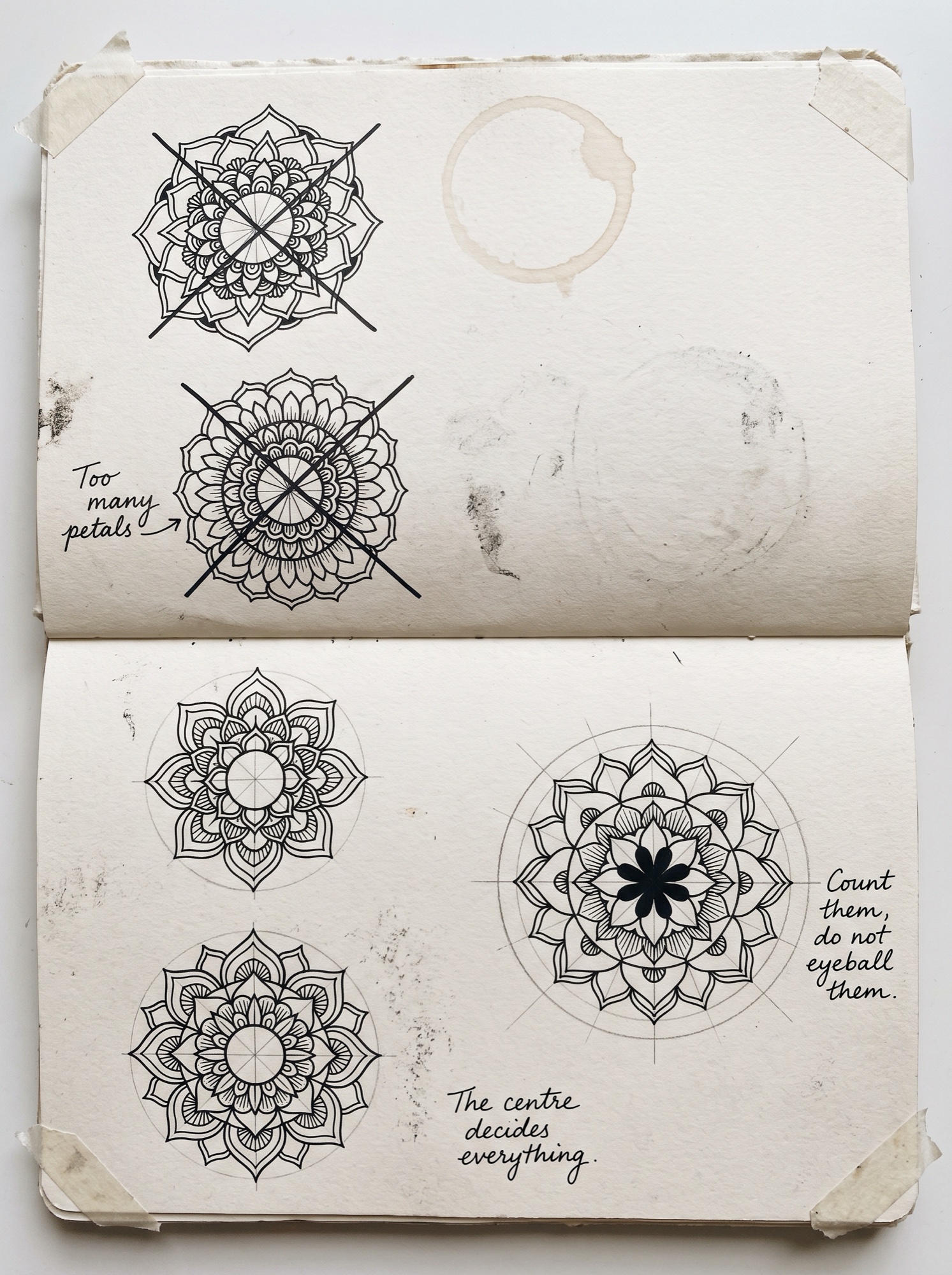
SaveThe page above is two failures and one that worked, and both failures say the same thing in the margin — too many petals, crowded into a ring that was never long enough to hold them. It is which is the correct ratio for how to draw a mandala and always has been. The note in the margin — count them, do not eyeball them — is the entire technique compressed into five words.
The tradition that throws the finished one away
In the Tibetan Buddhist tradition, a sand mandala takes a team of monks days to build. Coloured sand, laid grain by grain through a metal funnel, in a design of extraordinary precision. And then, when it is finished and photographed and admired, it is destroyed on purpose: the sand is brushed together into a pile and spilled into running water.
Days of work. Swept up with a brush. The point was never the object.
An entire tradition builds the most precise pattern work in the world and then pours it into a river, and here you are worried about wasting a sheet of printer paper.
I am not going to pretend that is a spiritual instruction for a Tuesday evening in a kitchen. But it is an extremely convenient historical fact to have in your pocket the first time a ring goes lopsided, because it dismantles the only thing standing between most people and a finished mandala: the belief that the first one has to be worth keeping. It does not. You are allowed to make one purely to find out what happens.
How to draw a mandala without a compass
This is the single most searched difficulty with the whole subject, and the answer is faintly ridiculous: a compass is one of the worst tools for the job. It puts a hole in the middle of your paper, exactly where the design is about to be most delicate, and it slips on the swing.
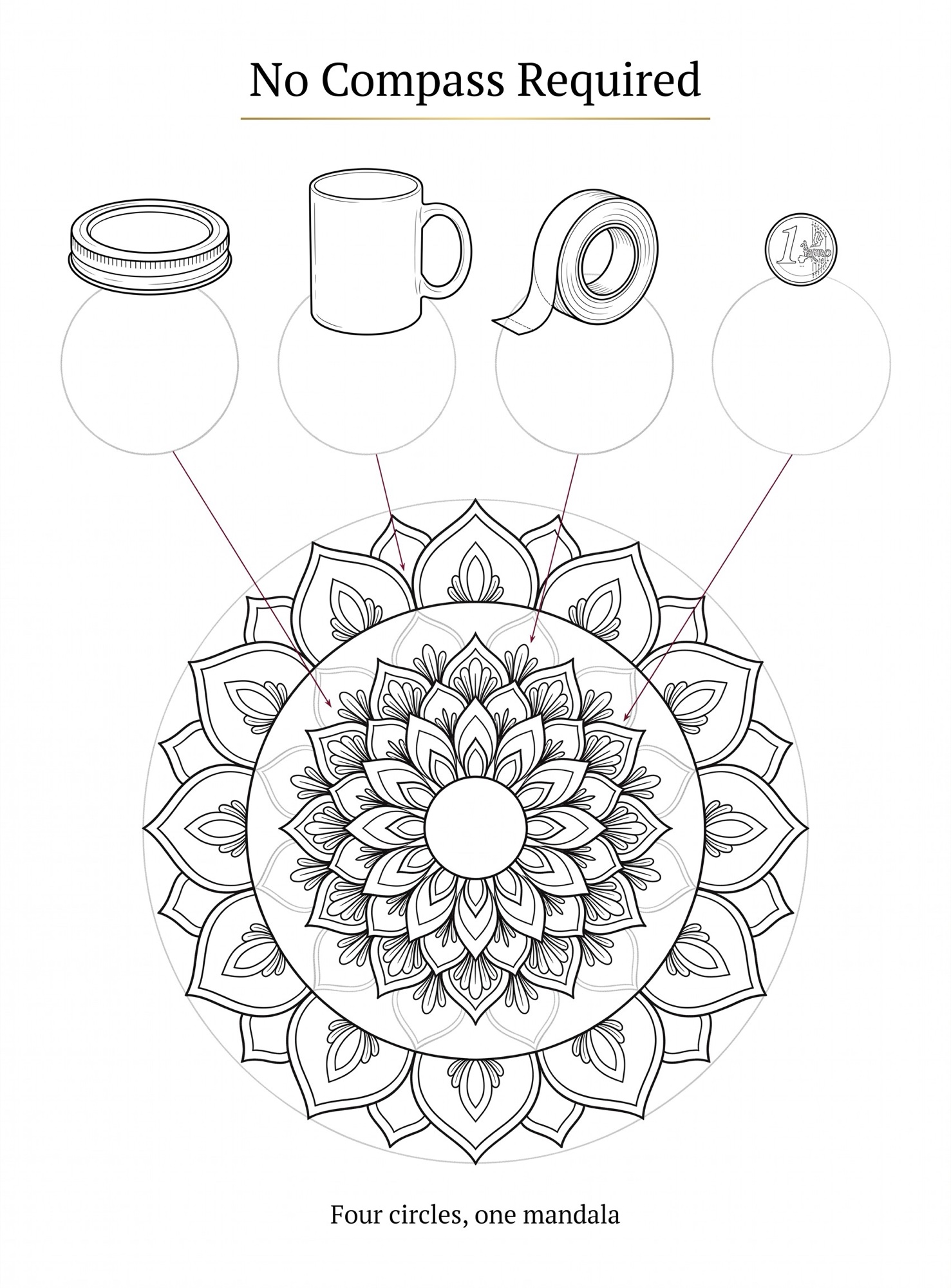
Round things you almost certainly own, in the order I reach for them:
- A jar lid — the outer ring, and the rim is deep enough to hold a pen upright
- A mug — the middle ring, and it has the advantage of already being on the table
- A roll of tape — draw round the inside as well as the outside and you have two rings for one object
- A coin — the centre, which wants to be smaller than instinct suggests
 Save
SaveDraw all four in pencil first, nested, sharing a centre. Mark the centre with a dot before you move anything, because you will need to find it again. Then rule two lines through that dot, one vertical and one horizontal, and two more diagonally between them. You now have eight equal slices and every ring is pre-divided into eight. The counting problem has just been solved by four straight lines and it stays solved for the rest of the drawing.
The twelve-ring build, centre outward
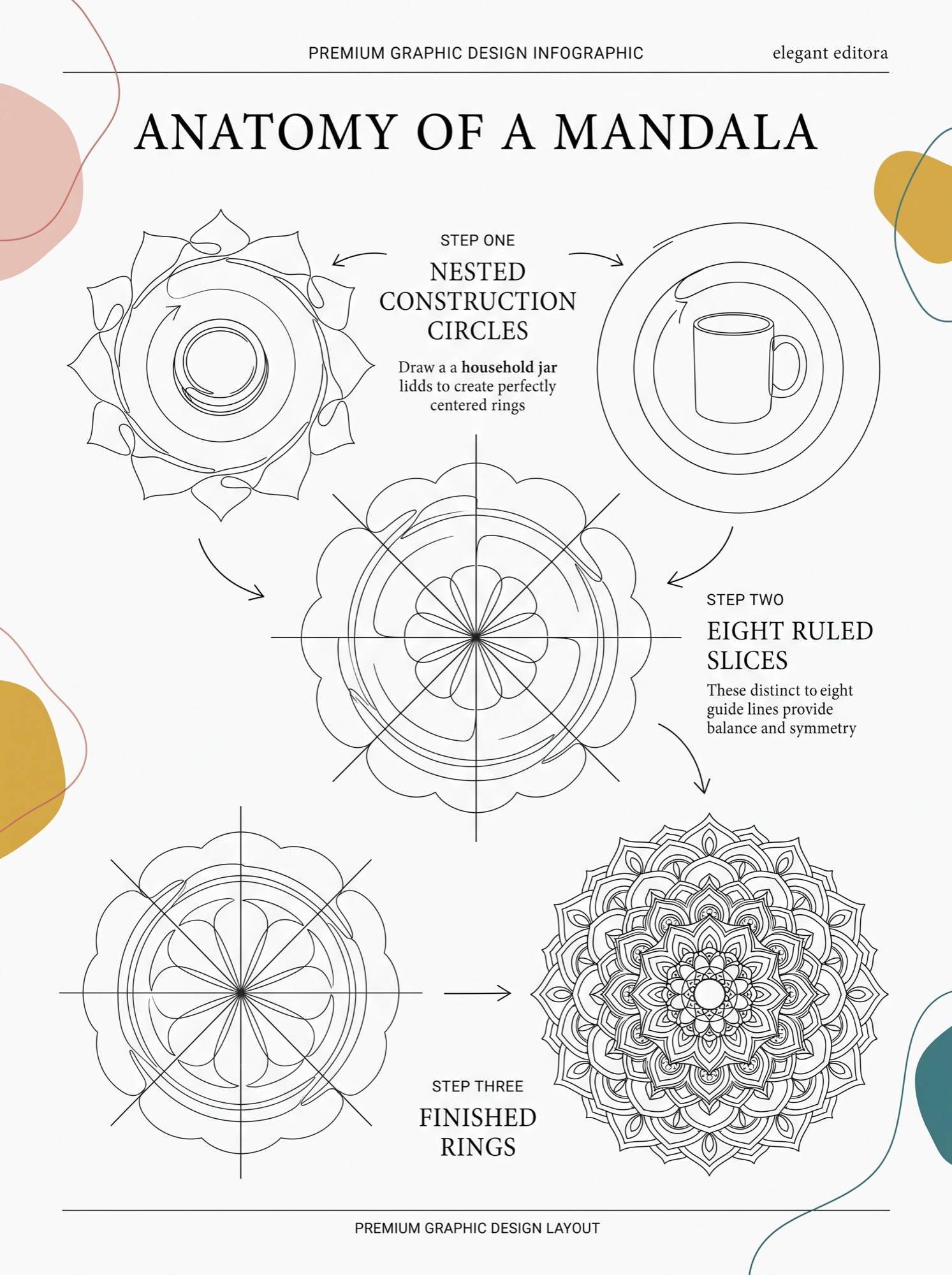
The order is the part of how to draw a mandala that nobody writes down, and it matters more here than in almost anything else we make, because a mandala cannot be corrected inward. Once ring four is inked, ring three is whatever it is forever. So the sequence below is not a suggestion about workflow, it is structural.
 Save
Save- Rings 1 to 3, the centre — small, tight, and finished before anything else exists. The centre decides everything: its size sets how many rings you get and how large each one can be. This is the part everyone rushes and it is the part every viewer looks at first.
- Rings 4 to 6, the engine — the widest shapes in the whole design go here. Petals, fans, teardrops. Big enough that the pattern reads from across a room.
- Rings 7 to 9, the texture — small repeated marks — dots, dashes, tiny scallops. This is where a mandala stops looking like a diagram and starts looking like a mandala.
- Rings 10 to 12, the edge — a border that closes the whole thing. Points, arches, or a simple double line. It does not need to be clever, it needs to be definite.
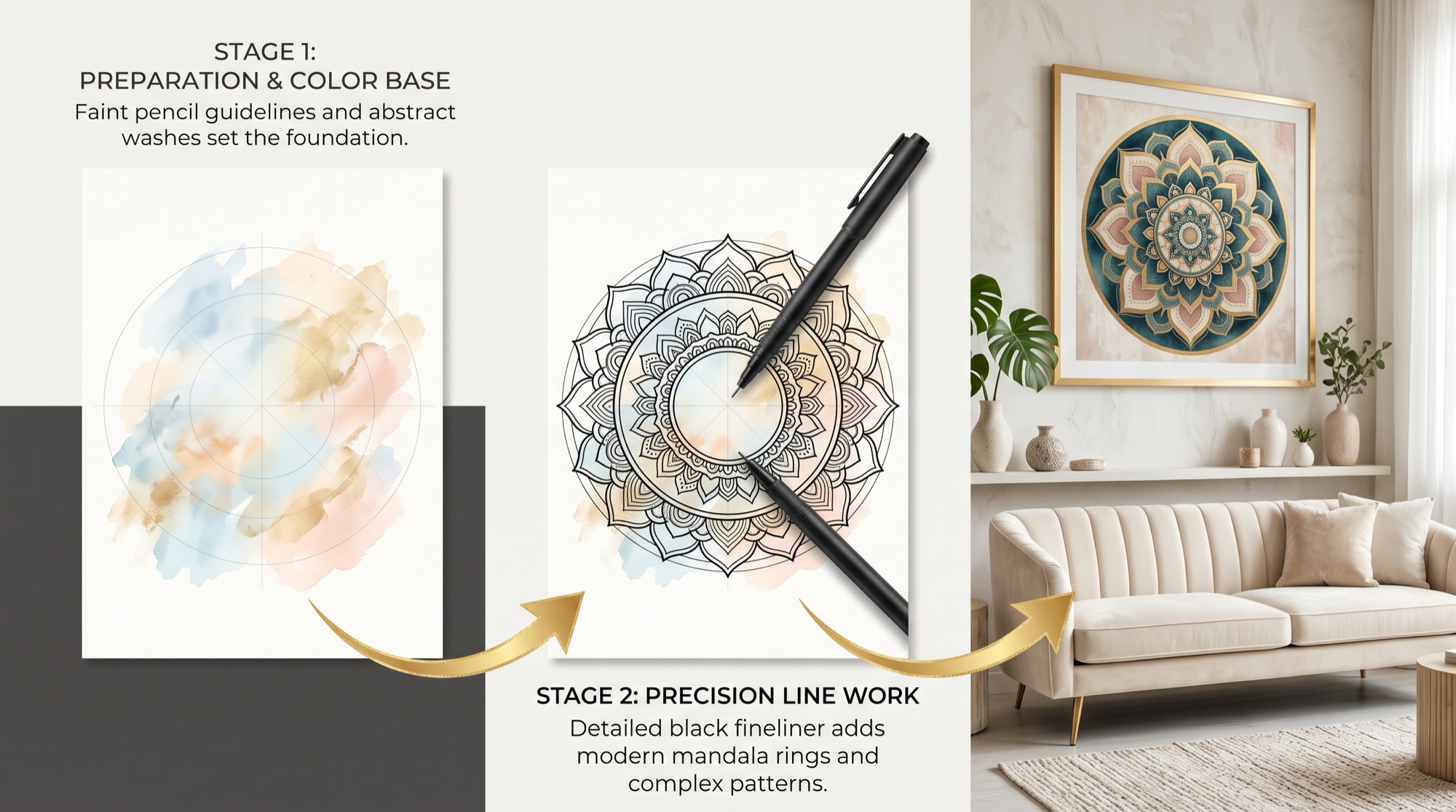
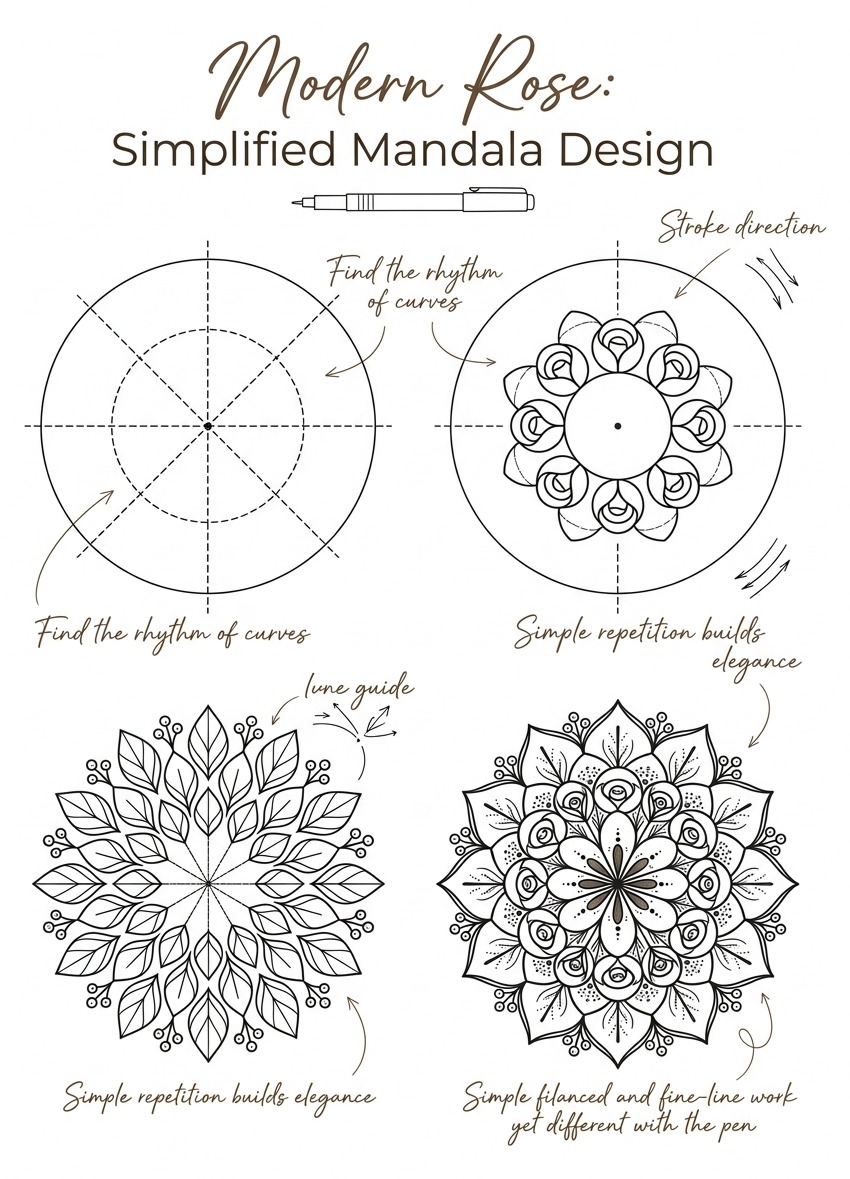
The sheet above runs the same route on a rose: find the rhythm of the curves, let simple repetition build the elegance, then let the fine-line work go somewhere different from the pen you started with. Four panels, and by panel three you have stopped thinking about whether you can do this.
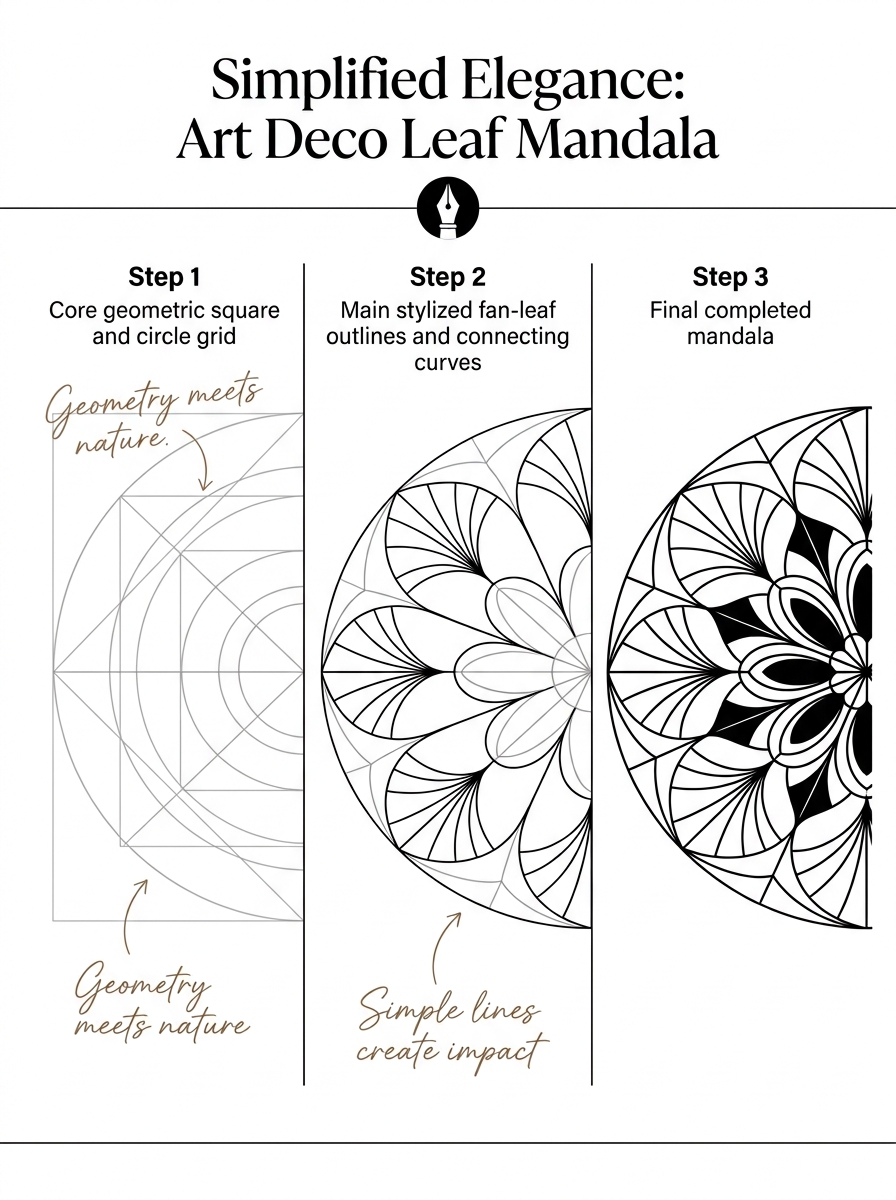
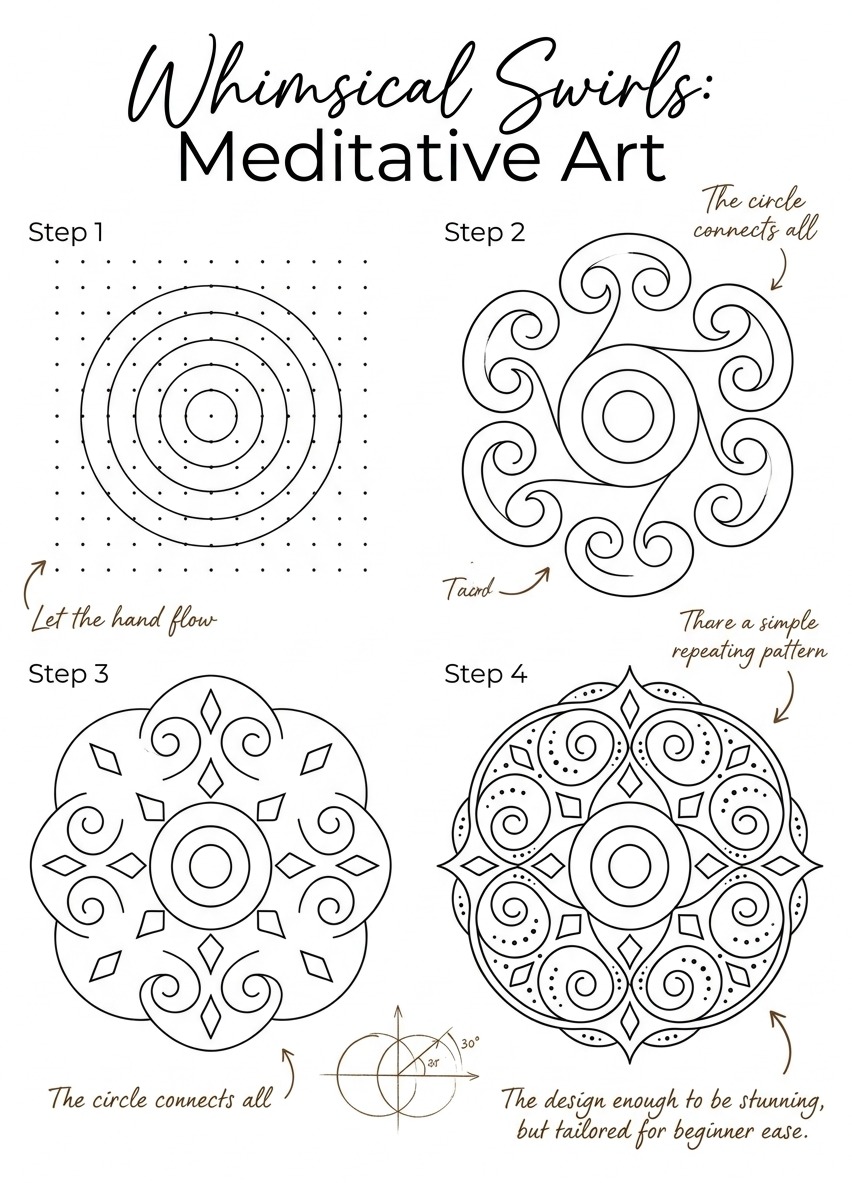
The swirls sheet is the one to run if geometry makes you tense. It starts on a grid of dots rather than a compass line, and the shapes are loops rather than points, so nothing has to meet exactly. The circle still connects everything. It is just more forgiving about how.
 Save
SaveThe four mistakes, in the order you will make them
- Starting with a centre that is too big — A large centre eats the interesting rings. Make it smaller than feels right, then smaller again. A coin, not a mug.
- Eyeballing the count — Seven petals where you meant eight is visible from the doorway. Rule the eight slices first; the pencil lines vanish under the ink and the eye never knows.
- Ink before pencil — Every ring is built twice. Graphite is free and it is the only draft you get.
- Stopping at ring six — The design goes through an ugly adolescence somewhere in the middle rings where it looks fussy and unfinished at once. That is not a sign it failed. That is ring seven arriving late.
The confession about the fourteenth ring
I have a habit I have failed to break, which is adding a ring after the one that finished it. The mandala is done. It has a border, it has a proper edge, it is balanced. And I look at the white paper left over round the outside and I think: there is room.
There is always room. That is what paper is. The last four mandalas I ruined, I ruined at the end, and every single one of them was already good two rings earlier. I now put the pen down and leave the room, and come back to see whether the urge survived the kettle. It usually does not. The hardest ring to draw is the one you do not.
 Save
SaveStart with the half that is already drawn
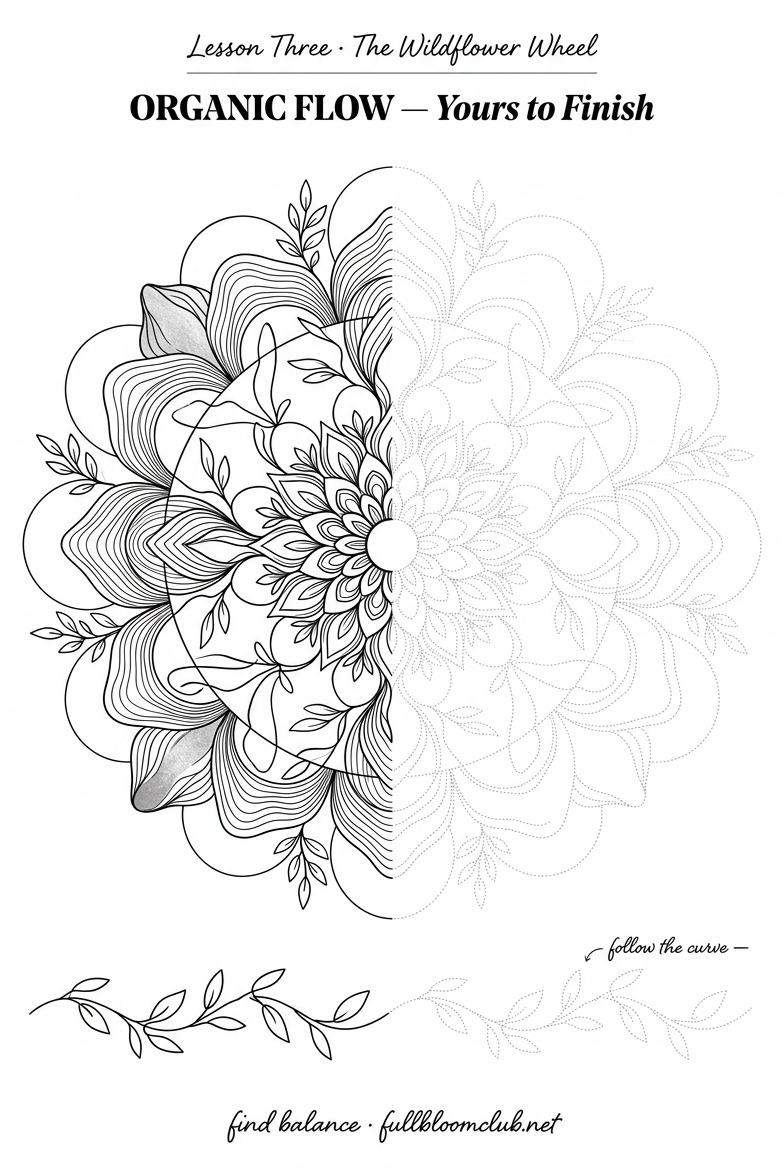
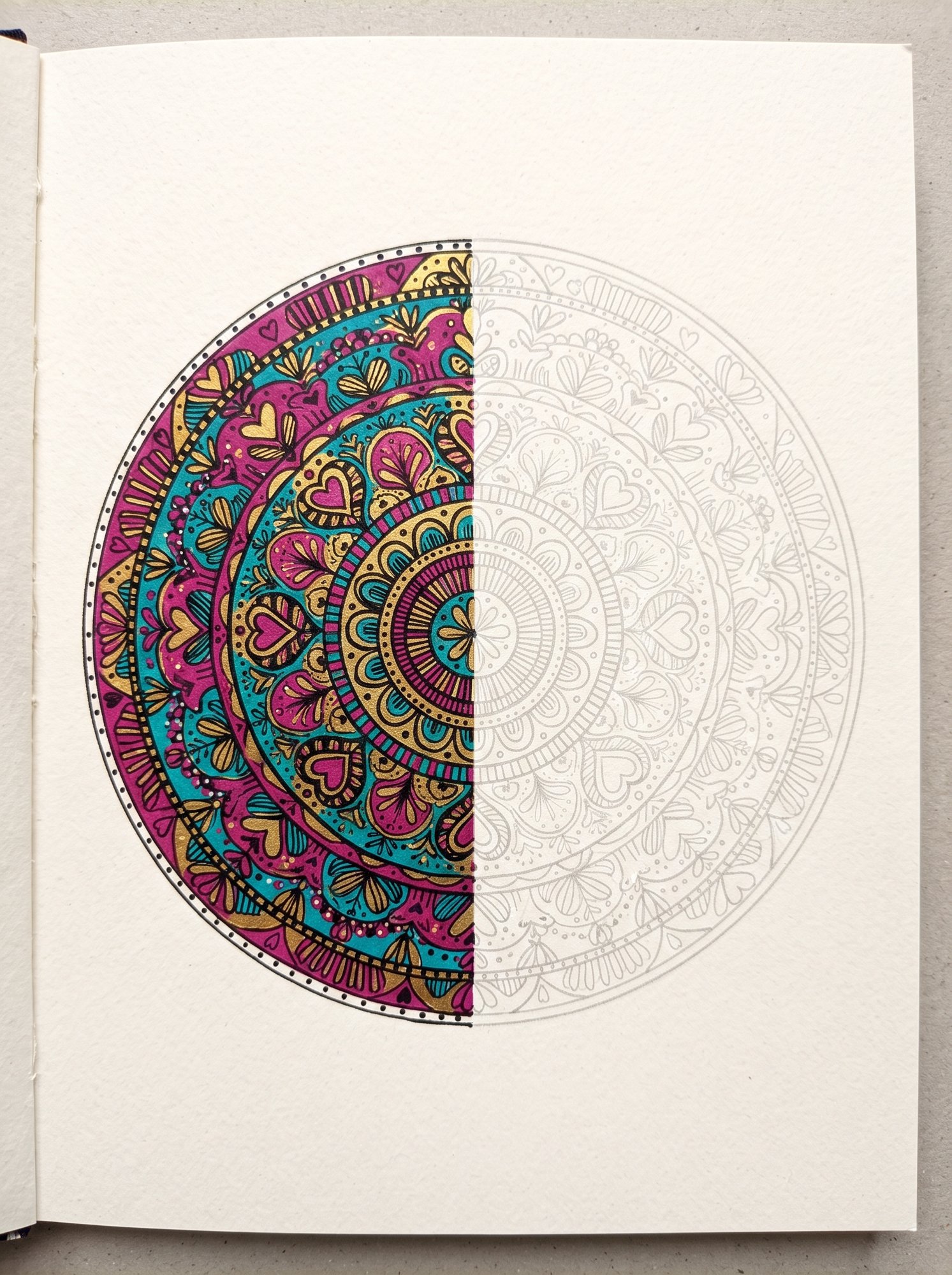
Below is the Wildflower Wheel, and it is deliberately only half finished. The left side is drawn, the right side is empty, and the centre line runs down the middle. Your job is to answer it — match the left with the right, ring by ring, and watch your hand work out the rhythm without being taught it.
 Save
SaveIt takes about twenty minutes and it is the fastest way I know to learn how to draw a mandala without once being taught how to draw a mandala. Mirroring is easier than inventing, and by the time you have mirrored eleven rings you are no longer mirroring, you are drawing.
Free Starter Pack
10 templates. 1 of them ends up framed.
Sent tonight. The first takes 12 minutes.
Unsubscribe in 1 click, no hard feelings
The wildflower wheel above is free and yours. When you want the rest of the route — every ring, every repeat, every border — the full collection is below.
How long does a mandala take?
The wildflower wheel above, twenty minutes. A twelve-ring mandala from a blank sheet, somewhere between forty minutes and an evening, depending entirely on how small you make the texture rings. It is one of the very few things you can genuinely stop in the middle of and pick up three days later without any loss, because the pencil rings are still there waiting and they do not care.
What pen should I use for a mandala?
Any fineliner that does not bleed. A 0.3mm for the structure and a 0.1mm for the texture rings is the classic pair, but one pen is fine for a first one. What matters far more than the pen is the paper — anything thin enough to see through will feather, and feathered dots in a texture ring turn the whole outer band grey.
Do I need to be good at maths to draw a mandala?
No. How to draw a mandala needs you to count to eight, twice. The geometry is done by the four ruled lines before you start, and the ruler does not know whether you enjoyed school. Anyone telling you that mandala work requires sacred geometry is selling a course, not a pen.
Where they end up
 Save
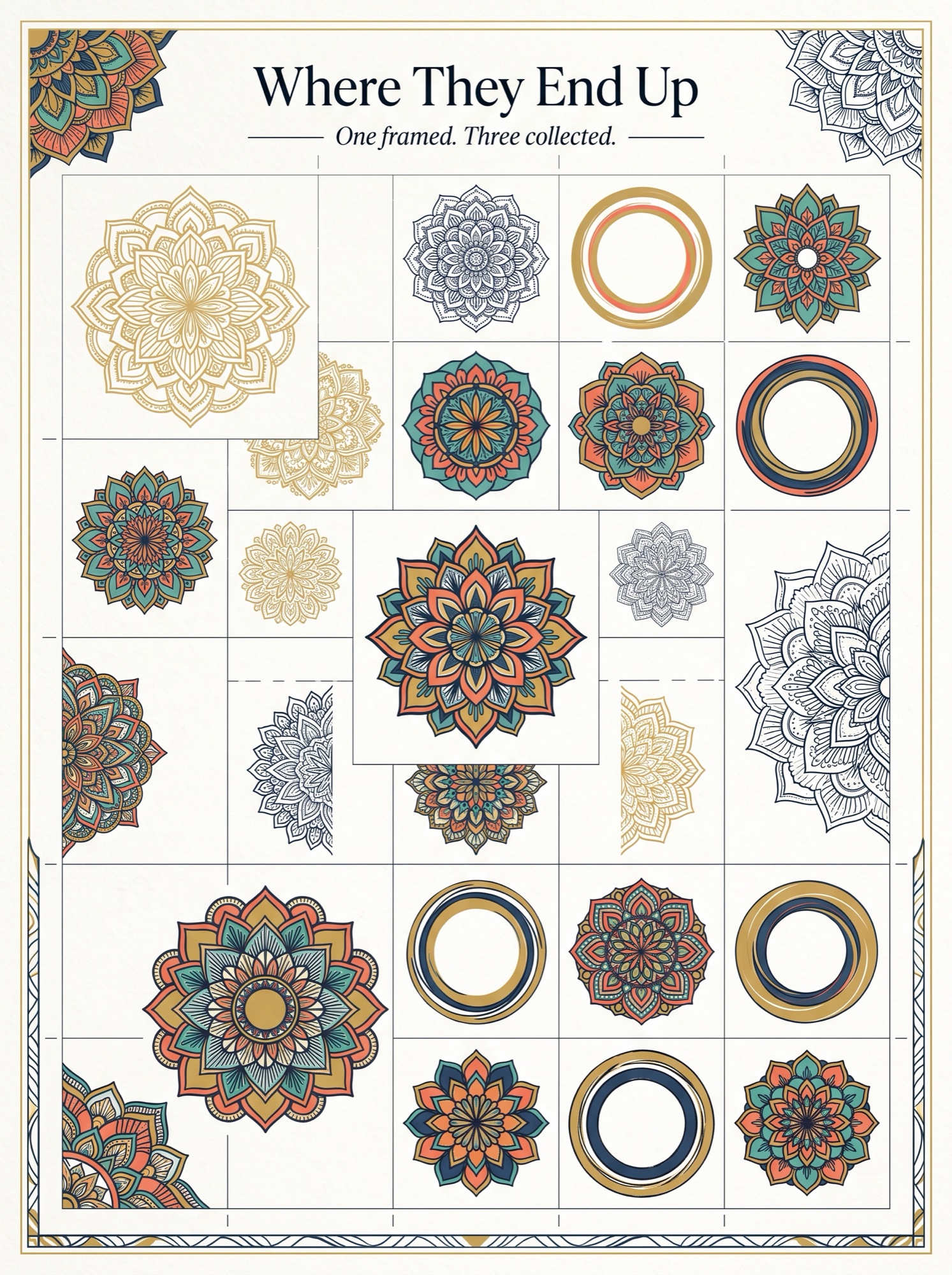
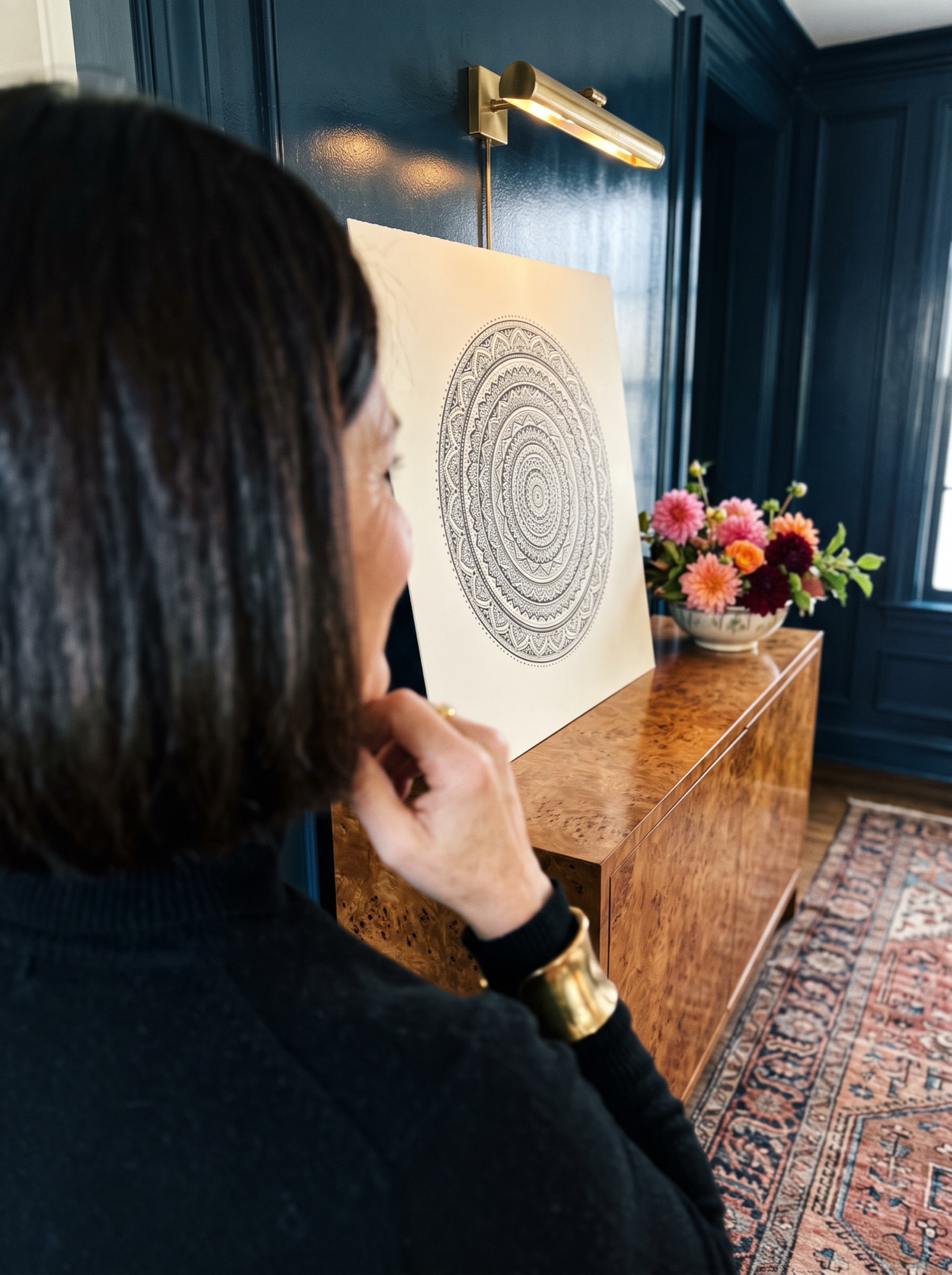
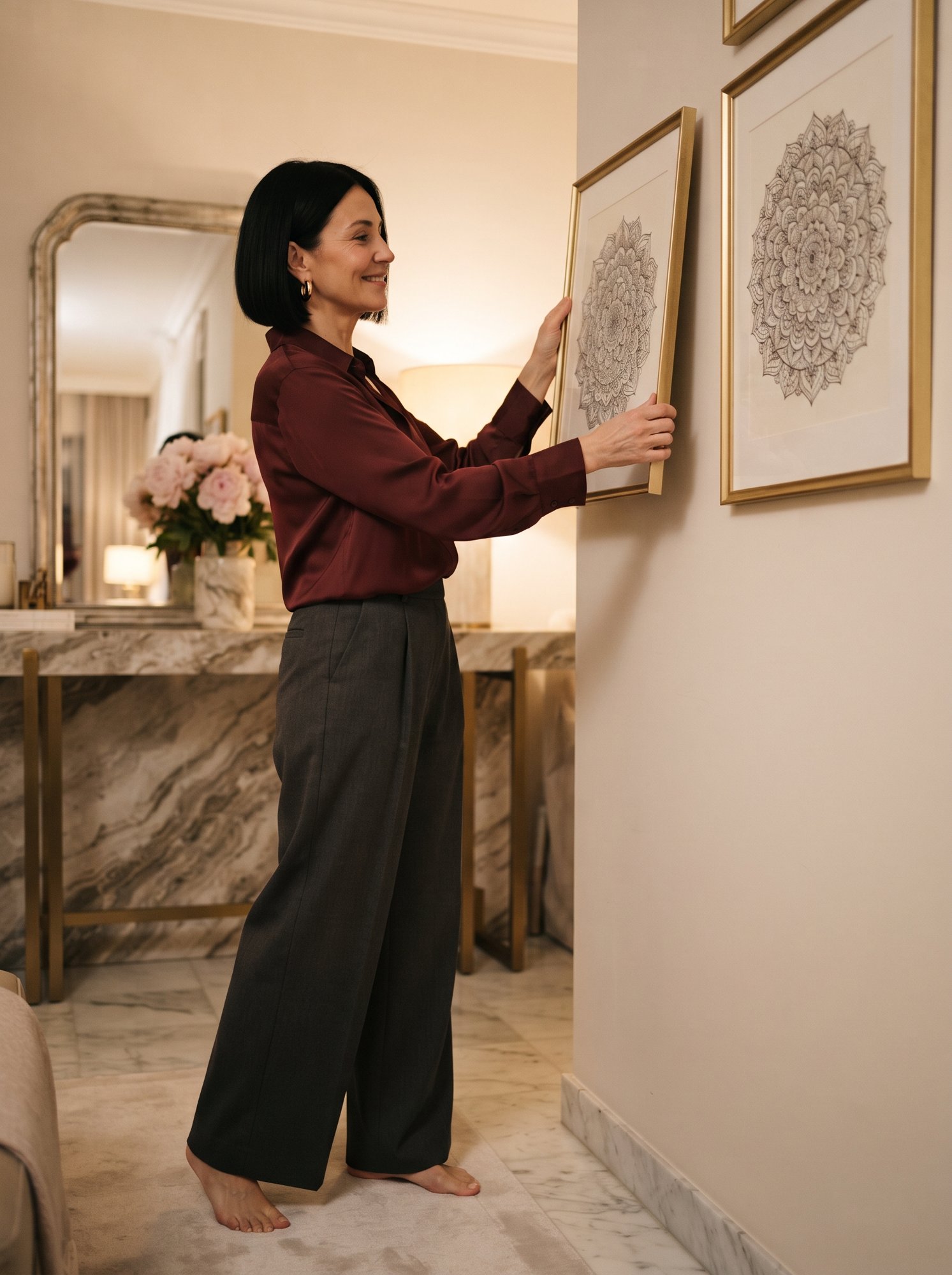
SaveNobody asks how to draw a mandala because they want a diagram. A single mandala at A4, matted with a wide border and framed in black, reads as bought. Three in a vertical stack down a narrow wall reads as collected. One framed. Three collected. And a small one in the middle of a folded card is the only birthday card anybody keeps, because they can tell it took an evening and they cannot work out how it was done.
12 guided mandalas, from first circle to finished edge
Tonight it is four circles round a jar lid. By the weekend it is a framed piece in the hallway that people stand in front of for longer than is polite. Every ring, every repeat, every border — the whole route from a pencil dot to something worth hanging.
Instant download · print as often as you like
Jung drew his before breakfast, in a war, with a camp of soldiers to run. You have a jar lid and an evening. Slight advantage, honestly.
Mirabelle wrote this. No training, strong opinions, many pens. Peer reviewed by a cat who left halfway through.