A man once won the biggest job in Europe by drawing a circle. Not a sketch of one, not a careful one — a one line drawing, freehand, in a second and a half.
No sketches, no portfolio, no references. The Pope’s messenger turned up asking for proof of skill, and Giotto dipped his brush in red, pinned his elbow to his ribs, and turned out one perfect ring of paint. The messenger went home convinced he had been made a fool of. He had not. That circle got Giotto the commission, and it is still the most efficient piece of self-promotion in the history of art — a portfolio you could do in a second and a half.
Because here is the thing about a circle. A circle is not hard to draw. A circle is hard to draw once.
A finished painting can be fixed for a year. A single line is finished the moment it stops, and it tells the truth about the hand that made it.
Ink is an unusually honest material. It records hesitation the way a microphone records a cough — the little stall, the second thought, the moment your hand held a committee meeting about a petal. A line that is allowed to stop and reconsider will always look like a line that stopped and reconsidered. And a line that could not stop looks, to anyone glancing at your wall, exactly like confidence.
That is the entire mechanism of a one line drawing, and it is closer to a trick than a talent. The pen goes down and keeps travelling. It does not get to vote on the last petal, because it is busy arriving at the next one. Nothing gets corrected, so nothing gets muddied. Twelve minutes later there is a peony on the table that looks like it took an afternoon — and nobody who sees it will ever guess that the reason it looks so sure of itself is that you were not allowed to think.
The Collection
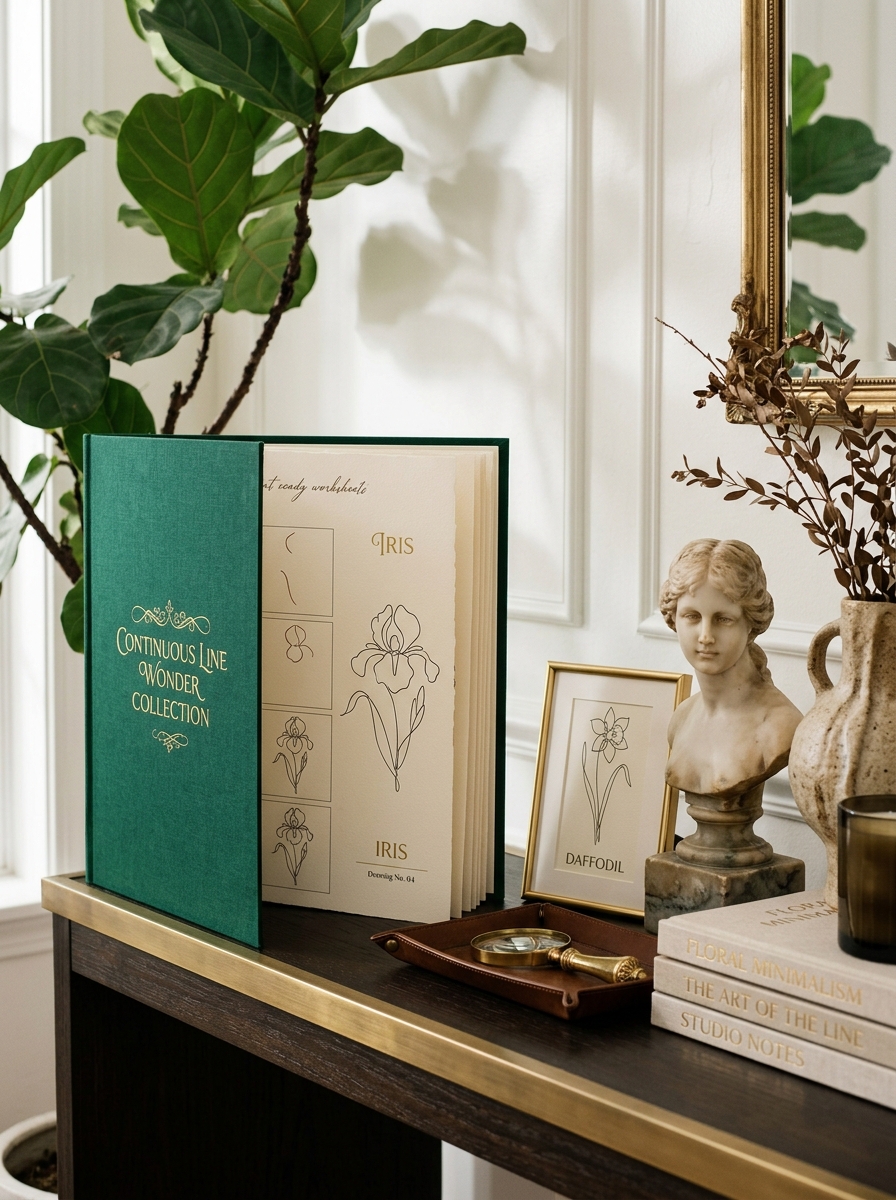
CONTINUOUS LINE WONDER — 30 flowers built that way. Loops, sweeps, and the small pleasure of not stopping.
The set for the evening when your head is loud and your hands are free. What you get: a flower on paper good enough to frame — which, if you have ever priced botanical prints, is not nothing.
What is below:
- What the unbroken line actually does to your hand
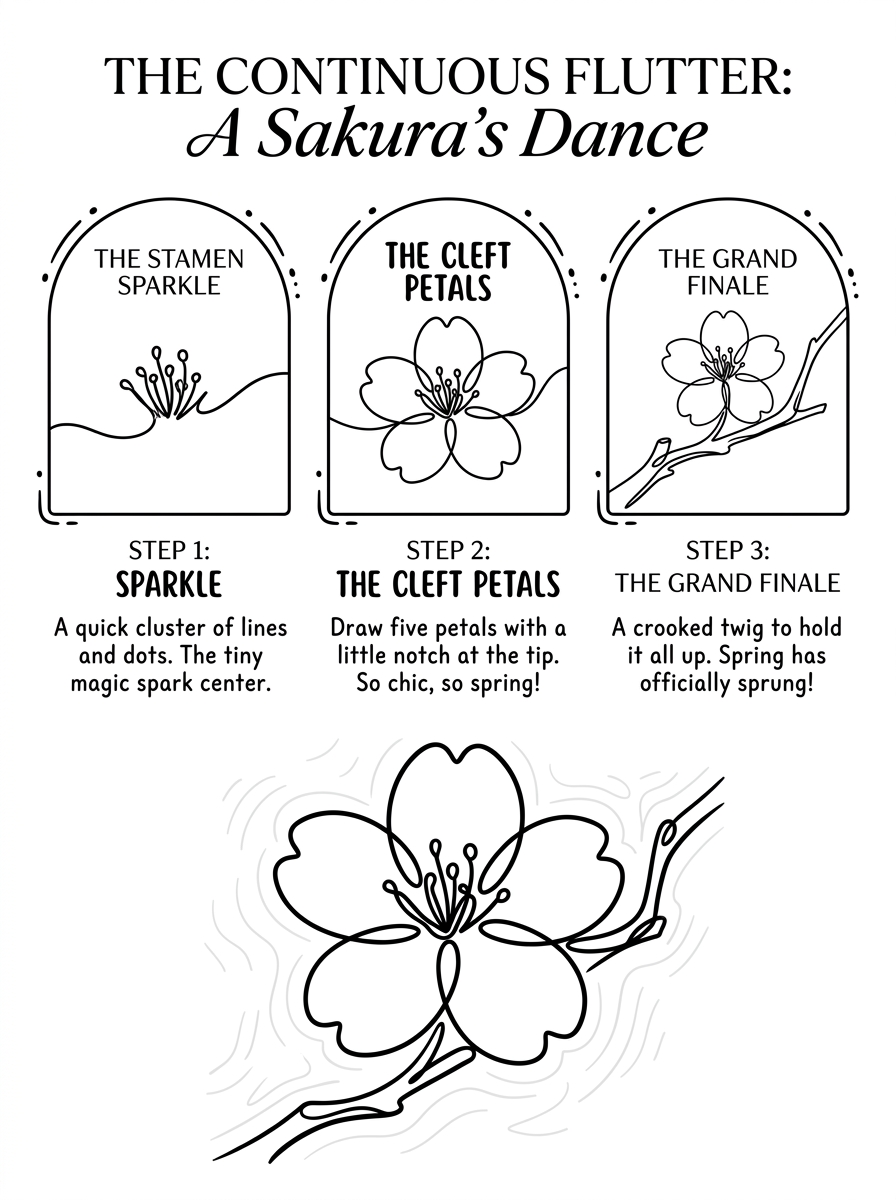
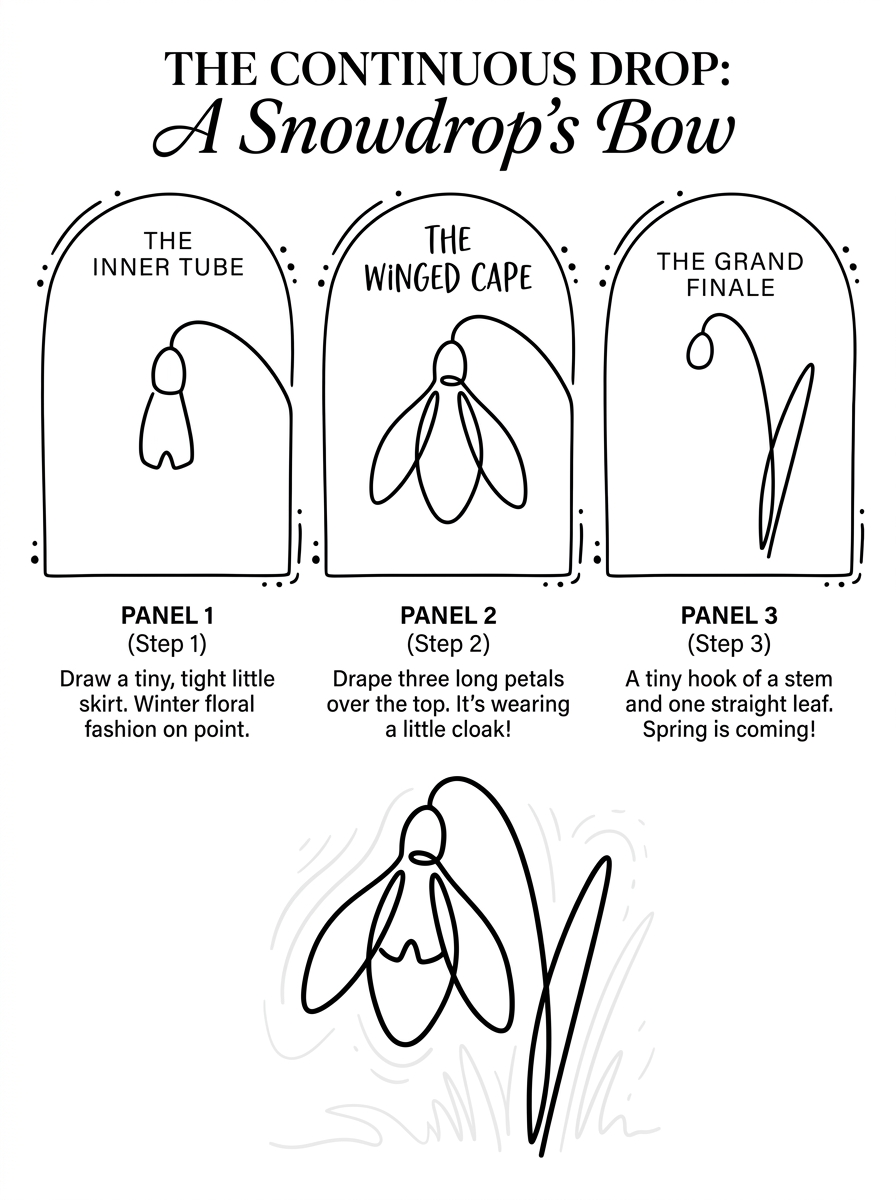
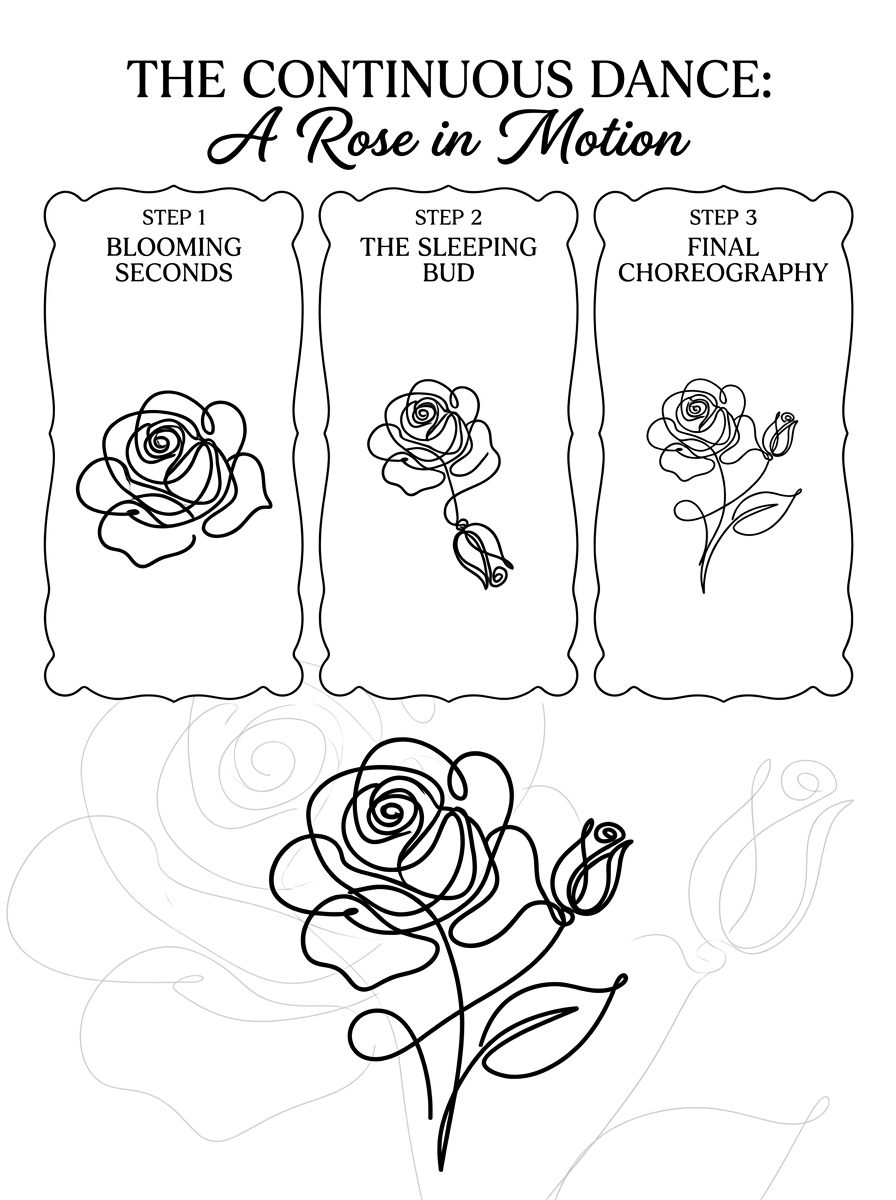
- The three-part build that works on any flower
- The four mistakes, in the order everyone makes them
- 30 flowers to try it on, easiest first
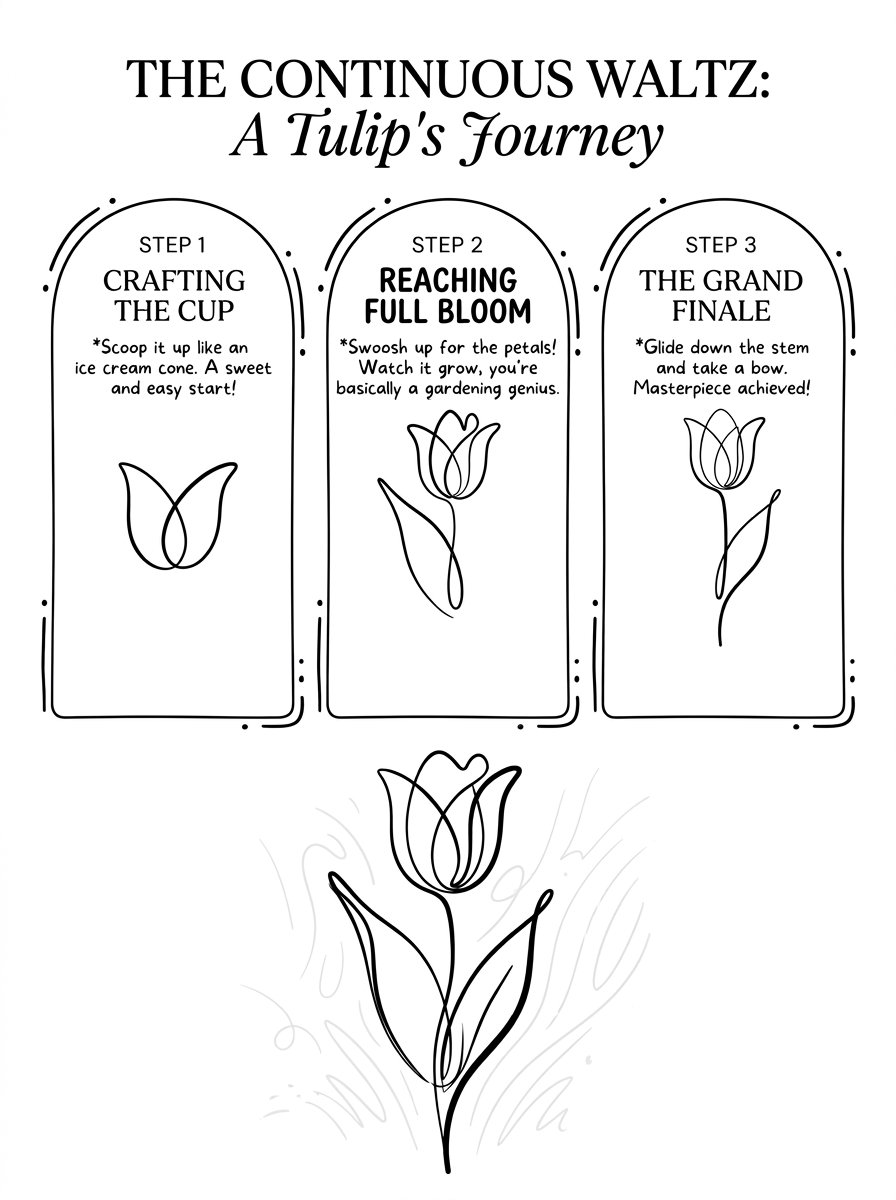
- The free tulip sheet — under two minutes, start there
Draw the tulip before you read the rest. The reading is not the point of this page.
 Save
SaveWhat the unbroken line in a one line drawing actually does
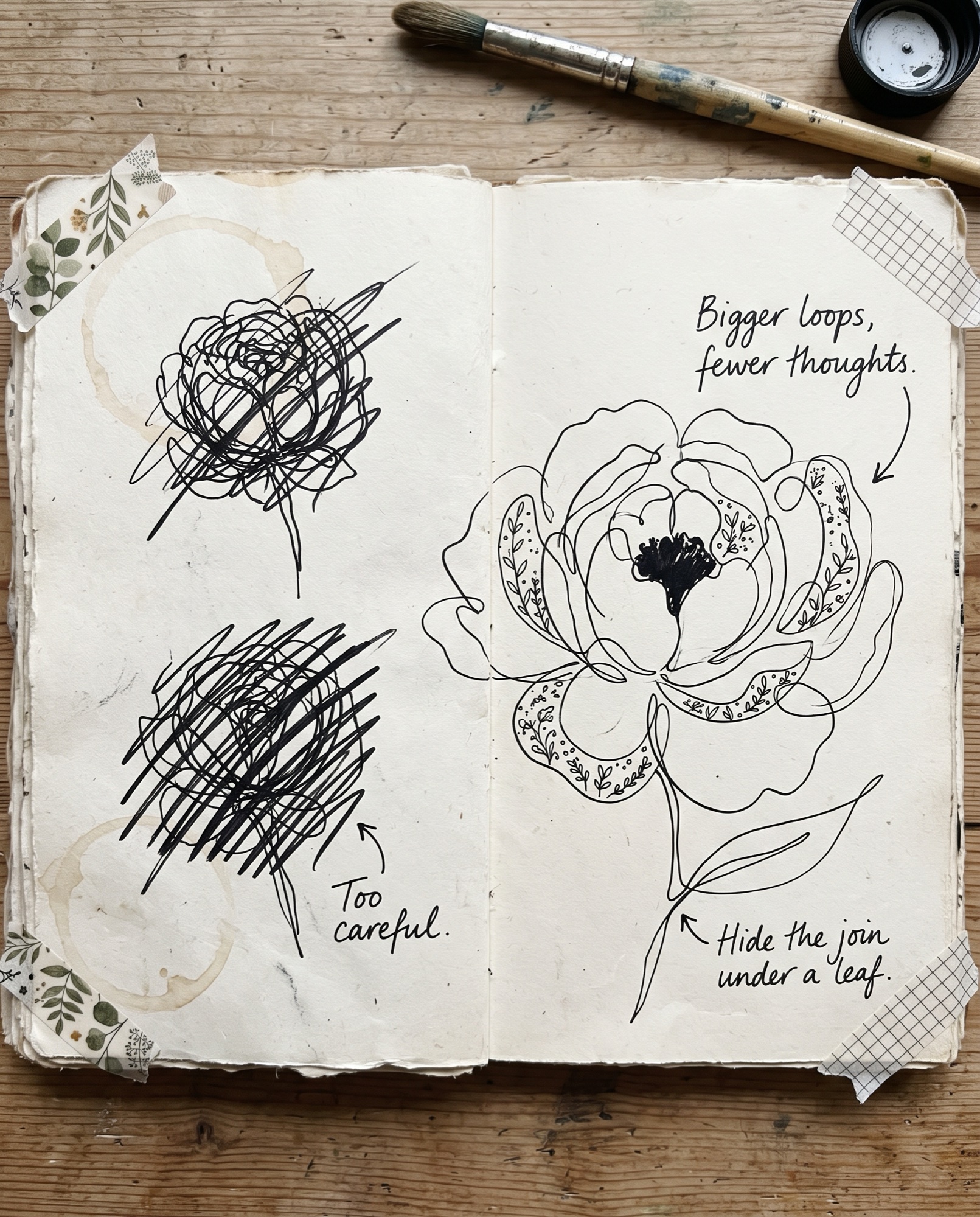
Ten small corrections and the shape goes muddy, the paper goes grey, and the flower on the page looks nervous — because it was made nervously. The careful version is almost always the more accurate one. It is almost never the one anyone hangs.
Take the lifting away and the vote never happens. The line commits, and commitment reads as confidence even when it was really just momentum. Your hand cannot fuss because it is busy travelling. This is why a one line drawing has a quality that careful drawings almost never manage: they look like somebody meant it.
The second thing it does is quieter. A continuous line forces you to plan the route rather than the picture — you start thinking about how to get from the outer petal into the centre without stranding yourself, and while you are thinking about that, you have stopped thinking about whether you can draw. Twelve minutes pass. Nobody notices them going.
Ellsworth Kelly kept himself honest with a stem
In 1948, in Boston, a young American painter drew an ailanthus leaf in unbroken contour. The next year in Paris he drew a hyacinth. He kept doing it for the rest of his life — eventually more than seventy botanical prints and, by his own count, uncountable drawings of foliage, all of them the same austere thing: the outline of a plant, in clean pen or pencil, centred on white, with no shading and nothing explained.
Ellsworth Kelly went on to make some of the boldest abstract colour paintings of the twentieth century. The plant drawings ran alongside all of it, privately, for sixty-odd years. There is no shading in a single one. He was not practising for something else. The line was the whole event.
A man who spent his life on enormous fields of pure colour drew leaves in one line the entire time, and never added a single shadow.
 Save
SaveThe one line drawing build that works on any flower
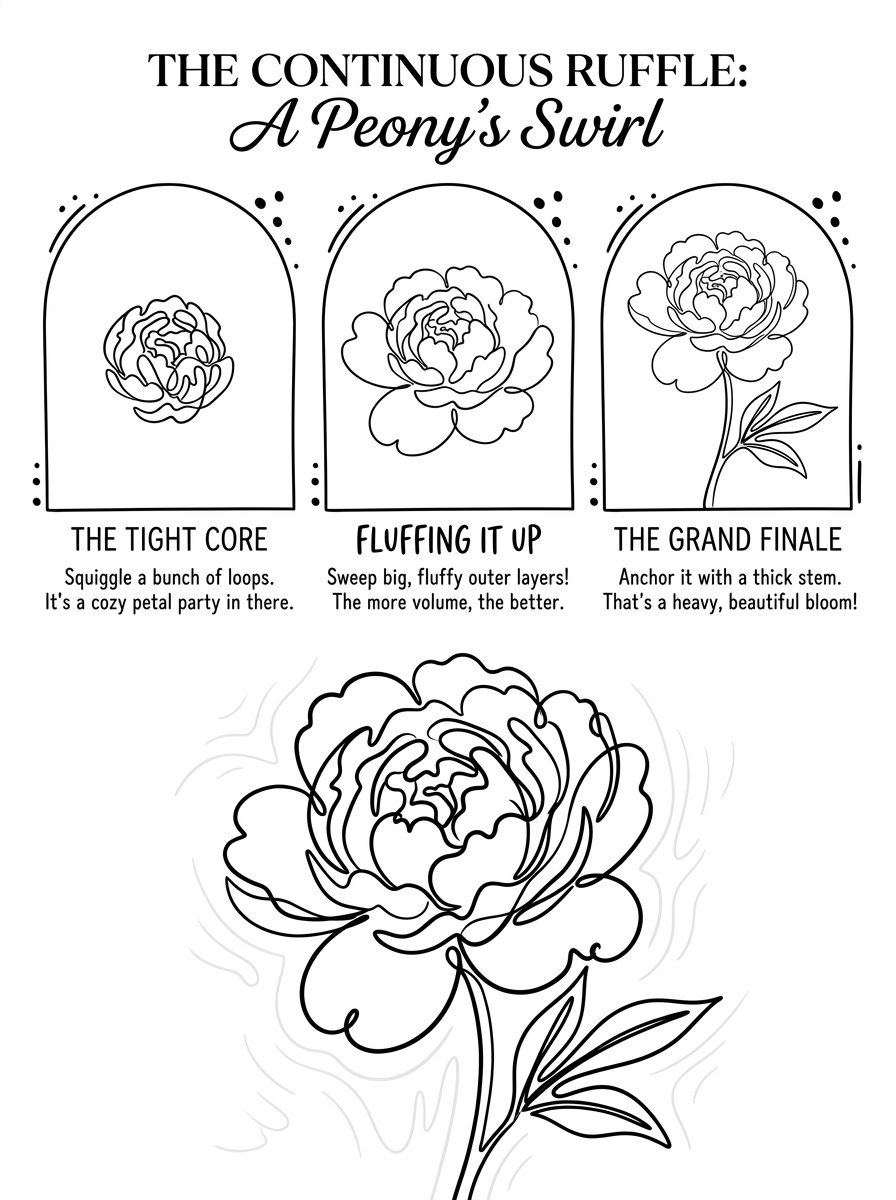
Every sheet in this collection runs the same route, and once you have done two flowers you will stop needing the sheet at all. The parts have names because naming them is what makes them repeatable.
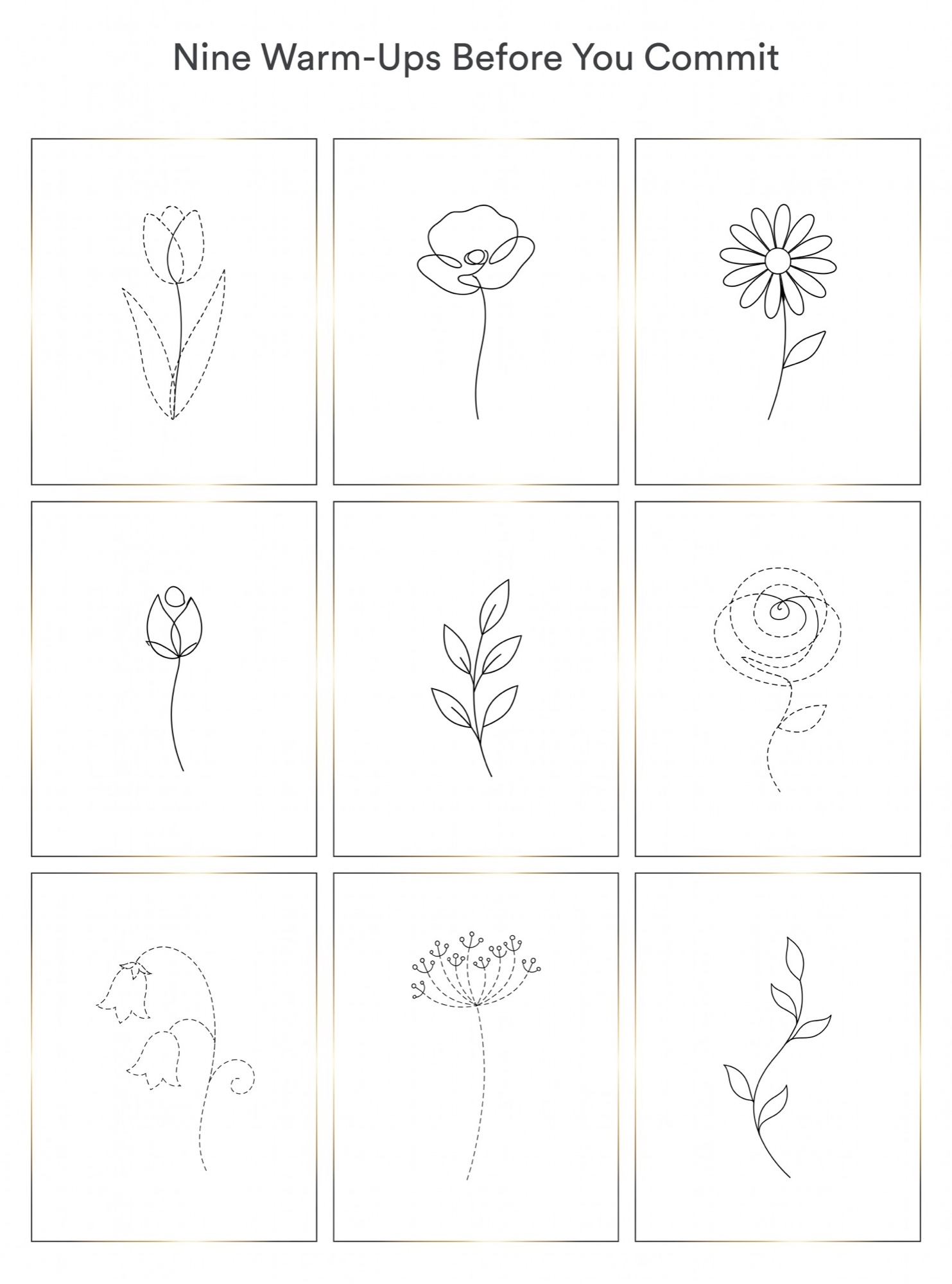
1. The core. Start in the middle with a loose tangle of loops — small, overlapping, no plan. This is the part beginners want to skip and it is the part that does the work. The centre is scribble, and scribble is where the flower gets its life. On the peony sheet the instruction is simply: squiggle a bunch of loops, it is a cosy petal party in there.
2. The sweep. Now the same line travels outward and gets generous. Big, soft, unhurried petal shapes, each one bigger than feels sensible. Volume is the difference between a flower and a doodle, and volume comes from the size of the arc, not from adding more of them.
3. The finish. One stem down, one or two leaves off it, and stop. Stopping is the actual skill — the drawing is finished several seconds before you believe it is, and everything added after that point is you being nervous in public.
 Save
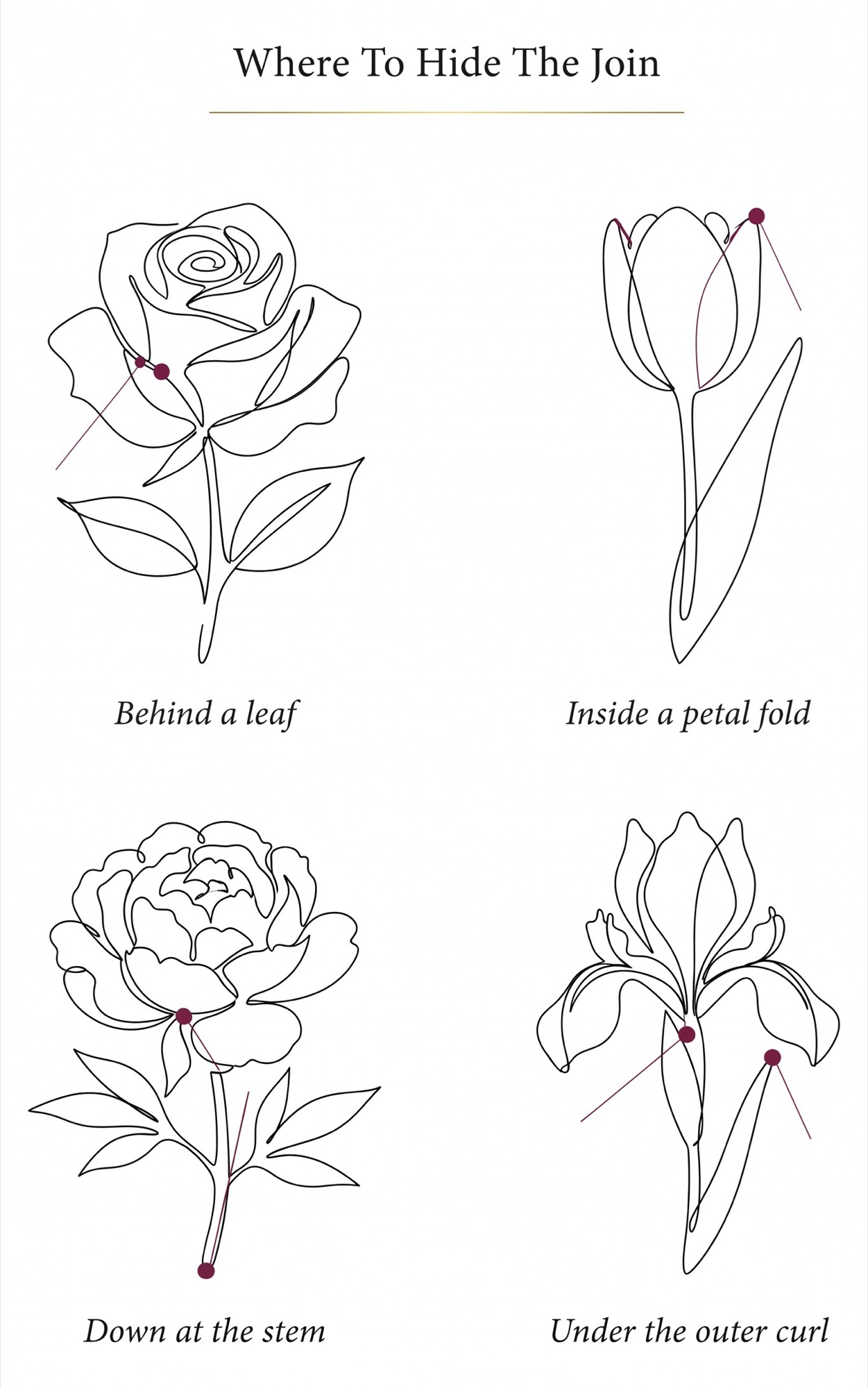
SaveThe iris runs the same route with different names — upright crown, cascading falls, grand finale — because an iris stands up where a peony sprawls. Same three moves. That is the entire method, and it survives being applied to thirty different flowers, which is how you know it is a method and not a trick.
 Save
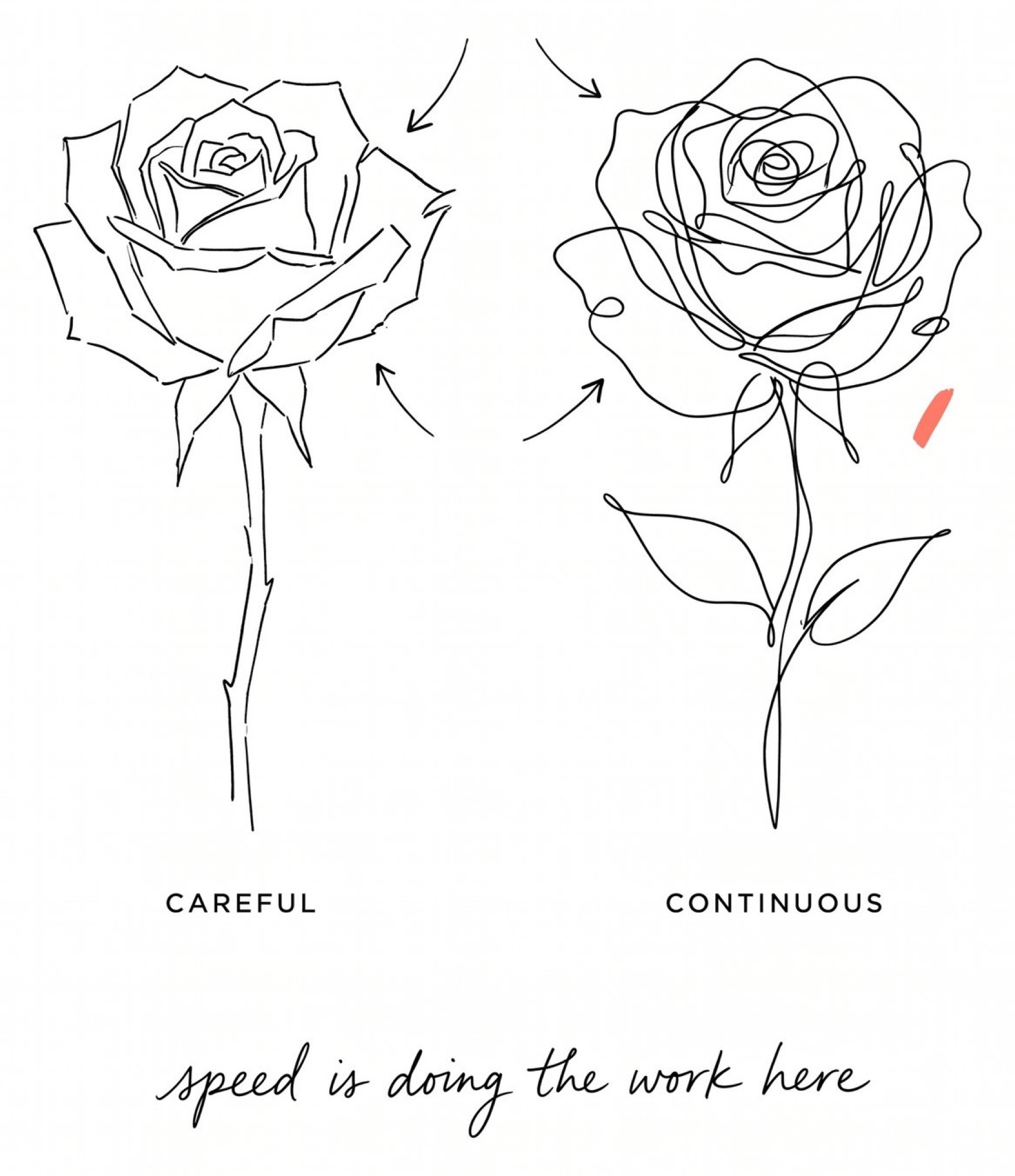
SaveSpeed is doing more work here than accuracy. A fast wobbly curve looks alive; a slow accurate one looks traced.
 Save
SaveThe four mistakes, in the order you will make them
- You will go too small. Everyone does. A small drawing hides in the middle of the page and looks timid; the same flower at twice the size looks deliberate. Start bigger than feels sensible, then go bigger than that.
- You will lift the pen mid-line and pretend you did not. Not the deliberate lift between bloom and stem — that one is allowed. The other one: the line looks wrong and your hand hops half a centimetre to patch it. Do not. Draw straight through the wrongness — the eye reads the whole shape and forgives the local error, but it never forgives a nervous gap.
- You will slow down at the hard part. Speed is doing more work here than accuracy. A fast wobbly curve looks alive; a slow accurate one looks traced. When you reach the bit you are dreading, go faster, not slower.
- You will not stop. See above. The peony is done at the leaf.
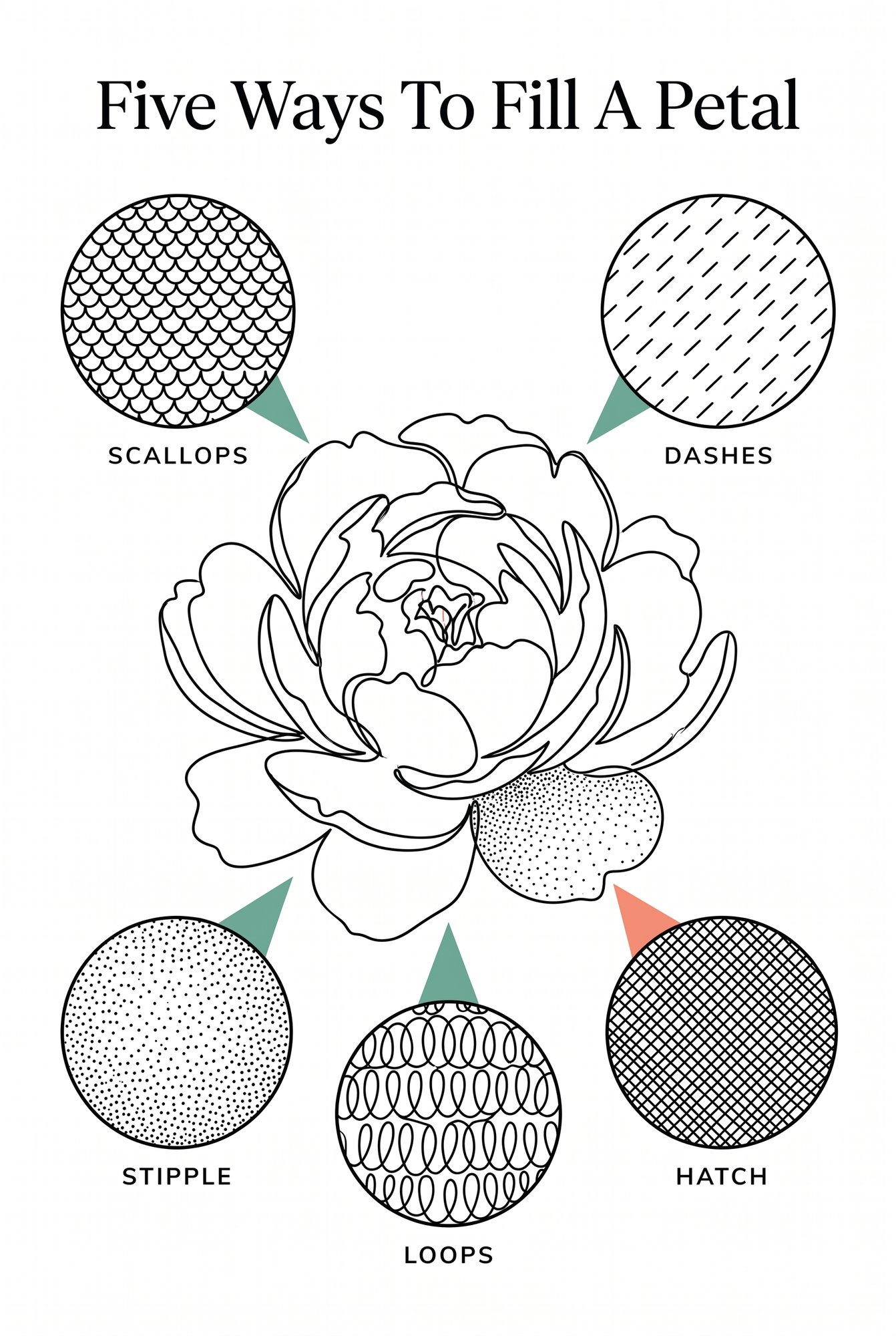 Save
SaveThe confession about the dandelion
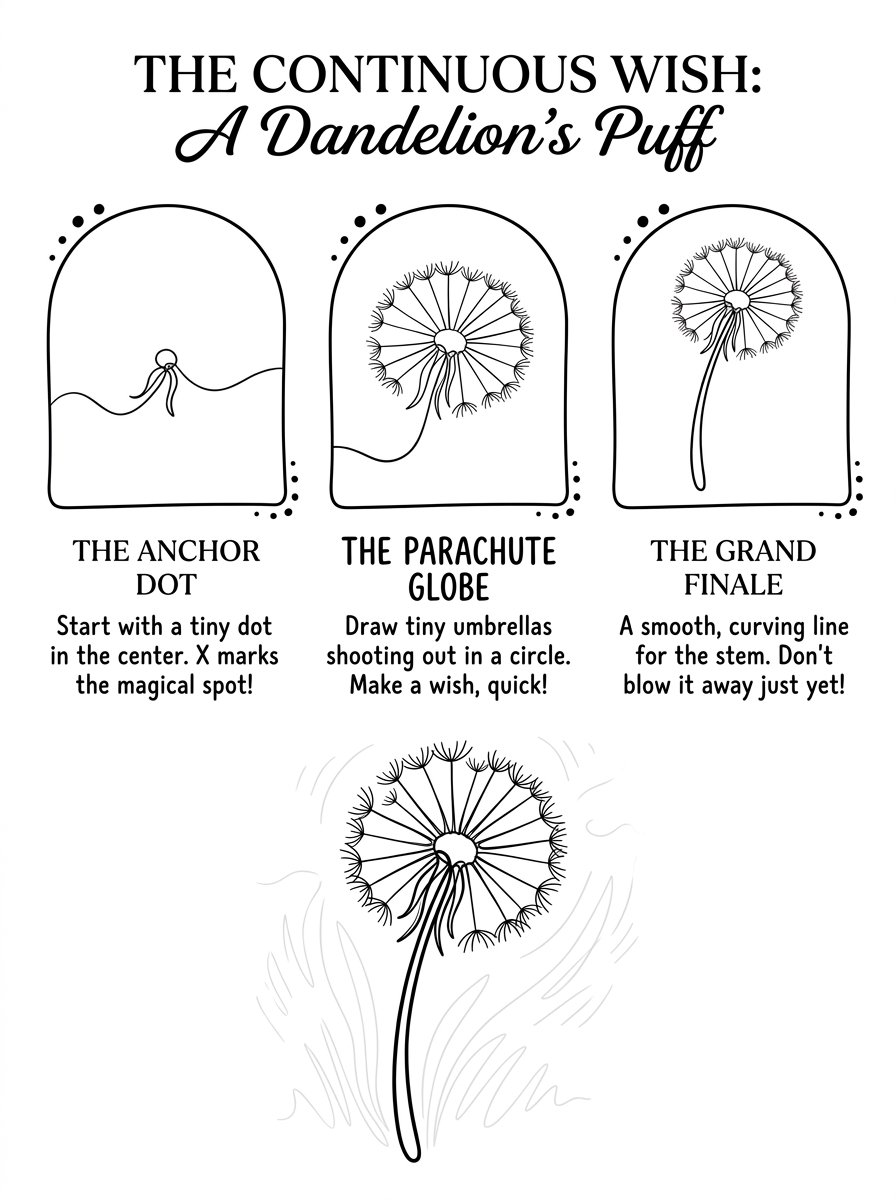
I have drawn the dandelion sheet more times than any other in the collection, and not because it is my favourite. It is because it is the one I keep getting wrong on purpose.
A dandelion clock is the most forgiving subject in the set — it is a ball of nothing, it is supposed to be irregular, and yet the first six times I drew it I made every seed the same length, evenly spaced, like a diagram of a virus. The correction was not technical. I had to physically make myself draw three seeds flying off where no seed would fly, and it looked wrong on the page and right in the room, which is a distinction I did not have language for until that afternoon. Now I do it on every flower. There is always one petal going somewhere it should not.
 Save
Save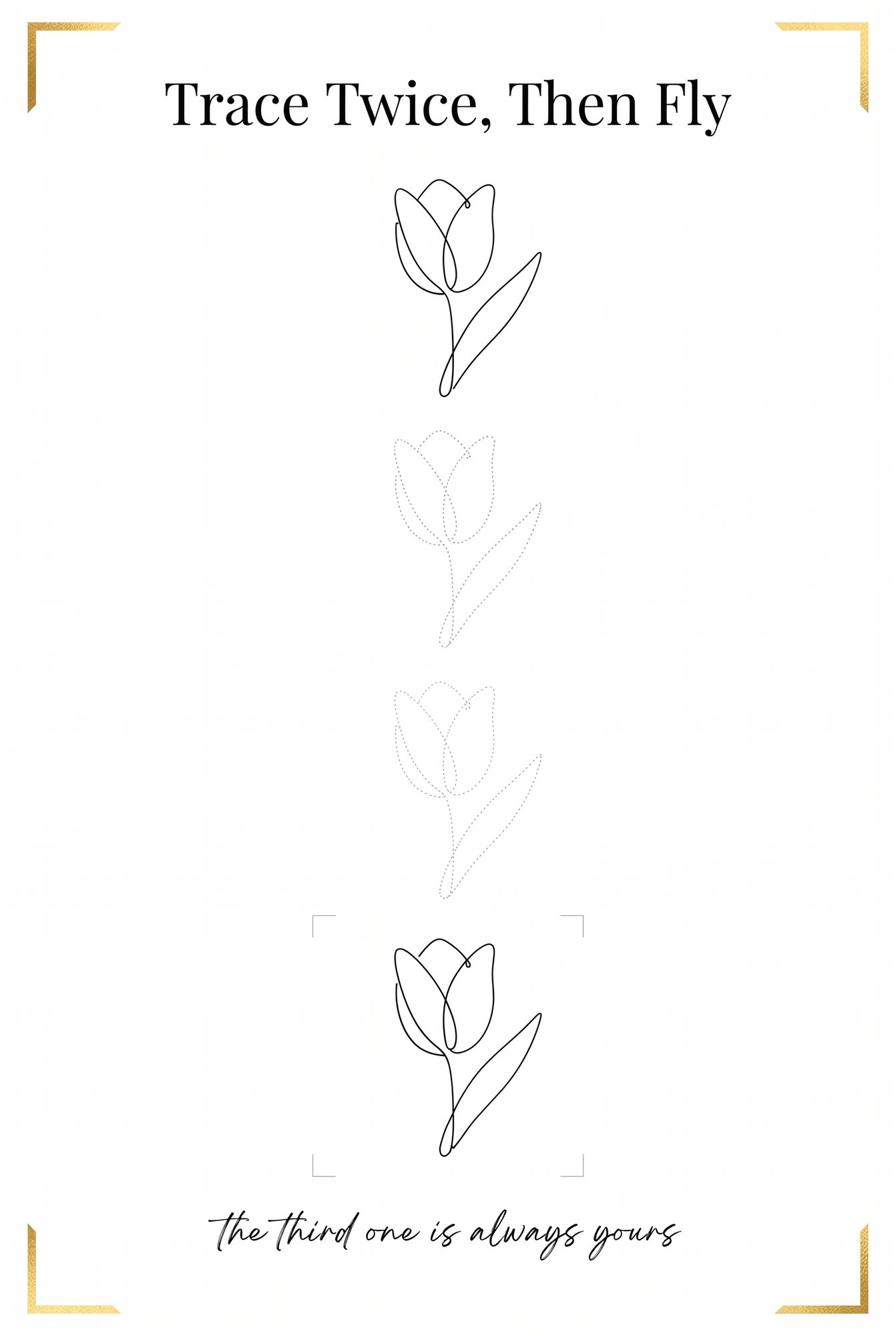 Save
SaveThirty flowers, easiest first
The collection covers thirty, and they are not equally kind to a beginner. In rough order of forgiveness:
Start here — forgiving, fast, hard to ruin:
- Tulip — three petals and a stem, the whole grammar in ninety seconds
- Poppy — one crumpled bowl, and crumpled is free
- Dandelion — a ball of nothing that is supposed to be irregular
- Lavender, cosmos, daisy — small, quick, endlessly repeatable
Once the line stops feeling foreign:
- Peony and ranunculus — the loose core does all the work
- Iris — upright crown, cascading falls, two different moves in one flower
- Magnolia, anemone, hydrangea — punish careful outlining, which is exactly why they teach fastest
The showing-off tier. The rose. A rose in one line is a spiral that has to open outward without crossing itself, and getting it right feels disproportionately good. There is a reason it is the one people frame.
The quiet ones, for eleven at night when you want the activity more than the outcome:
- Snowdrop and bluebell — three strokes and a nod
- Jasmine and freesia — sprays, so nothing has to be symmetrical
- Violet — the smallest finished thing in the set
There is always one petal going somewhere it should not. That is the petal doing the work.
Where they end up
Three one line drawing pieces in matching frames, hung close together, reads as a considered set rather than three drawings — the trick is same size, same ink, same amount of white space, different flower. One in the middle of a card says more than the card would have. The sunflower at A4 above a hallway table has fooled more than one guest into asking which gallery.
 Save
SaveNone of this needs anything you do not own. Any pen that flows. Any paper that does not bleed. The lavender sheet in particular has been done, successfully, on the back of a printed email.
What is one line drawing, exactly?
A one line drawing is built from unbroken lines rather than short sketchy marks — the pen travels without stopping to correct itself. The purest version is a single line from start to finish; in practice most flowers here are one continuous line for the bloom, plus a second for the stem and leaves. It is also called continuous line drawing. The line may cross itself as often as it likes; the rule is that it does not stop to fuss.
Do I need to be able to draw to try one line drawing?
Less than for almost anything else. The technique removes the two things beginners struggle with — proportion decisions and erasing — by not allowing either. Tracing the sheet twice and then going freehand on the third is not cheating; it is how a hand learns a route.
What pen should I use?
The one nearest you. A ballpoint from the kitchen drawer draws a perfectly good tulip. If you find you like the look of a heavier stem, any fine felt-tip will thicken it. Nothing here requires a shopping trip.
Free Starter Pack
10 templates. 1 of them ends up framed.
Sent tonight. The first takes 12 minutes.
Unsubscribe in 1 click, no hard feelings
The tulip at the top is free and yours. When you want the rest of the route — every flower, every three-part build, every finishing line — the full collection is below.
30 flowers, every one built from continuous lines
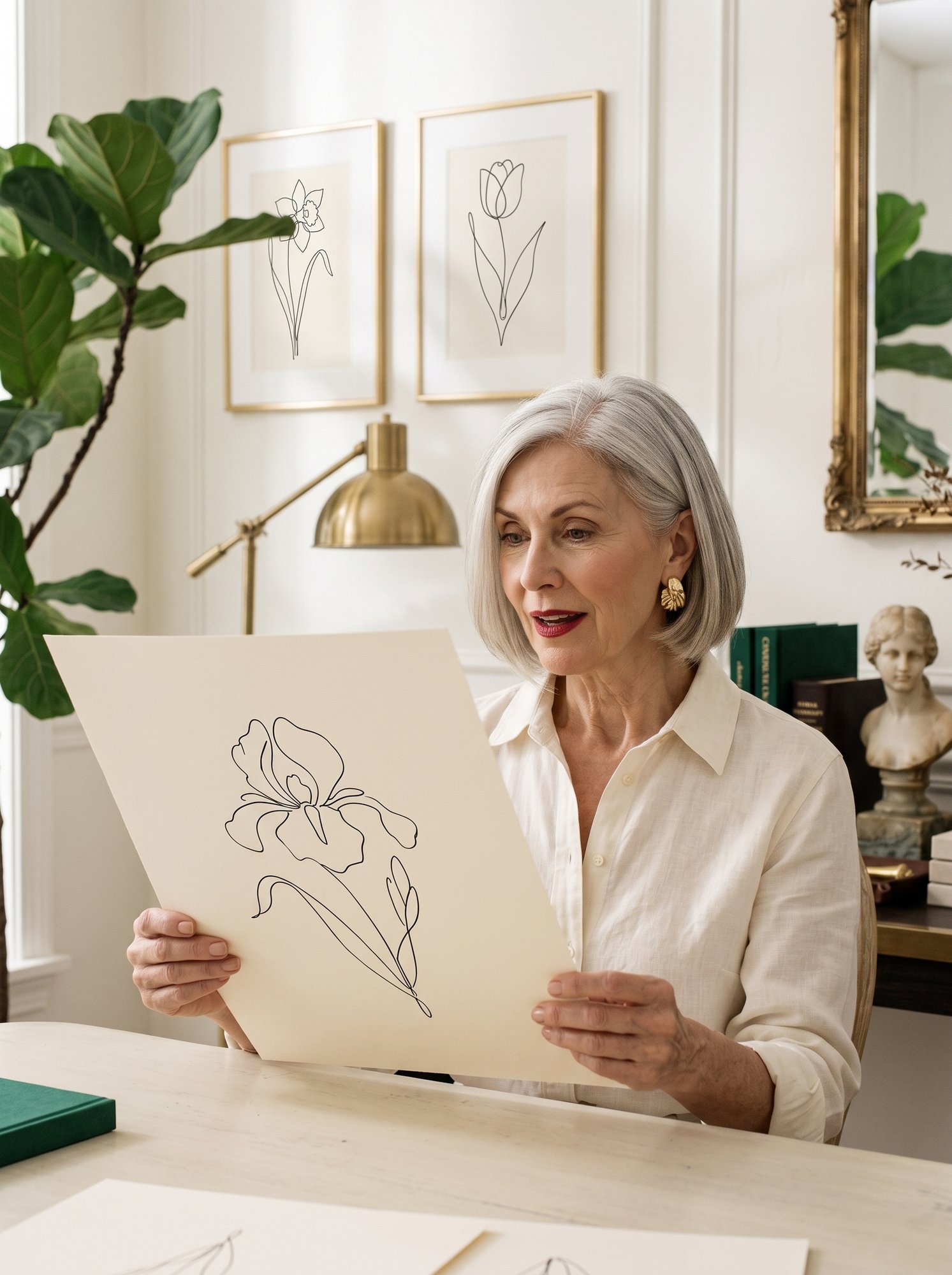
Tonight it is one peony at the kitchen table. By the weekend it is a framed trio in the hallway, a birthday card someone keeps on the shelf, a wall that people ask about. Every flower, every three-panel build, every finishing line — the whole route from first loop to something worth hanging.
Instant download · print as often as you like
Giotto had one shot at a circle and no eraser. You have thirty flowers and a kitchen table. Slight advantage, honestly.
Mirabelle wrote this. No training, strong opinions, many pens. Peer reviewed by a cat briefly, before she sat on it.