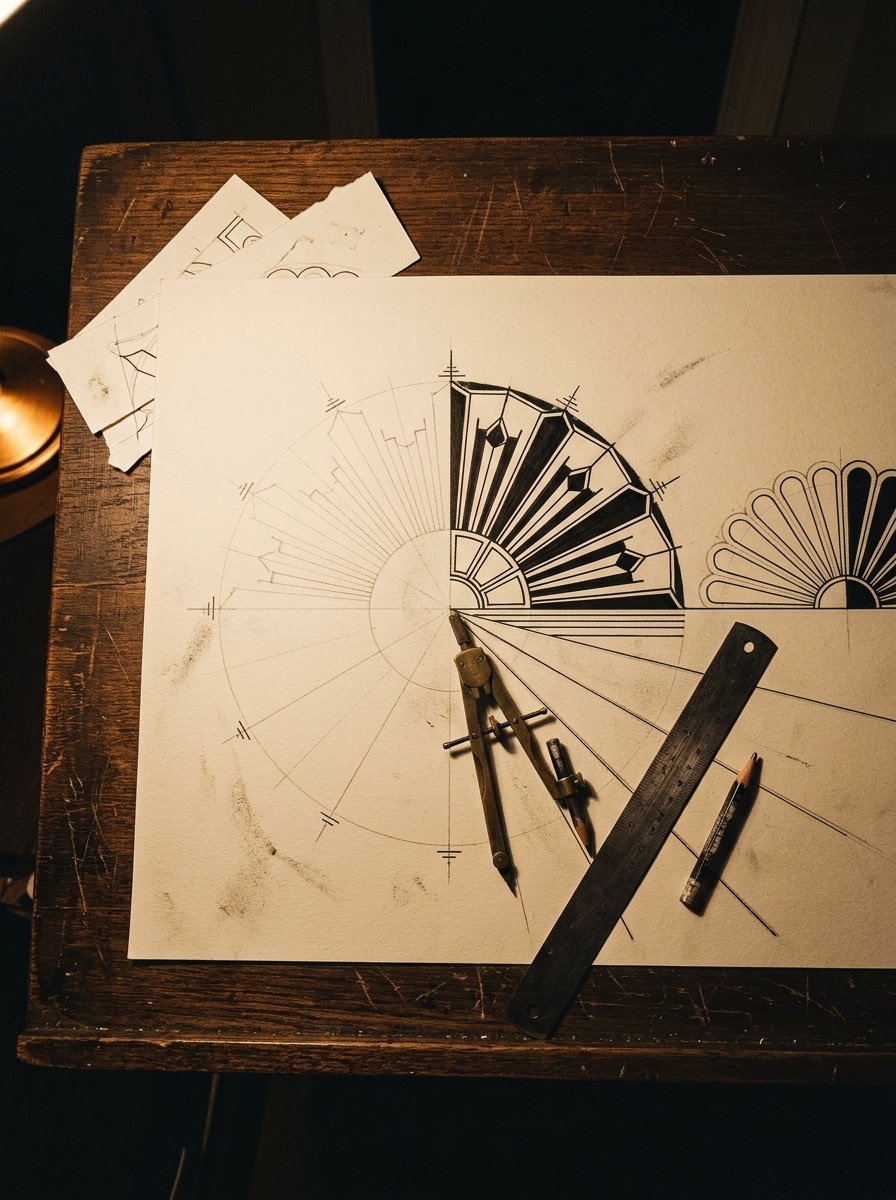
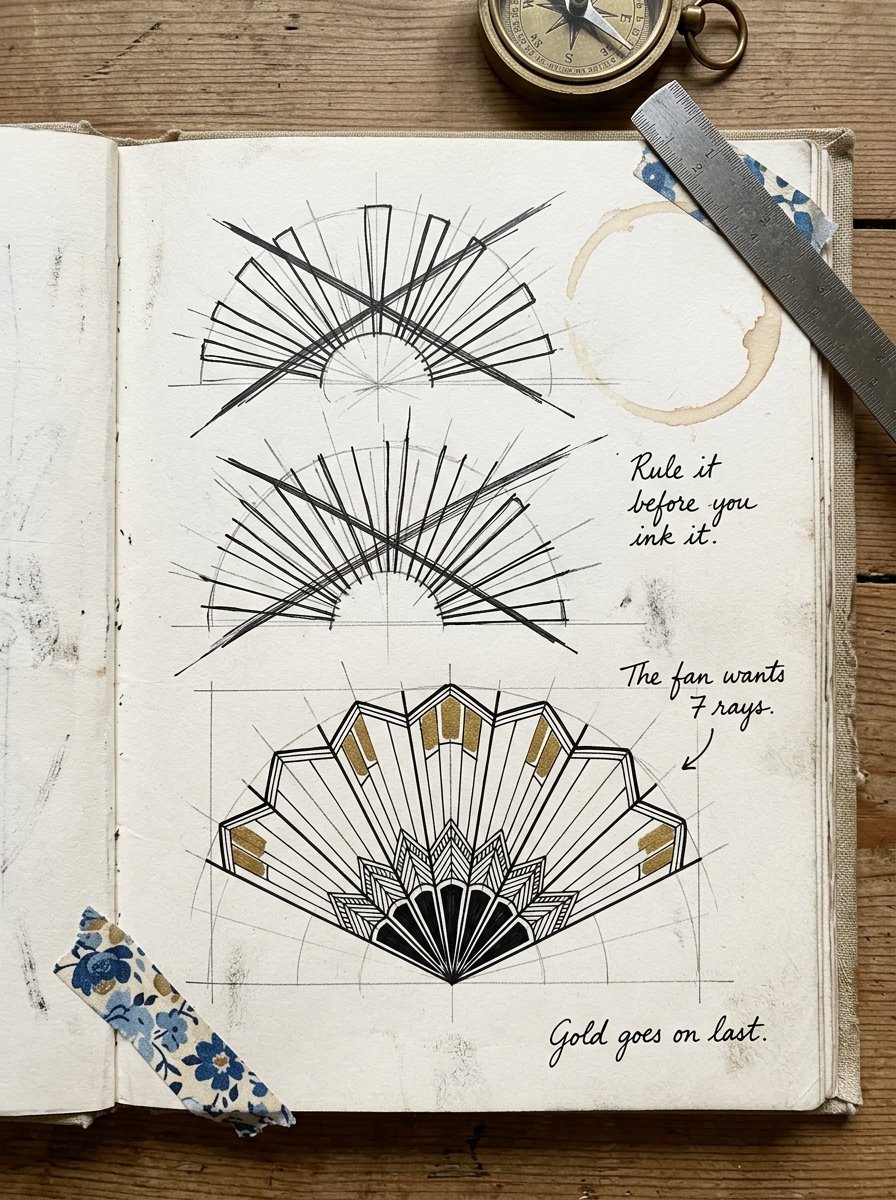
There is almost never a freehand line in an art deco drawing. Hunt one down and you will not find it. Everything is ruled, compassed or stencilled.
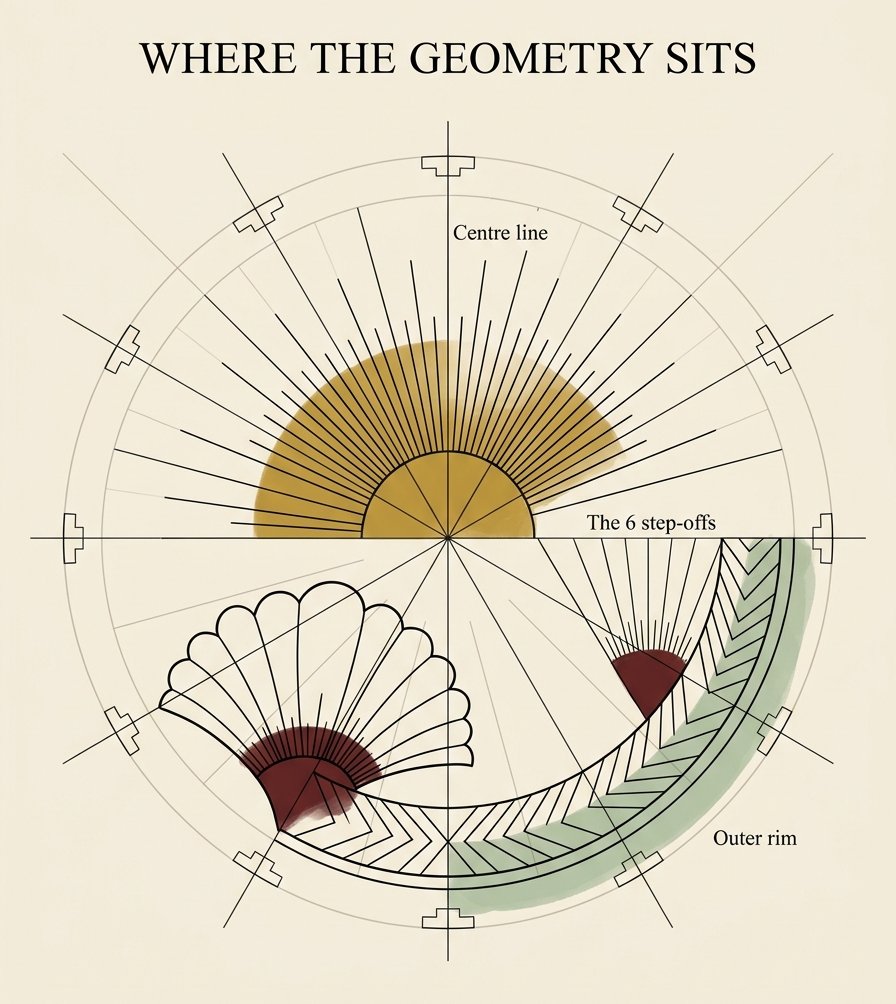
The fan, the sunburst, the chevron: all of it comes off a straight edge. Add a compass held at one width. Walk it around its own circle and it lands 6 times. Those 6 points are the skeleton of the style.
It looks expensive and behaves like arithmetic. (I held out for years. I wanted it to be talent.)
The name came from a Paris exhibition in 1925. Robert Bonfils drew its poster. What those makers shared was never a look. It was an order of operations. Measure, then mark.
Below are 75 art deco drawing motifs, inside 6 secrets. Every secret belongs to somebody who made marks for a living.
Each carries a name, a date and a source.
Download the free motif sheet →
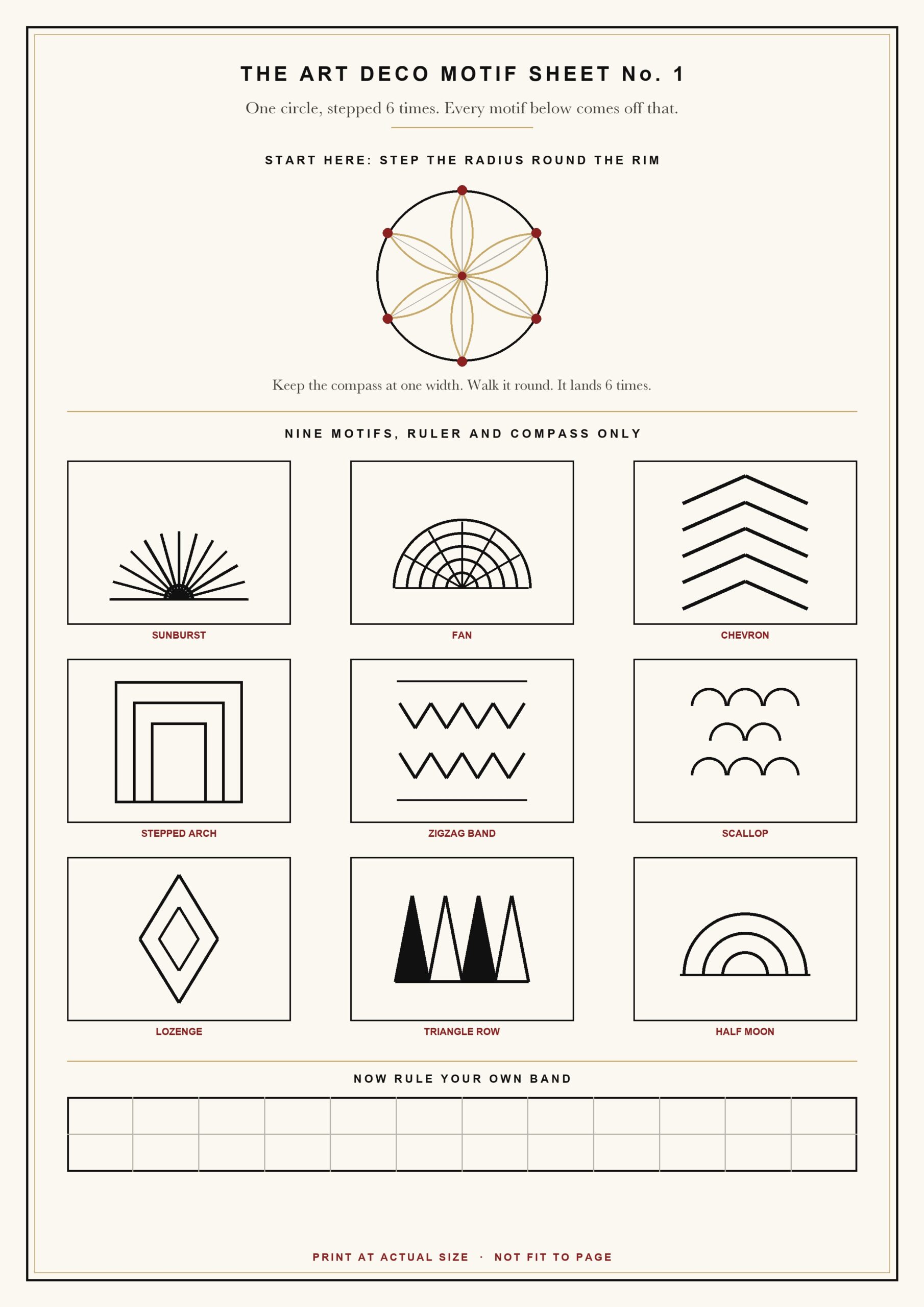
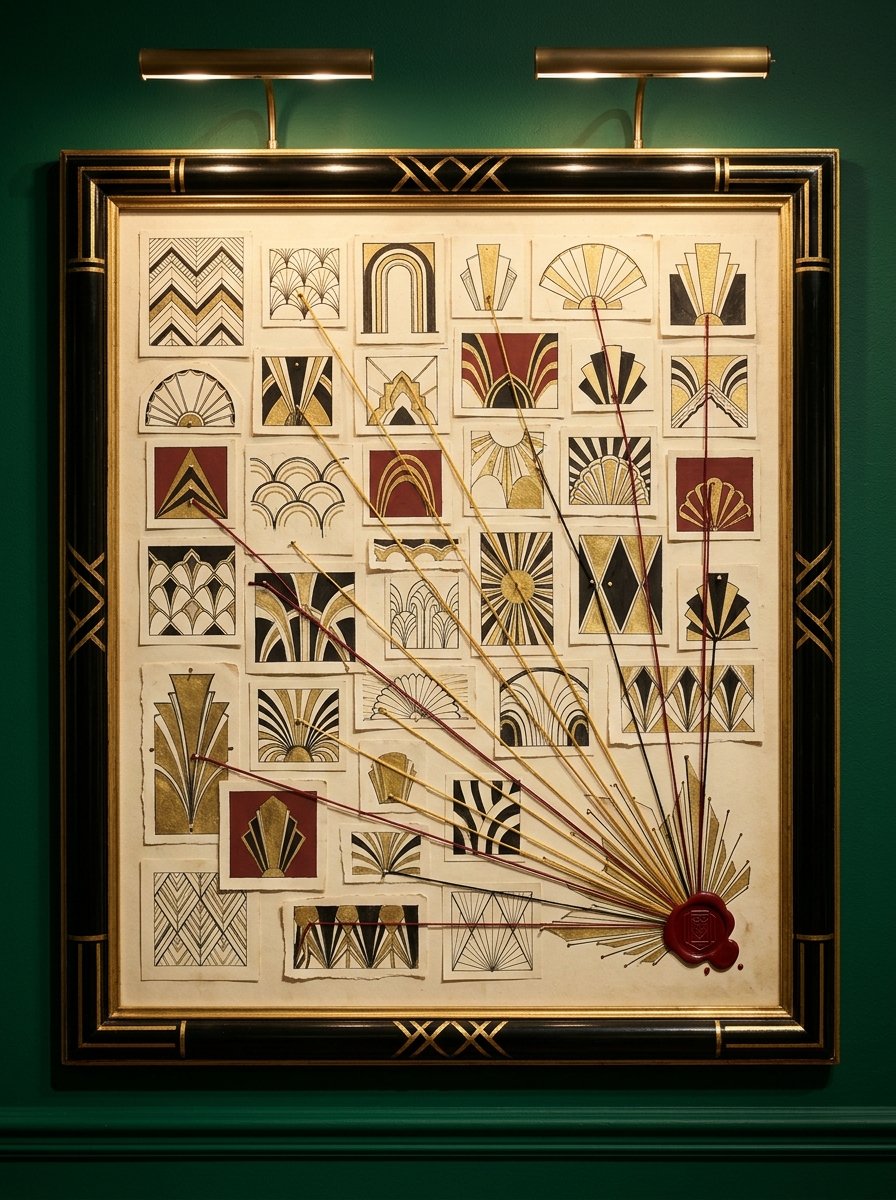
The sheet holds 1 circle with its 6 step-offs marked in red. Under it sit 9 motifs, each ruled off that same circle.
In the print box choose actual size. Do not let it scale. (Printers shrink things uninvited. This one will try.)
Then put the compass point on the centre dot and open it to the rim. Do not measure the gap. The circle already knows how wide it is.
Work down the sheet in order. The first row is ruled with a straight edge alone. The second needs the compass. The third asks for both at once. Row 3 is the one to repeat. It trains the hand to hold both tools inside the same motif.
That centre dot is not only a deco move. The Complete Mandala Creation Toolkit is built on the same one. It is the collection this post came out of. A deco band and a mandala ring want the same thing from you. Even spacing, settled before you start.
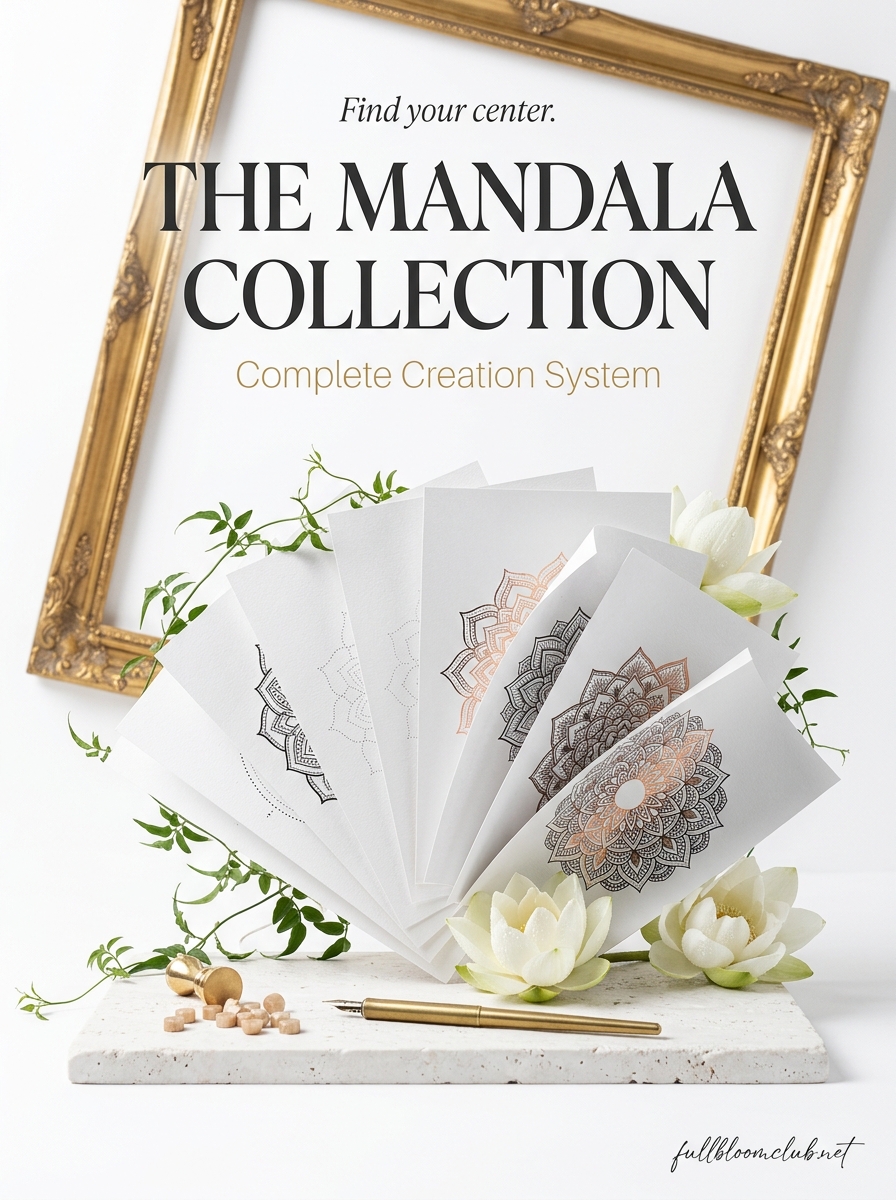
The Collection
8 grids, 88 elements, and 1 centre dot underneath every ring you draw.
The compass measures. The grid spaces. A deco band needs that exact pair of jobs. What you get: 8 master grids to rule over, and 88 elements to drop into them.
Back to the ruler. Every secret below was found by somebody who measured first, and each one ends with 3 things you can do with it tonight.
Edward McKnight Kauffer left his ruler marks visible in a finished art deco drawing
On 16 November 1934, Kauffer finished a design for a fuel company. A mechanical man leans on a giant lever in front of a graph.
The museum record lists the medium as pencil, pen and ink, and sprayed bodycolour on card. Then it adds one more line about the sheet.
There is a scale in pencil beneath.
He ruled a measuring scale onto the artwork, under the picture, and never rubbed it out. The finished piece still carries the workings.
That is the permission. Your construction lines are allowed to survive. (Mine survive whether I allow it or not.)
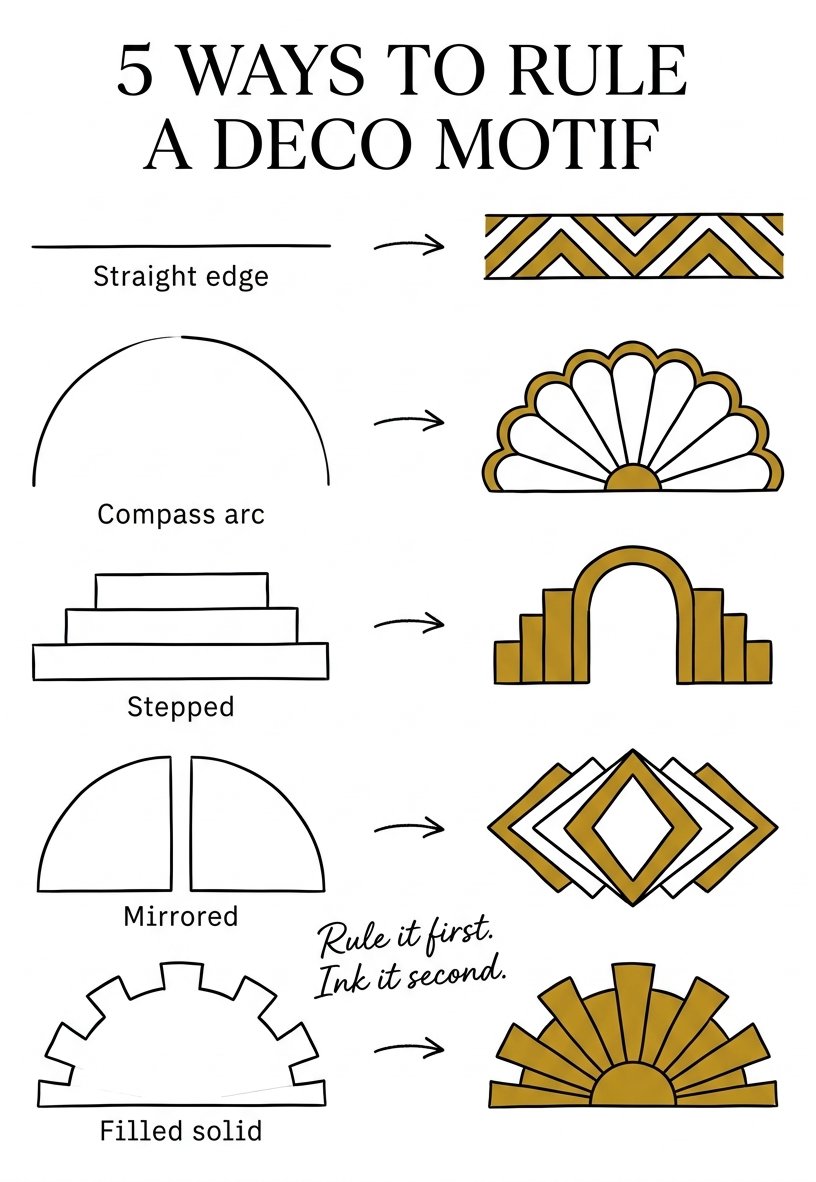
So rule the straight-line family first. They need nothing but an edge. A chevron is 2 lines meeting at a point. A zigzag band repeats that shape to the margin. A stepped pyramid climbs in equal jumps. A ziggurat climbs, then comes back down.
Then the flat-sided motifs. A triangle row alternates solid and hollow. A lozenge is 2 triangles base to base. A diamond chain links lozenges at their points. Herringbone is short strokes leaning alternately. It goes wrong when the paper stays still.
Rule 3 more before the section ends. A parallel rule band is 2 lines with a gap you keep constant. Stacked bars are those bands piled with air between them. A stepped arch is a doorway narrowing in stages. A skyscraper setback is that arch stood upright and stretched.
Tonight, three ways in. Rule 1 band across a scrap and fill it with chevrons until your hand settles. Or draw a stepped arch and leave every pencil line showing. Or copy Kauffer exactly and put a measured scale under a finished motif.
Georges Barbier’s colours were cut, not painted, one metal stencil at a time
Barbier’s prints sit in museums under a medium line that names a process, not a picture. The V&A calls a 1925 sheet of his a pochoir print. A 1913 plate at the Met has a medium field 1 word long: Pochoir.
Pochoir means stencil. A library that teaches the process spells out the method. Separate stencils were cut for every colour component. Sometimes in thin sheets of copper, zinc or aluminium.
Sometimes as many as 100 stencils were used to recreate a single image. Colour went on through the cut hole with a stubby brush called a pompon.
The crisp edge in art deco drawing is not a drawn edge. It is a cut one.
Nobody was keeping a steady hand, because the metal kept it for them. (This explains a great deal about my own edges, and I take no comfort from it.)
That changes what a pen is for. Ink the boundary, then fill flatly inside it. Stop shading your way toward a shape.
The cut-edge family starts round. A fan is a half circle with ribs running to its base. A scallop is a row of half circles overlapping like roof tiles. A shell is a fan with a small notch at the foot. A palmette lets its ribs spread past the rim.
Curves next, and they all come off the compass. A half moon is the top of a circle with its base ruled flat. A crescent row nests half moons inside each other. A teardrop is 1 arc meeting 1 straight line. A leaf blade is 2 arcs meeting at both ends.
4 more and the family is complete. A stylised tulip is 3 teardrops sharing a stem. A cut silhouette is any motif inked solid, with no interior line. A solid disc is exactly what it says. A keyhole is a disc sitting on a narrow rectangle.
Tonight, three ways in. Cut 1 fan out of card and draw round it 6 times. Or ink a scallop row and fill alternate scallops solid black. Or take a motif you already drew and redo it as a cut silhouette.
Eileen Gray put the geometry on last, after a dozen layers of lacquer
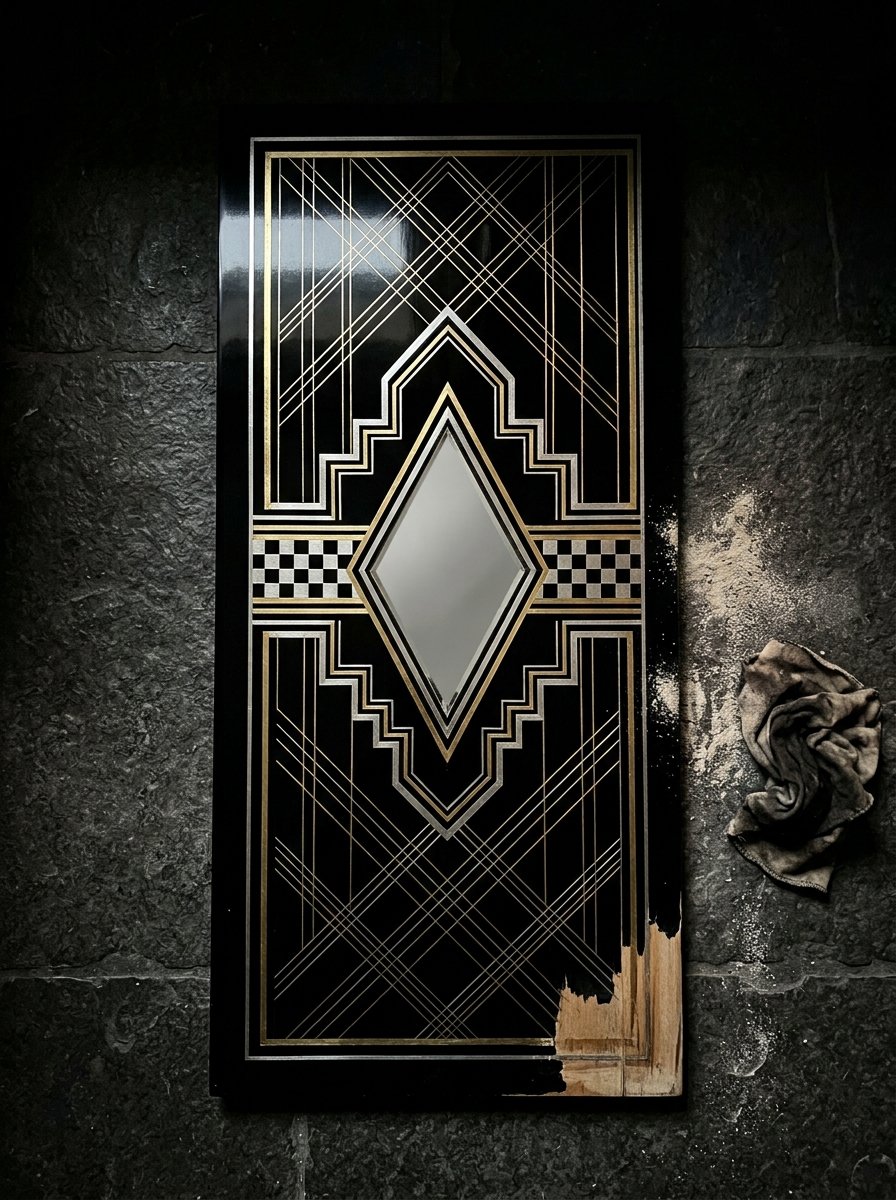
Gray made a lacquer screen around 1923. It is 8 panels held together with brass hinges. The museum record explains how the surface was built.
Each panel took at least a dozen thin layers of lacquer. Every layer dried for a day or 2 in a warm, humid, dust-free room. Then it was polished smooth with pumice before the next went on.
The geometric designs in silver foil were applied in the last few layers.
The geometry was not the foundation. It was the finish.
I got this backwards for a long time. I would rule the pattern first. Then I built a background around it. It always looked like an apology.
So build the ground, then put the structure on top. The grid family works this way. A grid overlay is ruled squares laid over a finished wash. A lattice is that grid turned 45 degrees. A trellis is a lattice with the crossings thickened.
Then the woven ones. A crosshatch panel is 2 sets of parallel lines at an angle. A chequer band fills alternate squares solid. A basket weave is short bars taking turns over and under. An inlay square is a small solid square dropped into a ruled frame.
The edges finish the job, exactly as Gray’s silver did. A corner bracket is an L of pattern that stays in the corner. A border frame runs the motif all the way round. A double rule is 2 lines close together. A stepped border climbs in blocks. A silver seam is 1 metallic line laid along a boundary you already inked.
This is the part of art deco drawing nobody photographs, and it is the part that decides the result.
Tonight, three ways in. Wash a page in 1 flat colour and rule a grid over it once dry. Or ink a border frame and leave the middle completely empty. Or add 1 gold line to a drawing you finished last week.
A.M. Cassandre built every poster on an armature you are not meant to see
Cassandre had a show at a New York museum in 1936. Its catalogue states his method flatly, with no romance in it.
The medium of all the posters is gouache. Stipple brush, paint gun, montage and stencils are used in varying degrees in each design.
The same catalogue counts his colours. Some posters run 5 or 6. In others, 2 are enough to carry the idea.
His own account of the structure, published by his estate, is the sentence worth pinning up. He called his method geometric, or more precisely architectural. He worked to give his posters an unshakeable solid ground.
An art deco drawing is held up by something you never see. You rule it, you build on it, and nobody who looks at the finished thing can find it. (I ruled mine and then could not bring myself to rub it out. Cassandre would have.)
The radiating family lives on that armature. A sunburst is rays off a centre point, spaced wider as they travel. A half sunburst is the same shape cut off by a ruled horizon. A ray fan stops its rays at a curve instead of running free.
Motion next, which is what deco used instead of shading. A speed line is 3 parallel strokes, blunt at the start and tapered at the end. An arrow band is chevrons all facing 1 way. A lightning bolt is a zigzag with unequal legs. A wave crest is an arc with a curl bitten out of its top.
4 to finish, and 2 colours will carry all of them. A cloud step is a stack of half circles on a flat base. A smoke curl is a spiral that opens as it rises. A searchlight is 2 long rays from a low corner. A horizon bar is the ruled line they sit on. A solid triangle is the simplest mark in the style.
Tonight, three ways in. Rule a faint armature of 6 rays and build a sunburst on it, erasing nothing. Or redraw a motif you like using 2 colours only. Or put a horizon bar across a page and hang a half sunburst on it.
René Lalique worked out every art deco drawing on transparent paper first
Lalique trained as a jeweller and became a professional draughtsman in 1882. He opened his own workshop in 1885. He carried on drawing his ideas at the start of every design.
The museum that holds those drawings uses the exact terms this article keeps reaching for. The incredibly fine strokes of the pencil. The use of geometry.
A research library catalogues more of them and records what he drew on. China ink, gouache and watercolour, on transparent vegetable paper. Tracing paper, in other words, dated between 1895 and 1905.
One sheet carries 3 designs for a belt buckle. One sits upper left. One lower right. The third in the centre.
He worked small, on paper he could see through, and arranged the designs deliberately. That is a worksheet. He invented it for himself 130 years ago.
I keep a pad of tracing paper beside me for this reason. (It has saved more drawings than any pen I own, and costs roughly nothing.)
The compass family is where this pays off. A compass rosette is 6 arcs swung from the 6 step-off points. A 6-petal flower is that rosette with alternate arcs inked. A vesica is the almond where 2 circles overlap. A quatrefoil is 4 vesicas around a centre.
Symmetry next, and tracing paper is how you get it honestly. A trefoil is 3 lobes on one stem. A circle chain is discs touching rim to rim. Concentric rings are circles sharing a centre. An arc garland hangs shallow arcs between 2 ruled lines.
4 more close the family. A mirrored spray is any motif drawn once and flipped. A fountain is 3 arcs rising from 1 point and falling outwards. A peacock eye is a disc inside a vesica. A dragonfly wing is a long vesica with ruled ribs inside.
Tonight, three ways in. Draw half a motif, fold the tracing paper, and trace the other half through. Or swing a compass rosette and ink only alternate petals. Or lay 3 small designs on 1 sheet the way Lalique did: corner, corner, centre.
Free Starter Pack
Get 10 Pattern Templates (+ Free Starter Pack)
Sent tonight. Bold fans, chevrons and scalloped bands to rule along a straight line.
Unsubscribe in 1 click, no hard feelings
Erté used 2 paints for 40 years, and 1 of them was metal
Erté designed costumes and covers for decades. The museum holds 209 of his works. On a 1924 costume design it lists the medium as gouache and metallic paint.
A 1930 piece says the same. So does a 1934 design for a pair of shoes, on a sheet roughly 28cm by 38cm.
That is 1 medium line, unchanged across a working life. Opaque colour, plus metal.
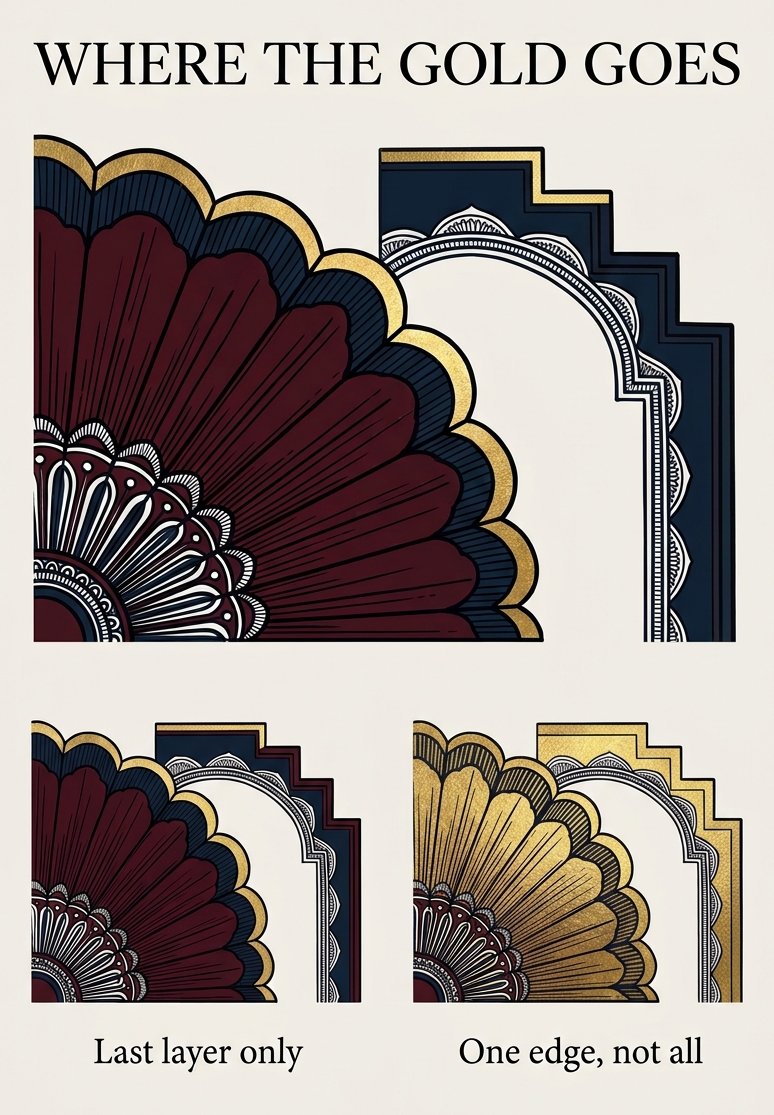
It is a smaller decision than it looks. Gouache sits flat and hides what is under it. Metallic paint does the opposite and moves as you move. Put them side by side. The flat colour looks flatter. The metal looks like light.
It is the cheapest upgrade in art deco drawing, and it costs 1 gel pen. (I own 3 gold pens and can account for the whereabouts of none of them.)
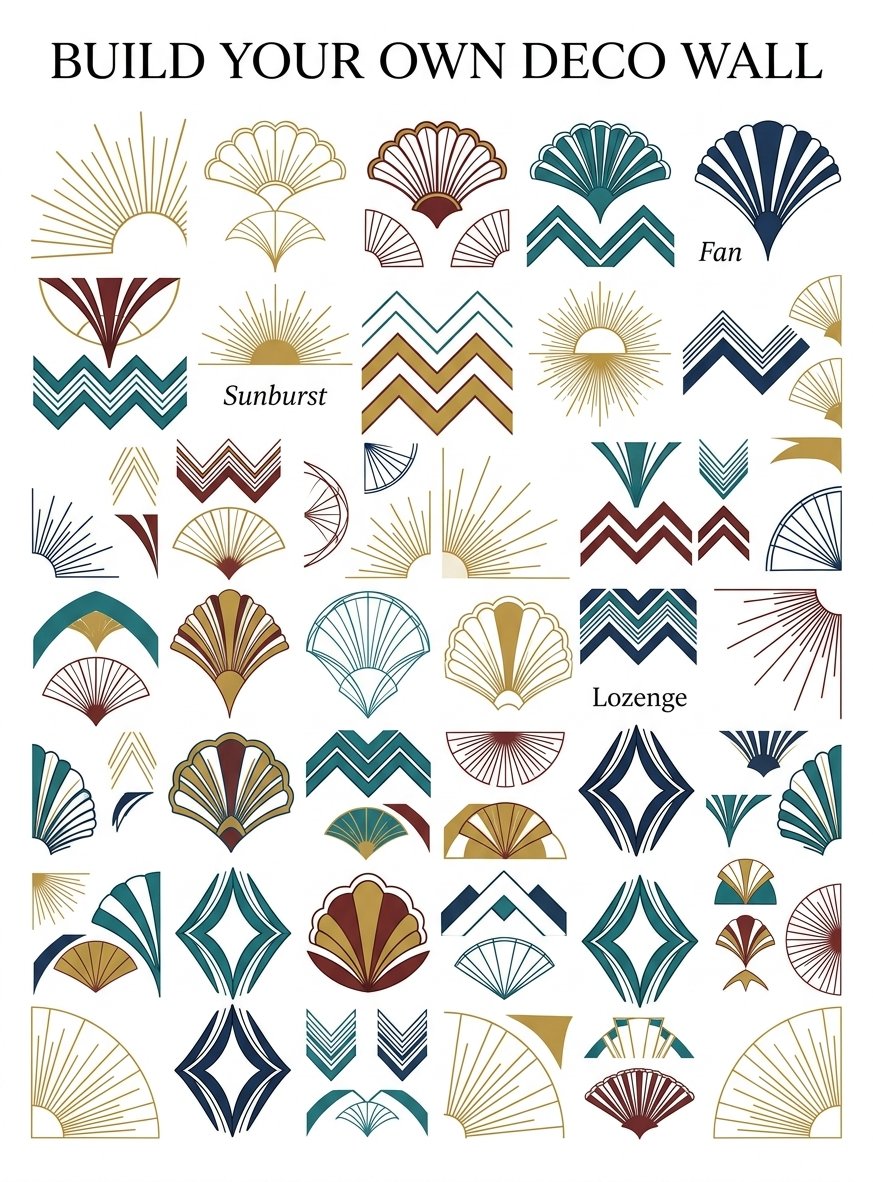
The ornamental family is built for that treatment. A starburst is a sunburst with rays of 2 different lengths. A star point is a single ray inked solid. A sunray crown is a half sunburst on a curved base. A plume is 3 long teardrops fanning from a stem.
Then the hanging motifs, where metal earns its place. A feather fan is a fan with each rib doubled. A tassel is a bar with short strokes hanging off it. A drop pendant is a teardrop on a thread. A bead string is small discs along a ruled line.
Links and coils next. A ring link is 2 circles overlapping at their rims. A spiral coil winds inward at an even rate. A scroll is a spiral that stops and straightens. A C-scroll reduces that shape to a single fat curve.
3 to finish, and they are the oldest marks here. A volute is a scroll with a thickening tail. A key fret is a line that turns only at right angles. A Greek key repeats that fret as a band. Deco borrowed it most often and changed it least.
Tonight, three ways in. Ink a motif in 1 flat colour and add gold to the last edge only. Or run a bead string along a border you already drew. Or draw a Greek key band and keep every turn square.
Your free art deco drawing motif sheet, and what to do with it tonight
The sheet at the top of this page is the short version of everything above. 1 circle, 6 step-offs, and 9 motifs ruled off it.
Print it at actual size. Put the compass point on the centre dot, open it to the rim, and walk it round. It lands 6 times, every time. It has done so since long before 1925.
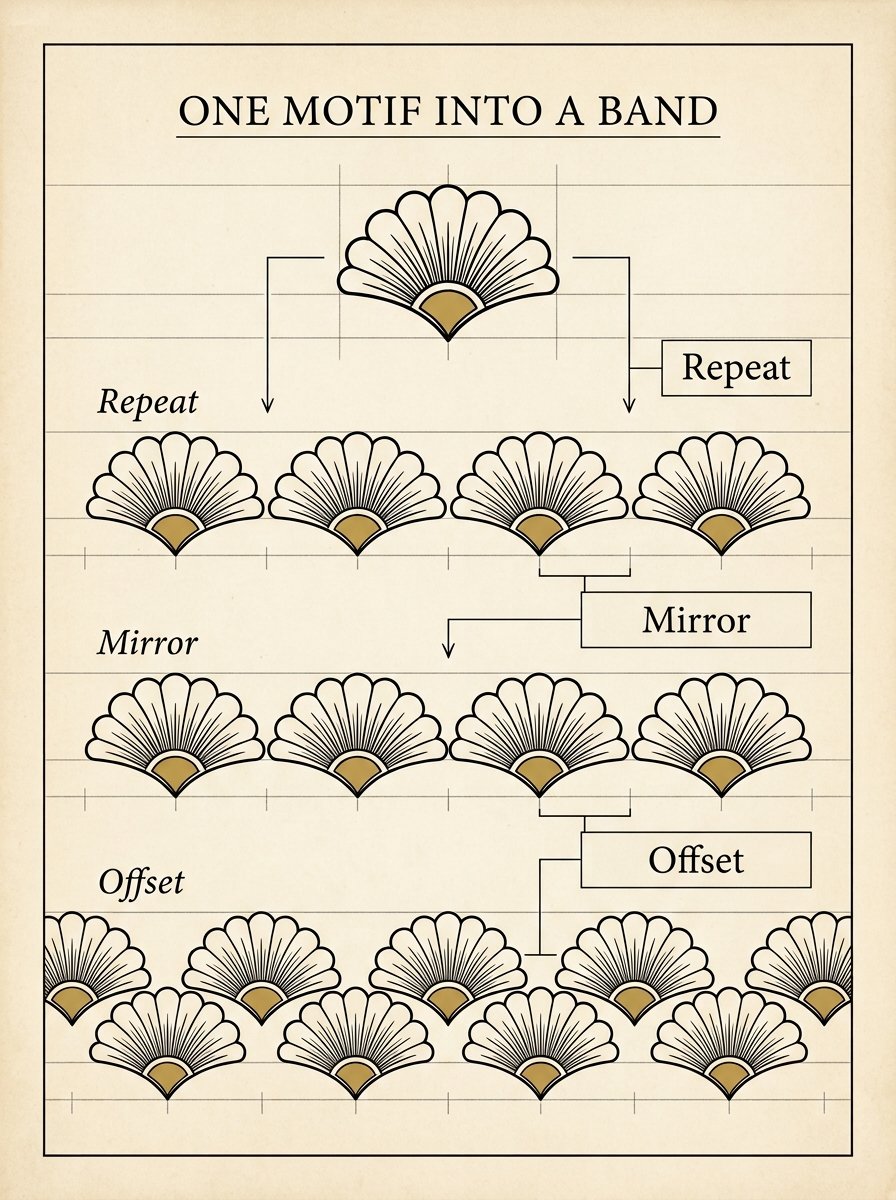
Then pick 1 motif and repeat it. A single fan is a study. The same fan 8 times along a ruled band is a border. That border is the thing that looks like 1925.
Repetition is the whole trick, and it is not a skill. It is a decision you make once and then keep. Mirror the motif, offset it by half a step, or run it straight. The band builds itself.
I ruled my first deco band on the back of an envelope. I got 9 fans into a space meant for 8. (The 9th is still there, slightly crushed, looking pleased with itself.)
The 12-ring mandala build goes further into the circle. It uses the same compass and no protractor.
A ruled band is 1 evening. The Complete Mandala Creation Toolkit gives that compass 8 grids to work on. It adds 88 elements to drop into them. The spacing is settled before you start.
88 elements and 8 ruled grids, and the compass sets out every one of them
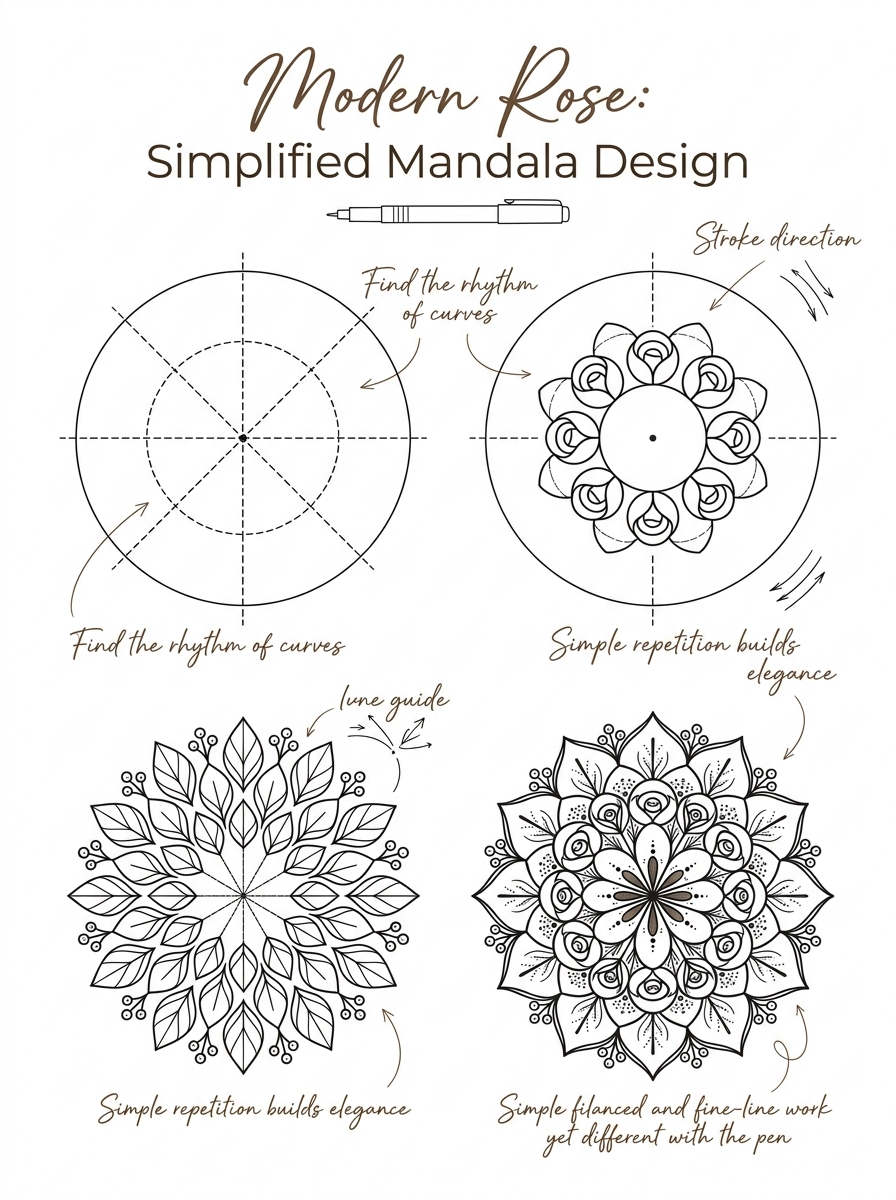
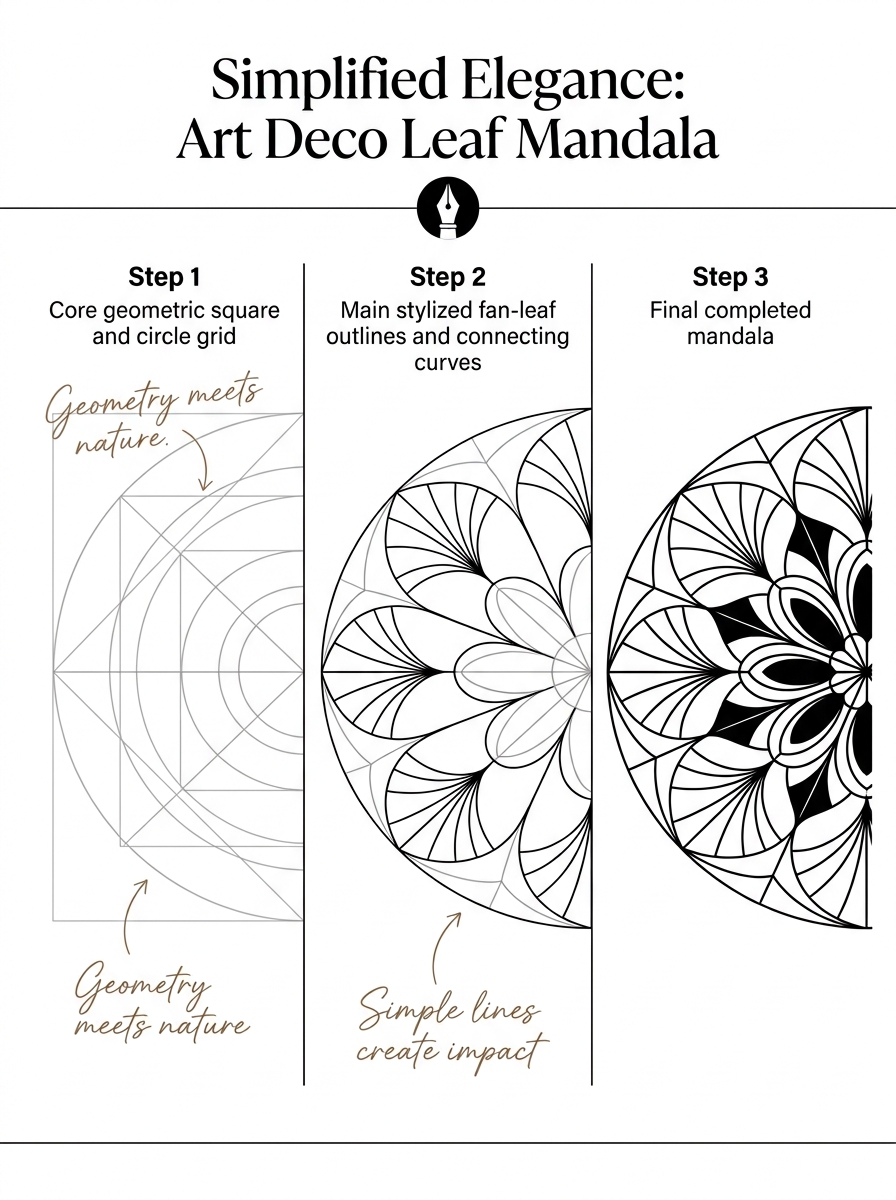
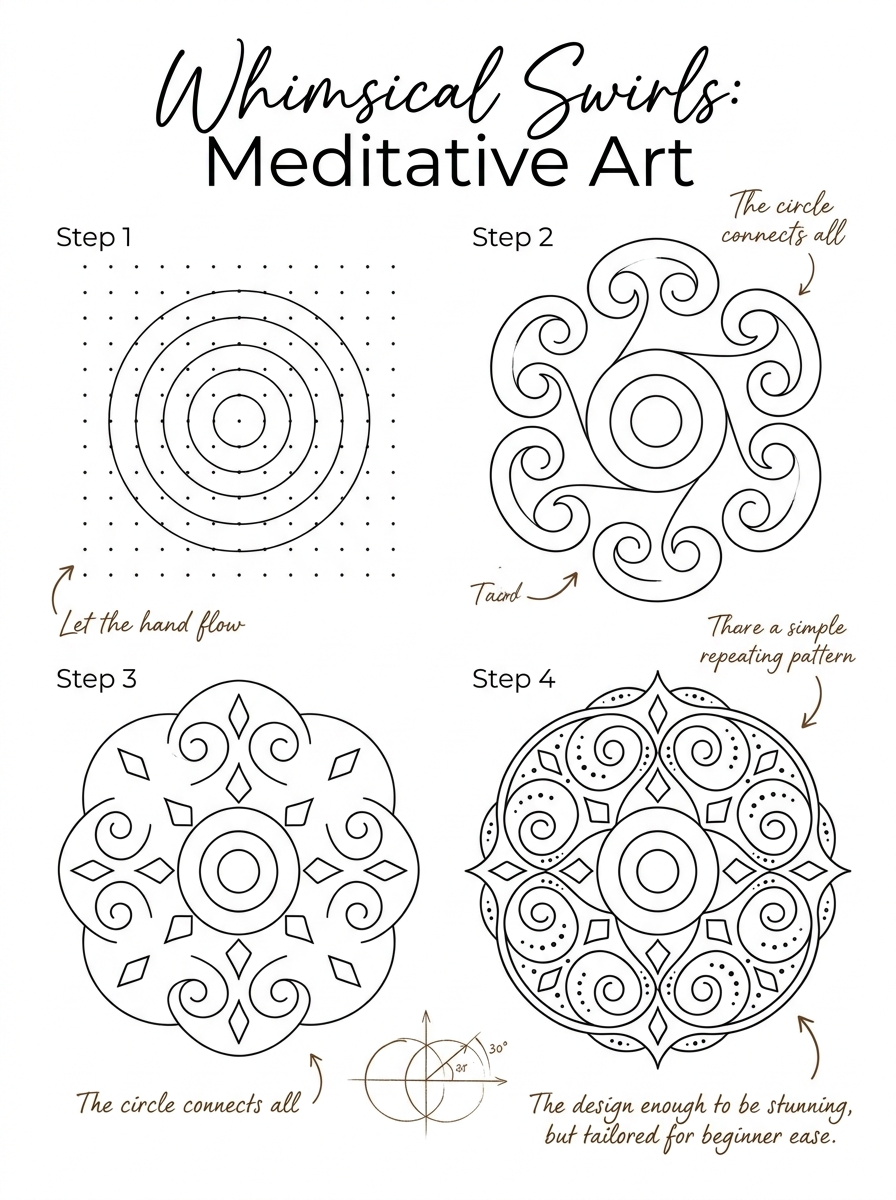
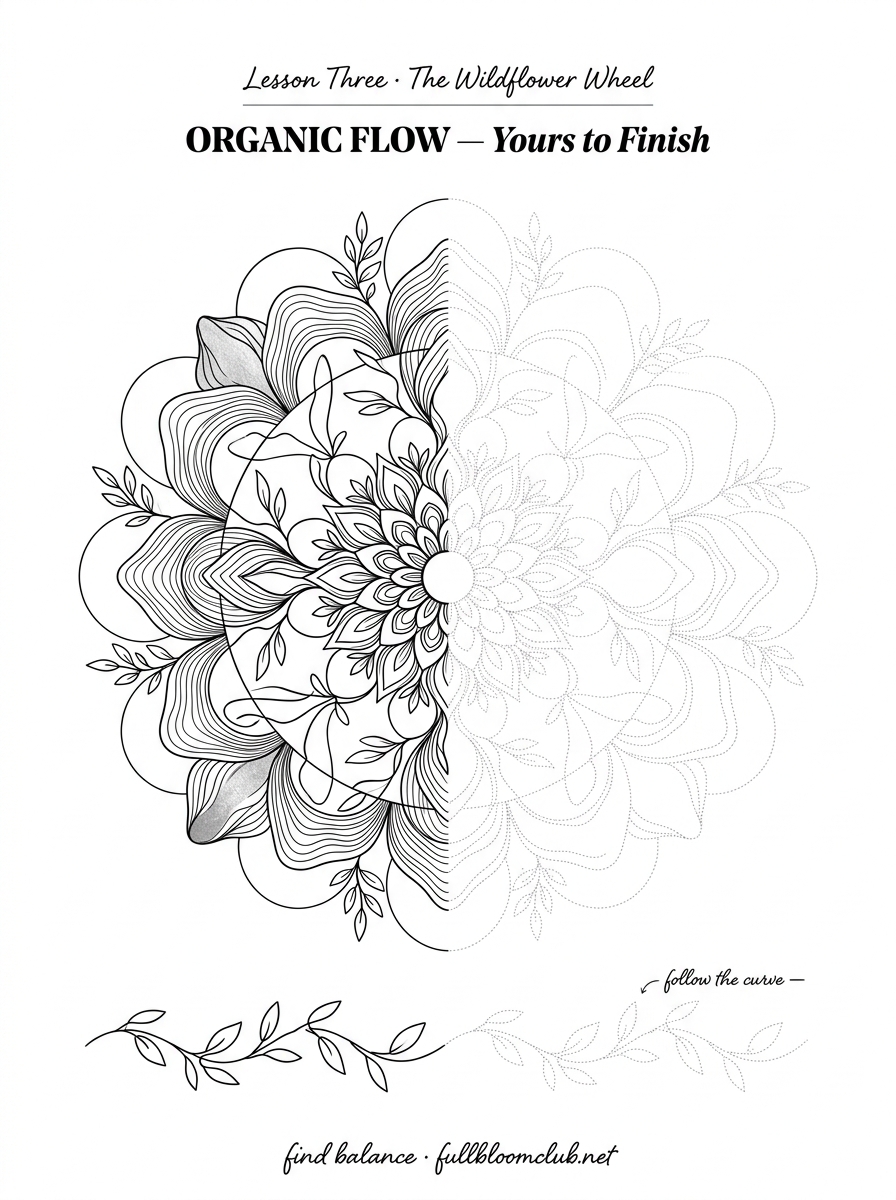
Rule a deco band on paper tonight. When the hand knows the spacing, the grids take it further than a straight edge can on its own.
Instant download · print at home
A compass does not know what century it is working in. It opens to a width, walks its circle, lands 6 times, and waits to see what you make of it.
“To create, one must first question everything.”
Eileen Gray
Mirabelle wrote this. No training, strong opinions, many pens. Peer reviewed by a cat who found the compass point and hid it.