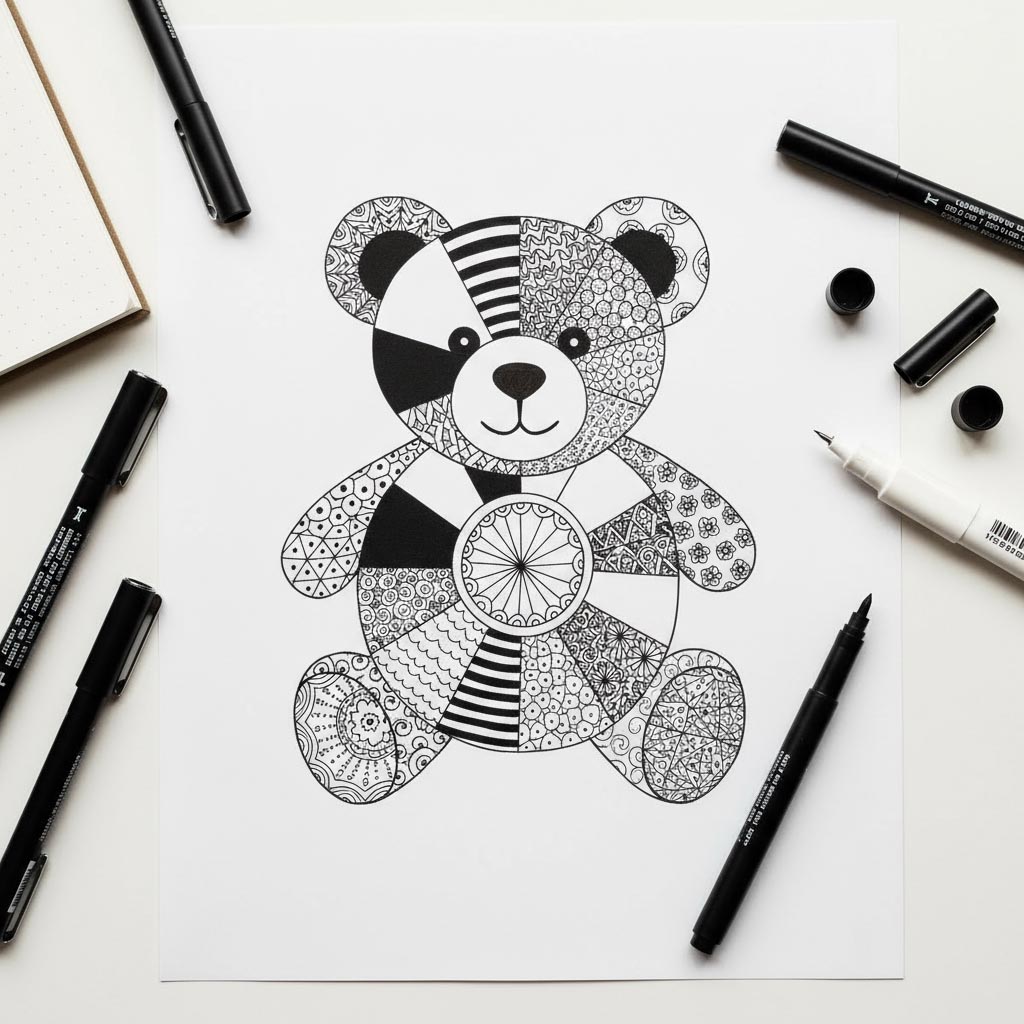
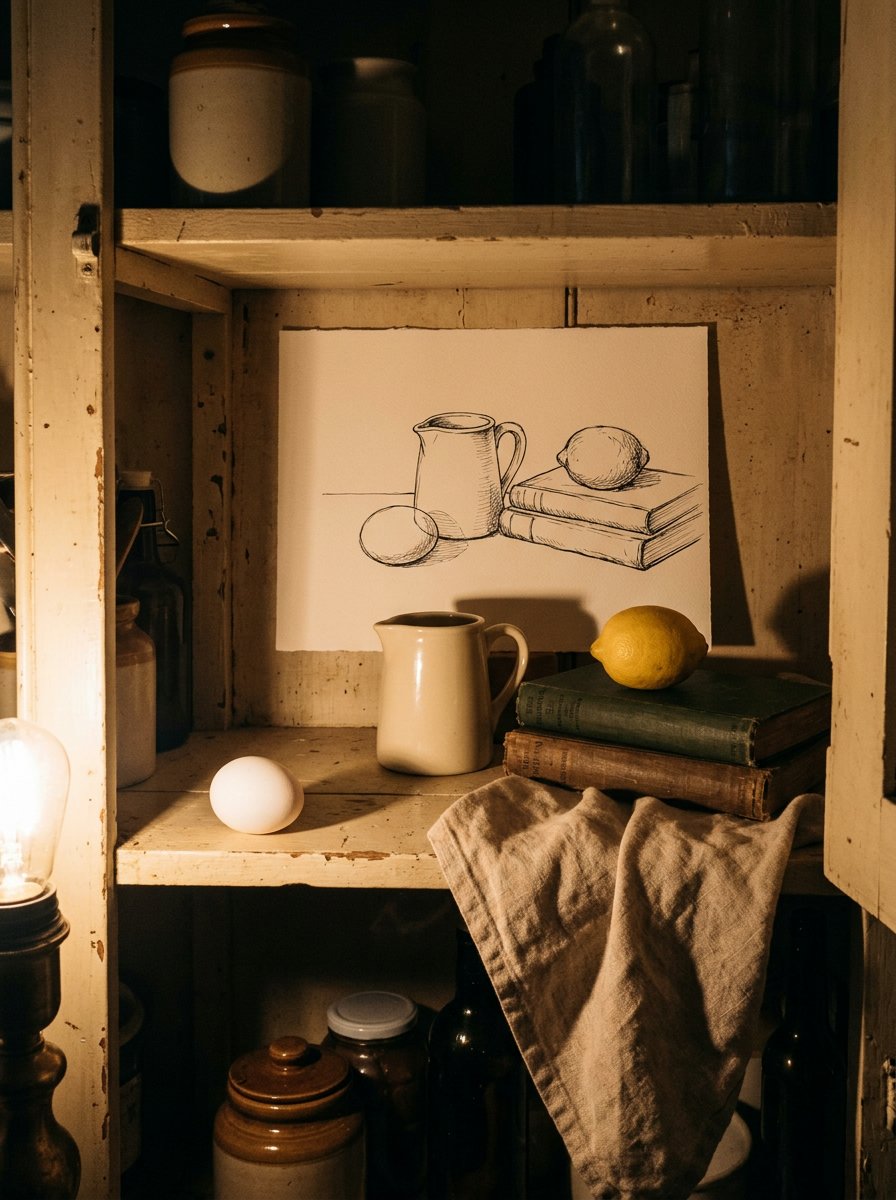
Two apples that touch are a composition. Two apples that do not are two apples. Most still life drawing ideas are decided right there.
You are looking at one shape, not two.
Objects that touch merge into one outline. Objects with a gap stay separate. Objects that overlap read as one in front of another.
So a still life is decided by where you put things. Not by how well you shade them.
(I blamed my shading for years. The shading was fine. The apples were touching.)
Below are 37 still life drawing ideas, sorted by the evening you have actually got.
Take the free sheet first. It is called The Setup Guide. It settles how far apart.
The guide runs 3 set-ups on one page: One Object, Three Objects, and A Full Table. Each marks the Gap, the Overlap and the Height.
Download the free setup guide →
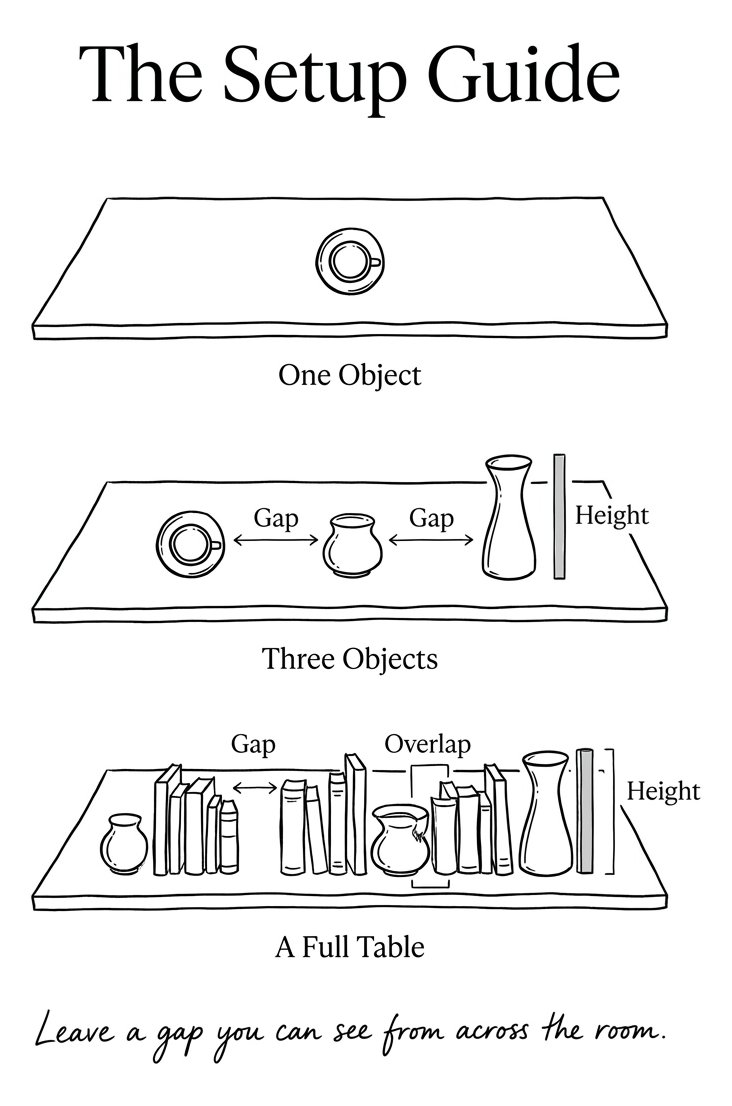
Print it at actual size, not fit to page. Then prop it beside the objects, not beside your paper. It is a guide for the hand that moves the jug. Not for the hand that holds the pen. The pen comes later, and it is the easy part.
Leave a gap you can see from across the room. That one line does most of the work.
The still life drawing ideas below all assume you have moved something first. That is the job. A still life that fails on paper usually failed on the table, 10 minutes earlier.
Here is what actually decides it. You are not arranging objects at all. You are arranging the gaps, and the objects are what is left over.
Which makes a set-up a small collection. You pick 3 things that agree to sit together. You remove the fourth that will not. That is also, more or less, how a wall of art gets built.
The Collection
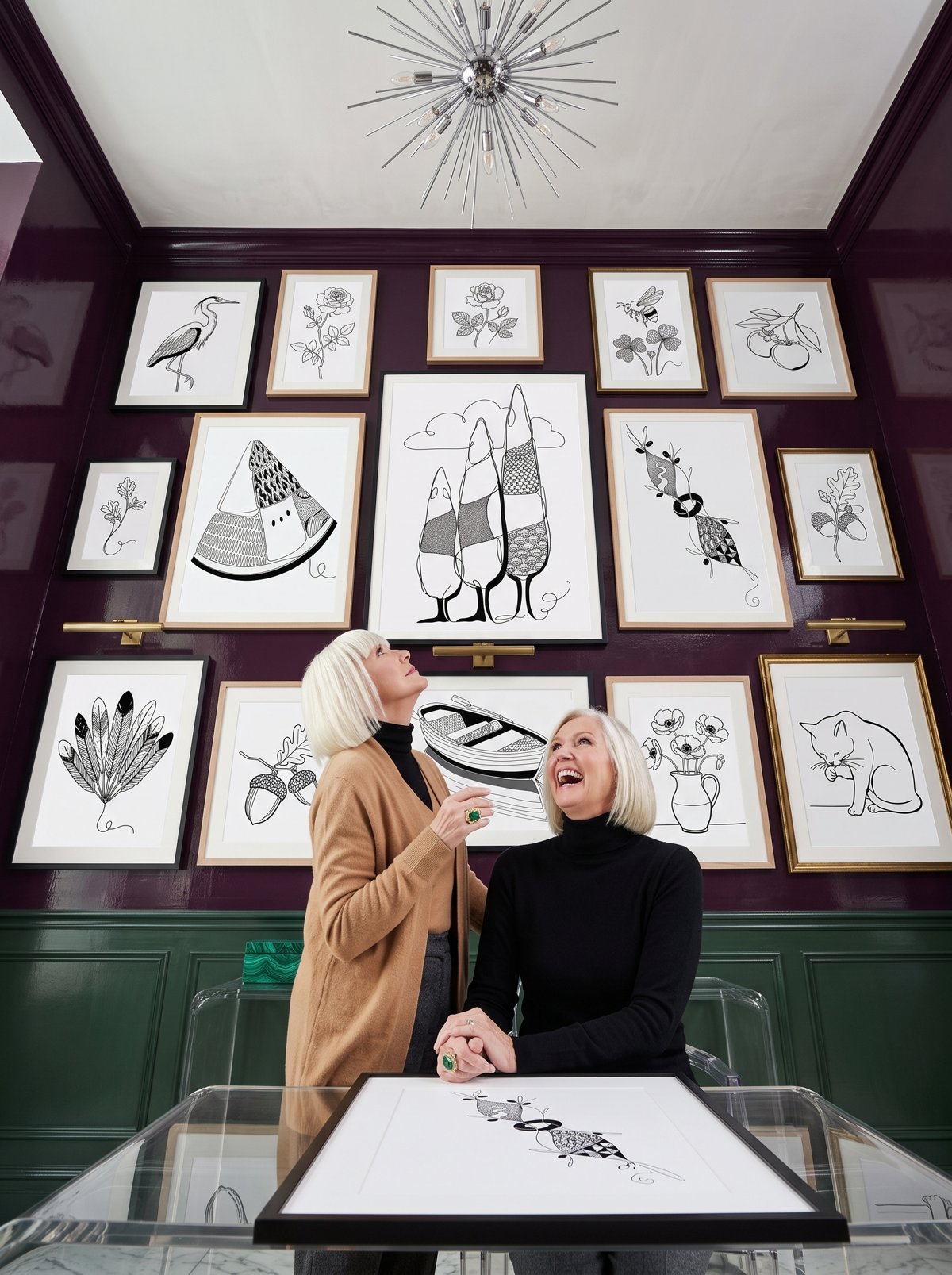
100 flowing-line pieces, and 3 of them will hang together as a set.
THE 100 COLLECTION. Stems, stones, and one uncluttered wall. For the evening the cupboard is open and nothing will sit still. Inside: 100 flowing-line ink art pieces in 10 themed sets. Japandi Ink is one of them. Each piece has a 5-step draw-along and a faint trace guide. What you get: an hour at the kitchen table that is not scrolling. And 3 pieces that hang together as a set.
Back to the shelf. The still life drawing ideas below are grouped by the evening you are in. Then the move that makes each one read.
Which still life drawing ideas work with one object and 15 minutes?
These still life drawing ideas need one object and a quarter of an hour. One lamp. One gap. Put the thing down, then move the lamp until the shadow is one you can see.
Giovanna Garzoni worked this small on purpose. She painted on calfskin vellum instead of canvas.
Her still lifes are miniatures. A plate of white beans. A dish of figs. She made around 20 of them for the Medici court between 1650 and 1662.
She also combined things that had no business sharing a table. An Asian porcelain bowl. A seashell. A handful of cherries. By the end she could name her own price, and did.
Small is not a lesser version of big. Small is the whole thing, done once.
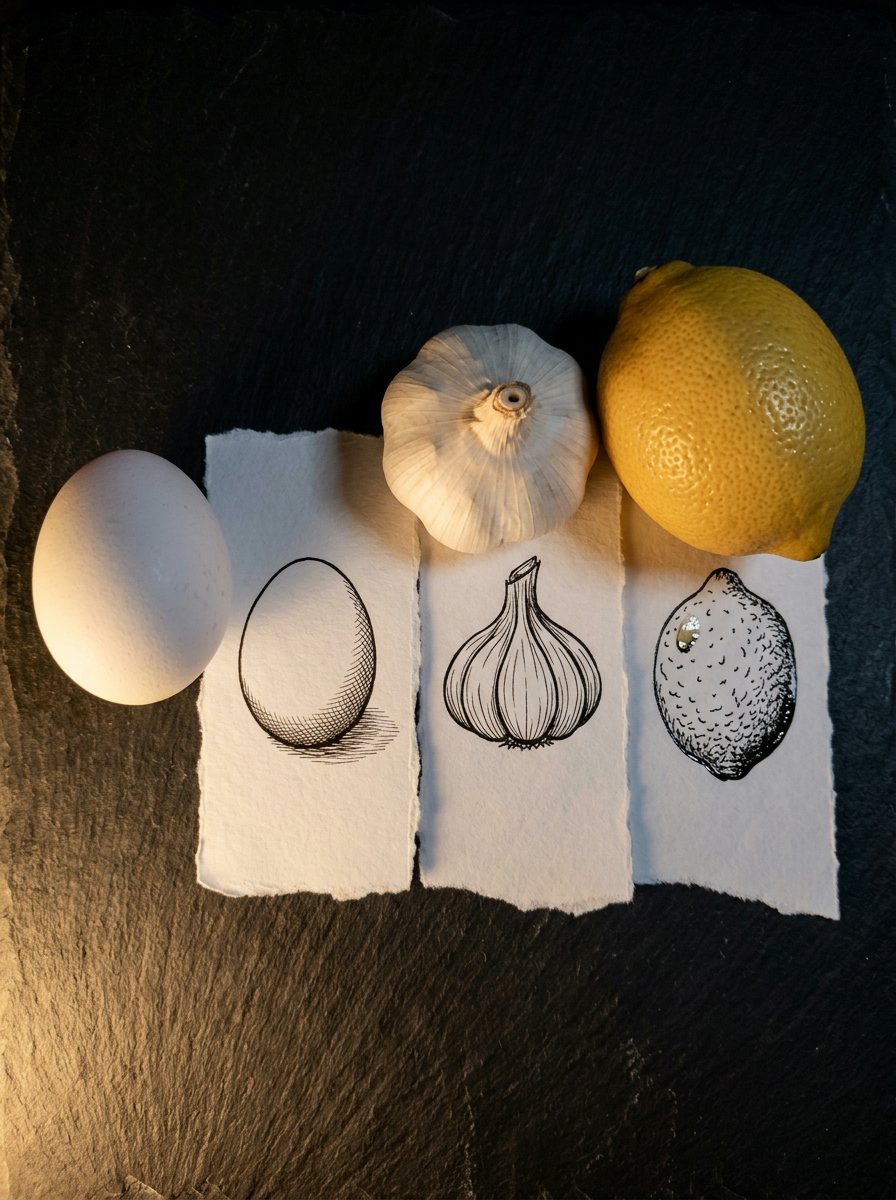
An egg is the honest start. It has nowhere to hide. Set it on a plain cloth and let the shadow describe it. A lemon rolls, so wedge it with a fold of cloth. Draw the fold too.
A garlic bulb is several curves pretending to be one. Find the seam where the cloves part and begin there. A single pear leans, and the lean is the drawing. Sit it leaning away from the light.
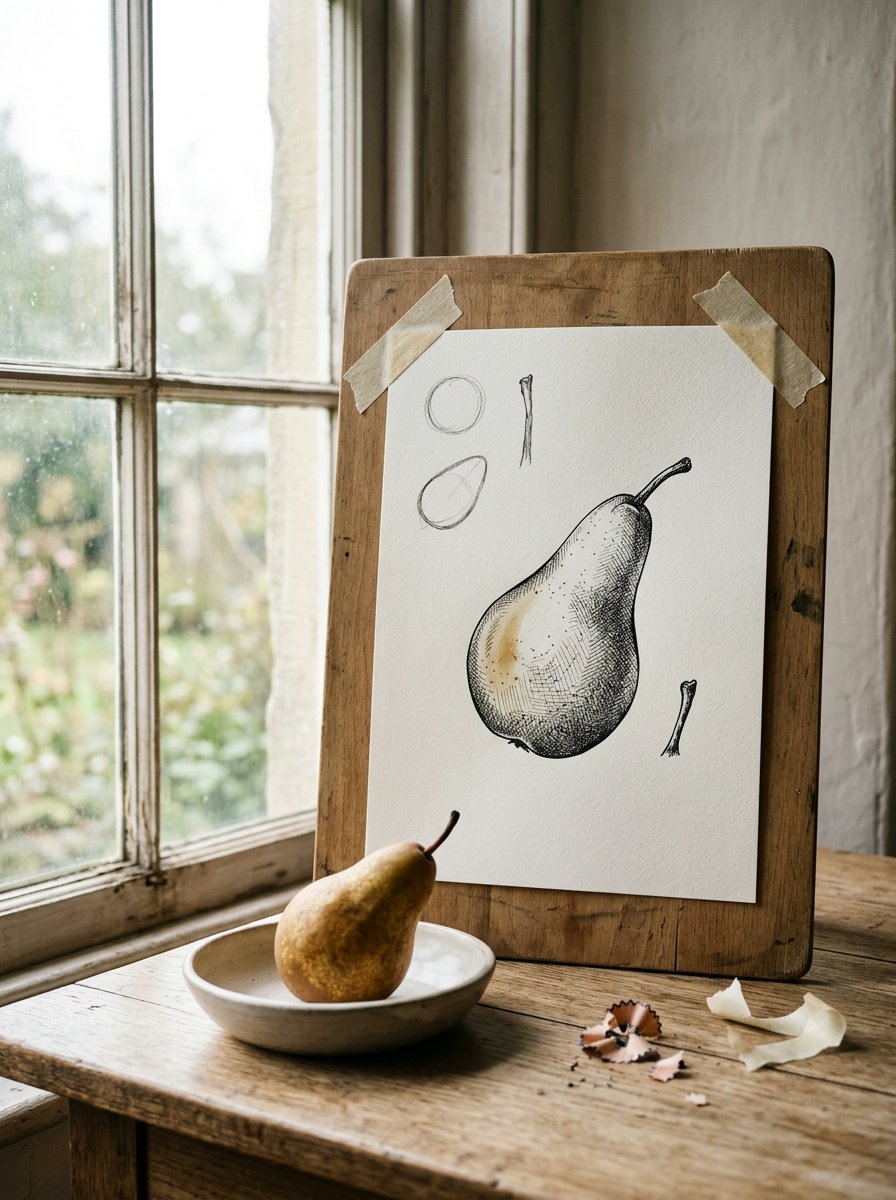
A mug from directly above is two circles and a handle. That is a gift on a tired evening. A tumbler is mostly the room bent out of shape. Draw what you see through it, not the glass.
A teapot is a ball with arguments. Block the ball first. Add the spout last. A folded tea towel has no correct shape, so it cannot go wrong.
A wooden spoon lies flat and dull. Stand it in a jar and it becomes a line with a weight on top. Half an onion is a set of rings you could not invent.
A jam jar holds light at the bottom. Put the lamp low and behind it. A shell is one spiral. Start at the opening and work inwards, never out.
(I have drawn the same egg more times than I will write down. It has never once been the same egg.)
What can I draw from a cupboard raid with nothing bought?
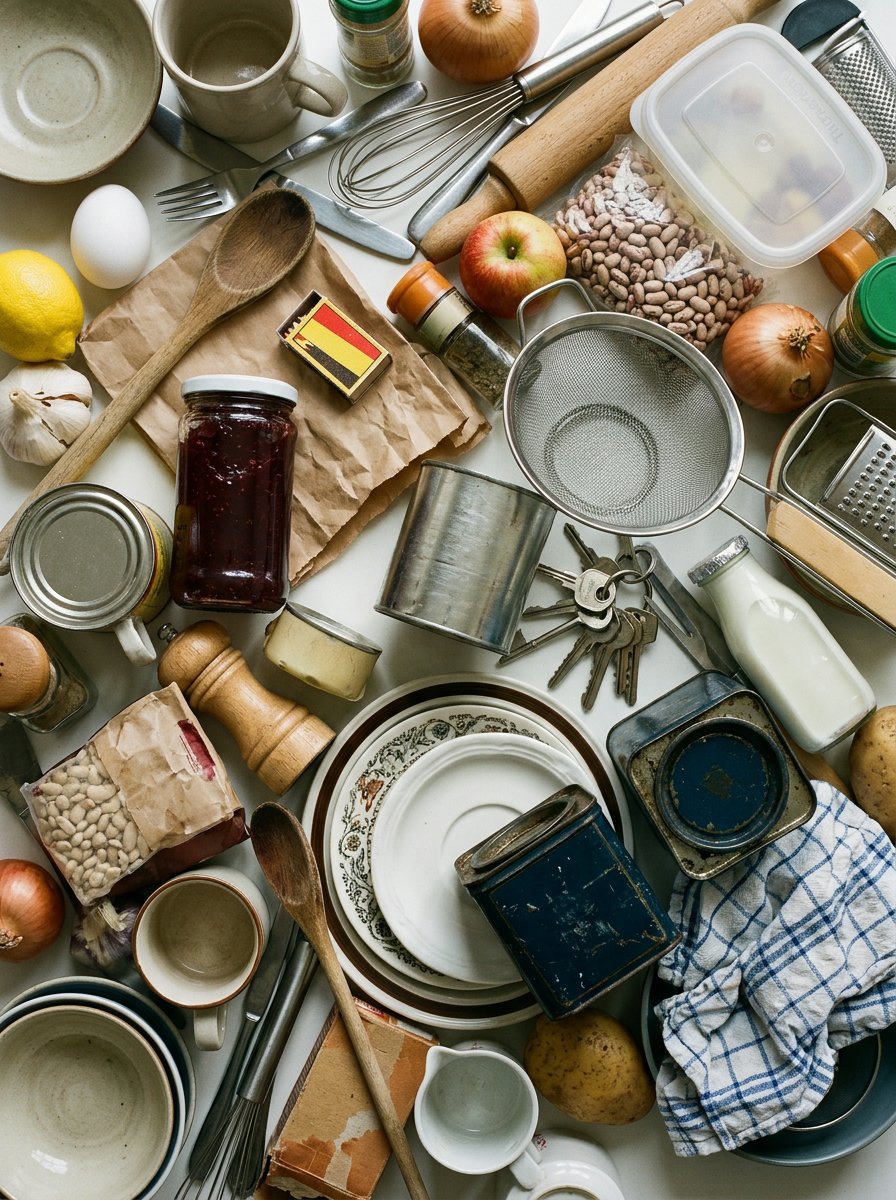
These still life drawing ideas cost nothing. Open the cupboard and take the first 3 things your hand lands on. You may not go shopping and you may not tidy.
Clara Peeters built a career out of exactly this. She was painting in Antwerp from 1607. Her subjects were ordinary. Bread, cheese, fish, a pewter jug, a plain vessel.
Then she did something quietly strange. She painted her own reflection into the shiny surfaces of the objects. Tiny, in the curve of a jug or a goblet lid. She signed one set of works on the handle of a knife.
Which tells you something useful about a shiny object. It is never only itself.
It carries the whole room, including you. So where you put it decides what it carries.
Three eggs in a bowl need one egg turned the wrong way. Otherwise it reads as a pattern. A stack of plates is a set of ellipses that must agree. Draw the top one properly and copy its lean down.
A paper bag, folded once and stood up, gives you every crease you could want. A tin with the label off is a cylinder and nothing else. That is the point of it.
A pepper grinder is three shapes stacked. Mark where each one stops. A colander is a bowl full of gaps. Draw the holes as shapes, not as specks.
A bunch of keys dropped on the cloth will overlap itself. Leave it where it fell. A matchbox, pushed half open, gives you an edge that turns a corner.
A milk bottle beside a lemon works on contrast. One is tall and cold, one is round and warm. A jug with one lemon in front of it is the smallest composed thing you can make.
A breakfast plate with crumbs beats a clean one every time. A tea caddy is a box, and a box teaches more than fruit does. A wrung-out cloth over the table edge gives the set-up somewhere to end.
(The raid rule exists because I once drove out for a pomegranate. It sat there a week looking expensive. I never drew it.)
How do I arrange still life drawing ideas so a table looks composed?
Now the heights. The still life drawing ideas in this group all lift something off the table. This is where most set-ups quietly fail.
Everything stands on the same flat surface at the same height. It looks like a queue.
Juan Sánchez Cotán solved it around 1602. The painting is Still Life with Quince, Cabbage, Melon and Cucumber, now at the San Diego Museum of Art.
The quince and the cabbage hang on threads, at different heights. The melon sits on the ledge. The cucumber juts out past it, toward you.
Hanging fruit on string was ordinary practice then, a way to stop it spoiling. He took the household trick and used it as a composition one. Four objects, four levels, out of one windowsill.
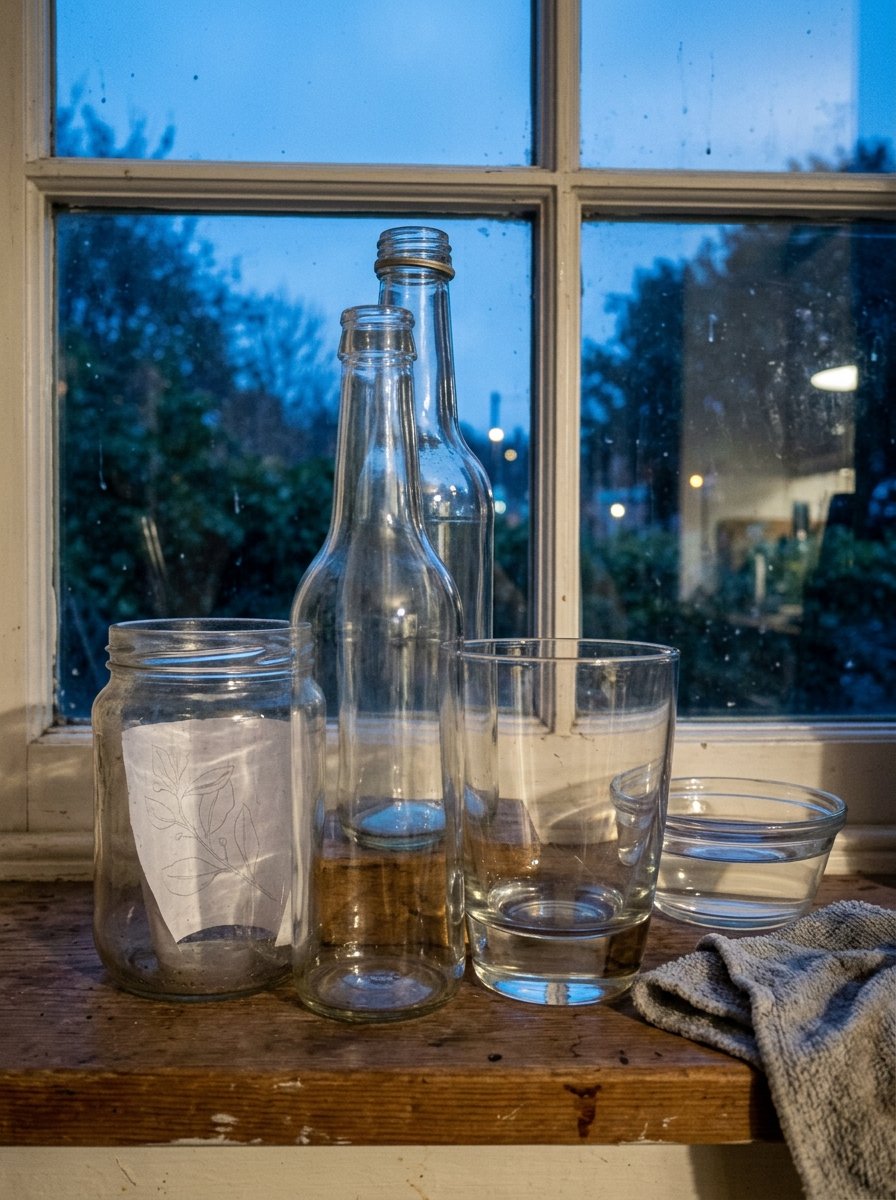
You are unlikely to hang a cabbage. You can absolutely put one thing on a book.
A jug, two lemons and a cloth is the starter set. The cloth is there to connect them. A bowl of apples with one apple set outside it works. The loose one gives the group a reason.
A bottle, a glass and a folded napkin need the napkin. It breaks the gap between the two tall things. Three pears at three heights is the same lesson in fruit.
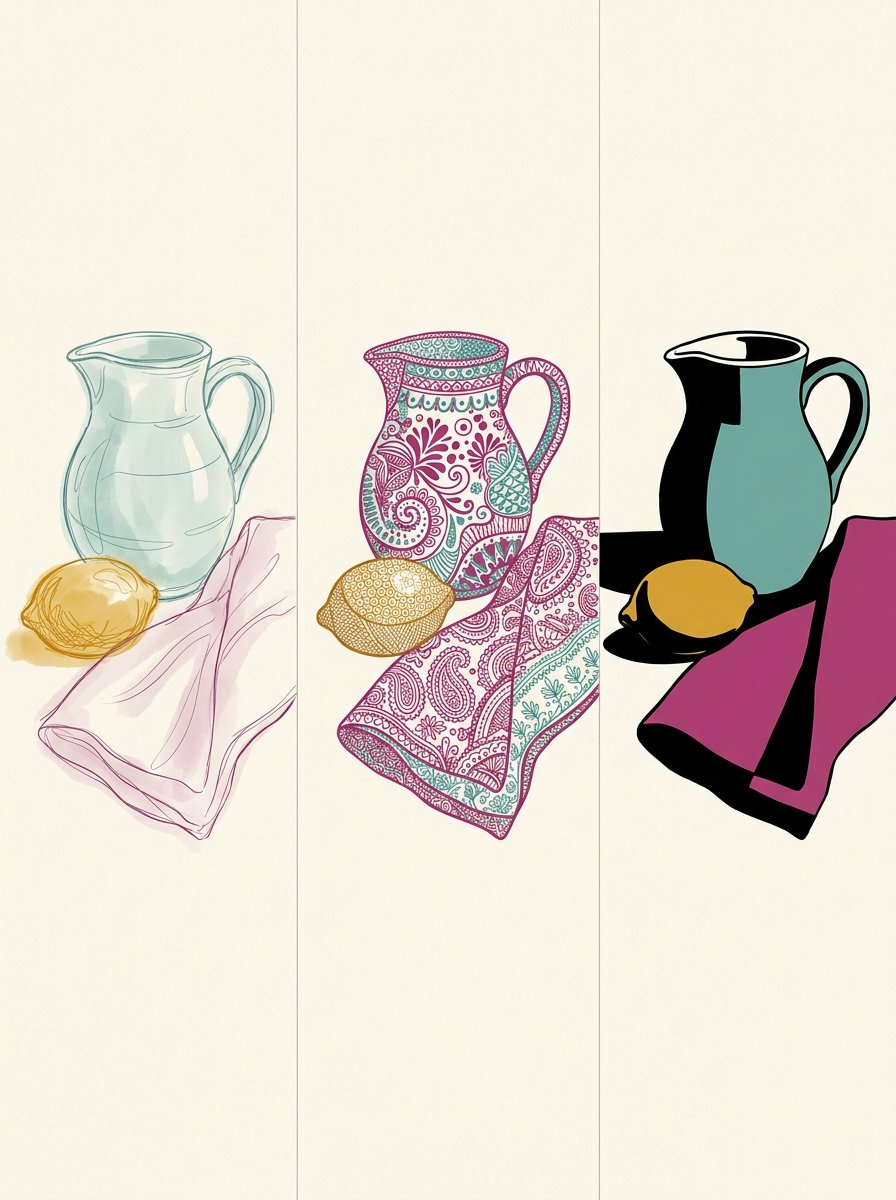
A cheese board is a composed table that arranges itself. A basket with a cloth spilling out hands you a hard edge and a soft one in one object.
A vase on two stacked books is the cheapest height trick there is. Bread, a board and a knife works because the knife points. A pointing object tells the eye where to go.
A teacup, saucer and spoon is a lesson in overlap. The spoon must cross the saucer. Otherwise the three sit there unrelated.
A shelf line-up seen straight on turns the whole thing into a flat pattern. Fruit hung on string at two heights is worth trying once, for the reason above.
The full table comes last. Set everything out, then remove a third of it.
The tallest thing goes at the back, then breaks the line.
That is the sentence I wish somebody had handed me first. (I rearranged one set-up 11 times and preferred the second version. The 9 in between were not wasted. They were how I knew.)
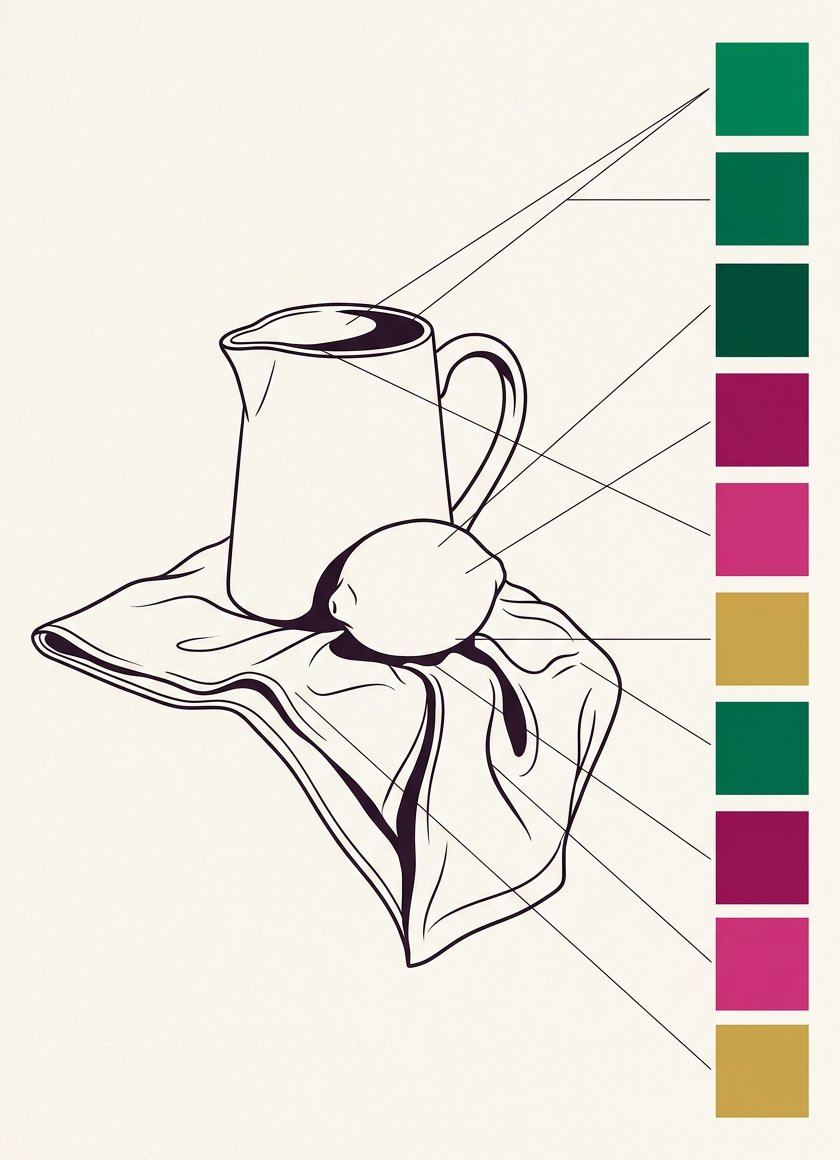
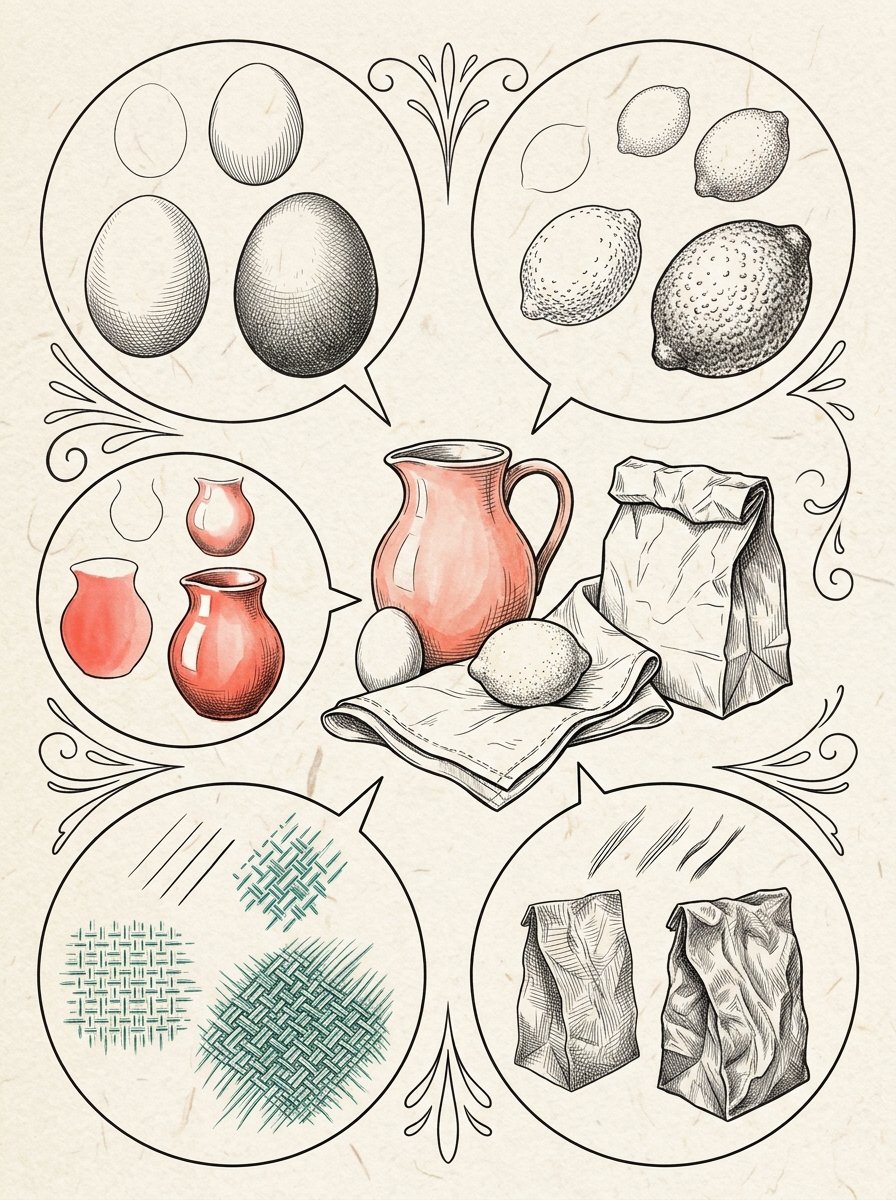
Those are the arrangements. What goes on the surfaces is the other half. A printed fill chart settles that fastest.
Free Starter Pack
Get 10 free pattern templates for the surfaces you have just set up.
Sent tonight. Fills for a jug, a lemon skin and a folded cloth.
Unsubscribe in 1 click, no hard feelings
How do I use the free setup guide tonight?
Work through the still life drawing ideas above in any order you like. Put the guide flat on the table where the objects are, and pick the column that matches your evening.
Set the objects down. Check the Gap, then the Overlap, then the Height, in that order.
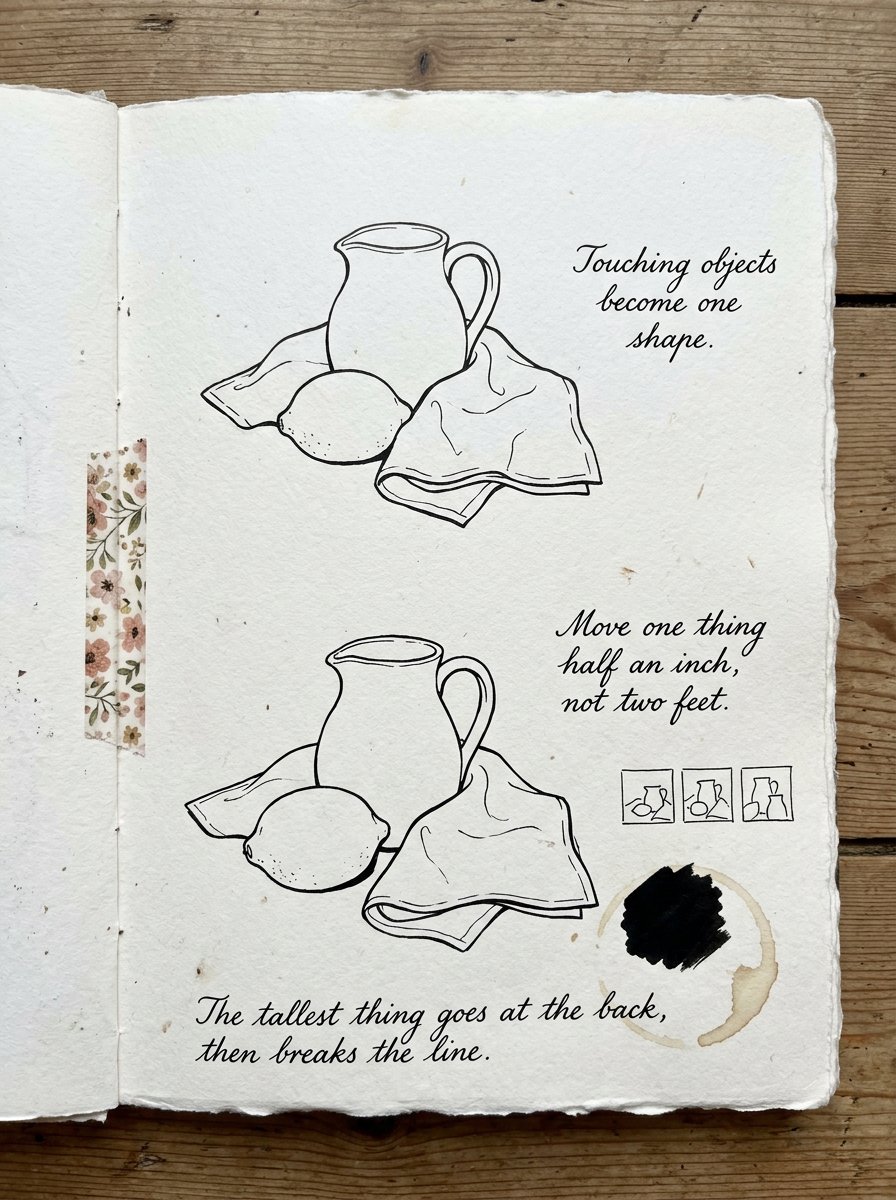
Move one thing half an inch, not two feet. Then sit down and draw what is in front of you.
Touching objects become one shape. That is the only rule that never changes. Every other decision on the page is a version of it.
If you would rather work in pencil, the still life pencil drawing guide takes over where this one stops.
One set-up, done properly, is worth a dozen drawn from a photograph on a screen. The best still life drawing ideas are already sitting in your kitchen. So is the lamp.
100 pieces to set up, and 10 themed sets to work your way through
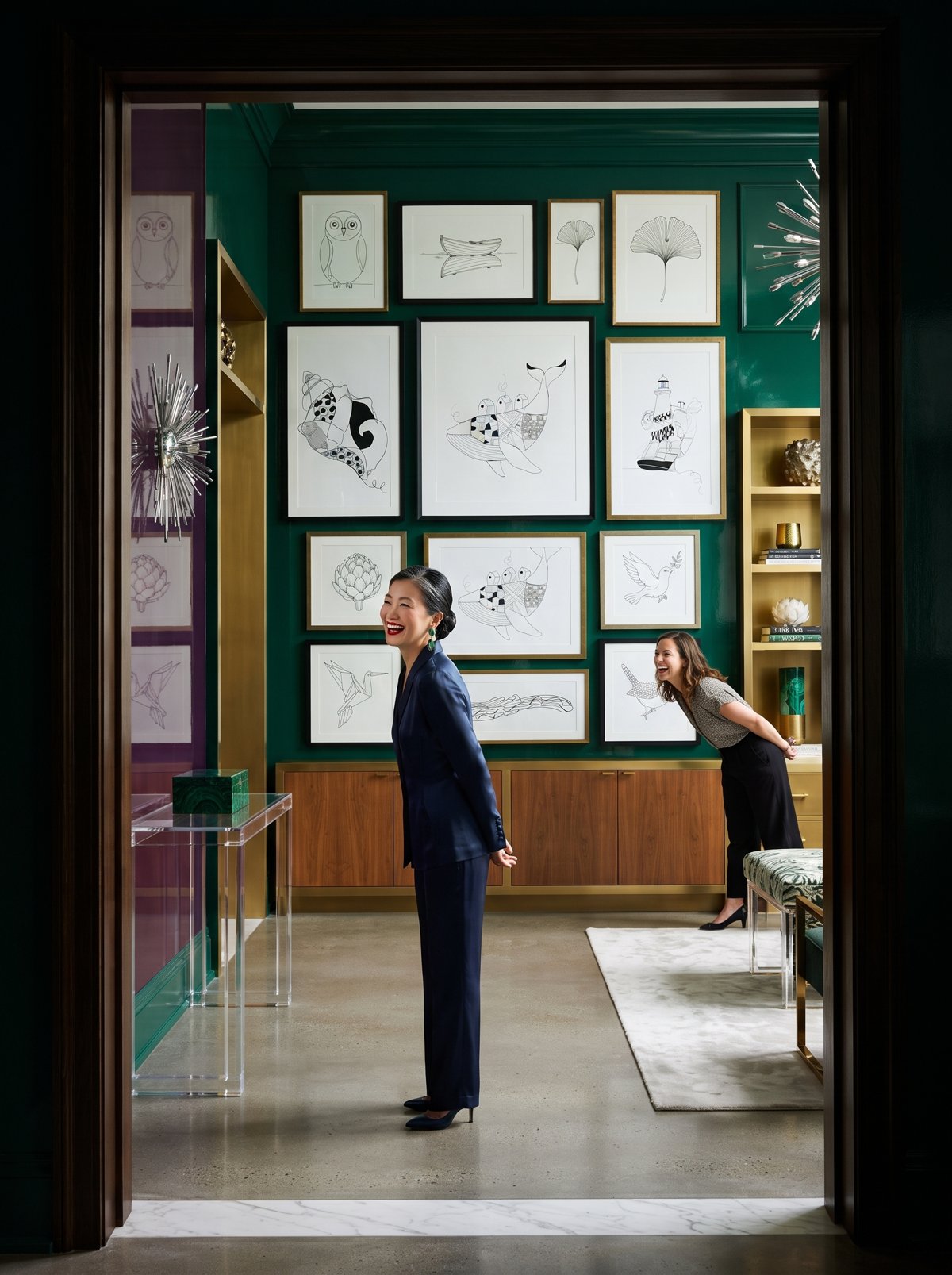
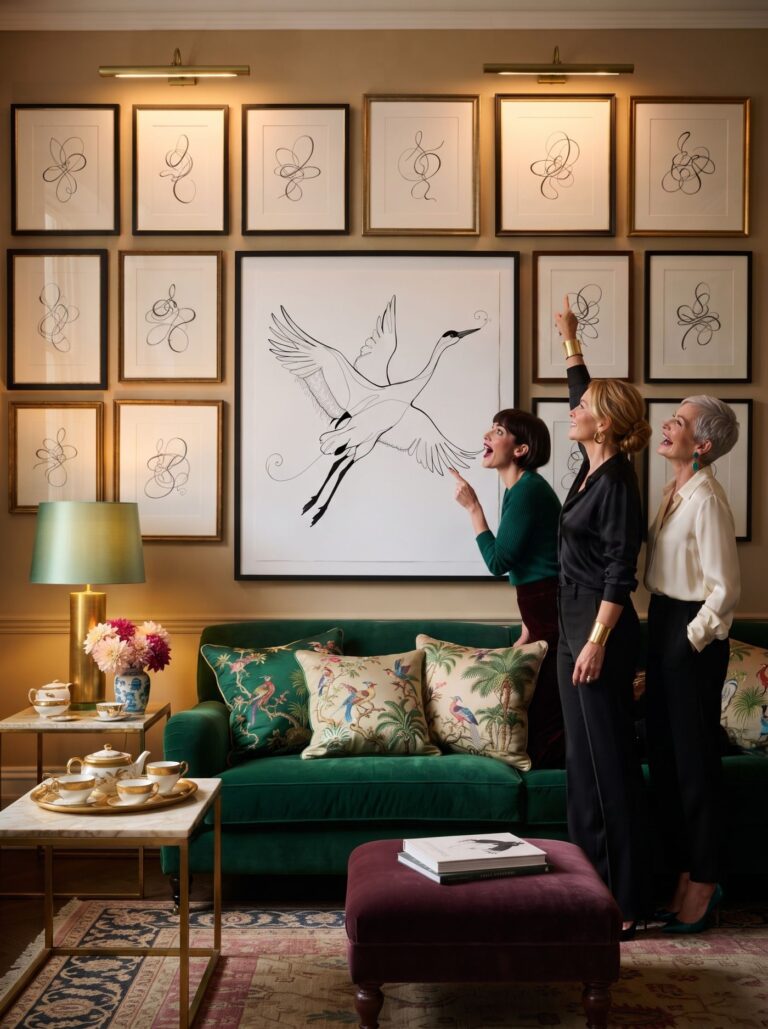
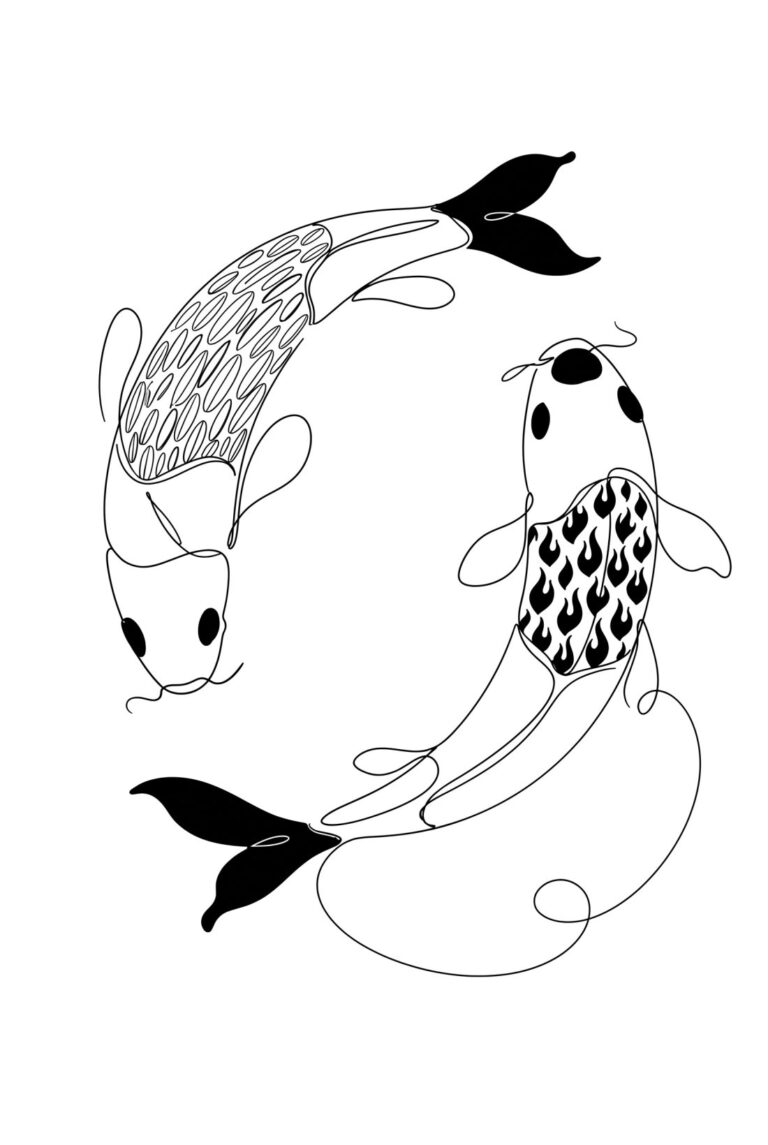
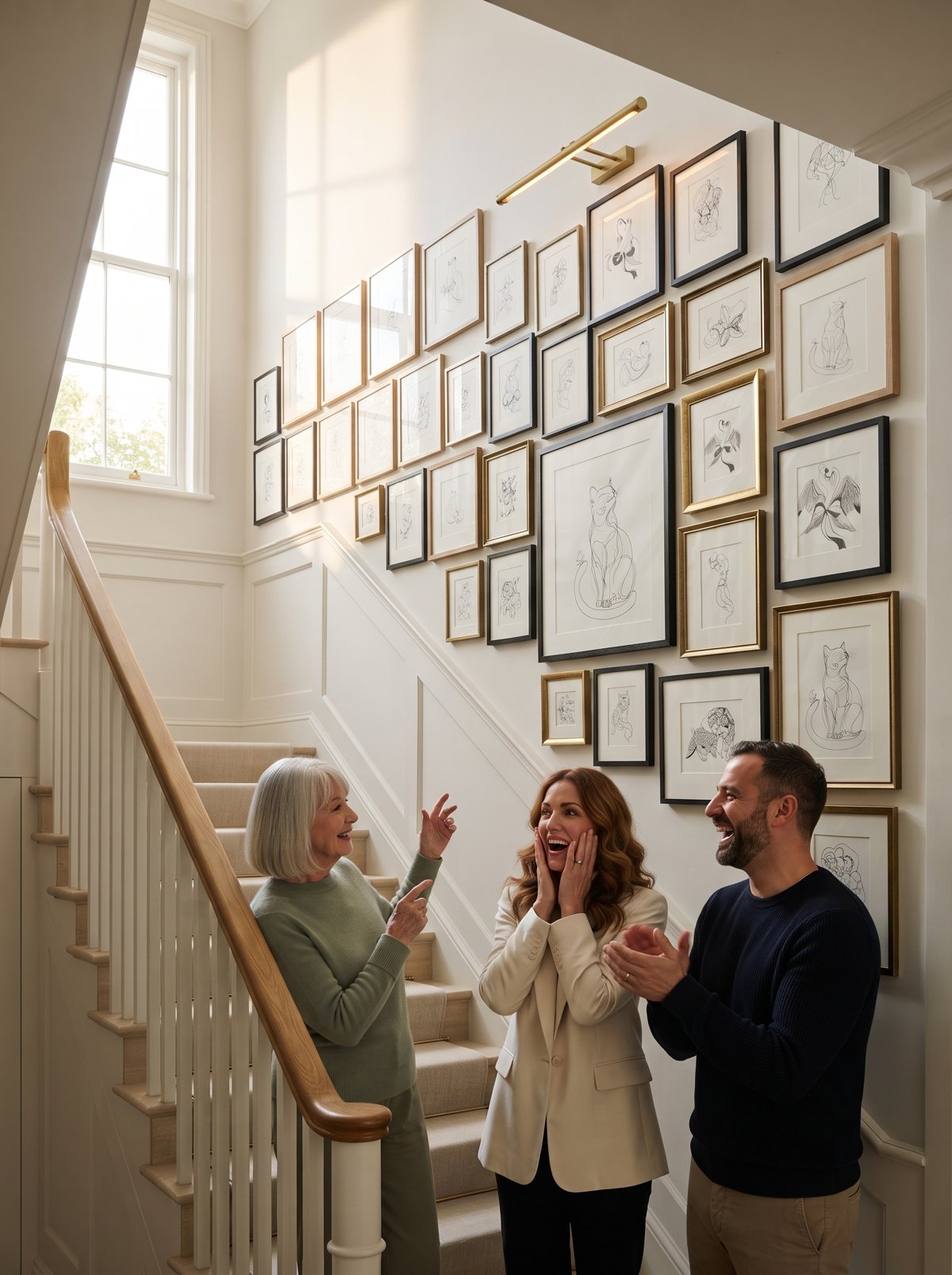
Pick a piece tonight and arrange the real objects beside it first. The draw-along breaks each one into 5 steps. Use the faint trace when the evening is short, or begin freehand on plain paper. I do both. The ones I keep are always the freehand ones.
Instant download · print as often as you like
A still life is just a shelf that somebody stood still in front of. Move one thing half an inch, and the whole shelf agrees to be looked at.
“Learning that hanging fruit from string was standard practice did not undermine the math and magic of Cotán’s suspensions for me.”
Cauleen Smith, San Diego Museum of Art
Mirabelle wrote this. No training, strong opinions, many pens. Peer reviewed by a cat who rearranged the set-up overnight and left one lemon on the floor.