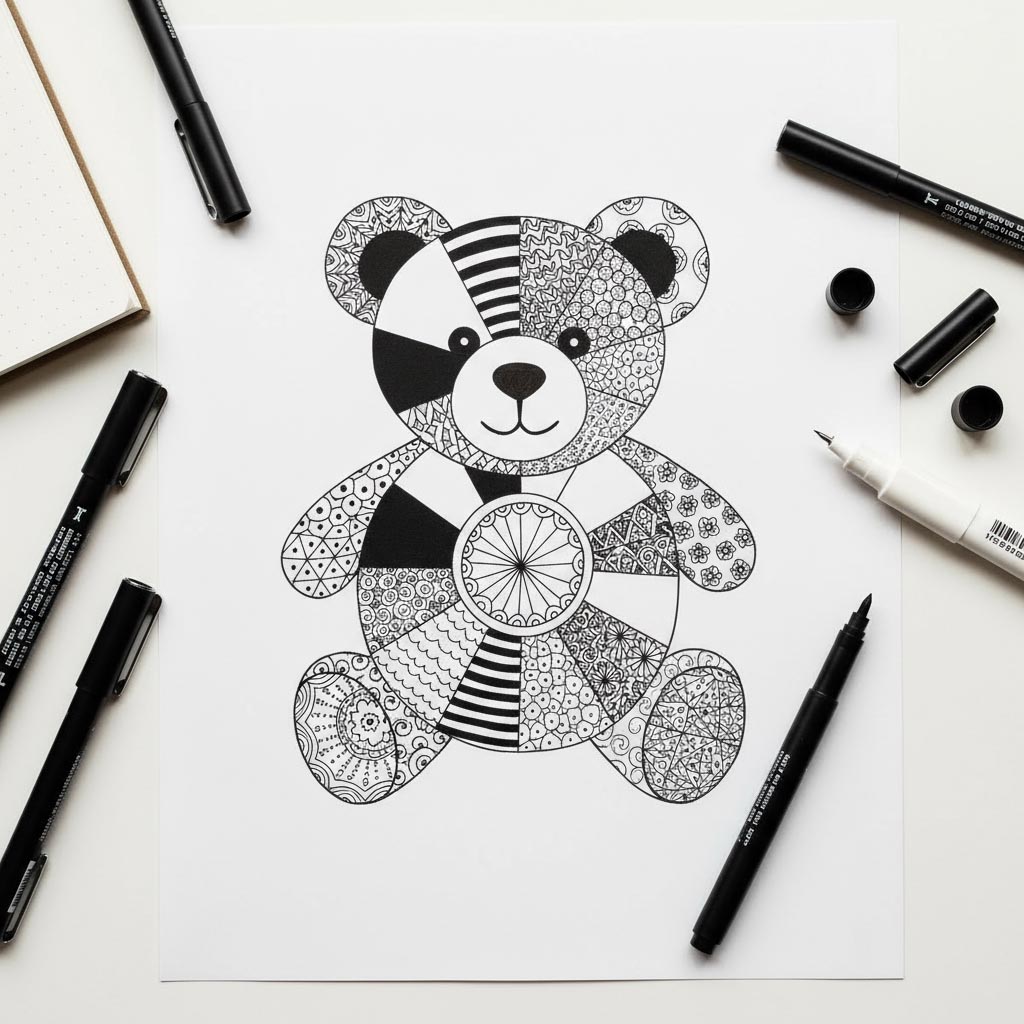
You do not need an idea. That is the part that stops people, and it is the part meditative drawing quietly removes: you need one mark and the willingness to make it again.
A dash. A dot. A small scallop. Then the same one, next to itself, 40 times, until the deciding stops.
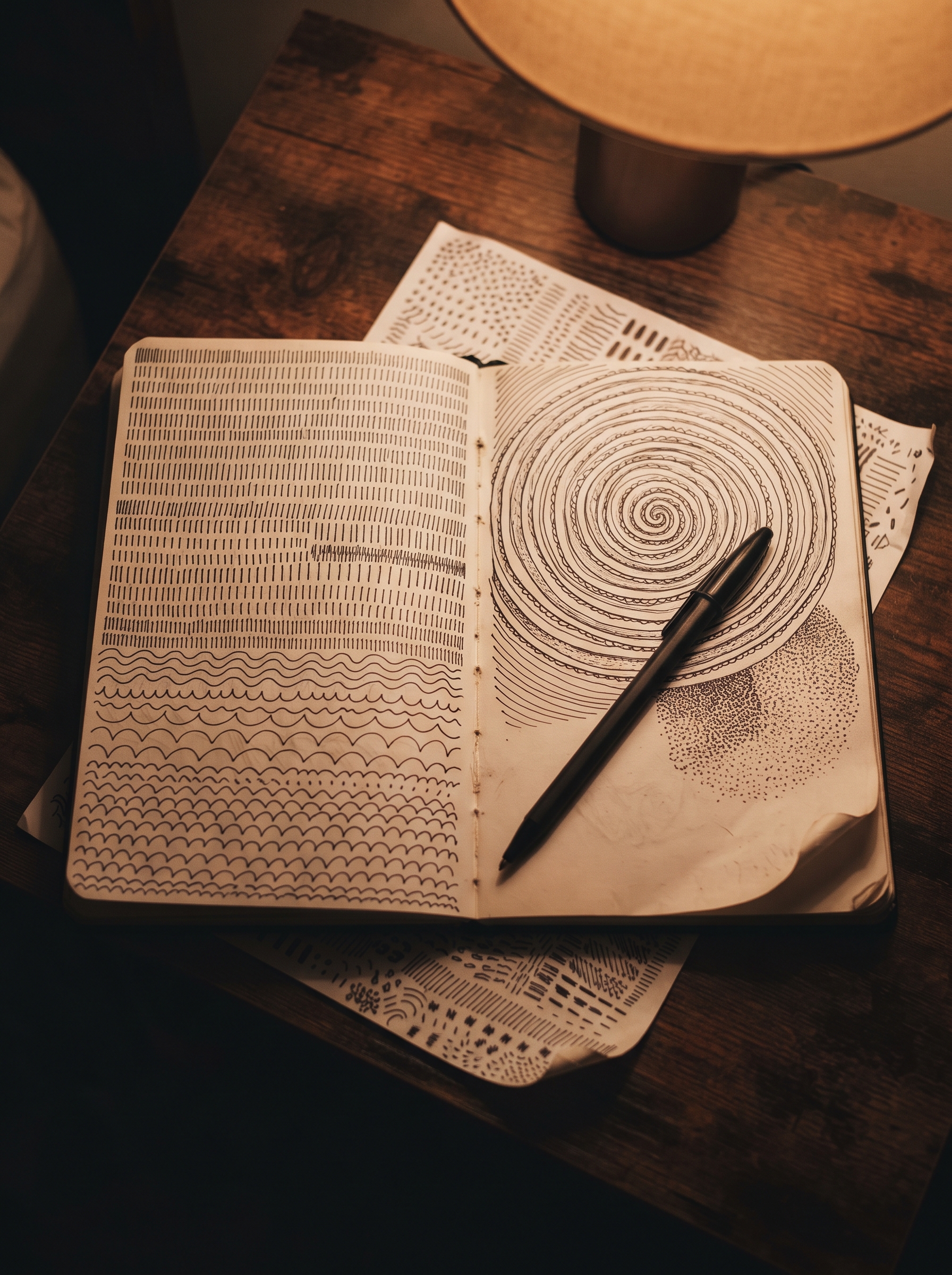
Somebody very good kept paper beside the bed for exactly this. Between November 1994 and June 1995 Louise Bourgeois filled 220 sheets on the nights she was awake — spiralling lines, wavy lines, marks radiating outward and repeating across the page in red felt-tip and ballpoint. They were not studies for anything. They were what the hand does when the head will not stop.
So the question is not what to draw. It is which mark, and how many times.
Below: 24 exercises in 5 groups, easiest first.
- The one-breath marks — one movement each, and they are over before you can judge them.
- The running marks — the same mark in a row, which is where the settling actually happens.
- The filling marks — textures for the inside of any shape. This is where the hour goes.
- The marks that go round — the same repetition, bent into a circle — where meditative drawing stops being practice.
- The marks for when it has gone wrong — 4 ways to keep going instead of tearing the page out.
Every one of them works in the back of a notebook with whatever pen is nearest. What none of them gives you is somewhere for the repetition to land — a shape with an edge, a centre and a reason to stop, so that an evening of marks ends as something you would actually put on a wall rather than a page of very calm scribbling.
The Collection
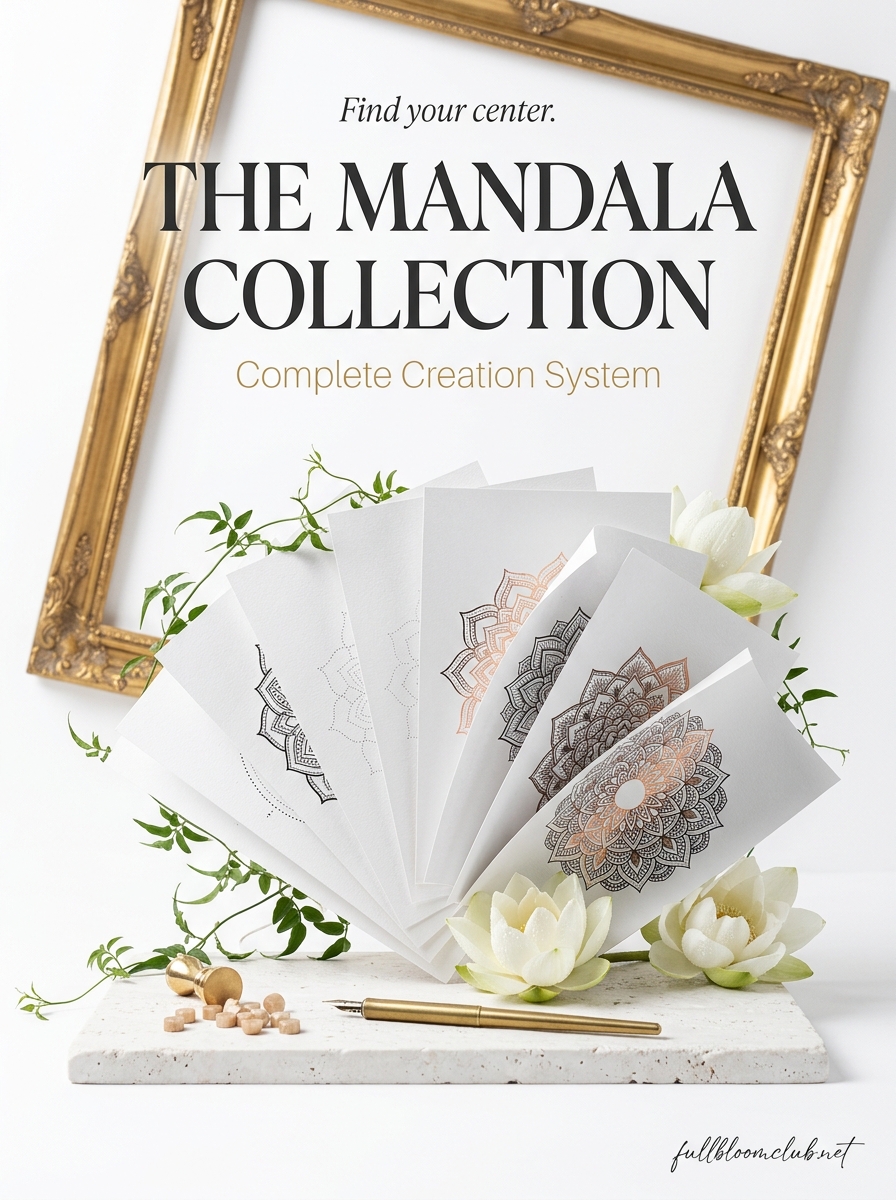
THE MANDALA TOOLKIT — grids, rings, and somewhere for all that repetition to land.
The set for the evening that has gone on slightly too long and is not going to improve by being thought about. 8 master grids do the measuring, so the only thing left to decide is which mark goes in the next ring — and deciding one small thing at a time is the entire trick. What you get: an hour that passes without you noticing, and a finished circle at the end of it instead of a page of practice.
Back to the marks, starting with the ones that take one second each.
Why repetition works when trying harder does not
The wellness pages will tell you meditative drawing calms you down. True, and about as much use as a road sign that says ARRIVE. The mechanism is narrower than that. A repeated mark removes the decision. There is no next choice to make, because the next thing is the same as the last thing, and a hand with nothing to decide is a hand that stops arguing.
You are not drawing something. You are giving your hands a job with no opinions in it.
Which is why the exercises below get harder to talk about and easier to do as they go. (My own notebooks are about 60 per cent dashes. I have shown them to nobody and I intend to keep it that way.)
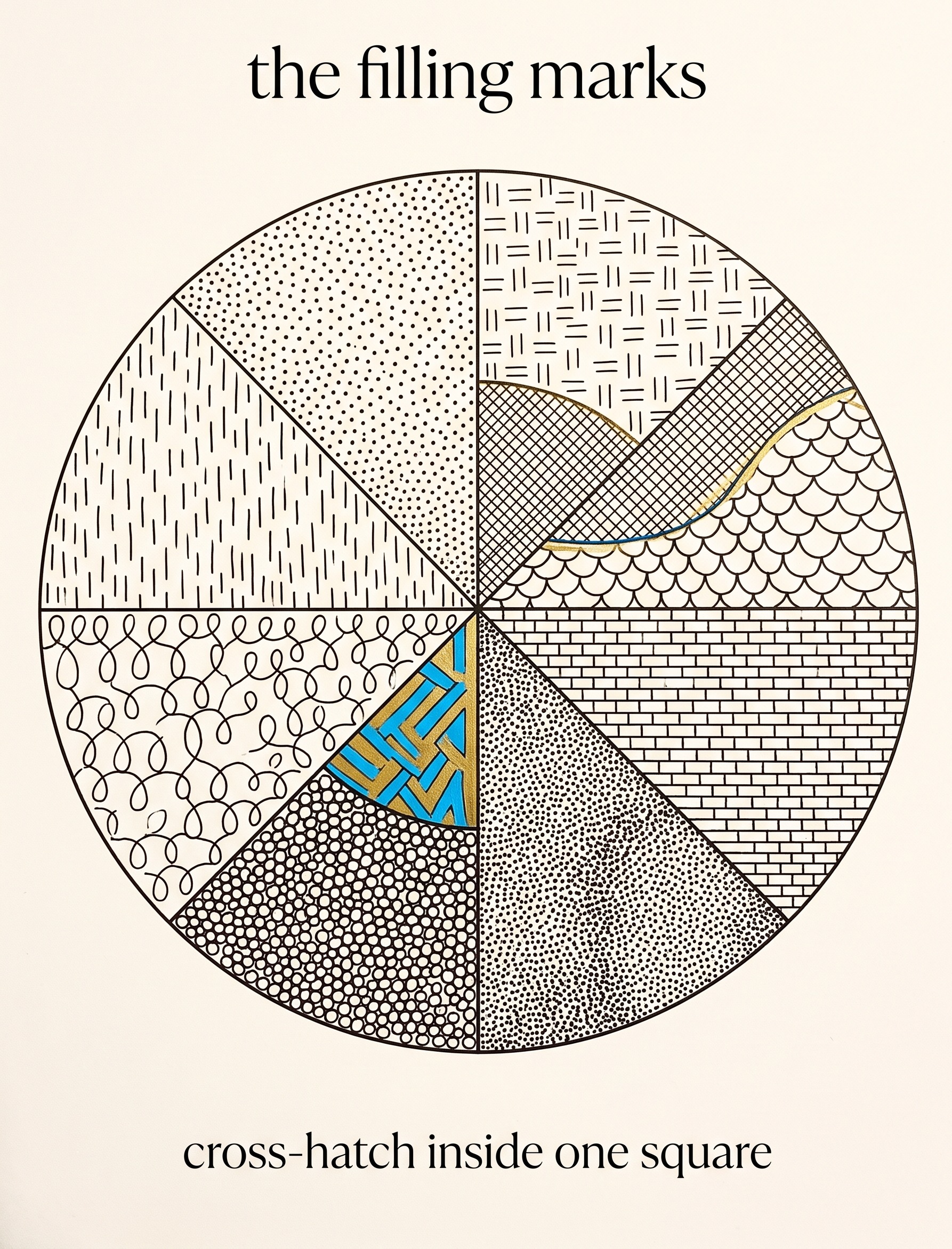
8 zones, 8 different fills, one shape. That is the whole practice in a single page, and every mark in it is on the list below.
24 meditative drawing exercises, easiest first
Numbered so you can work down them, grouped so you can pick one that suits how much of you is currently available. Every meditative drawing exercise here needs one pen and no plan.
The one-breath marks
- 1. The circle you do not close — one stroke, start at the top, stop just before you arrive. The gap is the point and it is the oldest move in this whole practice.
- 2. A line the length of one out-breath — breathe out, draw, stop when the breath stops. It will be shorter than you expect the first time.
- 3. The wobble, kept — draw a straight line slowly enough that it wobbles, then leave it. This is the exercise most people fail on purpose.
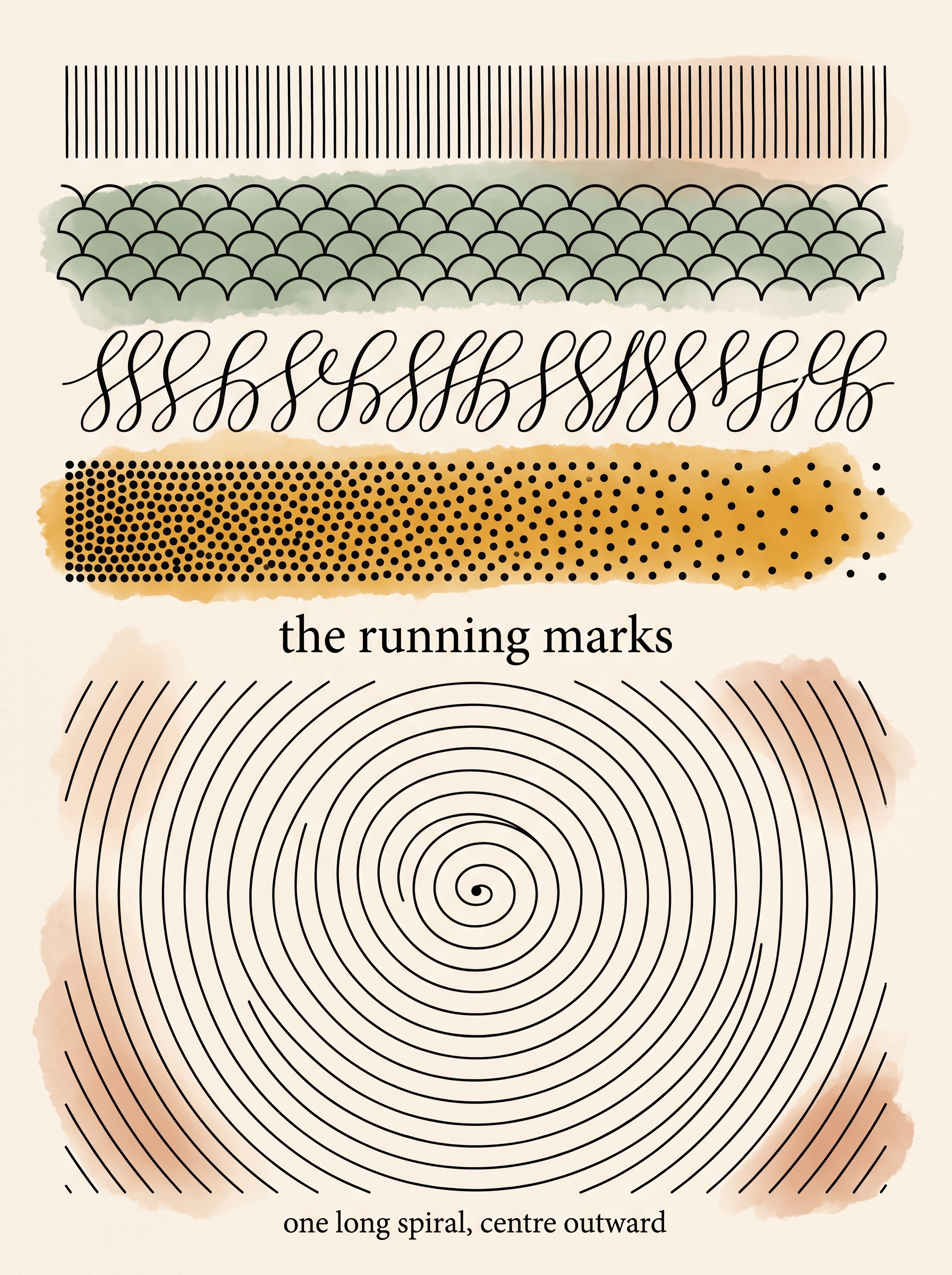
- 4. One long spiral, centre outward — 15 turns. Do not count them while you draw.
- 5. The same spiral, edge inward — completely different feeling in the hand, and nobody can tell you why.
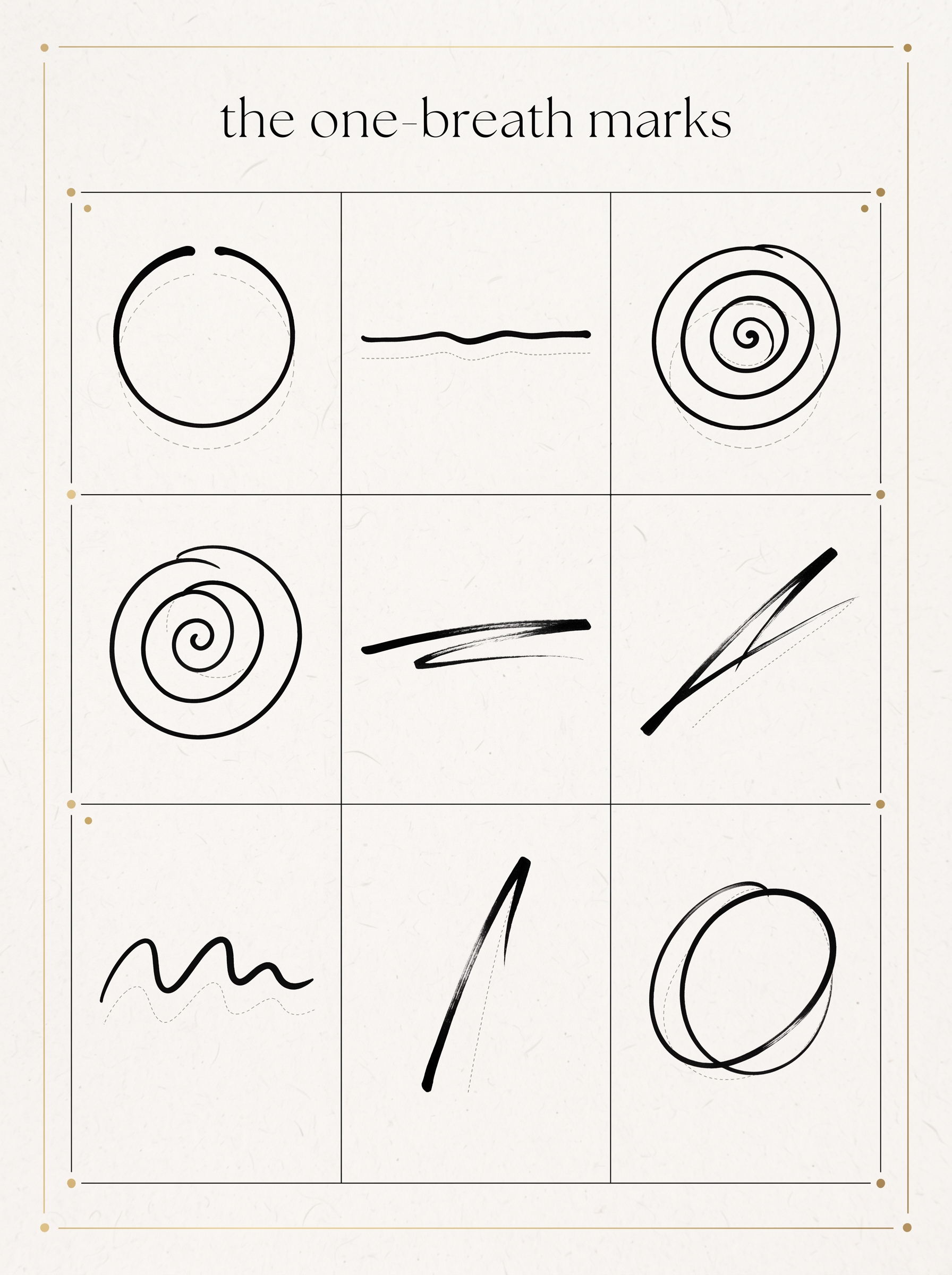
None of those 5 is a drawing. They are all one movement, held slightly longer than is comfortable, which is the entire difference between doodling and this.
The running marks
- 6. A row of upright dashes — 50 of them, evenly spaced. The evenness is the meditation, not the dashes.
- 7. The same row, deliberately uneven — and it looks better. This is annoying and it is true.
- 8. Scallops along a ruled line — half-circles, shoulder to shoulder, like a very patient fence.
- 9. A row of open loops — cursive letter e, over and over, without the writing.
- 10. Dots at 4 densities — tight, less tight, loose, scattered. You have just drawn a gradient without shading anything.
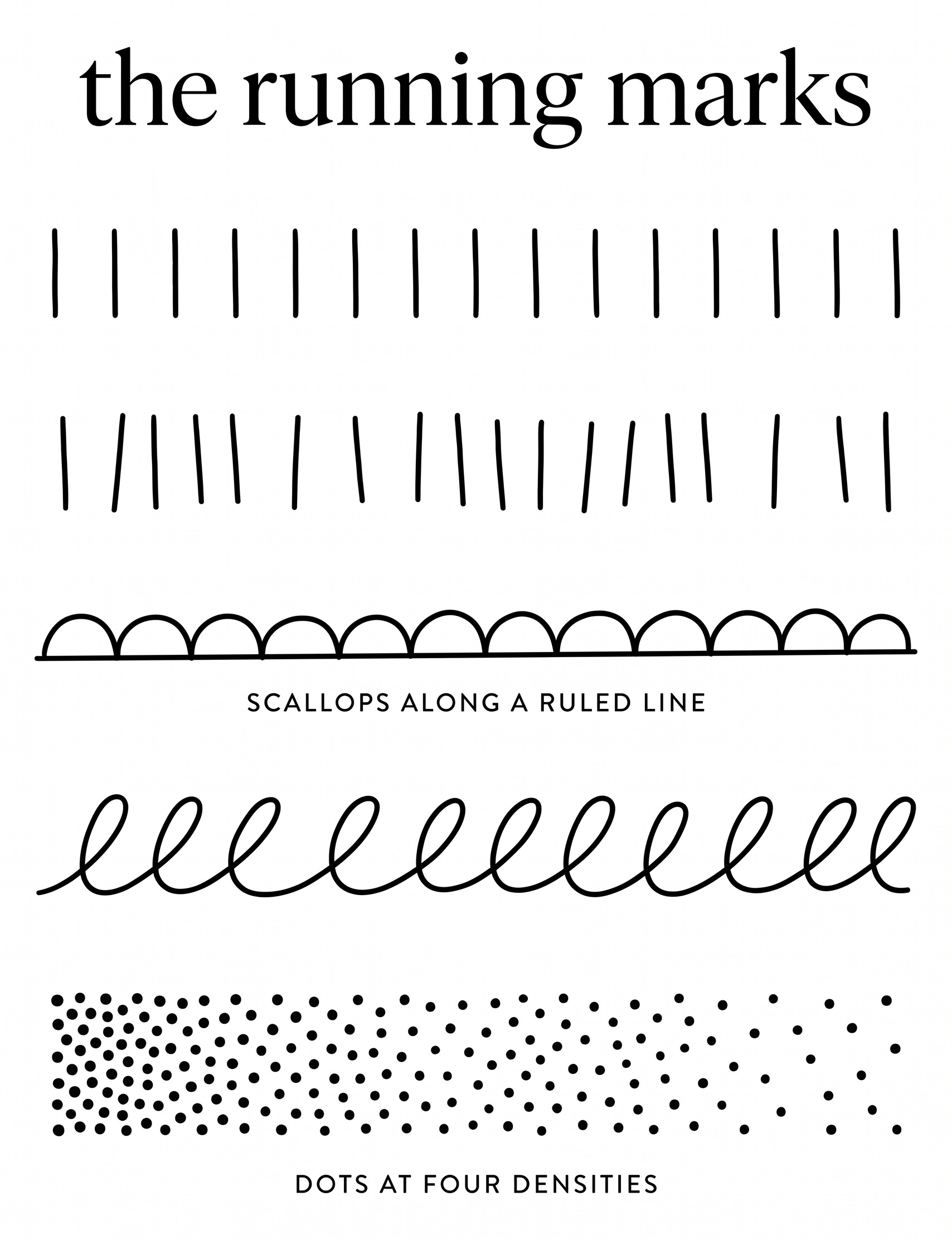
(I timed myself on the dashes once and stopped at 41, because a person came into the room and I did not want to be seen counting dashes.)
The filling marks
- 11. Cross-hatch inside one square — 2 directions only. Resist the third.
- 12. Stippling inside a circle — denser at one edge. 20 minutes will vanish.
- 13. Scales, overlapping — a semicircle, then the next one riding over it.
- 14. Tiny bricks — a wall you will never have to build.
- 15. Wandering vines with no plan — the only fill on this list where getting lost is the instruction.
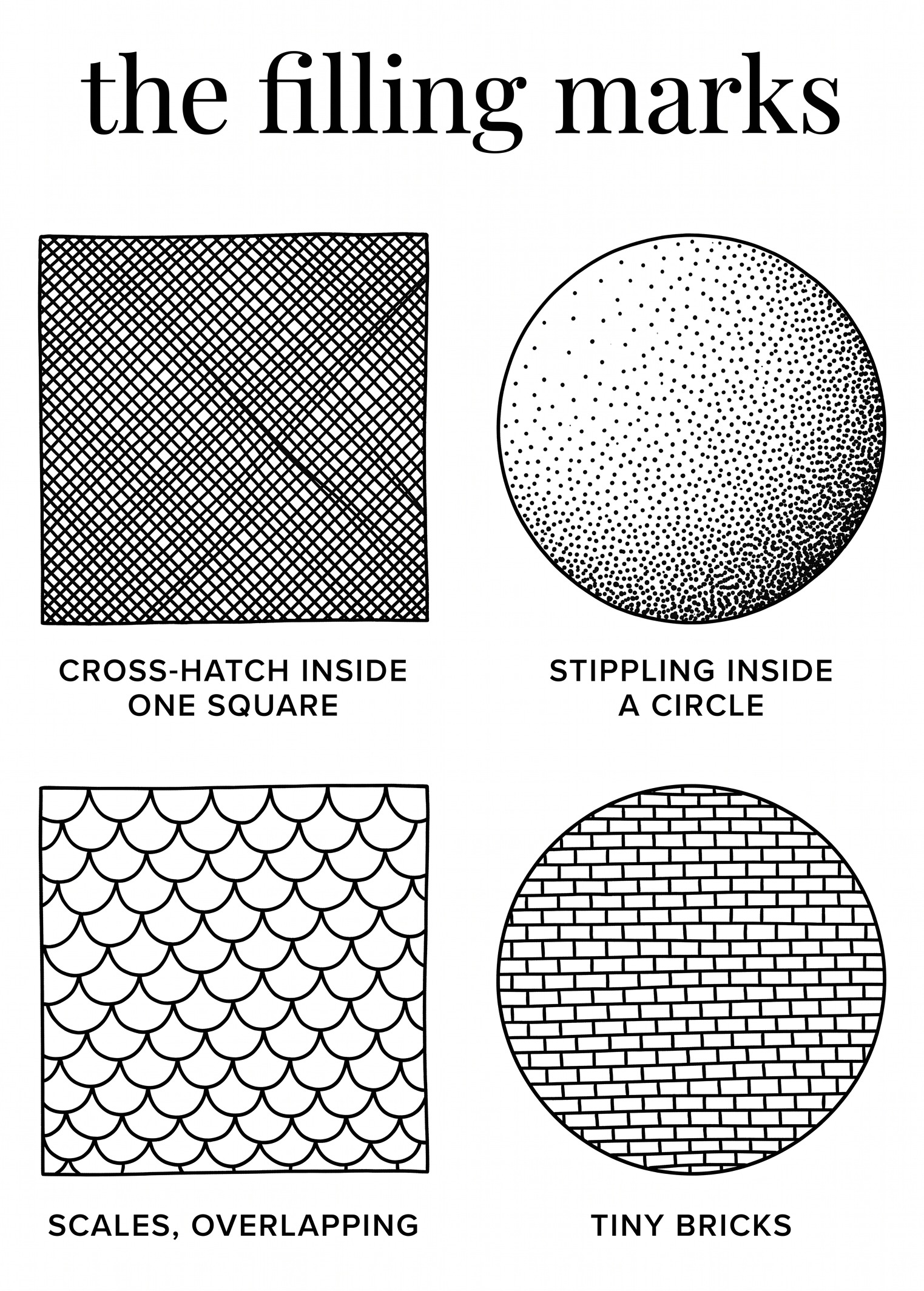
Fills are where the time actually goes. A shape takes a minute to draw and 20 to fill, and the 20 is the part you came for.
The marks that go round
- 16. A dot, then 6 marks around it — the first ring. That is genuinely all a ring is.
- 17. The same 6 marks, doubled to 12 — and doubled again to 24. Nothing new is being learned, only repeated.
- 18. Petals around a traced saucer — the saucer does the circle so your hand does not have to.
- 19. Alternating rings — one ring of dashes, one ring of dots, one ring of scallops.
- 20. A ring drawn deliberately off-centre — and then made to work. This is the ring that teaches the most.
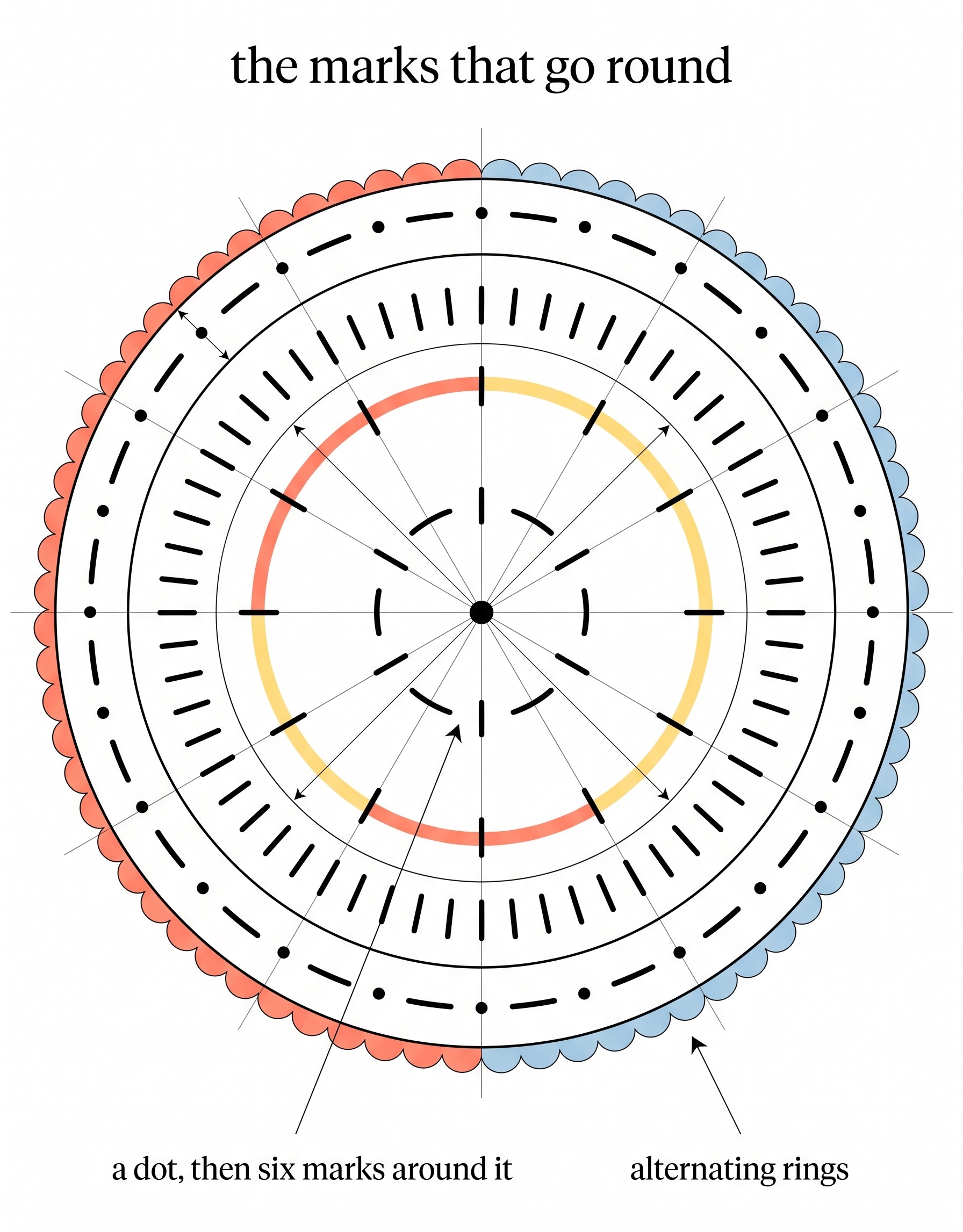
You have noticed what these are turning into. Everything on this list works flat, in a row, in a margin — but the moment repetition goes round a centre it stops being practice and starts being a piece.
The marks for when it has gone wrong
- 21. Fill the mistake in solid — black, decisive, done. It reads as intentional within about 4 seconds.
- 22. Repeat the mistake 5 more times — a wobble once is a wobble. A wobble 6 times is a pattern.
- 23. Draw a border around the whole page — instant permission to stop.
- 24. Turn it over and start on the back — the cheapest reset there is, and the one people forget exists.
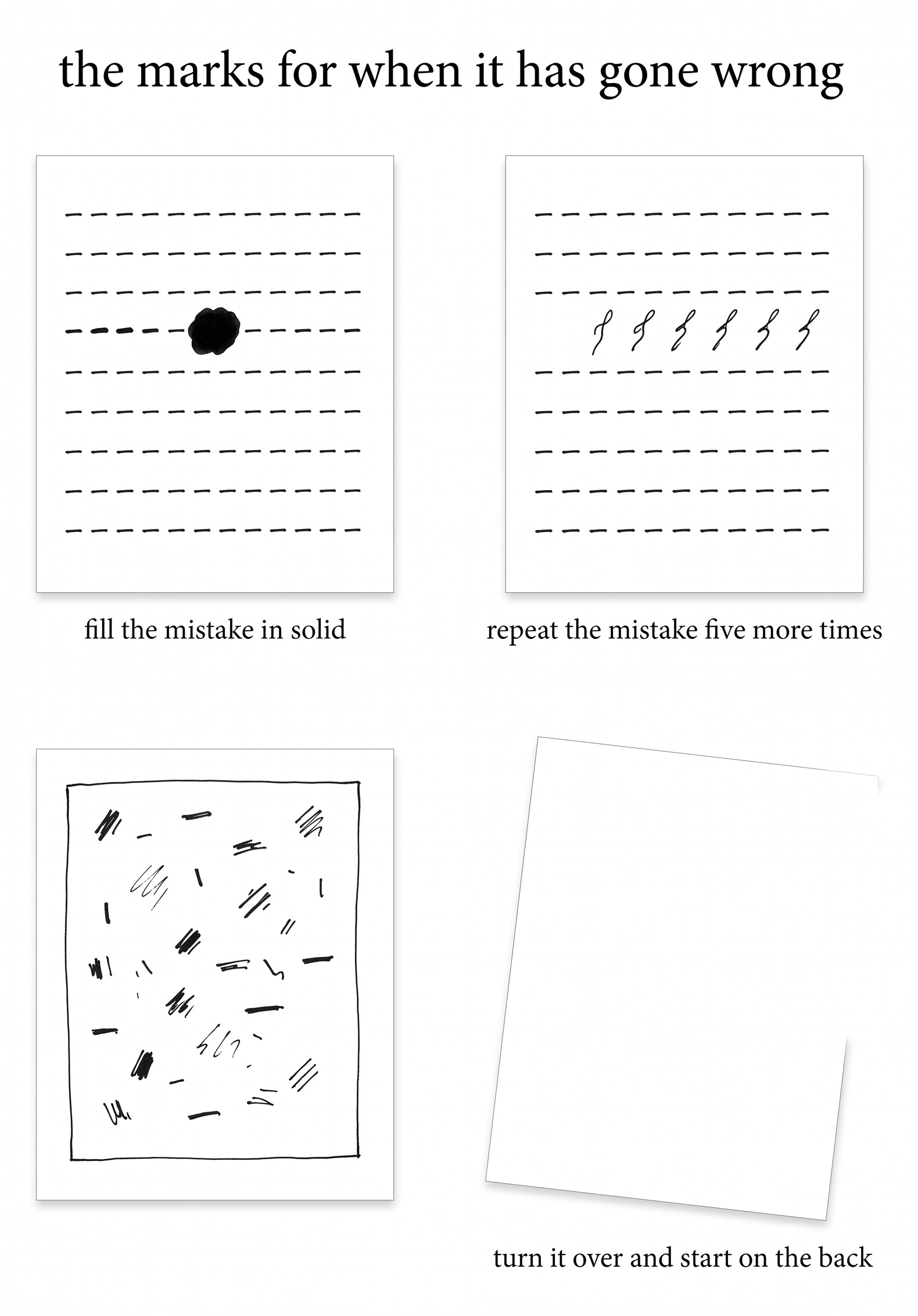
Every one of those is permission rather than repair. Nothing here is precious enough to rescue, which is why it is restful.
Flat, it is practice. Round a centre, it is a piece. Nothing else changed.
Where the repetition is supposed to end up
Groups 1 to 3 work anywhere — a margin, an envelope, the back of something that came through the door. Group 4 is different, and it is the reason this list is ordered the way it is. The moment a repeated mark goes round a centre, it stops being practice and becomes a composition. Same dashes. Same scallops. One decision about where the middle is.
That is the whole mechanism behind a mandala, and it is why meditative drawing and mandala work are usually the same evening in different clothes. If you want the ring-by-ring version rather than the mark-by-mark one, we have written that up separately — how to draw a mandala in 12 rings, without a compass.
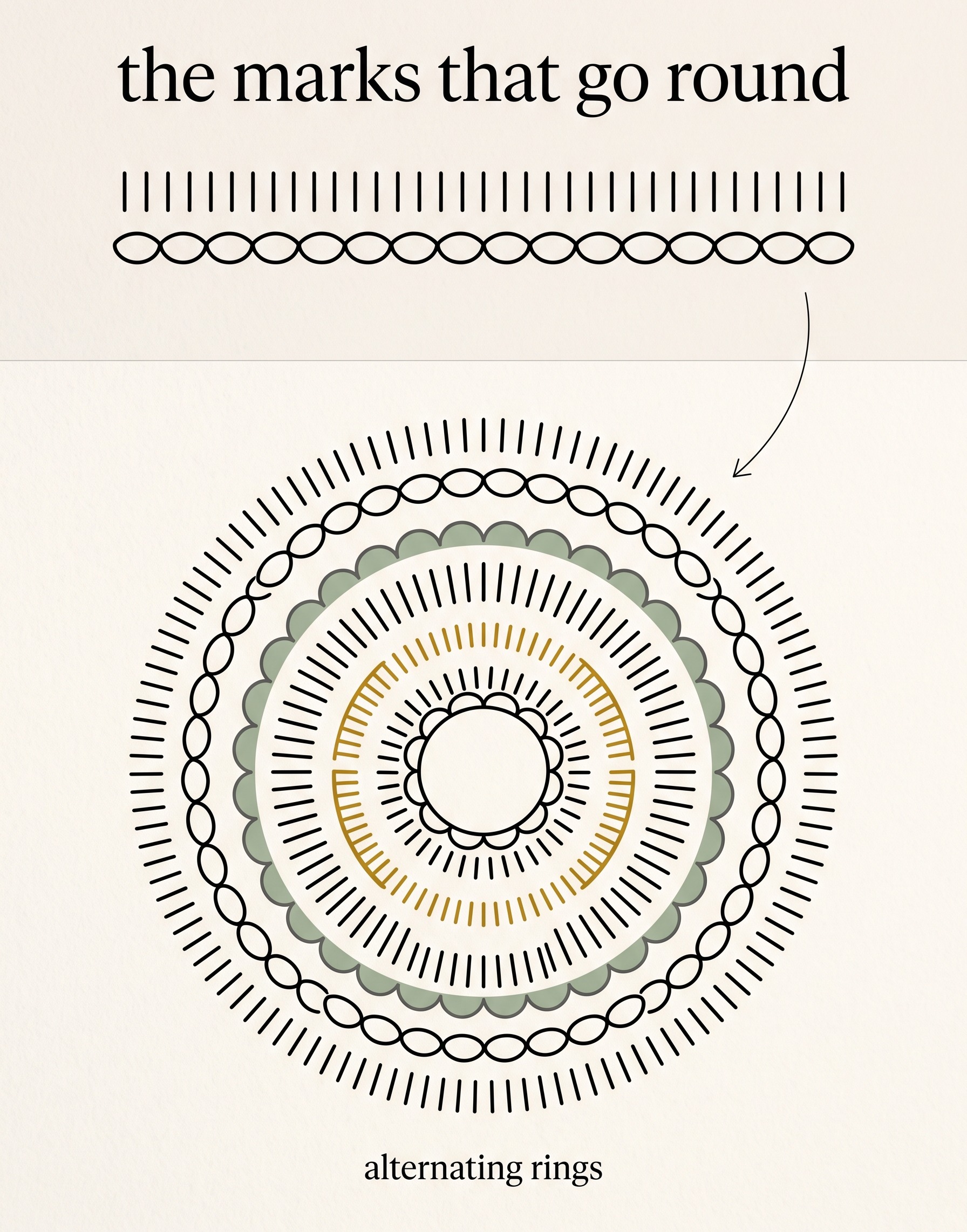
Nothing new is being asked of your hand at that point. The marks are the ones you already practised flat; they have simply been given somewhere to go.
What if I cannot keep the marks even?
Then you are doing the version that looks better. Perfectly even repetition reads as printed, and printed is not what anyone wants on a wall — the small variations are the evidence a person made it. Aim for even, accept what arrives, and notice that the pages you like best in 6 months will be the wonky ones.
The first 10 minutes are boring. The second 10 are irritating. Everybody quits in the second 10.
The evening I drew 400 dashes and one useful thing
I once filled an entire A4 page with upright dashes because I did not want to think about a conversation I had had that afternoon. It took about 50 minutes. The page is objectively terrible — it looks like a barcode drawn by someone with a grievance — and I have kept it, which tells you it did the job.
What I learned was not about drawing. It was that the first 10 minutes are boring, the second 10 are irritating, and somewhere in the third 10 the irritation goes and does not come back. (Nobody mentions the irritating part. It is the part everybody quits in.)
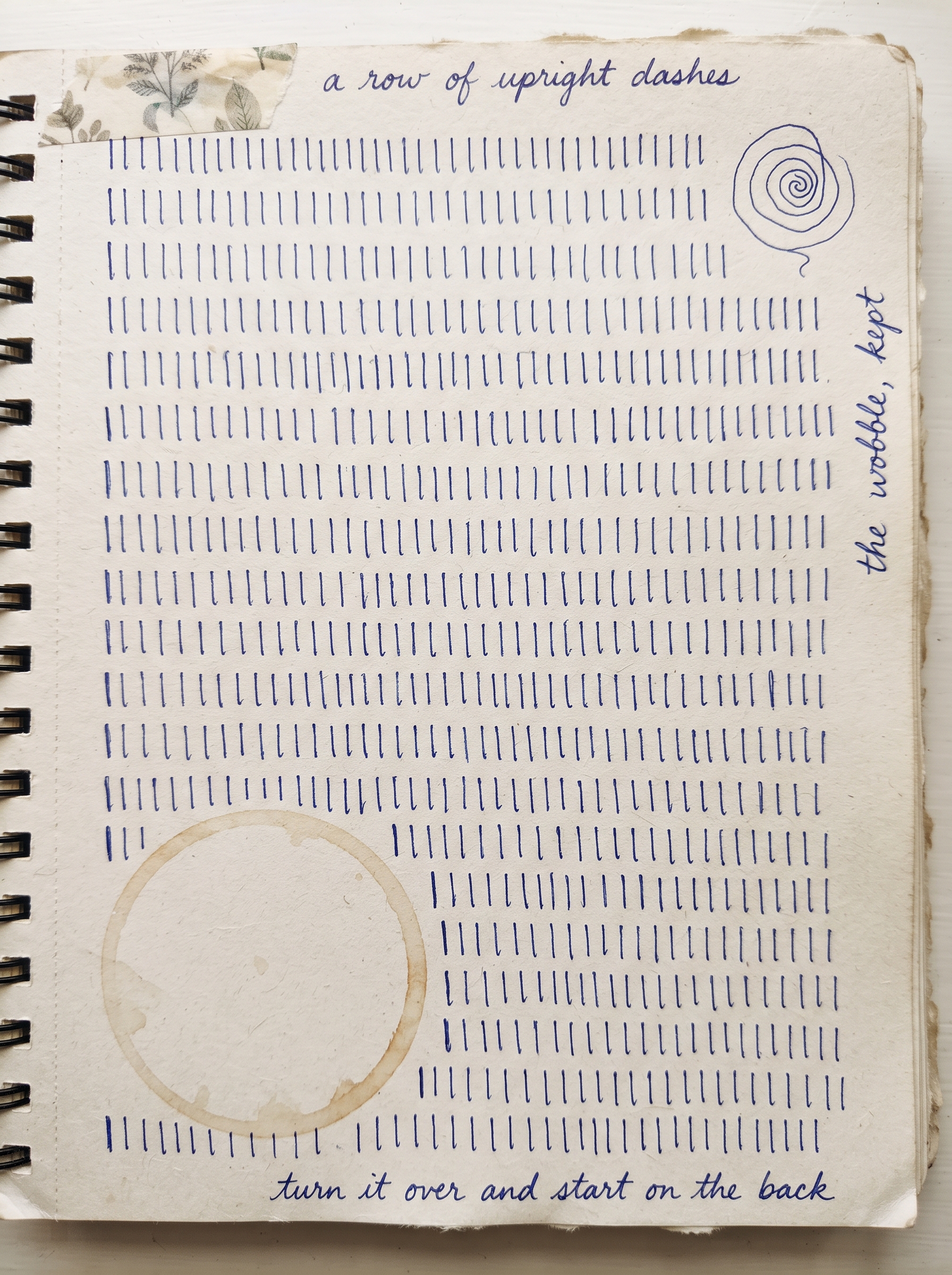
So: if it is not working after 4 minutes, that is not a sign it will not work. It is a sign you are 4 minutes in.
How long should meditative drawing take?
A meditative drawing session runs longer than 4 minutes and shorter than the time you will spend deciding whether to start. 20 is the honest number — 10 to get past the boring stretch, 10 to get the thing you came for. If 20 is not available, do a row of dashes at the top of whatever is in front of you and stop, because a short session that happens beats a long one that does not.
Do I need special paper or pens for meditative drawing?
No, and being fussy about materials is its own kind of avoidance. A ballpoint on the back of an envelope is a legitimate setup. (Bourgeois used red ballpoint on cardboard, which should settle the argument for good.) The only equipment note worth having: a pen that does not skip, because a skipping pen puts the deciding back in.
Is this the same as doodling?
Overlapping, not identical. Doodling is what your hand does while your attention is elsewhere. This is the reverse — the mark is where the attention goes, deliberately, which is why a page of it feels different afterwards even though it looks similar.
What to do with the pages afterwards
Most of them are practice and practice is allowed to be thrown away, which is worth saying out loud because a lot of people stop drawing rather than produce something disposable. Keep 3 kinds: the first attempt at any mark, because it dates the habit; anything that went wrong in an interesting way; and the one page a month that came out well enough to cut down and frame. (Everything else can go in the recycling with a clear conscience. I do this on Sundays and it is weirdly satisfying.)
The habit is the product here. A page a week for a year is 52 evenings you did not spend scrolling, and 8 or 9 pieces good enough to hang, which is more wall than most people manage on purpose.
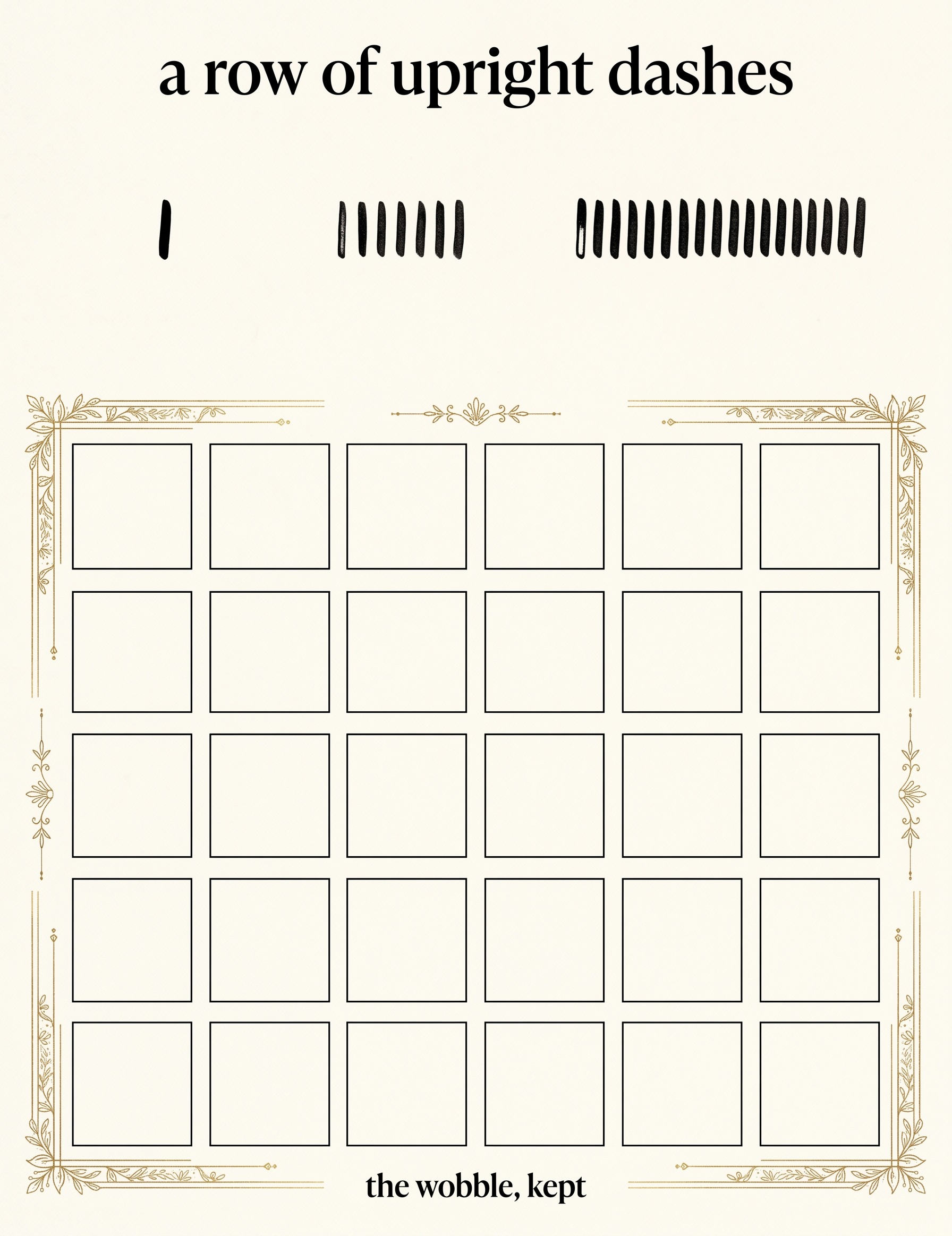
30 squares, one evening each. (I have never completed one of these grids in my life and I still recommend them, because the squares you do tick are squares that happened.)
Free Starter Pack
10 pattern templates. The marks, ready-made.
Sent tonight. Scallops, dashes, scales and stipple — every fill in this article, on one sheet.
Unsubscribe in 1 click, no hard feelings
8 master grids and 88 ready elements, so the circle is already measured
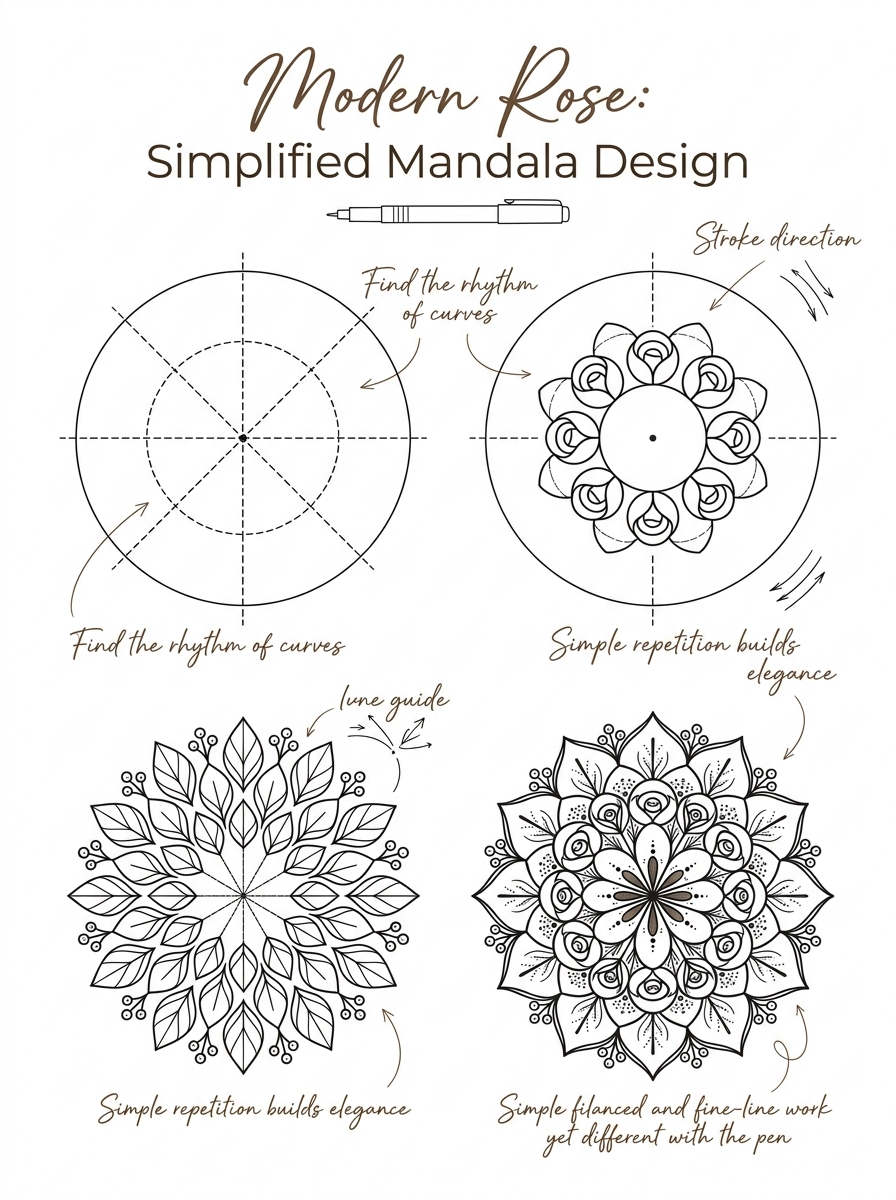
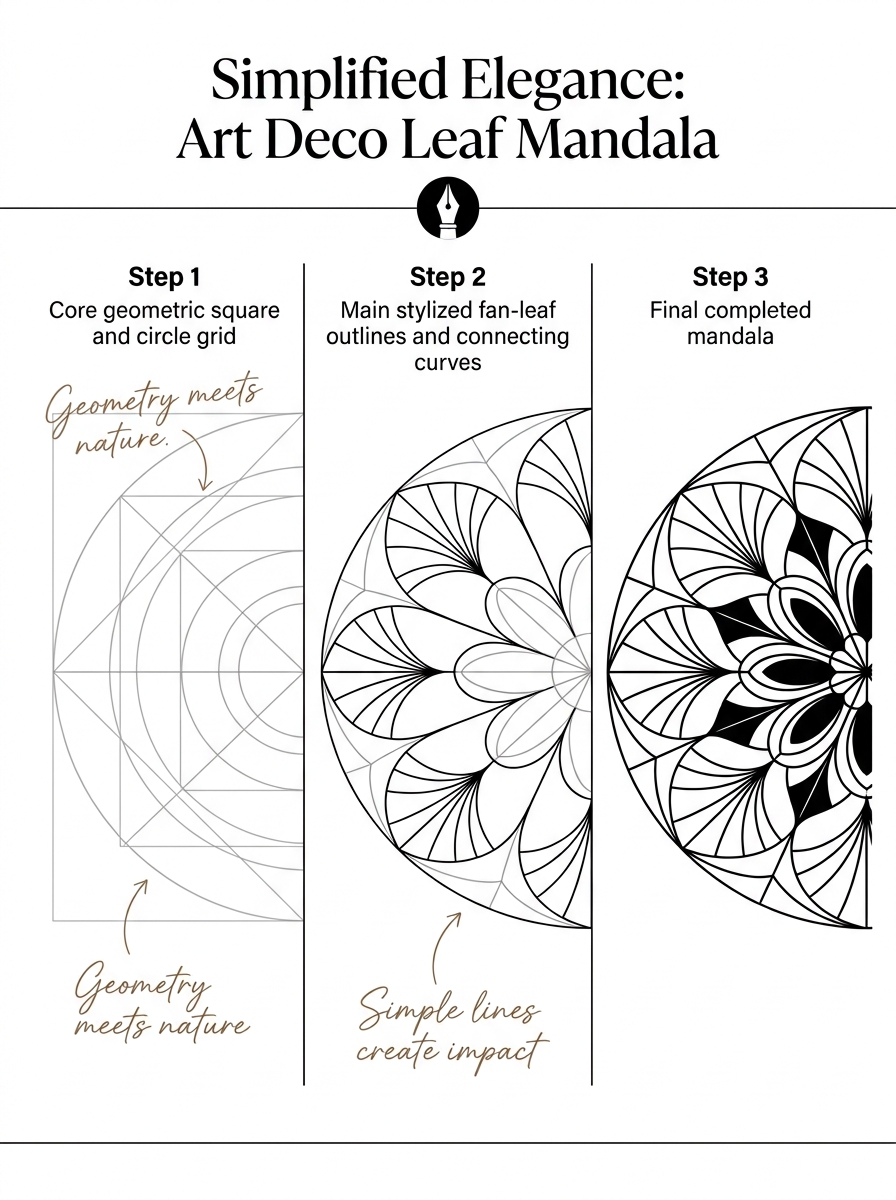
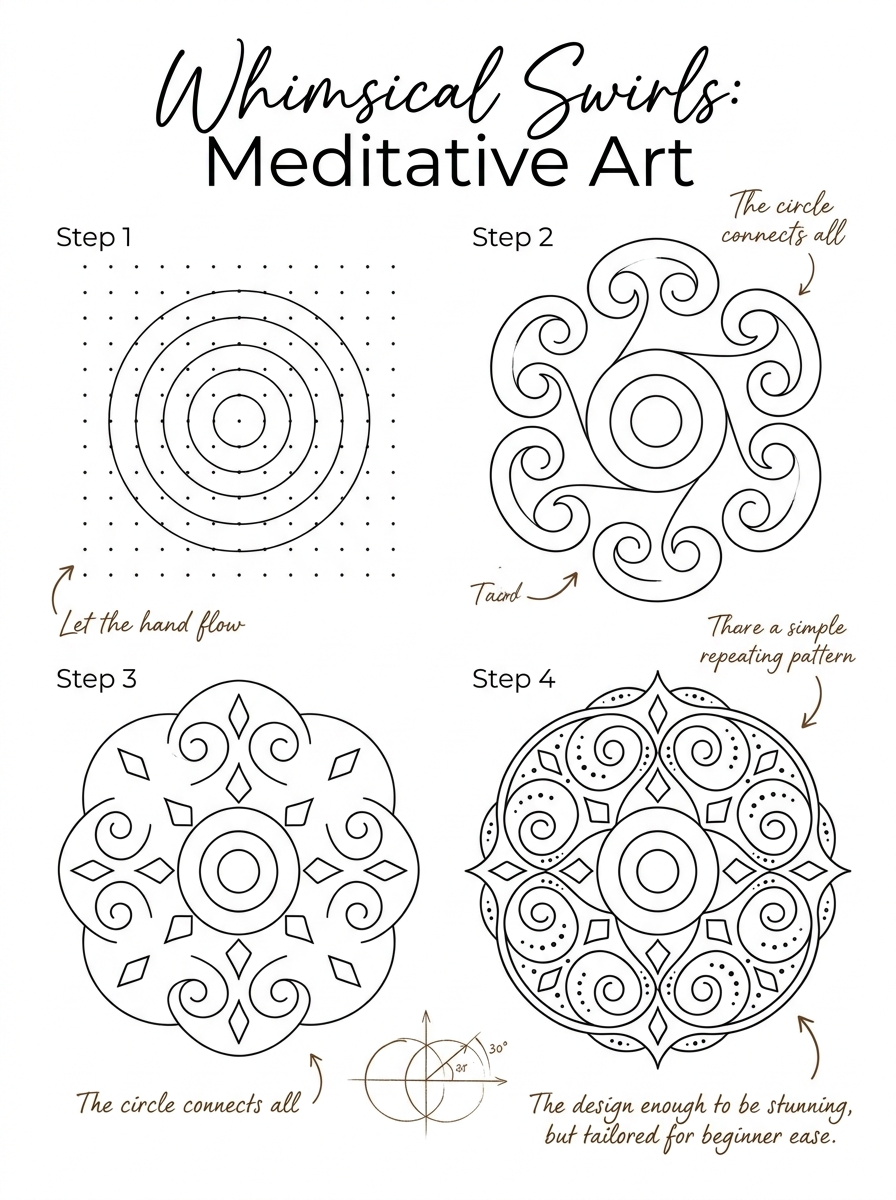
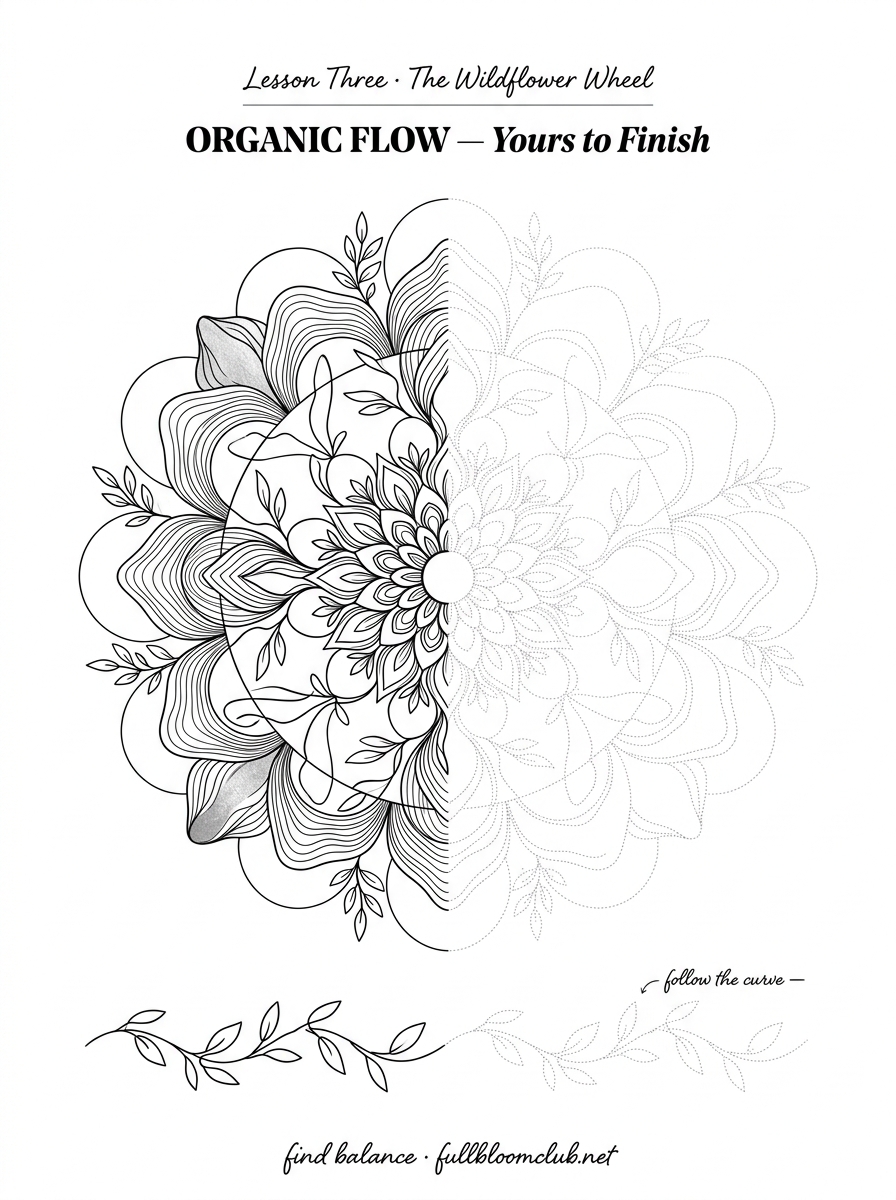
Tonight it is a row of dashes while the house goes quiet. By the weekend it is a finished circle on the mantelpiece that took one evening and looks like it took a fortnight. Every master grid, every ready element, every alternating ring — the whole route from one repeated mark to something worth hanging.
Instant download · print as often as you like
The hand knows the way long before the head agrees to come along. Let it walk. It has never once got lost, though it does take the scenic route through the margins.
“Art is a guaranty of sanity.”
Louise Bourgeois, 2000
Mirabelle wrote this. No training, strong opinions, many pens. Peer reviewed by a cat who sat on the wet ink and left a review of her own.