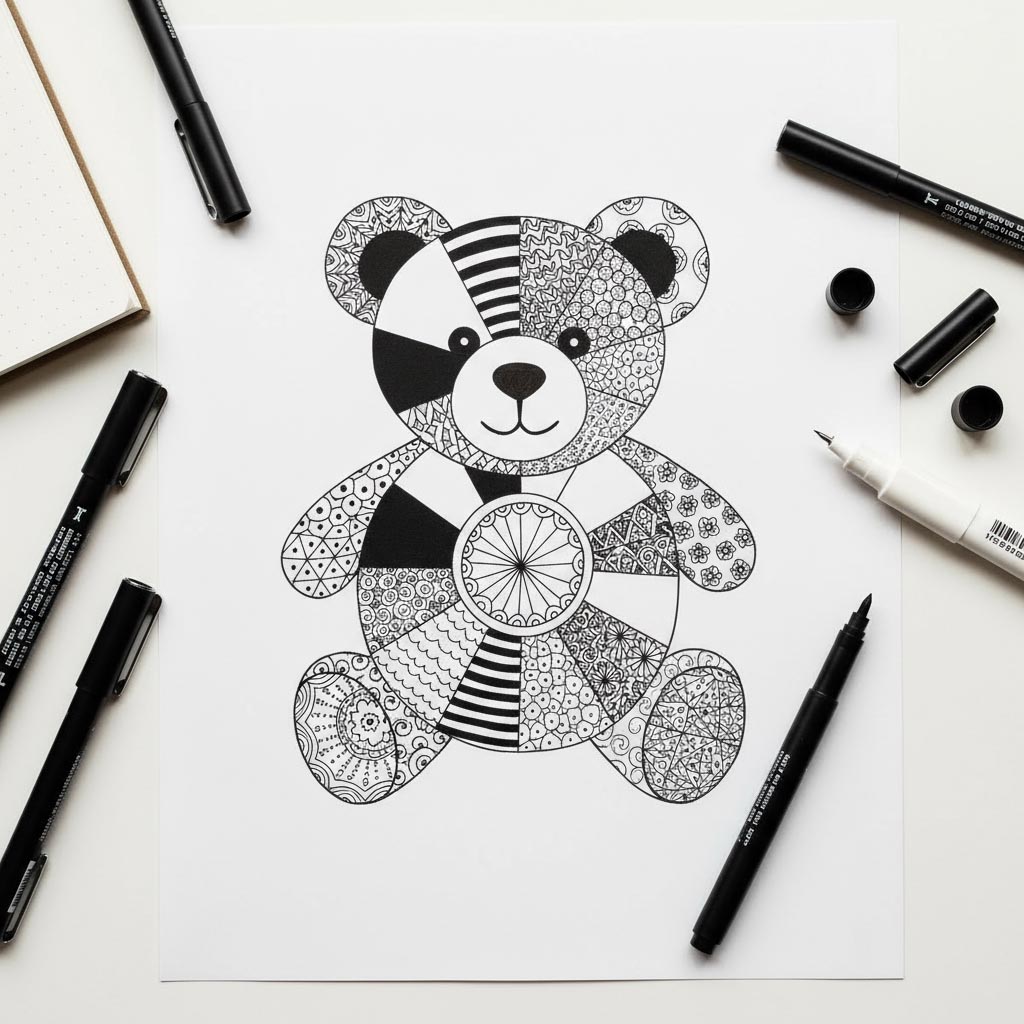
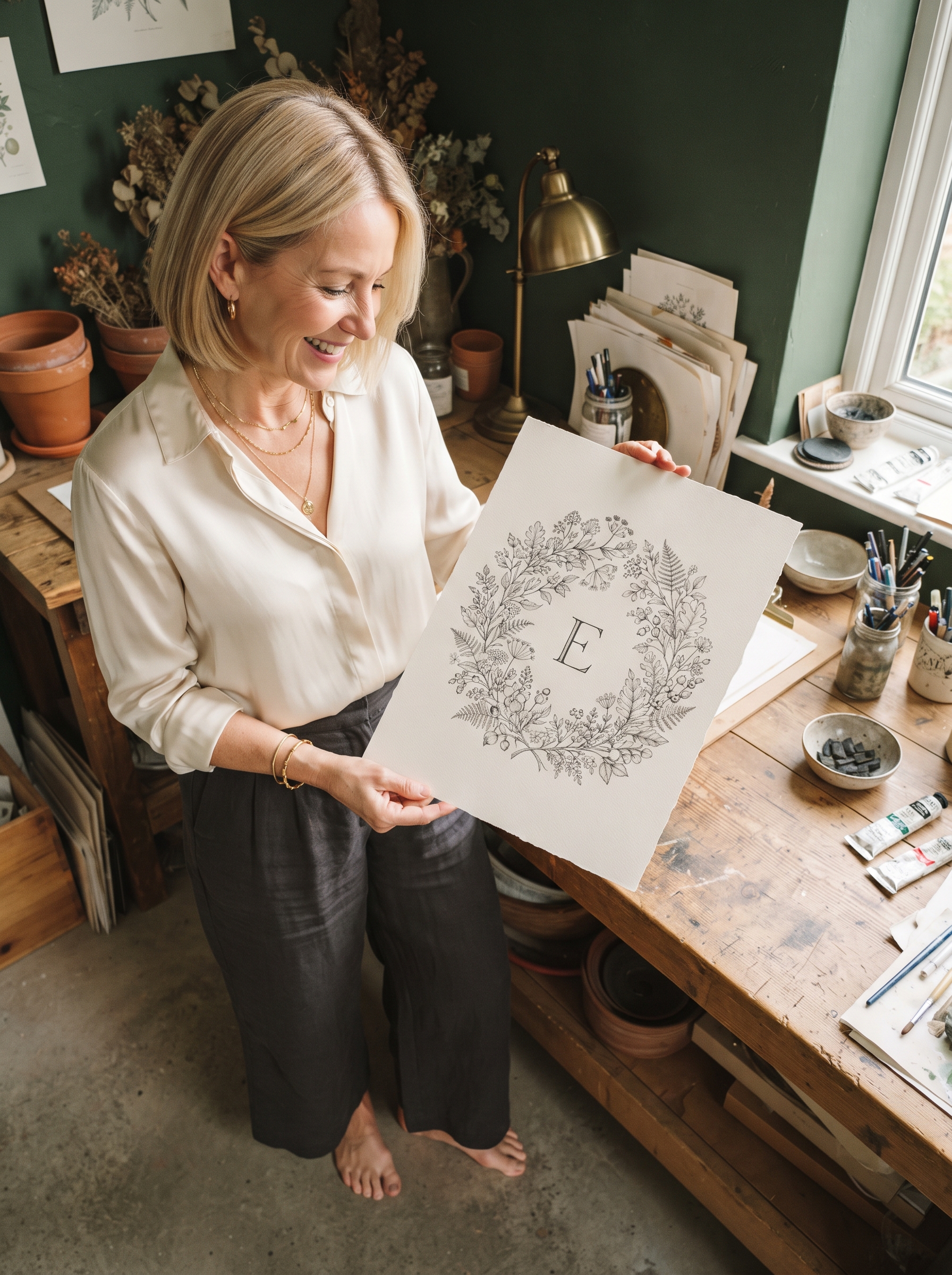
The hardest thing in a wreath is the circle. You are not going to draw it.
You are going to draw around a saucer. Every tutorial mentions this in step one and hurries past it, because tracing is not impressive. It is only the difference between a wreath and a wobble.
That permission is older than it looks. The oldest wreath on record was not hung on a door — it was drawn around a name. Egyptian scribes looped a rope into a ring called shen, “to encircle”, and stretched it into an oval so a pharaoh’s name fitted inside. That is the cartouche around Tutankhamun and Cleopatra.
They drew the container first and filled it afterwards. 3,300 years later that is still how you draw a wreath.
So a wreath was never decoration. It is a fence around the thing that matters.
Every drawing tutorial that has ever intimidated you begins with a blank page and a promise that talent will fill it. A wreath begins with a fence. You draw the boundary first, and then the boundary tells you where everything goes. There is no blank page.
What is below:
- The four-step build — and the step nobody prints
- The six shapes every wreath in the world is made of
- Where to leave the gaps, which is the part that is actually the skill
- Six mistakes, in the order people make them
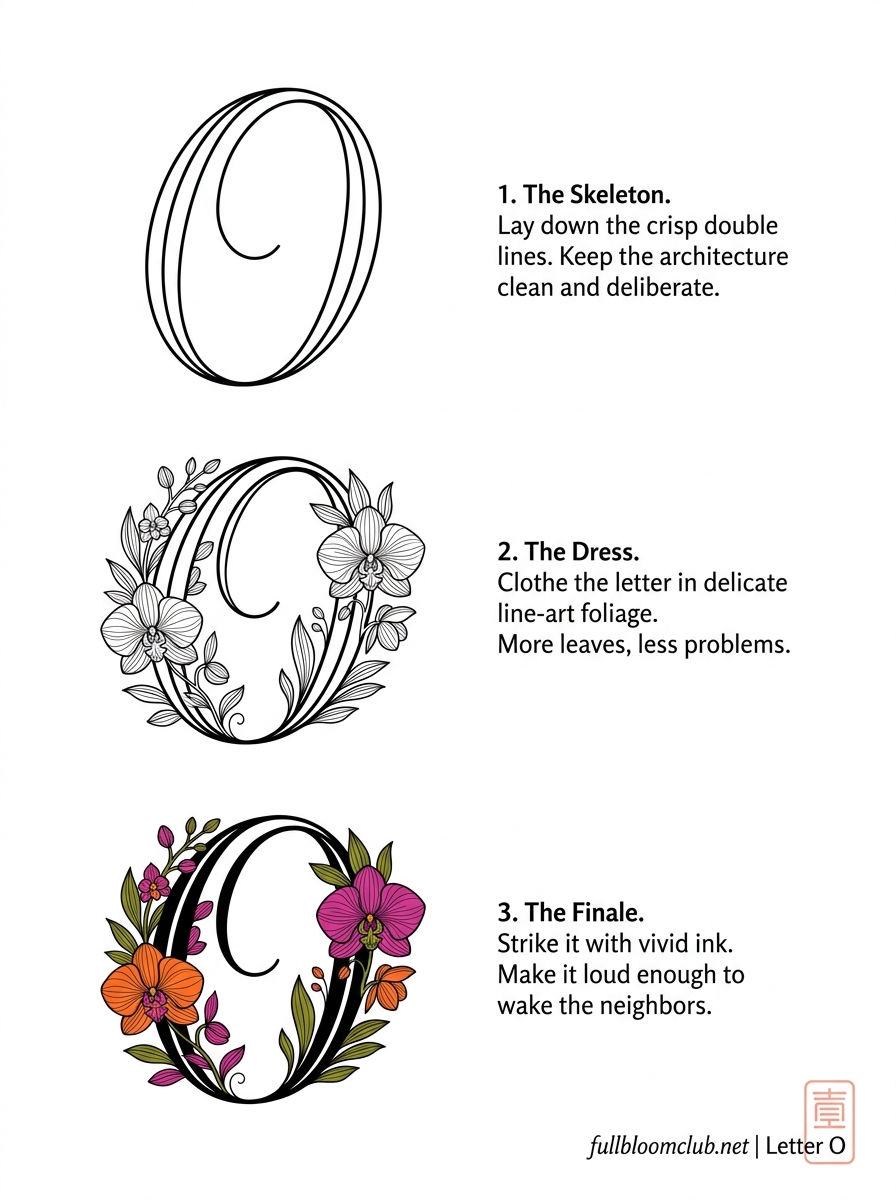
- The free letter O sheet — a wreath with a letter already inside it
Start with the O. It is free, it is below, and the reading is not the point of this page.
 Save
SaveThe most durable design idea in human history is a ring drawn around something you would like to keep.
That sheet is one letter of 26. The other 25 are built the same way, and the whole alphabet is below if the O goes well.
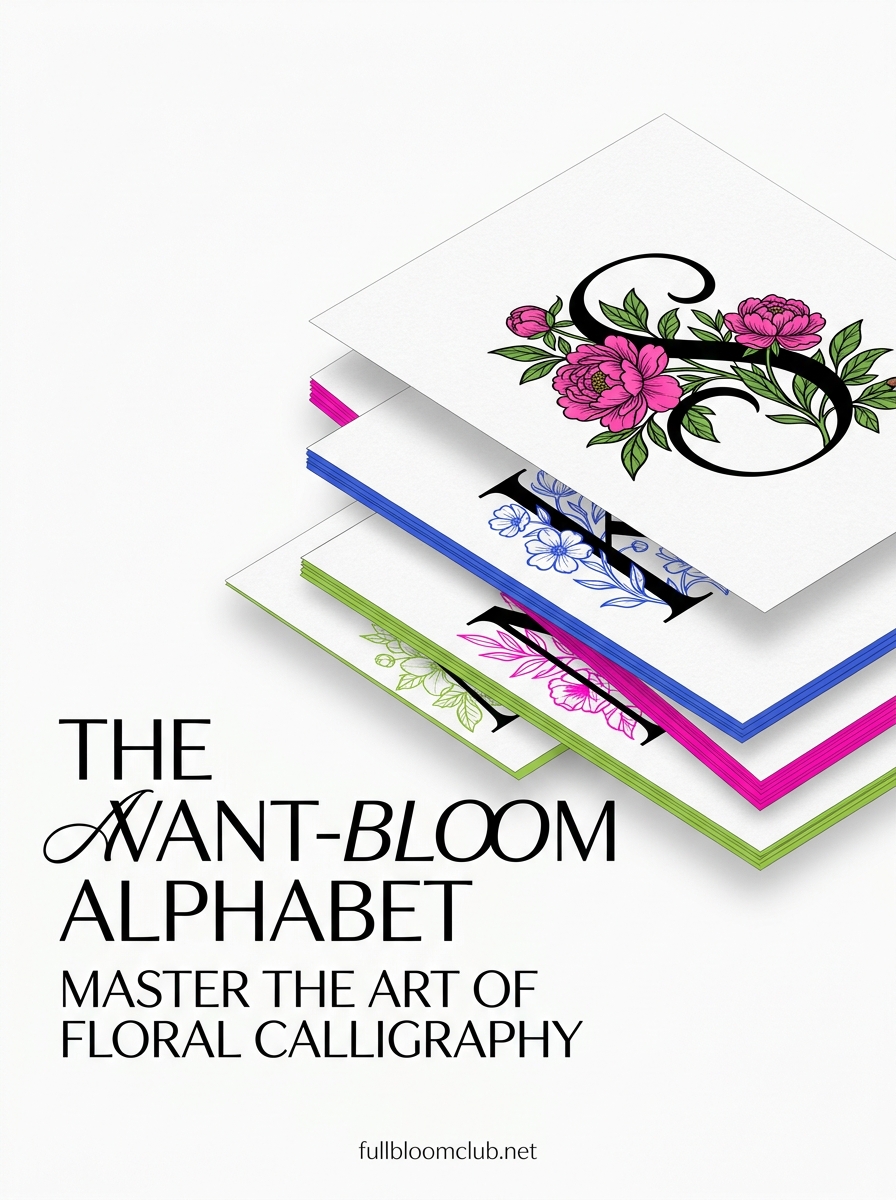
The Collection
THE AVANT-BLOOM ALPHABET — anemones, orchids, and a capital letter wearing them like it was born to.
The set for the moment somebody you like has a birthday in four days. What you get: a monogram you can hand over on a Thursday, and the specific pleasure of watching somebody work out that a person made it.
What follows is the method itself — the four moves, the six shapes they are made of, and the one decision that separates a wreath somebody drew from a wreath somebody printed. None of it needs a steady hand. All of it needs a saucer.
How to Draw a Wreath in Four Steps
The whole method fits in four moves, and the first one is the one nobody prints.
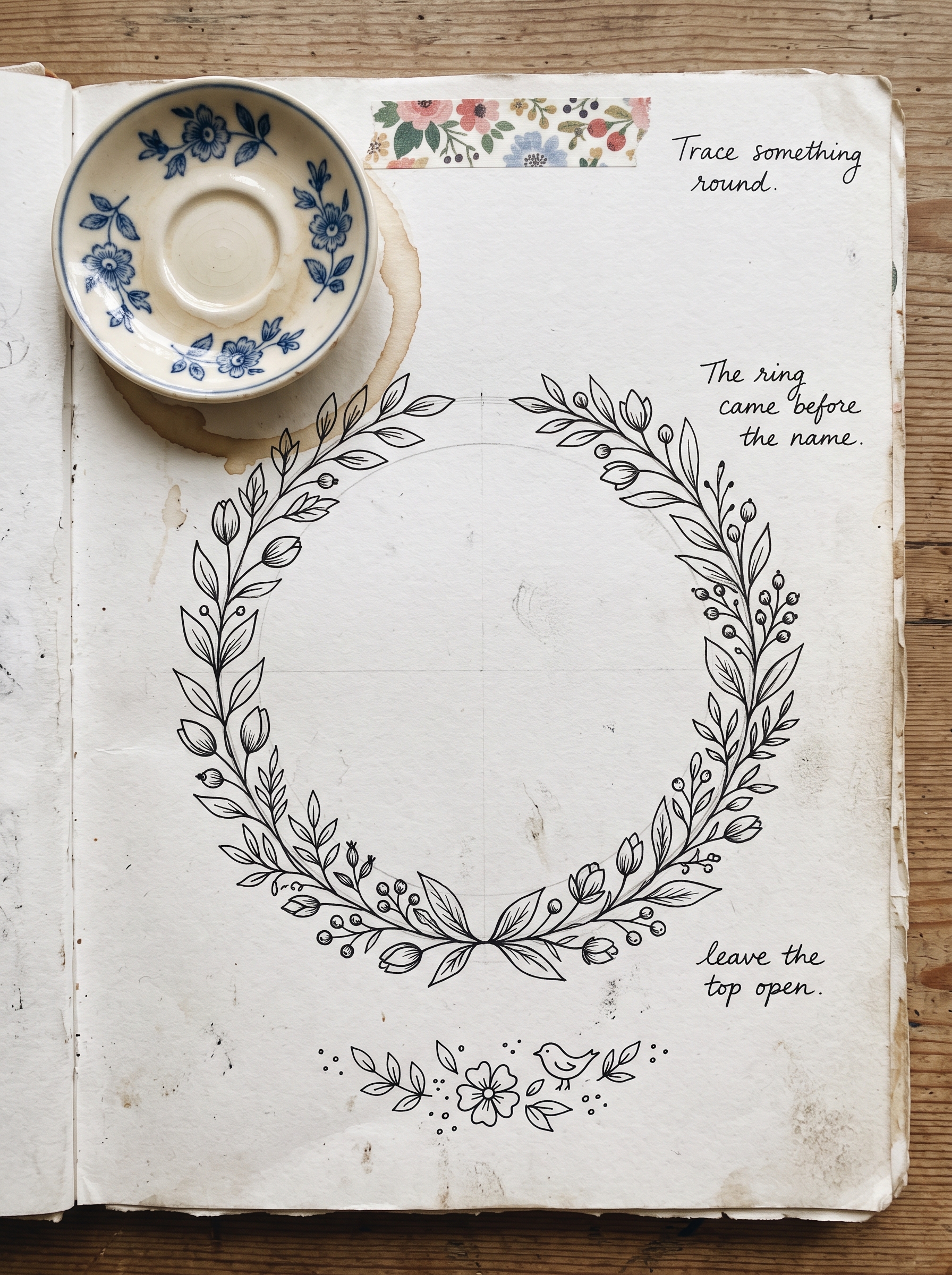
- Trace something round. A saucer. A jar lid. A roll of tape. Draw around it in pencil, lightly. This is the ring, and it is the only part of the drawing that has to be accurate — which is precisely why you should not draw it freehand and then spend eleven minutes resenting it.
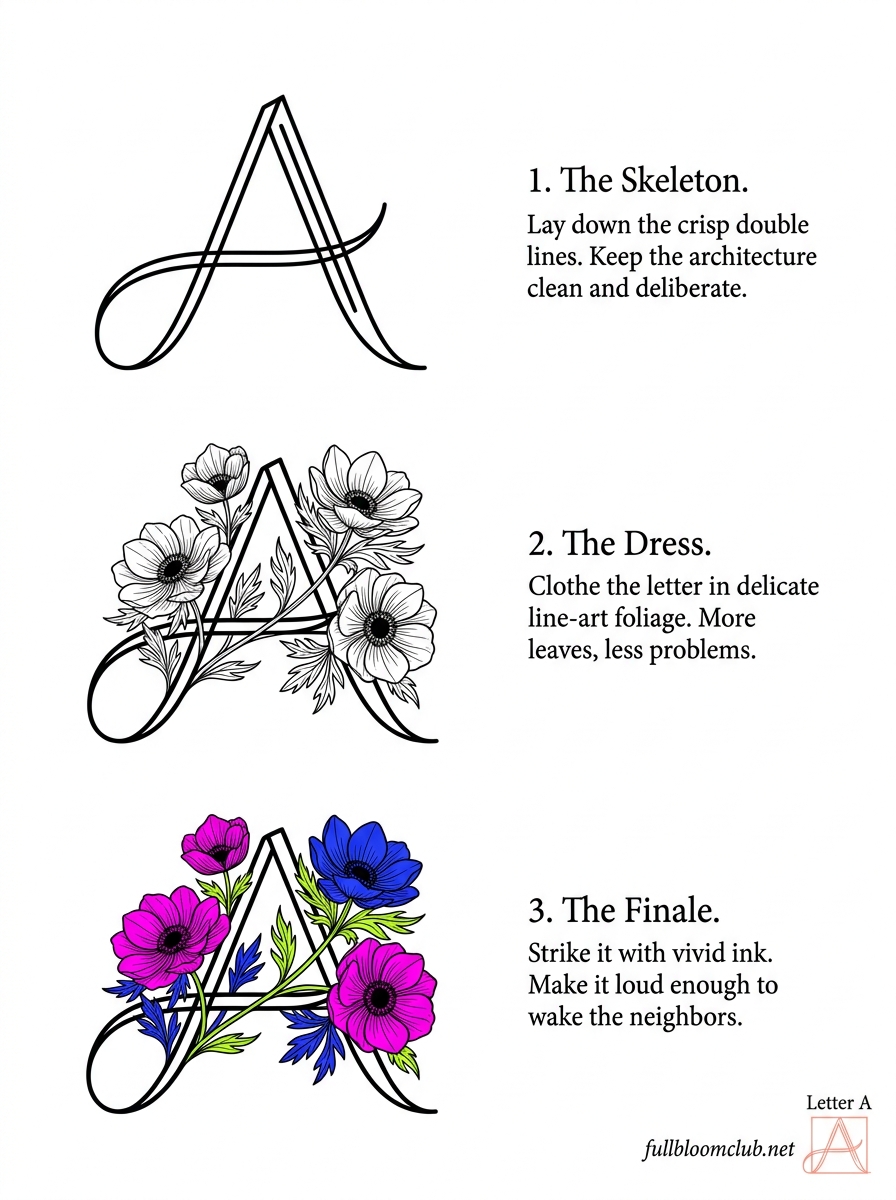
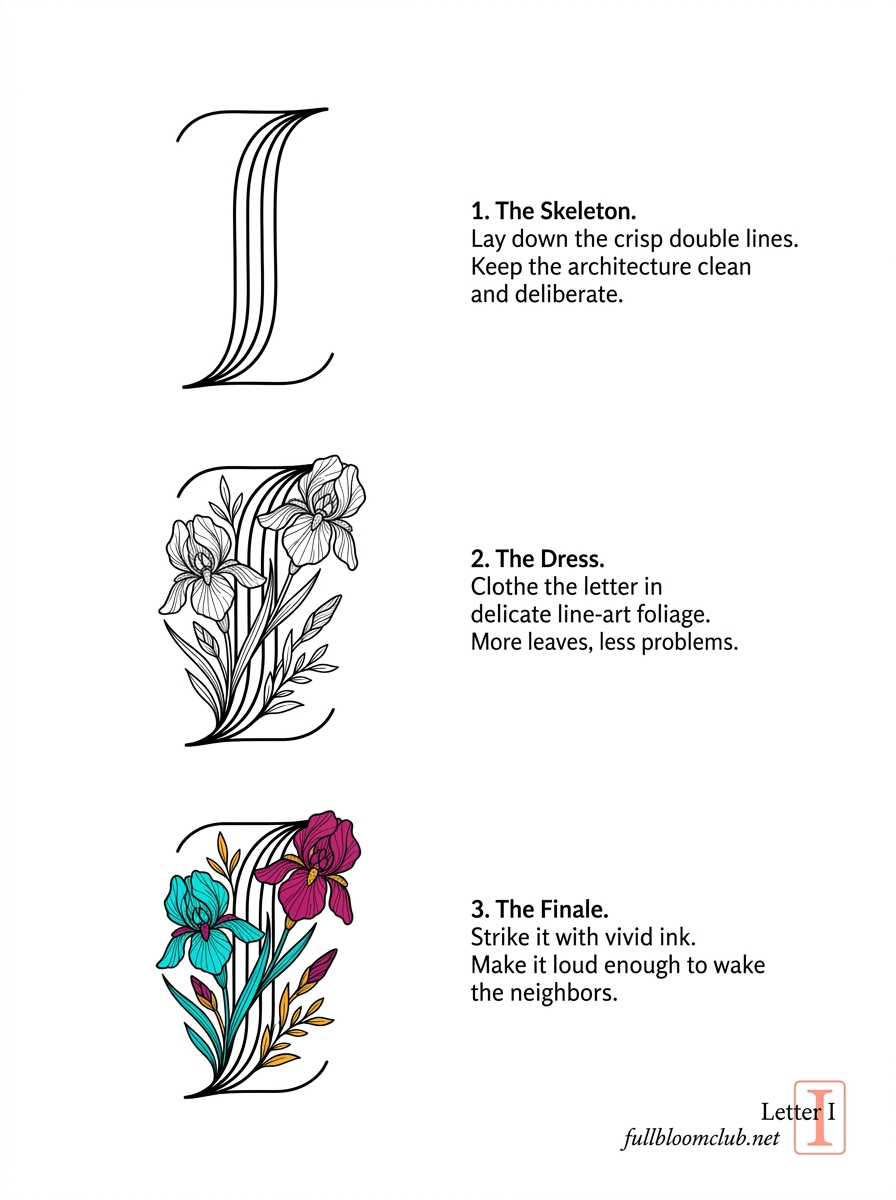
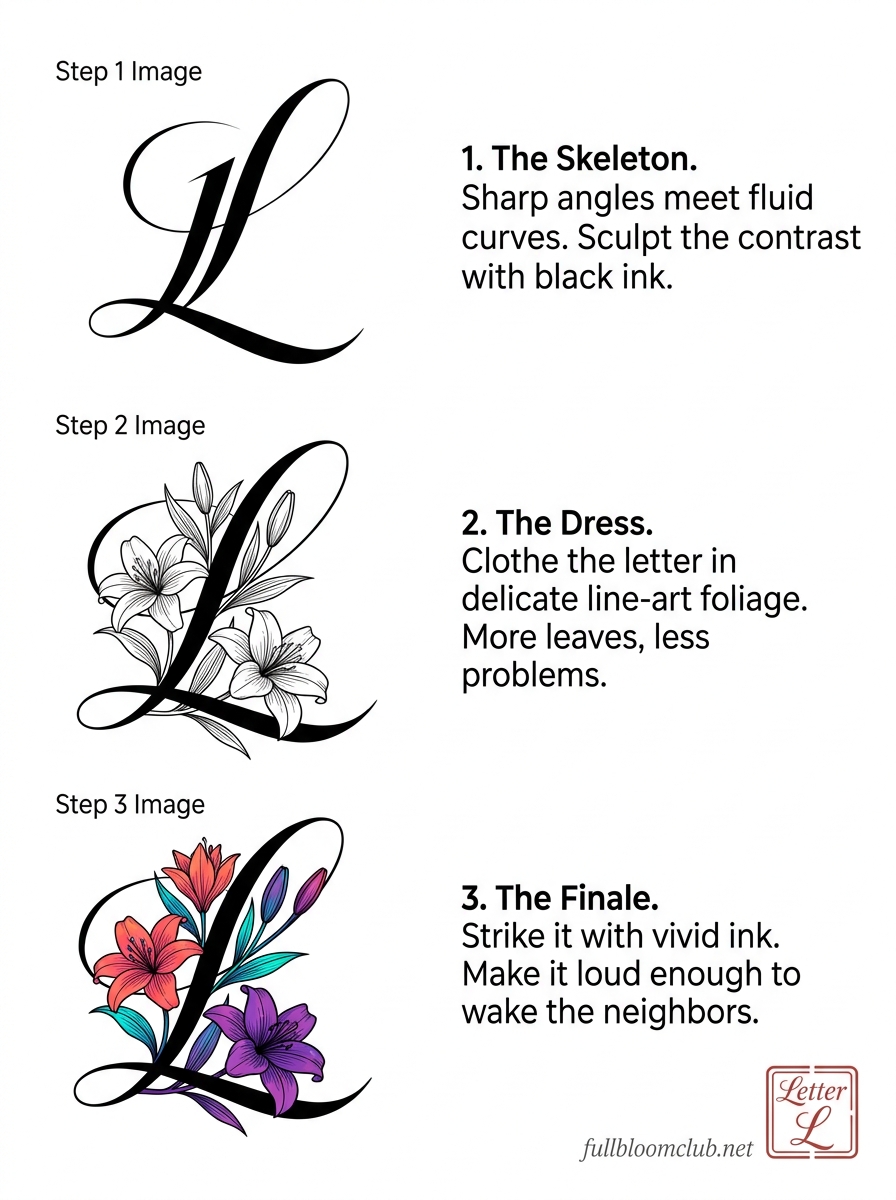
- The Skeleton. Lay down the crisp double lines. Keep the architecture clean and deliberate. If a letter is going in the middle, this is where it goes — built from two parallel strokes rather than one, so the letter has body instead of being a scratch.
- The Dress. Clothe the letter in delicate line-art foliage. More leaves, less problems. Work along the pencil ring, not inside it and not outside it. Leaves point outward from the circle, the way things grow away from a stem.
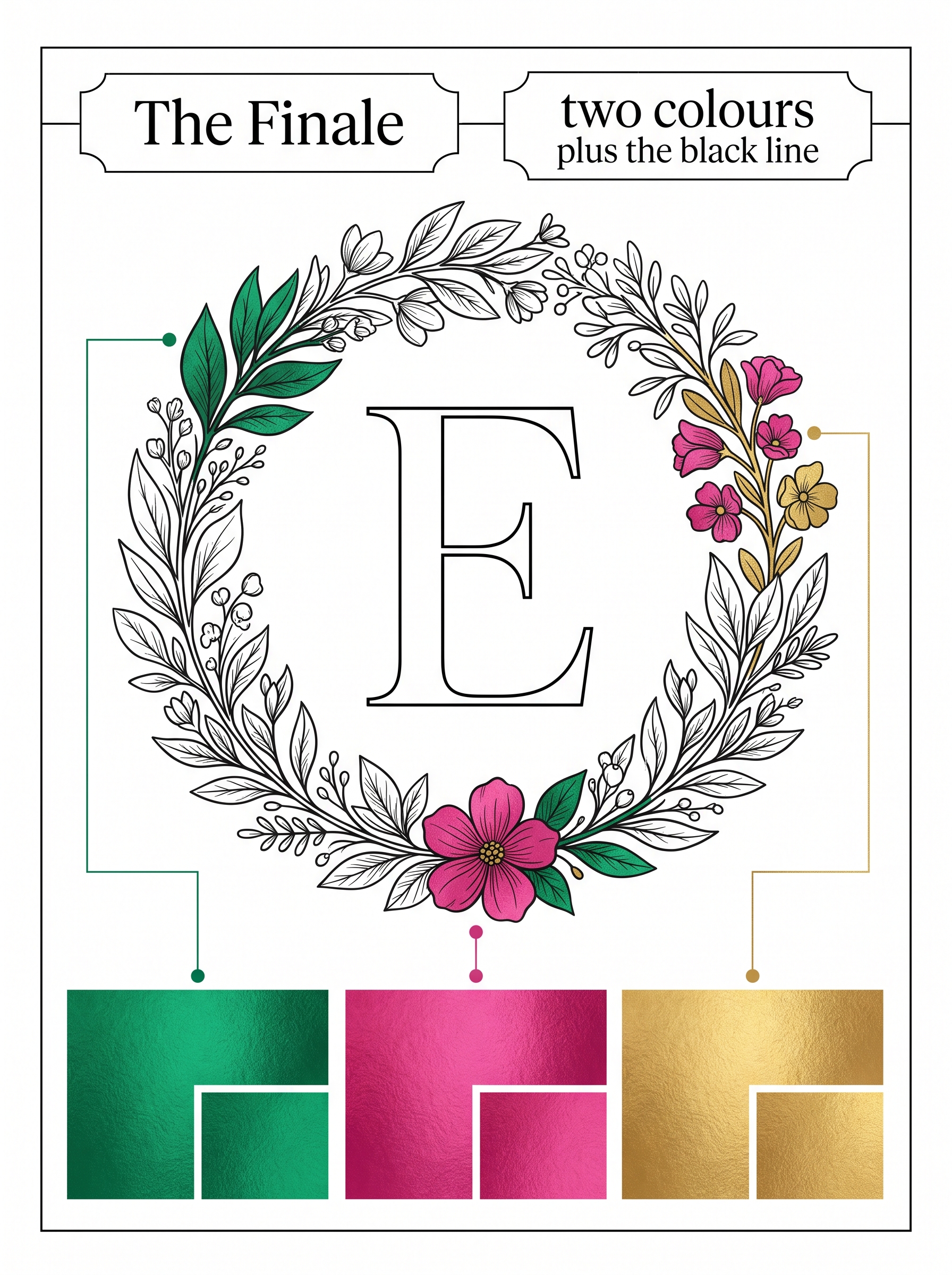
- The Finale. Strike it with vivid ink. Make it loud enough to wake the neighbours. Colour goes in last, in three places maximum, and the pencil ring gets erased at the very end — after the ink is dry, which I mention because I have twice not waited.
That is how to draw a wreath, in full, with nothing withheld. Four steps, and one of them is tracing a saucer.
 Save
SaveTracing the circle is not cheating. It is what the pencil ring was invented for, and the Egyptians had a rope.
Why Tracing the Ring Is the Professional Move
Here is the thing about the ring: nobody looks at it. Once the leaves are on, the circle disappears completely. It is scaffolding. Its entire job is to stop your leaves drifting into a spiral, which is what they will do if you draw them freehand, because a hand left unsupervised always curves inward and slightly downward. Ask me how I know.
The old carvers understood this. Grinling Gibbons, working in limewood at Hampton Court between 1699 and 1701, built festoons of flowers and fruit that hang down the panelling of the King’s Apartments — and his real trick was undercutting, carving behind the petals so light gets in underneath and the whole drop reads as though it is barely attached to the wall. In 1763 Horace Walpole wrote that there was “no instance of man before Gibbons who gave to wood the loose and airy lightness of flowers.” A man made lime trees look like they were floating. He did it by working to a fixed line and then hiding it.
The Ring Went on Heads Before It Went on Doors
The trail from a rope loop to a front door runs through a hat.
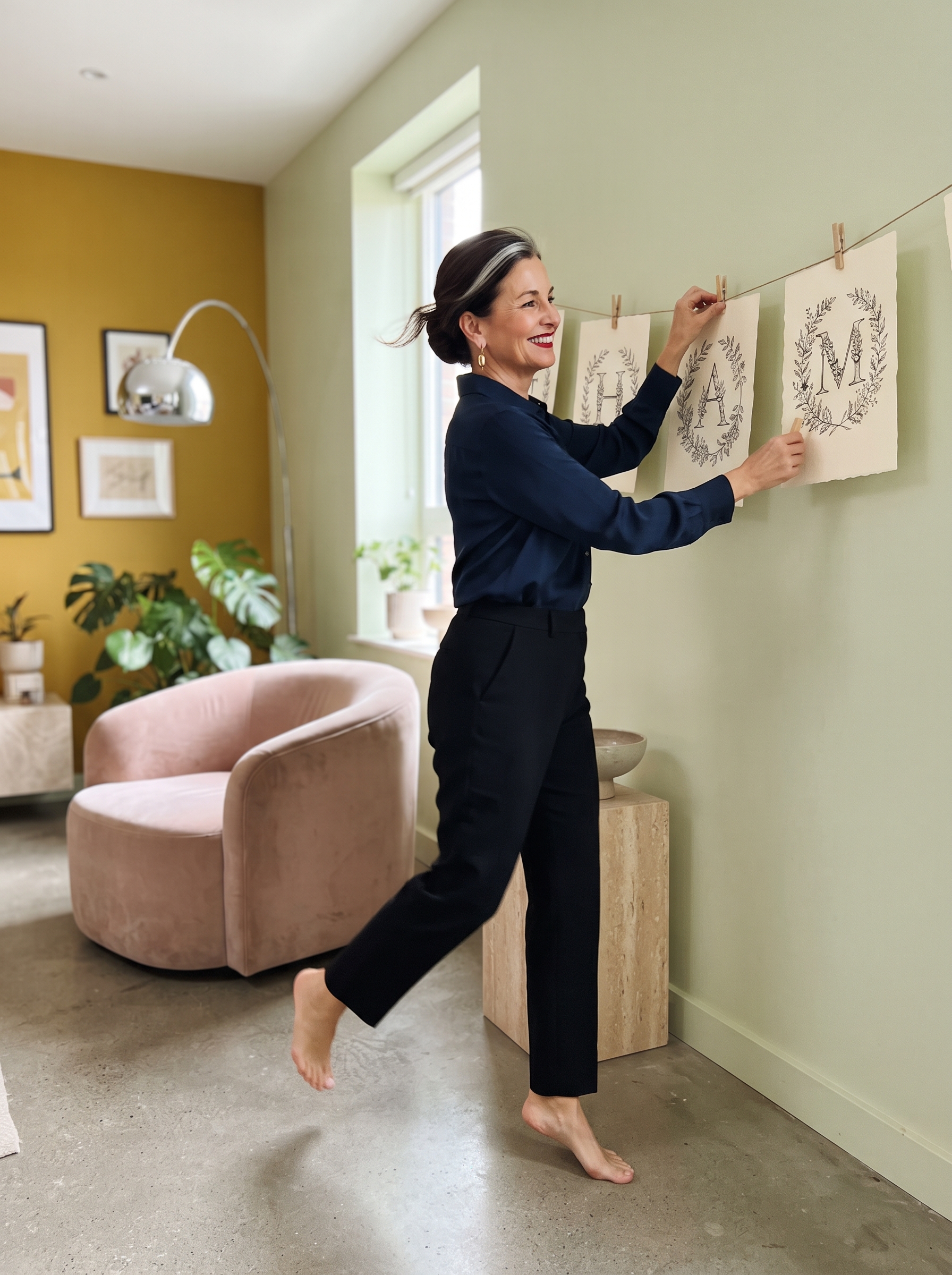 Save
SaveVictors at the Pythian Games were crowned with laurel, and the crown stuck around for two thousand years as the visible sign that somebody had done a thing well. The word survived even better than the object: laureate comes straight from the Latin laureatus, meaning crowned with laurel. Chaucer used the phrase “laureat poete” in the Canterbury Tales, describing Petrarch. A Nobel laureate is, etymologically and to this day, a person we have put leaves on.
So the shape has one consistent job across every culture that has picked it up. A ring goes around the thing being singled out. Egypt put it around a name, the Greeks put it around a head, and the eighteenth century hung it on a door — and at no point in that sequence did anybody suggest the leaves needed to be botanically accurate. Nobody has ever checked. This is the single most liberating fact in the whole discipline.
Two thousand years of the most prestigious object in Europe, and not one person asked which species the leaves were.
That matters when you learn how to draw a wreath, because it removes the only genuinely hard requirement. You are not illustrating a plant. You are making a ring out of leaf-shaped marks, and the marks are allowed to be from a species that does not exist.
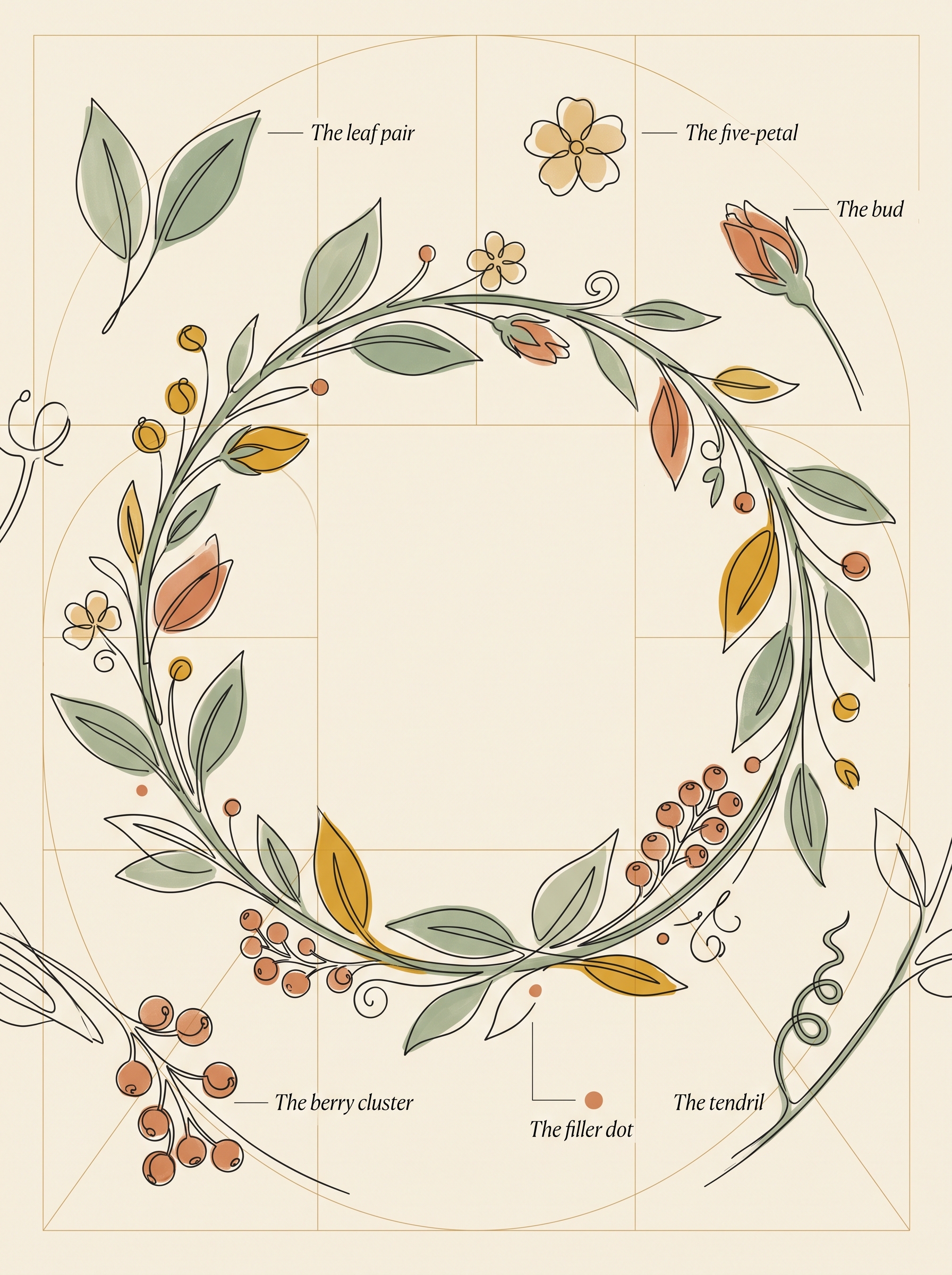
The Six Units That Fill Any Ring
Every wreath you have ever admired is six shapes repeated at different sizes. Not thirty. Six.
- The leaf pair — two mirrored leaves on a short stem. Your default. Fills more ring than anything else and asks nothing of you.
- The five-petal — a small open flower, drawn as a circle of five soft bumps. The one your eye reads as “flower” instantly.
- The bud — a teardrop with two little leaves at its base. Goes where a full flower would be too much.
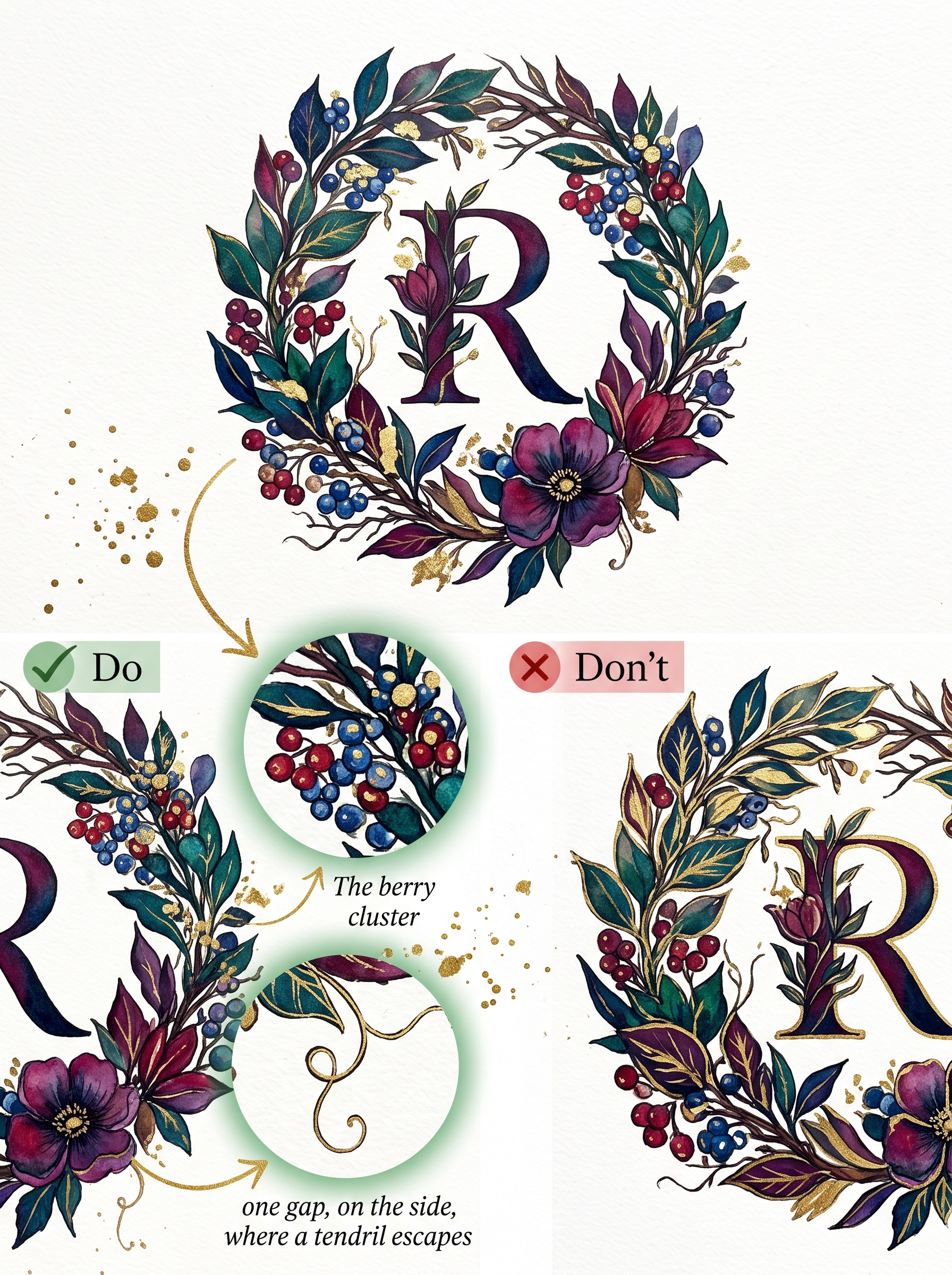
- The berry cluster — three to five dots on tiny stems. The rescue unit. Any gap that looks wrong gets berries.
- The tendril — one curling line, no leaves, spinning off the ring. The only unit allowed to break the circle.
- The filler dot — a single dot in a small empty patch. Not a mistake. A decision.
 Save
SaveDraw those six once on a scrap. That is the entire vocabulary. Everybody who has ever worked out how to draw a wreath has worked out those six shapes and then stopped looking for a seventh.
Where the Gaps Go — the Part That Is Actually the Skill
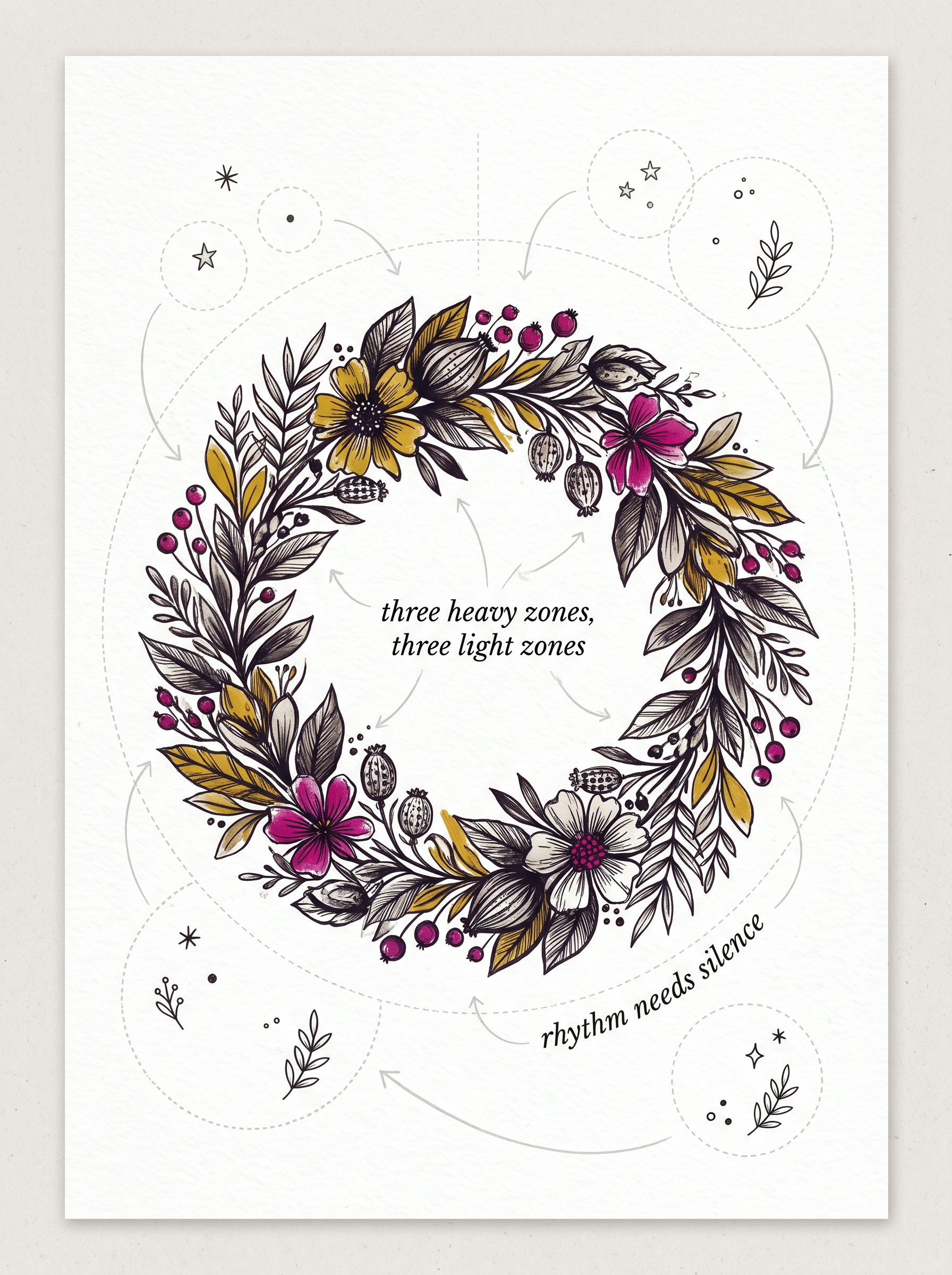
Beginners fill the ring evenly all the way round, which produces something that looks like a wreath but reads like a fence. The eye wants rhythm, and rhythm needs silence.
The rule I use: three heavy zones, three light zones, alternating. A heavy zone is a cluster of two or three big units touching each other. A light zone is one leaf pair and a lot of nothing. Put the heaviest zone at the bottom left or bottom right — never at the top, never at dead centre bottom, because symmetry is the fastest way to make a hand-drawn thing look printed and slightly sad.
 Save
SaveAnd leave the top open. A wreath with a deliberate gap at twelve o’clock looks designed. A wreath closed all the way round looks like it was drawn by someone who was worried.
A gap you left on purpose and a gap you ran out of leaves for look identical to everyone except you.
The Confession
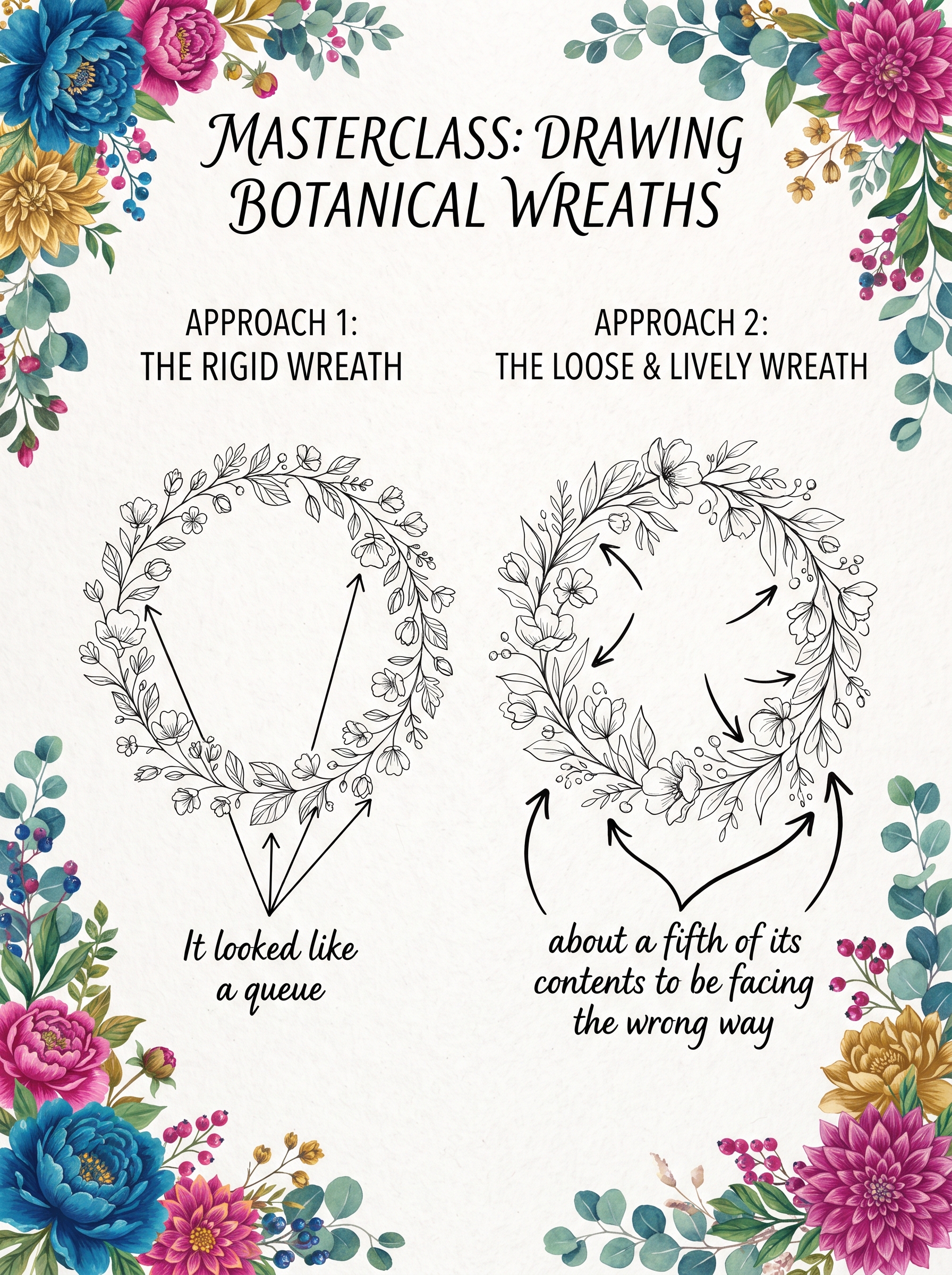
I once drew a wreath where every single flower faced the same direction — all 22 of them, heads turned politely to the right. I did not notice until I put it on the wall and my own eye kept sliding off it. It did not look like a garland. It looked like a queue.
The fix took four minutes: I turned six of the flowers to face outward and two to face into the ring, and the whole thing came alive. Not because it became correct. Because it stopped agreeing with itself. A wreath needs about a fifth of its contents to be facing the wrong way, and that is now the only rule I follow religiously and cannot explain to anyone.
The Letter in the Middle
 Save
SaveTHE AVANT-BLOOM ALPHABET. Anemones, orchids, and a capital letter wearing them like it was born to.
The set for the moment somebody you like has a birthday in four days and you have nothing, and the shops have exactly the thing you would be embarrassed to give. Every one of the 26 letters comes as three steps — the skeleton, the dress, the finale — so the page is never blank, it is only unfinished. Anemones get an unfair press, by the way: an anemone is a poppy that decided to stop being informal about it.
It is also the only collection here where the hardest part is stopping — the letter is done long before you have run out of places to put one more leaf, and admitting that is a personal problem I have not solved.
What you get: a monogram you can hand over on a Thursday, and the specific pleasure of watching somebody work out that a person made it.
Six Mistakes, in the Order People Make Them
Six ways learning how to draw a wreath goes wrong — and five of them happen before any ink is involved.
- Drawing the ring freehand. Then the leaves follow the wobble, and the wobble compounds. Trace it.
- Starting at the top. You will fill the top beautifully and arrive at the bottom with three leaves and a lot of regret. Start at the bottom left, work both directions.
- Same size all the way round. Three sizes minimum, or it reads as a border, not a wreath.
- Everything facing the same way. The queue. See above.
- Inking before the composition is settled. Pencil is free. Ink is a commitment you make once.
- Erasing too early. The pencil ring stays until the ink is properly dry. I have lost two good wreaths to impatience and one to a cat.
 Save
SaveFree Starter Pack
10 templates. 1 of them ends up framed.
Sent tonight. The first takes 12 minutes.
Unsubscribe in 1 click, no hard feelings
Which Wreath Is Easiest for a Complete Beginner?
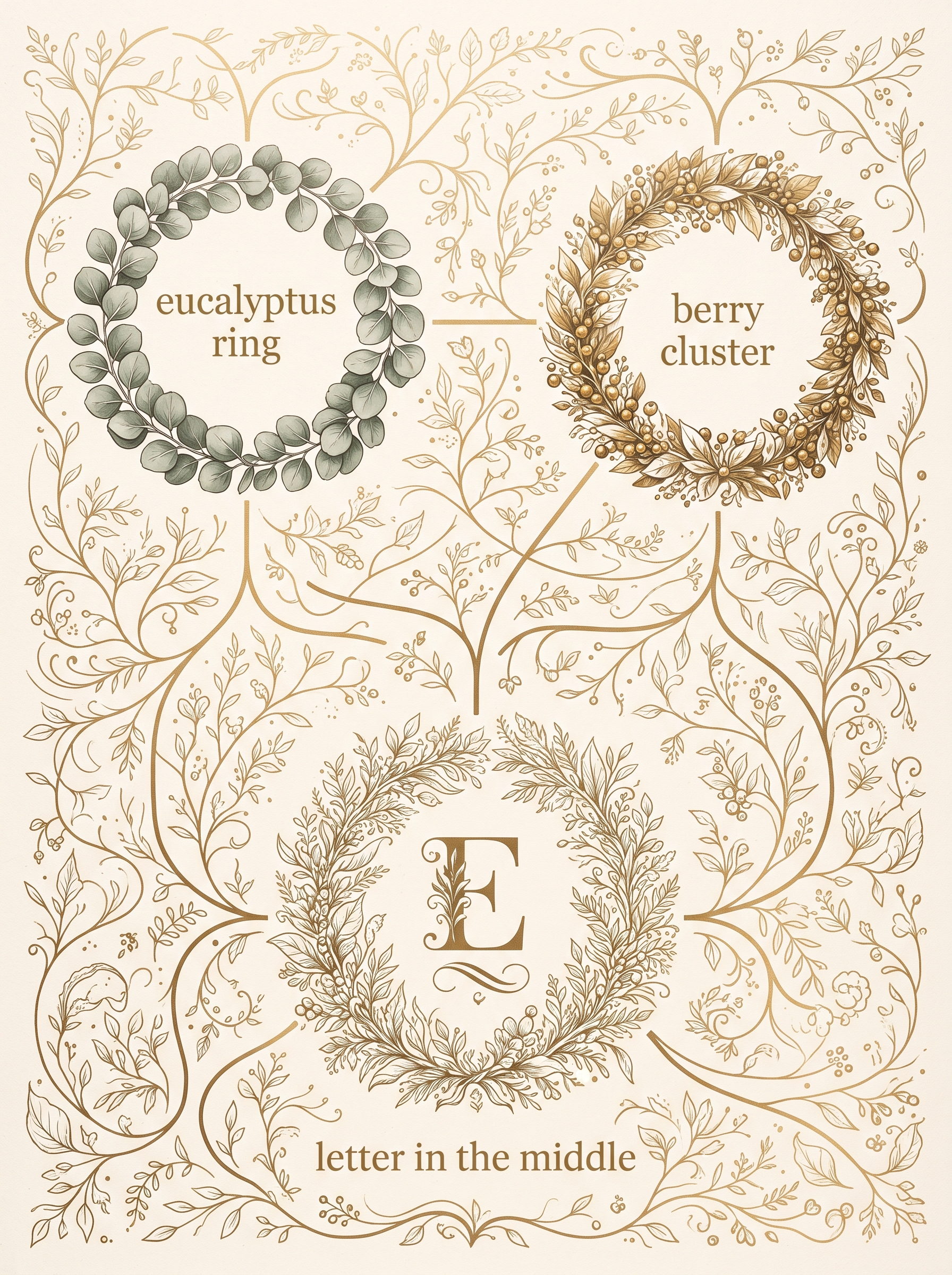
The eucalyptus ring — leaf pairs only, no flowers at all, three sizes, one gap at the top. It is six minutes of work and it is the one people ask about, because a wreath made of nothing but leaves looks restrained and expensive, and restraint is very hard to distinguish from taste.
 Save
SaveCan I Draw a Wreath If I Genuinely Cannot Draw?
Yes, and the reason is structural rather than encouraging. A wreath is a repeated small shape arranged along a line you did not draw. Nothing in it requires proportion, perspective, or a steady long stroke — the three things that actually separate people who draw from people who say they cannot. If you can draw a leaf twice, you can draw a wreath, because a wreath is a leaf drawn 20 times with the sensible parts spaced out.
Mary Delany would like a word here. At 72, having noticed that a piece of red paper on her table was the same colour as a geranium, she began cutting flowers out of paper — and made 985 of them, each built from dozens of separate hand-cut pieces, in ten albums now held by the British Museum. She called them mosaicks. She was not doing something difficult. She was doing something small, repeatedly, with attention. That is the entire technology.
She did not draw 985 flowers. She drew one flower, 985 times, and never got bored of the one.
How Do You Draw a Wreath With a Letter in the Middle?
Build the letter first, then the ring around it — the opposite order to everything above, and the only time that order changes.
The reason is spacing. A letter has a fixed width and a fixed height and it will not negotiate; leaves will go anywhere. If you draw the ring first and then try to fit a W inside it, the W arrives cramped and apologetic. So: pencil the letter in the centre at the size you actually want, then trace the saucer around it, then dress the ring. The letter sets the scale and the wreath agrees with it.
Two details that decide whether it looks made or bought. First, leave a clear margin of white between the letter’s outer edge and the innermost leaf — about the width of one leaf. Crowding is what makes a monogram read as clip art. Second, break the ring somewhere: one gap, on the side, where a tendril escapes. A closed ring around a letter is a stamp. An open one is a drawing.
What Pen Do I Need?
Any pen that will not skip. A fineliner around 0.3mm for the outlines and a slightly fatter one for the heavy zones is luxury, not a requirement — the drawing does not know what it cost. Colour is optional and works best when there is very little of it: two colours plus the black line beats six colours every time, which is the sort of thing that sounds like an aesthetic opinion and is really just about how eyes work.
Start With the Ring
Trace something round tonight. Put six leaf pairs on it, three berry clusters, and leave the top open. That is how to draw a wreath from nothing, and it took the pencil about as long as the kettle.
 Save
Save26 letters, three steps each, one traced saucer
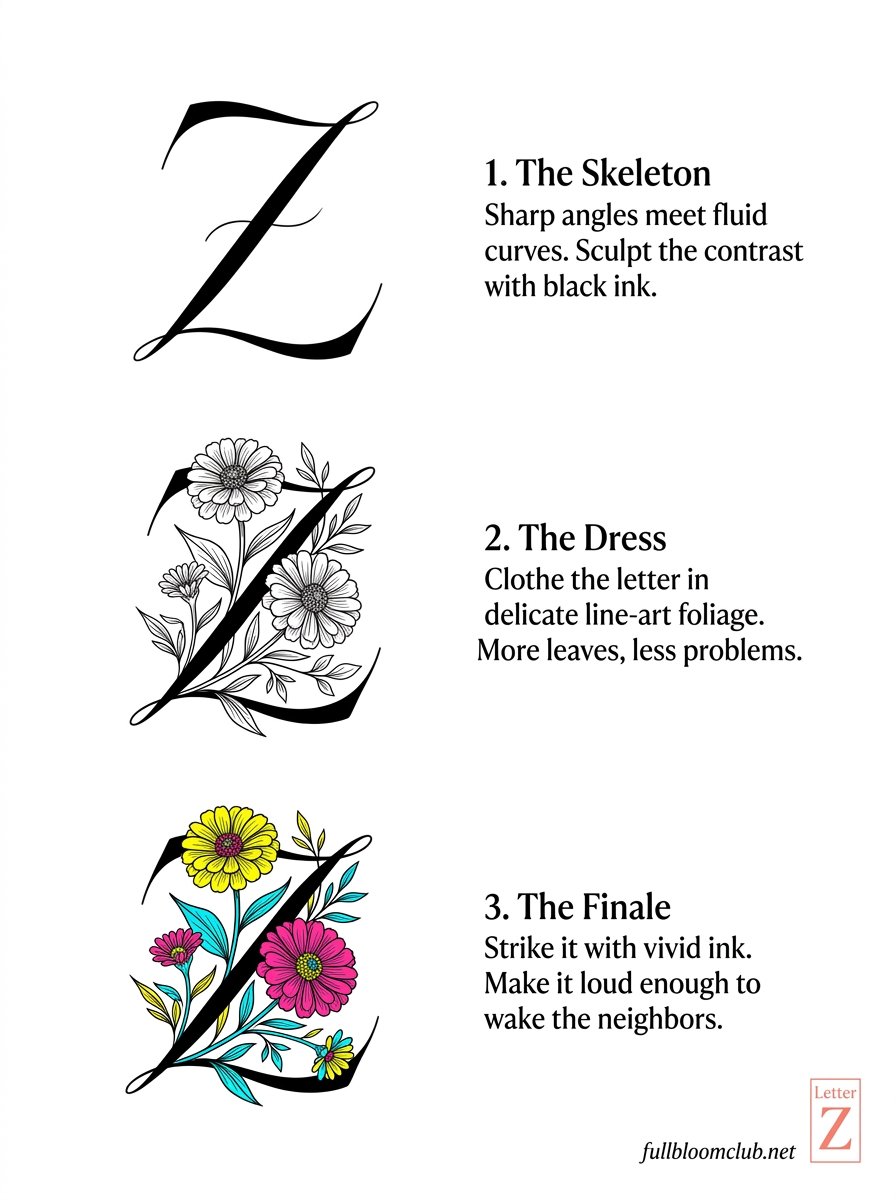
Tonight it is one letter on the kitchen table. By the weekend it is a name on a card somebody keeps, a monogram over the hallway hooks, and an initial framed for the person whose initial it is. The skeleton, the dress and the finale for every letter from A to Z.
Instant download · print as often as you like
That ring has meant one thing for 3,300 years: this one matters. Yours gets to decide what goes inside it.
Mirabelle wrote this. No training, strong opinions, many pens. Peer reviewed by a cat who disagreed and would not say where.