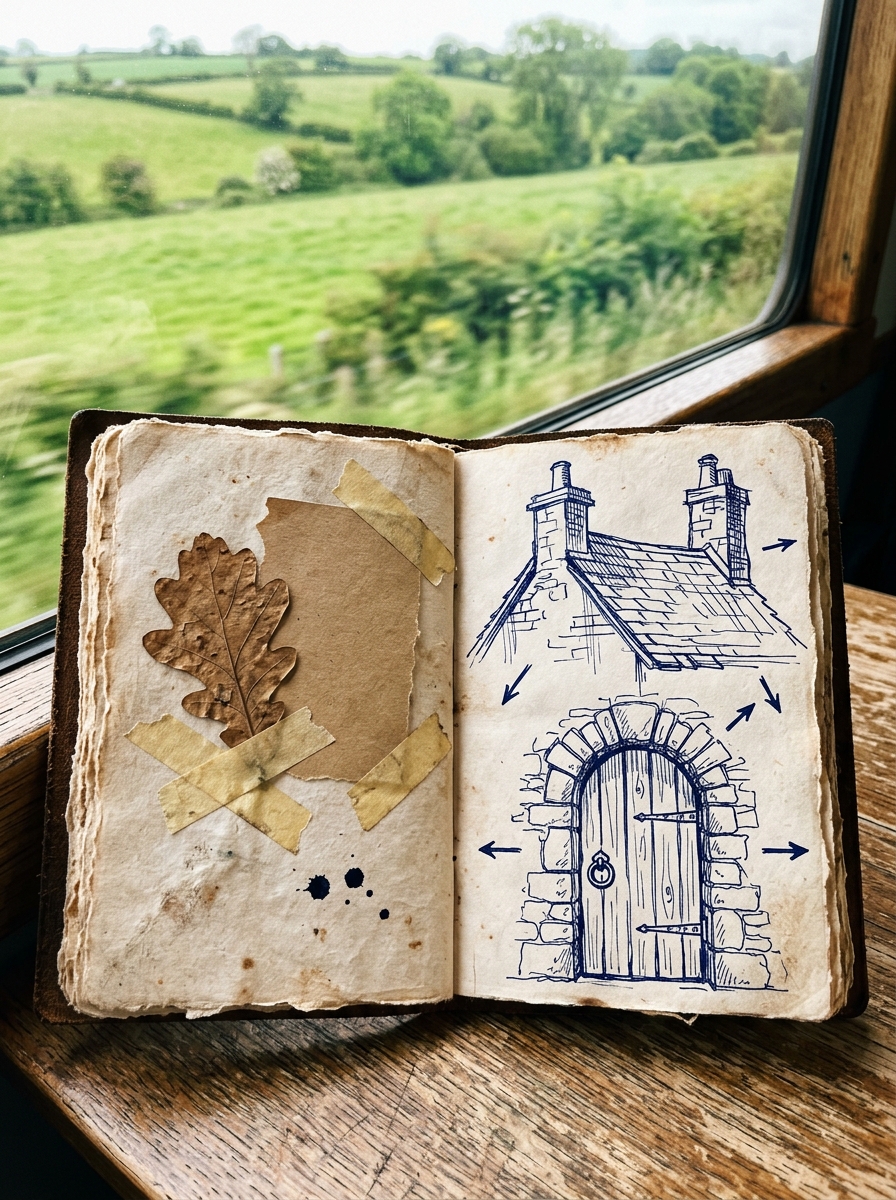
In 1486 a printer folded a page out to 160cm because the view would not fit in the book. Travel journal ideas nearly always arrive as a list of things to draw. That is the smallest part of the problem.
You will be tired. You will be moving. You will not pass this way again.
And the page has to hold things that are not drawings at all. A ticket. A price. A word you heard once.
A travel page is a container first and a drawing second.
(I have a journal from one trip. It has 4 beautiful pages at the front and 80 blank ones after day three. It is a lovely object and a record of nothing.)
Below: what to carry, what to write instead of colouring, and 207 ideas split 3 ways.
The sheet comes first.
Download the free seaside route map →

Print it at actual size, not fit to page. (The shrink-to-fit box arrives already ticked. Untick it.)
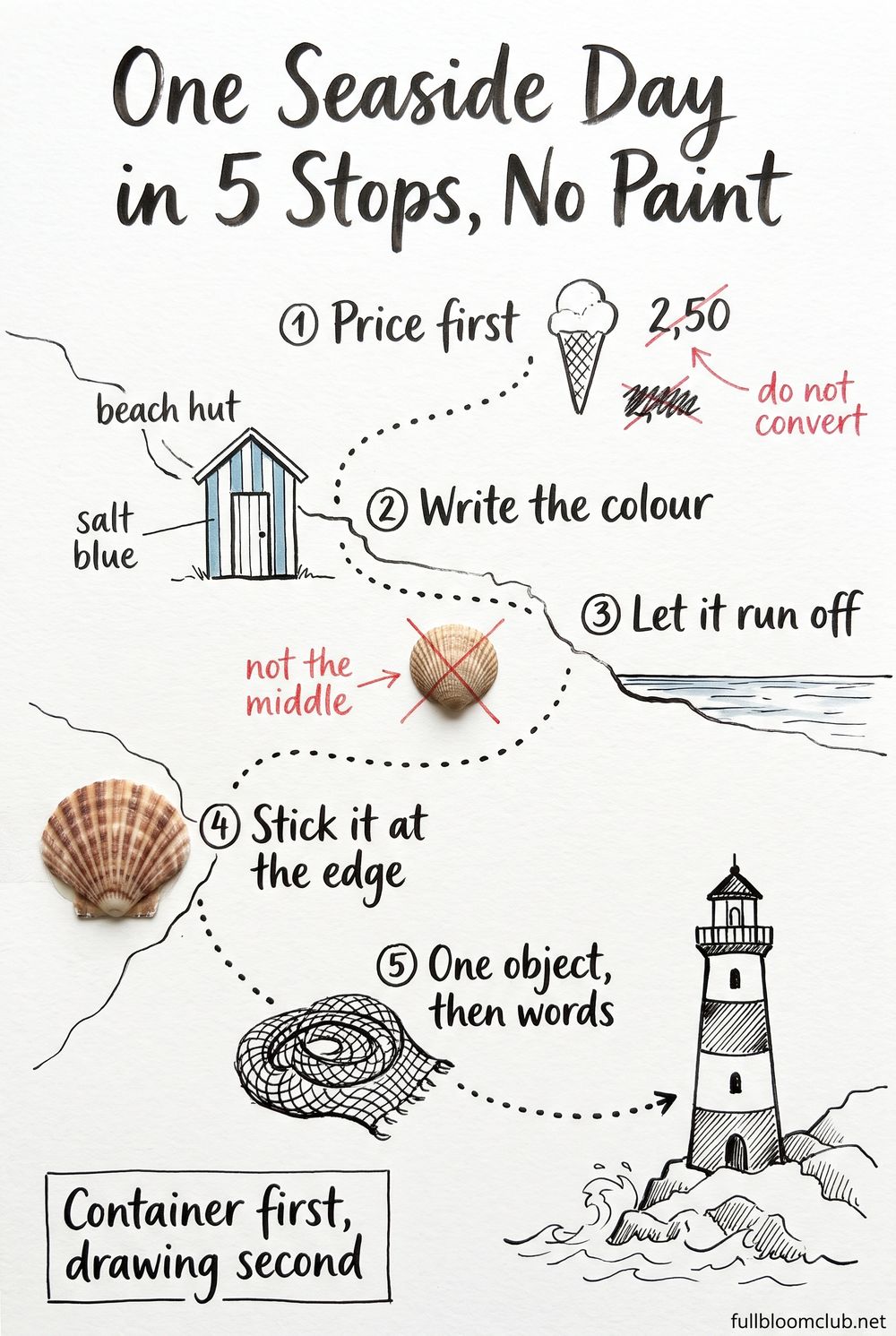
The sheet is one seaside day drawn as a route, 5 stops on a dotted line, ending at a lighthouse.
Each stop is one move. Price first. Then the colour. Then a view that runs off the edge on purpose.
The beach hut says salt blue on a leader line. You write the colour. You do not paint it.
Stop 4 glues a shell at the edge, and stop 5 draws one object before a single word.
The red pencil marks the two mistakes I make most. A shell stuck in the middle, and a price I converted.
Do the stops in any order. The page does not mind.
(Mine usually goes price, colour, view, and then the ticket a day late.)
One page a day is the rate that survives a trip. Two is ambition.
On a day with nothing in it, the stops still work.
Do one of them and leave the other 4 alone. That still counts as a record.
A sheet can draw you the route. What it cannot do is hand you a shape on the evening you get home. Tired, and still wanting to draw.

The Collection
30 flowers, and every one of them already knows its own shape.
CONTINUOUS LINE WONDER. Petals, stems, and one pen that will not stop. For the evening you are home from somewhere and your hand still wants to move. Inside: 30 flower worksheets. The bloom goes down as one continuous line. The stem and leaves follow as a second. What you get: one finished flower tonight, and a drawer of them by spring.
So the rest of this is what the page has to carry, heaviest thing first.
Travel journal ideas are 3 different objects, and mixing them is why the book stops
Nearly every guide treats the whole thing as one list. It is 3 lists.
A page is a layout. You decide it before you draw, usually sitting still.
A prompt is a question you answer in about 4 minutes, often standing up.
A drawing is a thing you looked at for longer than you meant to.
They cost different amounts of you, and that is the entire point.
(My 4 beautiful pages were all layouts. I had no prompts, so on a tired day there was nothing I could actually do.)
Sort them into 3, and a bad day still gets a page.
The heaviest thing to carry home is a whole view, so let it run off the page
A view is wider than any book you are carrying. Every single time.
So stop trying to fit it in. Start in the middle and work outwards.
Let both edges stay open. A view that runs off the paper reads as a view.

In April 1483 a party left Mainz for Jerusalem and came back the following January.
They had taken an artist with them, which almost nobody did.
He drew the towns as they went. Venice, Corfu, Rhodes, Jerusalem.
When the book was printed in 1486 it carried 5 fold-out woodcuts.
They were the first fold-outs anyone in the West had seen.
The Venice view is 30cm tall and 160cm long. The page had to fold to hold it.
(A book that admits the view is bigger than the book. I think about that a lot.)
He printed the first edition at his own house, and it was reprinted 13 times in 30 years. You can read about Erhard Reuwich and what he brought back.
The view was wider than the page, so they changed the page.
Colour is the one thing that will not travel, so write it down instead
Paint on a moving table is a mess, and you know it before you start.
So do not carry the colour. Carry the word for it.
Draw the outline in ink. Then write the colours straight onto the drawing.
Ochre, dusty. Rust on the hinge. Cold grey below. Green, almost black.
A ship’s artist worked exactly this way on a voyage that left England in 1768.
He came home with 269 finished watercolours and 674 outline drawings.
The 674 were not failures. Each one carried his notes on the colours.
Back in London, 5 artists worked them up from those notes alone.
743 copperplate engravings came out of it in the end. The whole set is Banks’ Florilegium.
(674 drawings nobody coloured in, and they all got coloured anyway. I find that settles the argument.)
4 colour words on a page will rebuild the whole thing later.

Pack the line and leave the paint at home
An English watercolourist crossed to Dieppe on 18 July 1817 and stayed 5 weeks.
He carried sketchbooks and drawing equipment, and no painting materials at all.
A watercolourist. On a drawing trip. With the watercolours left behind.
He went back in 1818 for 7 weeks, and again in 1820.
100 etchings were published out of those journeys in 1822, by John Sell Cotman.
Every one of them began as line, made on the spot, with the colour absent.
What goes in the bag: one pencil, one folded sheet bigger than the book, a glue stick.
Glue, not tape. Tape lifts in heat and takes the drawing up with it.
(I learned that on a page which is now 2 pages stuck firmly to each other.)

A ticket is the only thing on the page that was actually there
Everything else is your version of the day. The ticket is the day.
So it earns its place, and it still has to go somewhere sensible.
Stick it at an edge or a corner. Never in the middle.
A thing in the middle becomes the subject, and it is not the subject.
Draw around it, not up to it. Leave a finger’s width of clear paper.
Overlap 2 or 3 of them at a corner, and glue the bottom one down first.
(My best page is a bus ticket, a bill and a wrapper, all overlapping. The drawing on it is tiny and it does not matter.)

What the day cost is a drawing you can make in 10 seconds
Prices date a page far better than dates do.
Write the number the way it was written, in the currency you paid.
Do not convert it. Converting turns a real thing into arithmetic.
A coffee, standing up. The room for one night. Left luggage for 4 hours.
Put them in a narrow column down one side, with a tiny drawing beside each.
(I can still tell you what a coffee cost in a town I can no longer name. The column lasted longer than the memory.)
This is the part of a travel page that ages best, and it takes no skill at all.

Rule the index before you rule anything else
A full travel journal is unfindable. That is its normal condition.
There is a fix, and it is over 300 years old.
In 1685 a philosopher published a method for notebooks, in French.
The English edition followed in 1706, as A New Method of Making Common-Place-Books.
You give the inside cover 2 pages and rule them into a grid.
Down one side go the letters. Across the top go the vowels.
Every heading you write goes in by its first letter and its first vowel.
His own example: the head EPISTOLA goes under E and i.
You write the page number in that square. That is the entire system.
(It takes about 10 minutes on day one and I have never once regretted it.)
Do it before the book has anything in it, or it will never be done.

21 travel journal ideas for a page you plan sitting still
These are layouts. Decide one before the pen moves, not after.
A layout is what stops a page becoming one drawing marooned in white.
One big drawing in the middle, and the day’s paper scraps taped round the edge. The page split down the centre: morning on the left, evening on the right. A narrow strip down one side for every price you paid. One long view across both pages, running off both outer edges.
A grid of 9 small squares, one object in each. The map you were handed, torn to fit, with your route inked over it. A page for one meal: the plate, the glass, the bill. The window of wherever you slept, drawn from the bed.
A row of doors down the left margin, nothing else on the page. One page left blank on purpose, for the thing that has not happened yet. The whole page given to a single roof. Tickets overlapped like fallen cards, drawn over in ink.
A colour strip along the bottom: 4 washes, 4 written names. The page as a receipt, item by item, in the order you paid. A corner portrait of whoever sat opposite you. The same street corner drawn twice, morning and night.
A page of hands: yours, the driver’s, the one that brought the plate. Everything you could see without turning your head. The words you learned, each one drawn as the thing it means. A pressed thing taped down, with its shadow drawn around it.
The last page of the trip, saved for the journey home.
(Number 10 is the one I skip every time and then wish I had not.)
45 travel journal ideas you can answer in 4 minutes
A prompt is answered standing up, on a platform, with a bag on your shoulder.
Some are drawn and some are written. Both count as a record.

While you are moving:
Draw the seat in front of you. Write what the air smells like, in 3 words. Draw the shape of the window you are looking through. Note the time and what the light is doing. Draw the thing in your lap.
Write the first word you did not understand today. Draw the skyline as one unbroken line. Write what this journey cost, without converting it. Draw the pattern on the seat fabric. Note the name of the stop you have just left.
Draw whatever is hanging above you. Write the sound the doors make. Draw the back of the head in front of you. Write what you can hear with your eyes shut. Draw your own shoes from above.
While you are sitting somewhere waiting:
Draw what is on the table, including the salt. Write what you ordered and what actually arrived. Draw the chair opposite, empty. Write the price of one coffee here. Draw the roofline across the street.
Write the word for thank you, spelled as you heard it. Draw the glass with whatever is left in it. Write what the room costs a night. Draw the tiles under your feet. Write the name of the street you are on.
Draw the door you came in through. Write what the weather did between 2 and 4. Draw the plant in the corner. Write down something somebody said to you today. Draw the light fitting above the table.
(The one about what the weather did is the one that brings a day back. I cannot explain why it beats the view.)

At the end of the day, before you sleep:
Draw the contents of one pocket. Write the best thing you ate, in one line. Draw the key to the room. Write what you got wrong today. Draw the view from the bed.
Write the 3 colours you saw most. Draw what you carried all day. Write what tomorrow costs. Draw the shoes by the door. Write the one thing you would not have guessed.
Draw the bag, packed. Write what you will forget first. Draw the last thing you looked at. Write the day in one sentence, in the present tense. Draw the ticket for tomorrow.
141 things to draw when you will not pass this way again
These travel journal ideas are grouped by where you will be standing when you see them.
None of them needs you to be good, and all of them need you to be quick.
What moves under you, where you have about 90 seconds before the thing you are drawing leaves:
A train window, a fold-down table, a luggage rack. A ticket stub, a seat number, a folded map. A platform clock, a departure board, a bench. A bus handrail, a bell cord, a wing mirror.
A ferry rail, a life ring, a coil of rope. A tram wire, a stop sign, a kerb. A boarding pass, a passport corner, a stamp. A road sign, a mile marker, a bend.
A bicycle basket, a bell, a chain. A taxi meter, a dashboard clock, a hanging charm. A suitcase handle, a wheel, a label. A rucksack strap, a water bottle, a folded coat.
Where you slept, and I mean the room, not the view from it. (The view is in everybody’s photographs. The light switch is not.)
A room key, a number on a door, a handle. A bedside lamp, a folded towel, a kettle. A shutter, a curtain hook, a window catch. A radiator, a coat hook, a mirror.
A balcony rail, a washing line, a plant pot. A tiled floor, a skirting board, a light switch. A wardrobe door, a hanger, a spare blanket. A view of a wall, a gutter, a pigeon.

What you ate, and what it cost. I draw the bill more often than the meal, which says something I have decided not to examine:
A coffee cup, a saucer, a spoon. A wine glass, a carafe, a cork. A bread basket, a butter dish, a salt cellar.
A menu board, a chalk price, a napkin. A bill on a saucer, a coin, a note. A market crate, a paper bag, a weighing scale.
A fruit stall, a price card, a striped awning. A pastry, a paper wrapper, a trail of crumbs. A plate you finished, a fork, a folded receipt.
(The bill on a saucer is my favourite object in any country. It is always slightly wrong and always beautiful.)
The street, at eye level, which is the only height at which a town looks like itself:
A door knocker, a letterbox, a number tile. A shutter slat, a window box, a drainpipe. A street lamp, a wire, a hanging sign.
A cobble, a kerbstone, a drain cover. A bollard, a chain, a scooter. A cafe chair, a folded parasol, a table leg.
A tower roofline, a clock face, a weather vane. A bridge rail, an arch, a reflection. A stall awning, a rope, a peg.
What came home in a pocket. Every one of mine is still in a jar, and I could tell you where each came from:
A boarding-pass stub, a cloakroom tag, a bottle cap. A coin, a stamp, a matchbook. A pressed leaf, a feather, a pebble.
A sugar packet, a tea tag, a receipt. A shell, a sea-worn tile, a piece of string. A postcard, a torn corner, a paper band.
A hotel soap, a luggage tag, a hair grip. A pen lid, a paper clip, a folded note. A key you kept, a button, a spare coin.
Free Starter Pack
Get 10 free pattern templates for the pages that came home empty.
Sent tonight. Fills for an outline you made on a train and never finished.
Unsubscribe in 1 click, no hard feelings
A bank of things to draw solves the blank page on the road. It does not solve the evening you are home, unpacked, and still holding a pen.
30 flowers, each one already broken into its 3 moves


Every worksheet takes one flower apart. The bloom goes down without stopping. Then the stem and the leaves follow it. Print the faint guide when your hand is tired, or work beside the real thing. I keep the freehand ones.
Instant download · print as often as you like
Which travel journal ideas work when the day was completely ordinary?
Ordinary days make the best pages, and nobody believes that until later.
Draw the thing you used most today. A cup, a handle, a key.
Write what it cost and where you were standing.
A page about a bus stop you waited at twice will outlast a page about a cathedral.
(The cathedral is in everybody’s photographs. The bus stop is only in yours.)
Ordinary also means quick, which means the page actually gets made.
How do you start a travel journal entry without staring at the page?
Never start with the day. Start with one object in front of you.
Draw it before you write a single word. The writing comes easily afterwards.
If nothing is in front of you, put down the price of the last thing you bought.
A number on a blank page removes the blankness immediately.
(I start with the price about half the time. It is the cheapest possible first mark.)
Then the colour words, then the view if there is one. In that order.
A page made on a train is not a worse page. It is a page with the day still moving through it. Let the line wobble where the road did. Write the colour you would otherwise lose. Stick down the one paper thing that was in your hand. The book will hand back the trip you took, not the one you tidied.
“Had not been idle from the time he left England, having finished 100 drawings on various subjects, and taken sketches of many more.”
A Journal of a Voyage to the South Seas · 1773
Mirabelle wrote this. No training, strong opinions, many pens. Peer reviewed by a cat who inspected the open suitcase and declined to get out of it.