

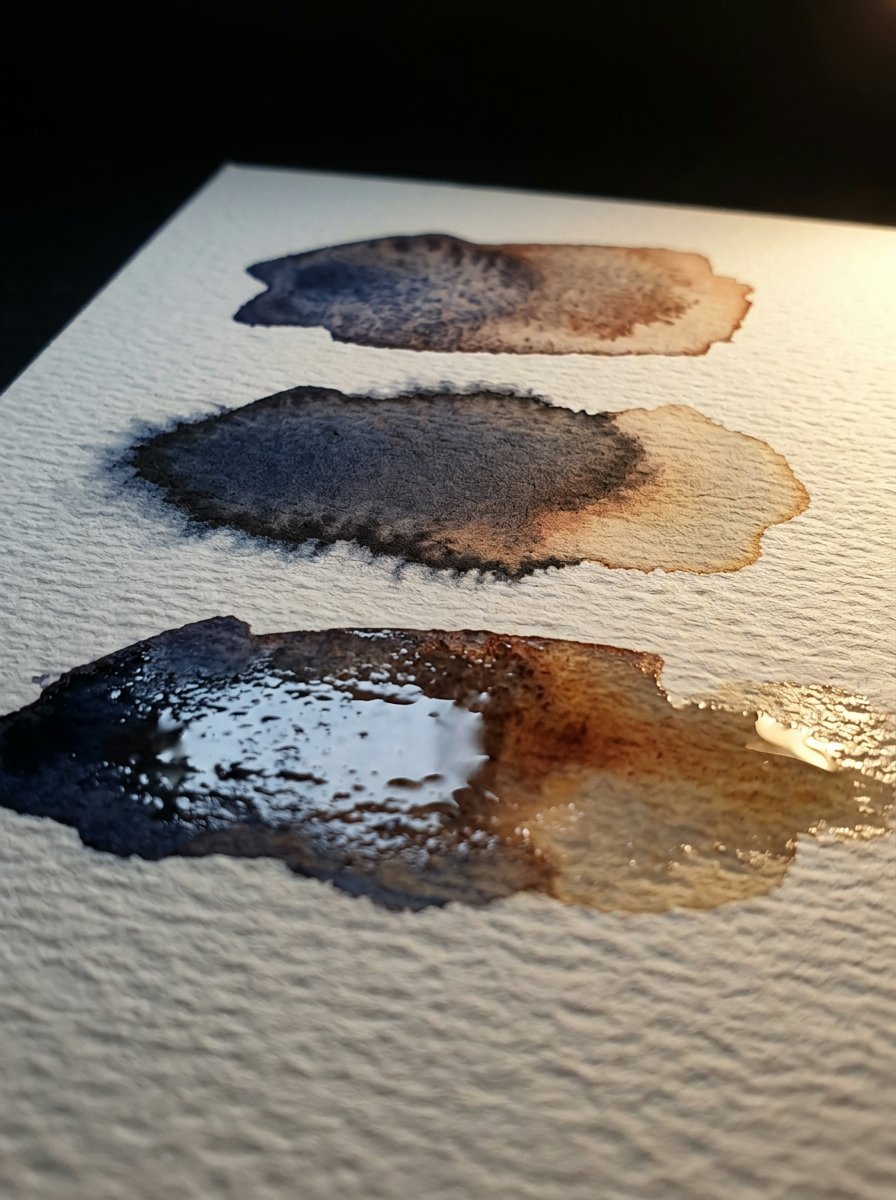
I get about 30 seconds of usable time and I have just spent 12 of them hunting for a tissue. Abstract watercolor for beginners is not a drawing problem. It is a clock problem.
Put a wash on paper and it starts leaving straight away.
For about half a minute it is still a puddle. Anything you drop in will travel.
Then the shine goes off the surface, and the same drop sits exactly where it lands.
Nothing about the brush changed. The paper did.
(I blamed my brushes for a month. The brushes were fine. I was 40 seconds late.)
Below: what the wet window does, and what 4 painting manuals wrote down about it.
Then 83 washes, sorted by the window each one needs.
The wash clock card is first.
Download the free wash clock card →

Choose actual size in the print box, never the option that scales it down.
(It will offer to shrink it. The margins it invents are nobody’s margins.)
The card splits one drying wash into 4 windows.
Window one is the puddle. The surface is glossy and the water is still moving.
Window two is the sheen going off. The gloss patches out and the edge stops travelling.
Window three is damp. Matte, cool, and still soft underneath.
Window four is bone dry. It takes a hard edge and gives nothing back.
It is a card and not a list because you hold it against the paper.
Tilt the sheet to the light. The gloss tells you the window. Nothing else does.
I keep mine propped behind the water jar, which is the only place I reliably look.
That is most of abstract watercolor for beginners: knowing which window you are in.
It still does not tell you what to put in the window.
And at 9pm the missing part is never the technique. It is the shape.
What the card cannot hand you is a wash already broken into panels that say wet or dry.

The Collection
33 washes already broken into panels, and every panel says wet or dry.
MODERN WATERCOLOR. Geodes, horizons, and one jellyfish that behaves. For the evening you want the timing settled before the brush is wet. Inside: 33 step sheets, each with its colour strip and its panels. (Every panel says wet-on-wet or on dry, which is this article on a worksheet.) What you get: a wash you can start at 9pm, and a piece flat enough to frame.
Now the windows, in the order the paper goes through them.
Second 0: the wash is a puddle and it has not decided anything
A fresh wash is water sitting on a sized surface. It has not soaked in.
It is a shallow pond with a skin, and it moves as one piece.
Drop colour in now and it goes travelling. You are not placing it. You are releasing it.
This is the only window where the paper does the drawing for you.
Francis Nicholson set it down in 1823, in The Practice of Drawing and Painting Landscape from Nature, in Water Colours.
Wet the whole sheet, he says, then lift the surplus off with blotting paper.
Wait until the shine has gone. Then colour stays where the brush puts it.
When he wanted the opposite, he wet the back of the paper to slow the drying.
Two directions, one control. He was managing the clock, not the brush.
A wash is not a mark you make. It is a mark you start and then negotiate with.
(I tilted a puddle to fix it once. It is still over there.)
So window one is for travel. Big soft shapes, no edges you care about.
The clear-water field is water with almost nothing in it. Start here. The single drop bloom wants the brush touched on and lifted at once. The two-colour meet needs both colours equally wet, or the drier one wins. The tilted run wants the board propped on a book and then left alone.
The back-run halo is the scar made on purpose. Load the brush wetter. The sinking pigment uses a heavy granulating colour and no stirring at all. The dropped second colour goes in while the first is still glossy, once only. The feathered edge is what a wash does alone once you stop fussing it.

That is 2 washes held up to the light. The overlap is the darker one.
Every layer subtracts from the white. There is no white paint coming later.
The soft horizon is 2 bands meeting wet. The join is the whole piece. The sky band wants the board tipped away so colour gathers at the bottom. The smoke plume is one stroke into clear water, then not touched again. The spreading star goes down from a single loaded point. Put it down, step back.
The bleeding square is a wet block that softens at every corner. That is the point. The double puddle bridge joins 2 puddles with a thread of water. Colour walks across. The heavy-to-light pull starts loaded at one end and is pulled out with a damp brush. The pooled corner is a tilted wash gathering, and then you approving of it.
The rocking wash tips the board gently 2 ways while everything is still wet. The wet seam should be invisible or obvious. Never nearly. The drifting comma is one confident curve laid into a damp field. The loose lozenge needs the paper wetter than the brush. That softens the corners.
The blurred bar is a wide stroke that loses both ends in clear water. The creeping tide lets colour in at one edge and walk inward on its own.
Abstract watercolor for beginners lives in the 30 seconds while the sheen is there
Tilt the paper towards a lamp and a wet wash throws back a hard gloss.
That gloss is the instrument panel. While it is there, the wash can still move.
Colour dropped in now spreads a little and stops. Edges go soft, not runny.
This is the good window, and it is short.
Aaron Penley called quick drying “a great evil” in 1870, in Sketching from Nature in Water-Colours.
Damp the paper, then lift the water off with blotting paper.
He kept a thick sheet on the board, because thick paper holds moisture longer than thin.
The matte-damp stripe is laid the moment the gloss patches out. It holds its width. The soft-edge disc is a circle with no hard rim. Harder than it sounds. The quiet halo is the pale ring round a lift. Lift once and leave it. The lifted window is a rectangle taken out with a thirsty flat brush.

The ladder above is one wash, top to bottom. Only the edge changes.
The dotted line on it marks where each edge was meant to be.
Each rung names the window that made it. The edge is the tell, not the colour.
Read your own edges back and you can date every wash you have made.
(Penley is quietly telling you the paper is the timer. I wish somebody had said so sooner.)
The blotted light is blotting paper touched on and lifted straight up. Never dragged. The pressed fold is a crease in damp paper. Colour gathers along it. The damp granulation needs a coarse pigment, paper with tooth, and no interference. The half-held edge is softened on one side only. That is how light reads.
The slow bloom arrives late. Drop it in and go and do something else. The muted overlap lays a second colour across the first as the gloss dies. The settling band goes heavier at its lower edge if you let it. The dulled corner is deliberately muddied, and it anchors a floaty page.
The sunk dot is one dot into damp paper. It sinks instead of spreading. The damp comb is a fan brush drawn once across a damp field. The receding wedge is a triangle that fades as it goes, in one pass. The thumbed edge is clean thumb pressure on damp colour. A real technique.
The cloth-lifted patch takes more than blotting paper does. Use a folded cloth. The shy bleed barely happens. Restraint is the whole exercise. The stalled run stops halfway. Tip the board back level to stop it. The held crescent stays thick at one point while the rest thins away.
The quieted seam is a join softened afterwards with a barely damp brush.
The moment the shine goes is the moment the wash locks
There is a point where the surface turns matte and stops taking instruction.
Touch it after that and you do not blend. You dig.
A wet brush into a locked wash shoves the sunk pigment aside and leaves a pale scar.
That scar is a back-run, and it is the most common ruined evening in watercolour.
It is also, once you can make it on purpose, one of the best marks in the medium.

The card above is that mark twice. On the left it is an accident.
On the right it is clear water dropped in deliberately, and it is the better mark.
Load the brush wetter than the wash and it happens every time.
(I have made every one of these by accident. The card was cheaper than the accidents.)

The dial above is the other half of the clock. Angle decides where water goes.
Nicholson worked at a moderate slope and started at the top.
You follow the bead down and it lays itself flat. Flat on purpose is a slope.
Penley turned the paper upside down once a wash was quite dry, then worked the far end.
John Heaviside Clark wrote the timing out in 1836.
It is in his Practical Essay on the Art of Colouring and Painting Landscapes in Water Colours.
For a soft edge, work while the edge is wet and turn the brush at once.
For a light, do the opposite. Wet the spot, wait until it is nearly dry, lift with bread.
Bread, because a crumb lifts sunk pigment without scrubbing the sizing off the paper.
Same tool, 2 moments, 2 opposite results.
Penley lifts a light a third way, and his is the fastest.
Fold blotting paper and touch its sharp edge in while the wash is still wet.
The colour comes away softly and the white of the paper comes back.
Abstract watercolor for beginners goes wrong on damp paper, not wet paper
Wet paper is honest. It looks wet, so you treat it as wet.
Damp paper looks finished. It is matte, it is pale, and it is lying.
Underneath, the sizing is still soft and the pigment is still loose.
Put a confident second wash on damp paper and the first comes up into it.
That is the muddy middle everybody gets and nobody can explain afterwards.
George Barnard put it in one clause in The Theory and Practice of Landscape Painting in Water-Colours.
His words: “if too dry the colours will not float or blend”.
The sentence cuts both ways, and the second half is the one that costs you.
He damps the paper front or back, then floats the wash on while it is still damp.
He also notes that a slight slope of the board much assists.
(3 manuals, 3 decades apart, all quietly obsessed with a board being tipped a bit.)
So the damp window is for waiting, and waiting is the skill nobody sells a brush for.

If you want a drawing under a wash, put it there faintly and early.
Grid the small study, not the big sheet. Then carry the shapes across square by square.
Graphite under a dry wash stays put. Under a wet one it floats and greys the colour.
Draw it, knock it back with a putty rubber, then wet the paper. In that order.
Bone dry is a different material, and it is the one that takes an edge
Dry paper gives the hard edge, and a hard edge is what makes a wash look deliberate.
Lay a second colour over a dry first and both stay visible. That is a glaze.
Glazing is the only way to get depth in a medium with no white paint.
Test it with the back of your hand, not a fingertip. The back feels cool first.
If it is cool, it is not dry. Cool is window three wearing window four’s clothes.
Barnard’s own list of what colour does is worth reading aloud, because it is all verbs.
Put on full or dry. Floated. Blotted. Dragged.
Not one is about what you are painting. All 4 are about how wet it is.
(That list reorganised my whole shelf. I own fewer brushes now and better paper.)
Nobody in these manuals talks about talent. They talk about moisture, constantly.
The hard-edge tile is a square glazed over a dry square. The overlap is the drawing. The first glaze must be dry underneath or it lifts, and you will see it. The second glaze goes on faster than feels right. A slow brush disturbs the first. The stacked square is 3 or 4 squares built up, each one waiting its turn.
The crisp crescent is cut with the side of a round brush, in one movement. The dry-brush drag needs a brush squeezed nearly empty, dragged fast over dry tooth. The scraped rib is scratched out with a fingernail once everything is properly dry. The lifted ring is a circle taken from a dry wash with a damp brush.

The chart mixes each pair twice. Once wet in the puddle, once as a dry glaze.
Same 2 colours, 2 results. Wet mixing gives you one new colour.
Dry glazing leaves both visible through each other, which is why it looks lit.
The taped band is masked with tape. Pull the tape slowly, at a low angle. The cut horizon has no softness in it anywhere, which is why it reads deliberate. The reserved white is bare paper you protect early. You cannot add it later. The overlapped pane is 2 transparent rectangles crossing. The cross is a third colour.
The layered lozenge is glazed twice with one colour to double its depth. The sharp wedge has one cut edge and 2 left soft from an earlier window. The dotted field is small dots on dry paper. They stay the size you make them. The pale scaffold is a first wash you mostly cover. It still changes everything above.
The deep well is 4 glazes of one colour in one spot. It goes nearly black. The printed edge is the crisp rim a wash leaves when it dries undisturbed. The negative bar is the gap between 2 dry shapes doing the work of a line. The granulated slab is a coarse pigment left to settle inside a dry-edged block.
The abstract watercolor for beginners washes that need 2 sittings
Some washes cannot be finished in one go, and those are usually the good ones.
They need a wet layer, a real gap, and then one dry decision on top.
The gap is not patience for its own sake. It is the sizing hardening again.
An hour will do it in a warm room. Overnight is safer and costs you nothing.
(I have ruined more washes in minute 40 than in any other part of the evening.)
The built geode is wet rings inside one another, then a dry glaze to sharpen the rim. The banded horizon is 2 wet bands, dried overnight, then a third glazed across. The deep terrazzo drops chips on dry paper. Wet paper turns them to soup. The split field works one half wet and the other half dry, on purpose.

The map above is the whole sequence. One wet sitting, one gap, one dry sitting.
The second sitting is one decision long. I always want it to be three.
The weighted corner gathers a tipped wash into one corner, then glazes it again. The gradient ladder is 5 steps from full colour to clear water, each dried first. The ring on ring lays a dry ring over a wet one. It reads as glass. The tide line keeps the hard line a wash leaves, then builds on it.
The folded map is a soft field with dry creases ruled across it afterwards. The quarry face is a granulated block with hard steps cut into one side. The marbled seam drops 2 colours wet, then veins them with a dry liner. The stone slab is a heavy flat wash with one dry-brushed edge for weight.
The dusk band is a wet gradient with a dry band glazed across its darkest part. The cold shoulder is kept deliberately unbalanced, then anchored once dry. The warm gutter leaves a warm channel between 2 cool blocks. Keep that white clean. The shadowed pane glazes a rectangle over a soft shape, so the shape sits behind.
The salted plain is a granulating wash left completely alone for an hour. The veined block lifts pale veins from a dark block once it is bone dry. The banked cloud is a soft mass with one hard underside. The hard edge goes last. The long estuary is mostly water. It takes the longest to dry, every time.
Free Starter Pack
Get 10 free pattern templates for the flat half of a dry wash.
Sent tonight. Small fills that sit on dry paper and stay put.
Unsubscribe in 1 click, no hard feelings
Those fills are for the flat areas a dry wash leaves behind.
And a flat area is most of what an abstract wash actually is.
Which of the 83 are actually worth framing
The title promises washes worth framing, so here is the honest filter.
A wash survives a frame when it holds one clear decision and one clean edge.
The abstract watercolor for beginners washes that hang well were made in one window.
Everything in window one with a clean outer edge. Everything in window four that got its glaze.

Those are 5 finished washes, lying down, waiting to go up.
A mount kills anything fussy. Behind glass, a busy wash reads as a smudge.
Window two is the one to watch, because soft everywhere reads as unfinished.
Give a soft wash one hard edge and it stops apologising.
The watercolour technique post covers the handling side of this.
This page is only about when, which turns out to be most of it.
(I frame the ones I could not repeat. That is not sentiment, it is a filing system.)
33 washes with the wet steps and the dry steps already separated


Pick one tonight and read its panels before you wet anything. Each sheet gives the colour strip, the order, and what the paper should be doing. Paint it once exactly as written, then paint it again and change one window. The second one is always the one I keep.
Get the Modern Watercolor Collection →
Instant download · print as often as you like
Water has somewhere to be. Give it the 2 minutes it is asking for. It will lay itself flatter than any hand could manage, then quietly leave the room.
“This quick drying is a great evil.”
Aaron Penley, Sketching from Nature in Water-Colours, 1870
Mirabelle wrote this. No training, strong opinions, many pens. Peer reviewed by a cat who walked through a wet wash and left a considered opinion along the hall.