

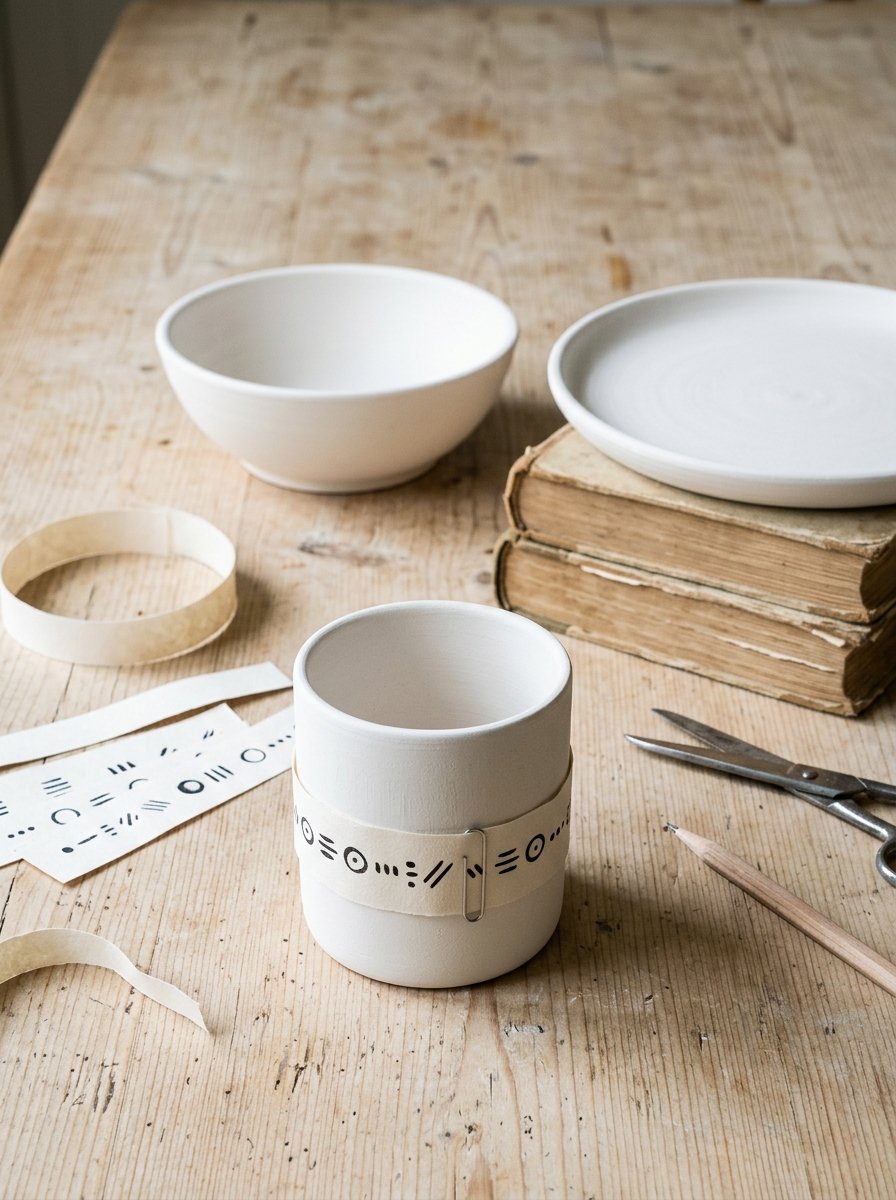
The man they called the Raphael of maiolica lifted his scenes straight out of a printed book. The best paint your own pottery ideas get decided long before you walk into the studio.
That is what paper is for. You draw it at home, then copy it onto the piece.
Most paint your own pottery ideas go wrong for one reason. The colour in the little pot is not the colour it will be. You paint in chalky grey and the kiln decides later.
(I once painted a mug the colour of wet cement. It came out cornflower blue. I have never been so relieved by a household appliance.)
So the useful work happens before you arrive.
Here is the order that works. Pick the piece, measure its curve, trace the design, then paint in sequence.
Start with the free sheet. It carries 49 designs, drawn small and drawn to be traced.
Download the 49 designs to trace →
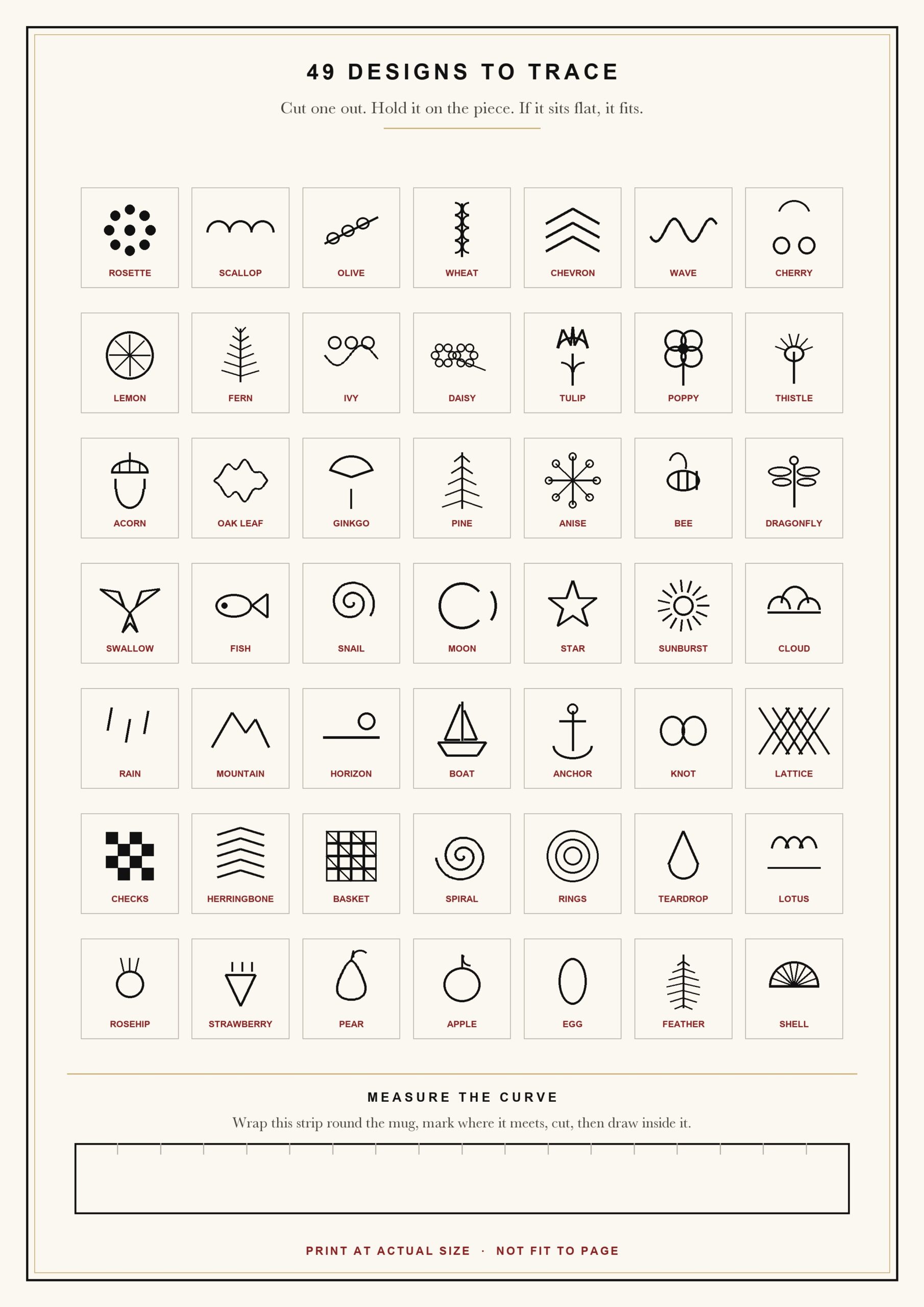
Set the print dialogue to actual size, never fit to page. (Shrink it by a few millimetres and the strip stops matching the mug.)
Cut out the one you want. Hold it against the piece. If it sits flat on the curve, it will sit flat on the pot.
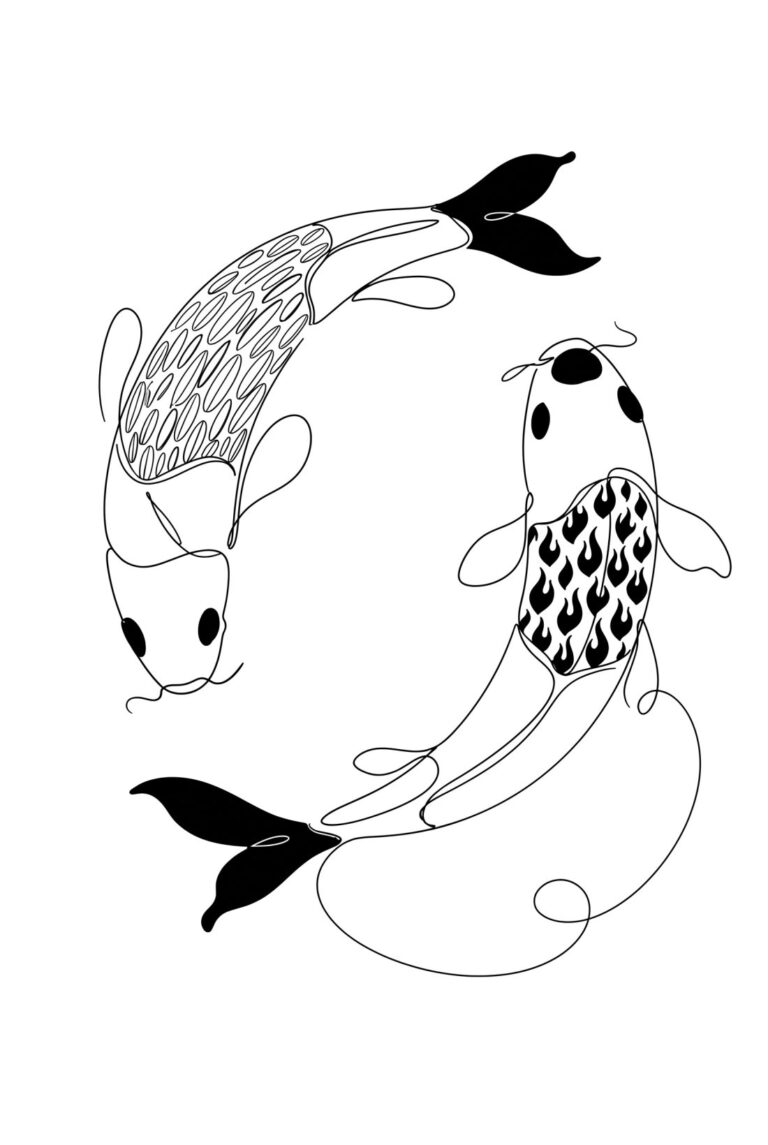
Every design on that sheet is a plain line drawing. That is the only thing a pot ever needs from you. I keep The 100 Collection open beside the kettle for this, because each piece arrives with its own trace guide.
The Collection
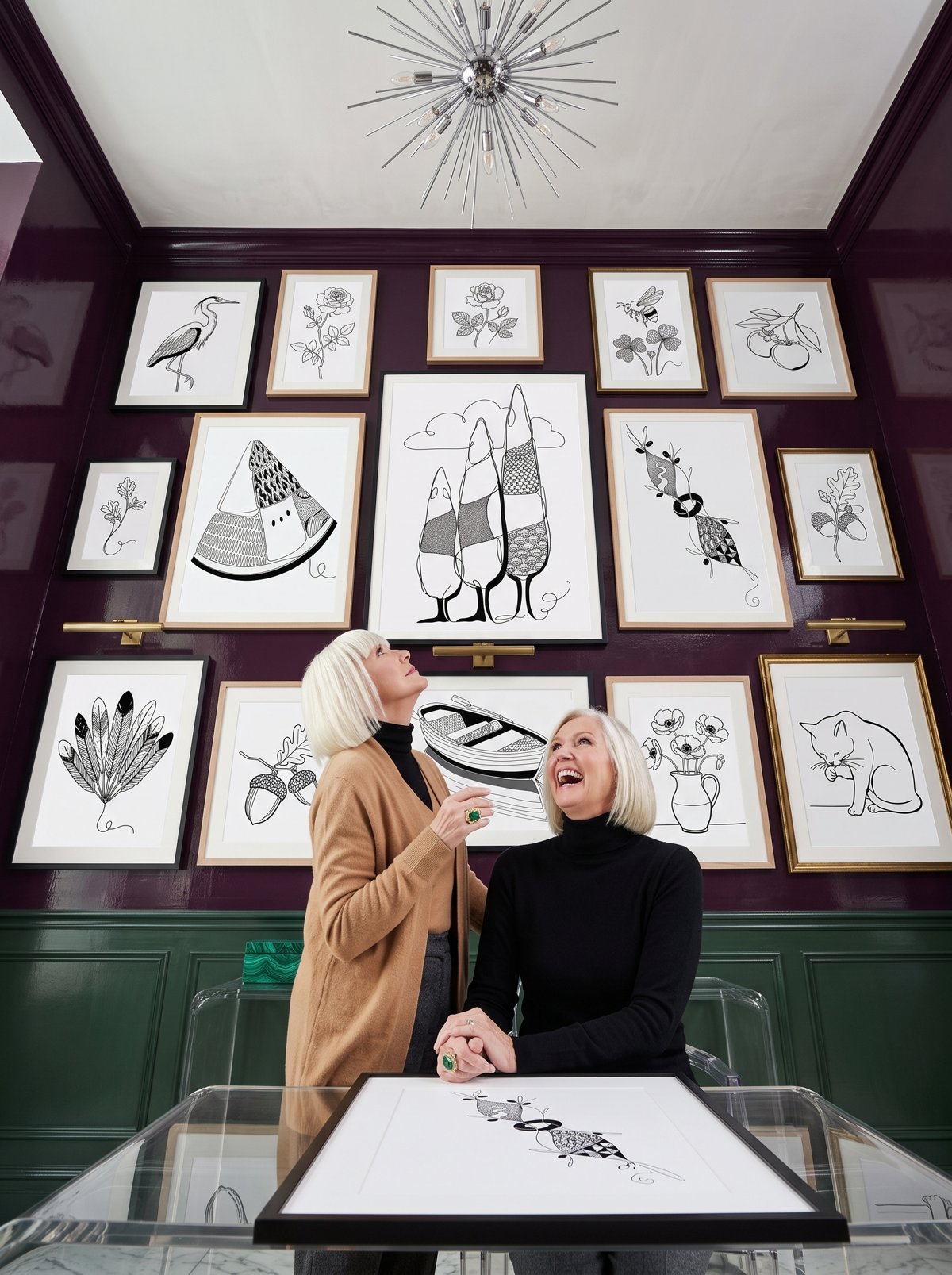
THE 100 COLLECTION — creatures, fruit, weather, and a line you can borrow.
Every piece is one clean ink drawing, which is the only thing a curved pot can carry. What you get: 100 finished pieces, and a trace guide behind every one of them.
<
Now the steps, in the order the piece actually needs them.
The best paint your own pottery ideas start with the piece, not the picture
Choose the shape first. The shape rules out most designs before you draw anything.
A mug is a cylinder. It has no flat face at all. Whatever you put on it wraps away from the eye.
A jug is a cylinder too, with a lip that interrupts the band.
A bowl is worse. The inside curves in two directions at once. A design that works on paper goes saggy in the middle of a bowl.
A plate is the kind one. The rim is a flat ring and the well is nearly flat. Start there.
(I spent my first visit on a bowl. I have opinions about bowls now.)
Pick a piece with one clear zone. A mug band, a plate rim, a tile face. One zone is a finished object. Four zones is an evening gone.
Turn the piece over before you commit. Look at how much of it you can actually reach while holding it. The part your hand covers is the part you will smudge.
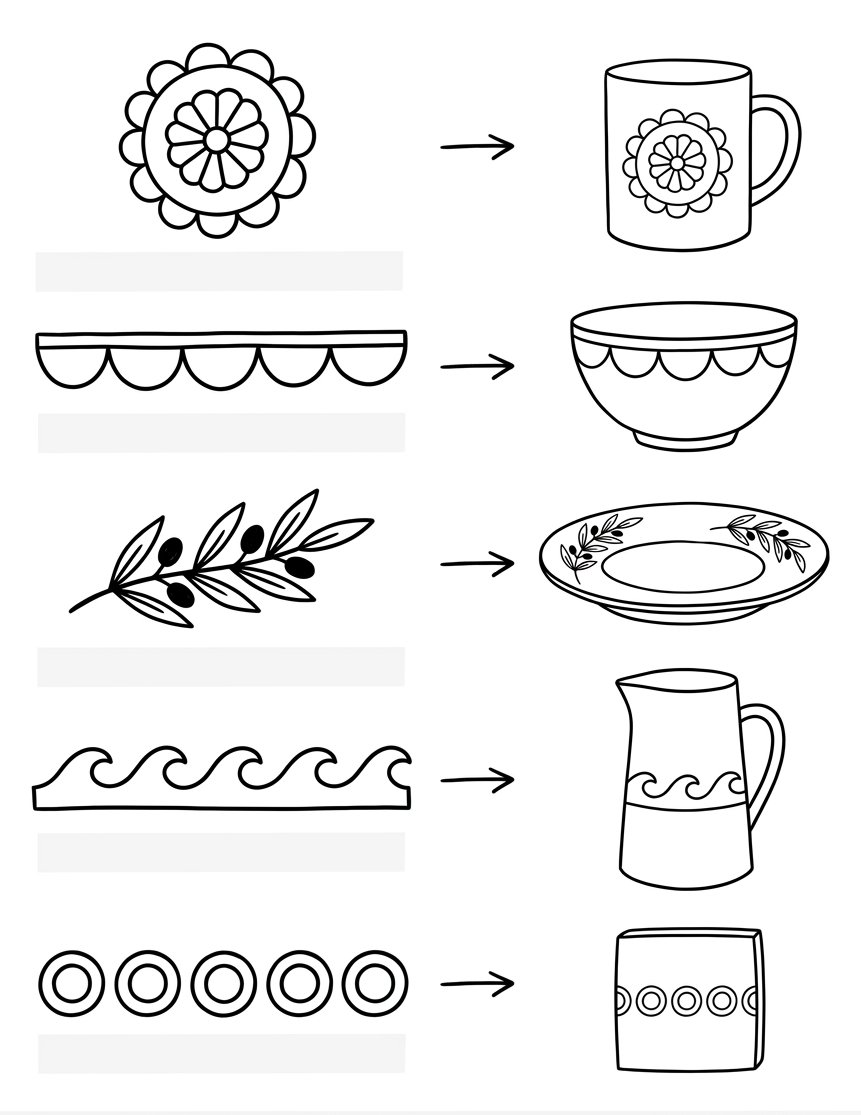
Look at the second column there. That is the same drawing on a curve.
Measure the curve with a paper strip before you draw a single line
This is the step nobody mentions, and it costs nothing.
Cut a strip of paper. Wrap it round the mug. Mark where it meets itself, then cut it there.
Now unwrap it. That strip is the real width of your design. Draw inside it.
A flat rectangle lies to you. It always says there is more room than there is.
I drew a band of leaves on plain paper first. On the mug the last two leaves had nowhere to go. So they became a knot, and the knot looked deliberate.
The same trick works on a plate. Trace round the plate onto paper, then draw the rim pattern in the ring.
Keep the pattern away from the lip. Anything within a thumb’s width of a rim meets a mouth or a dishcloth eventually.
And decide now where the pattern will end. A band that runs round a mug has to meet itself somewhere.
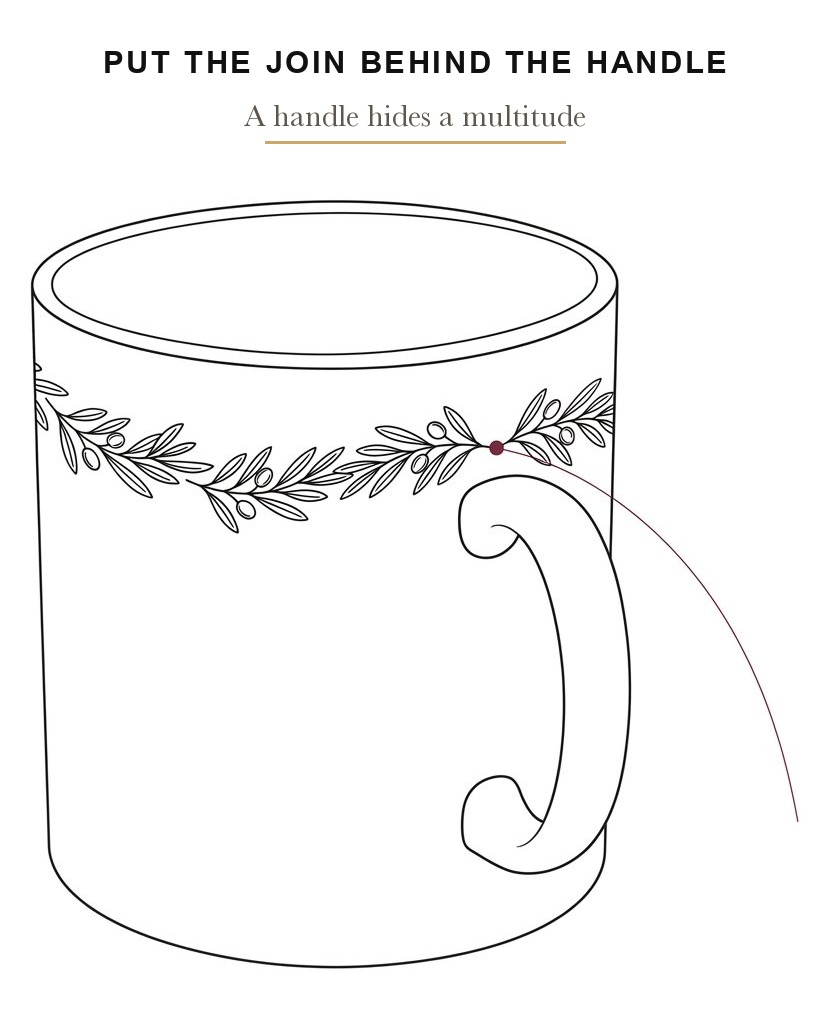
Put the join behind the handle. A handle hides a multitude.
Nicola da Urbino borrowed his outlines from a printed book, and it made him the best in Italy
Here is the part that settles the tracing question for good.
Nicola da Urbino worked at Castel Durante, and he is called the Raphael of maiolica. He painted whole scenes across a single plate.
He did not invent those scenes. He lifted them from printed woodcuts, including an illustrated Ovid printed at Venice in 1497. Later he worked from engravings after Raphael.
So where is his art. It is in what the borrowed line became. Bernard Rackham wrote that Nicola turned those crude printed outlines into figures of supple vitality.
A plate of his carrying the arms of Isabella d’Este, made around 1524, is in a museum in London.
(I find this enormously cheering at a kitchen table with a pair of scissors.)
Your version is the same move. Take the outline from the sheet. What happens after it is yours.
The choices that are yours start straight away. Which motif, how big, how many, which way up, and what you leave out.
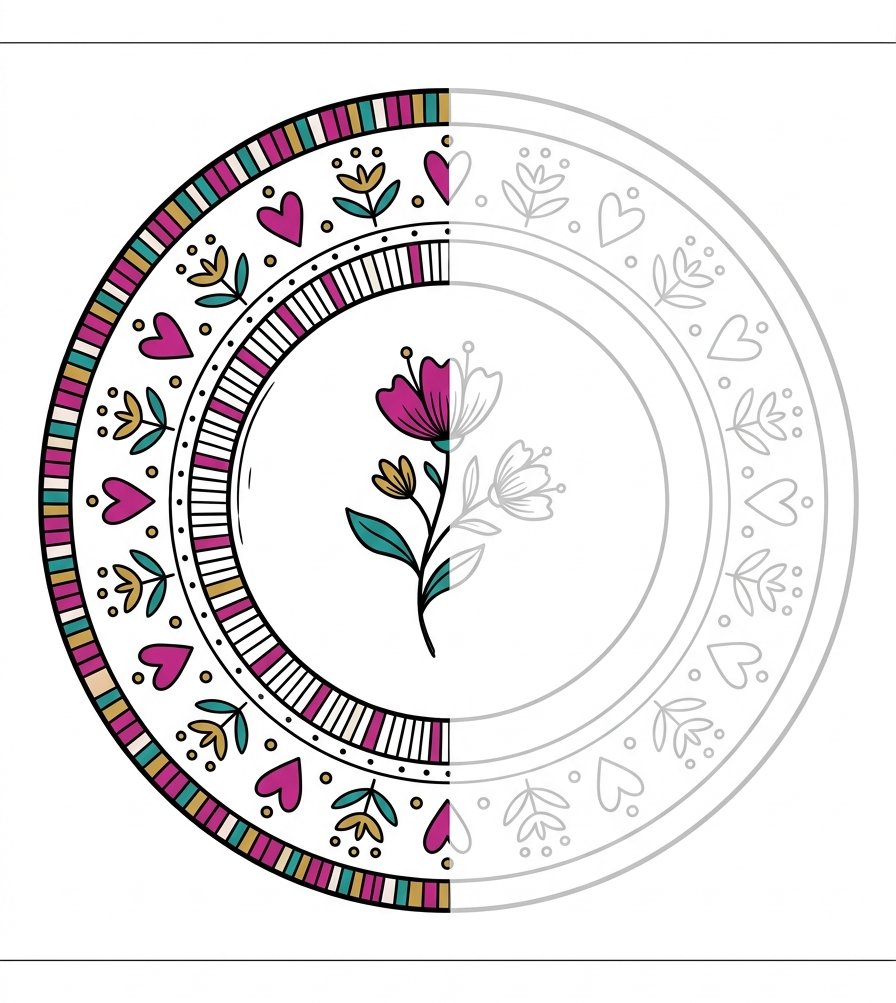
Half drawn, half left faint. Trace the faint half and it is your line.
Cipriano Piccolpasso wrote the workshop secrets down, and drew every one of them
The studio will not tell you any of this. Somebody did, once, and then sat on it.
Cipriano Piccolpasso lived at Castel Durante, in the middle of the maiolica trade. Around 1556 he began writing a book about how pots were actually made.
He covered the clay, the shaping, the glazes and the preparation of the colours. Then he drew the workshops himself. The manuscript runs to 77 folios of his own pictures, and it sits in a museum library in London.
It is accepted as the first full account of pottery-making ever written in Europe.
Nobody printed it. It stayed unpublished for 300 years and finally appeared in 1857.
(That is a long time to leave the good notes in a drawer. I think about that man more than is reasonable.)
Take the lesson plainly. Write your own order down before you go.
One card is enough. Which zone, which motif, which colour goes first, and how many coats.
I take mine in my pocket and I follow it. It is the difference between painting and deciding, and you cannot do both at once.
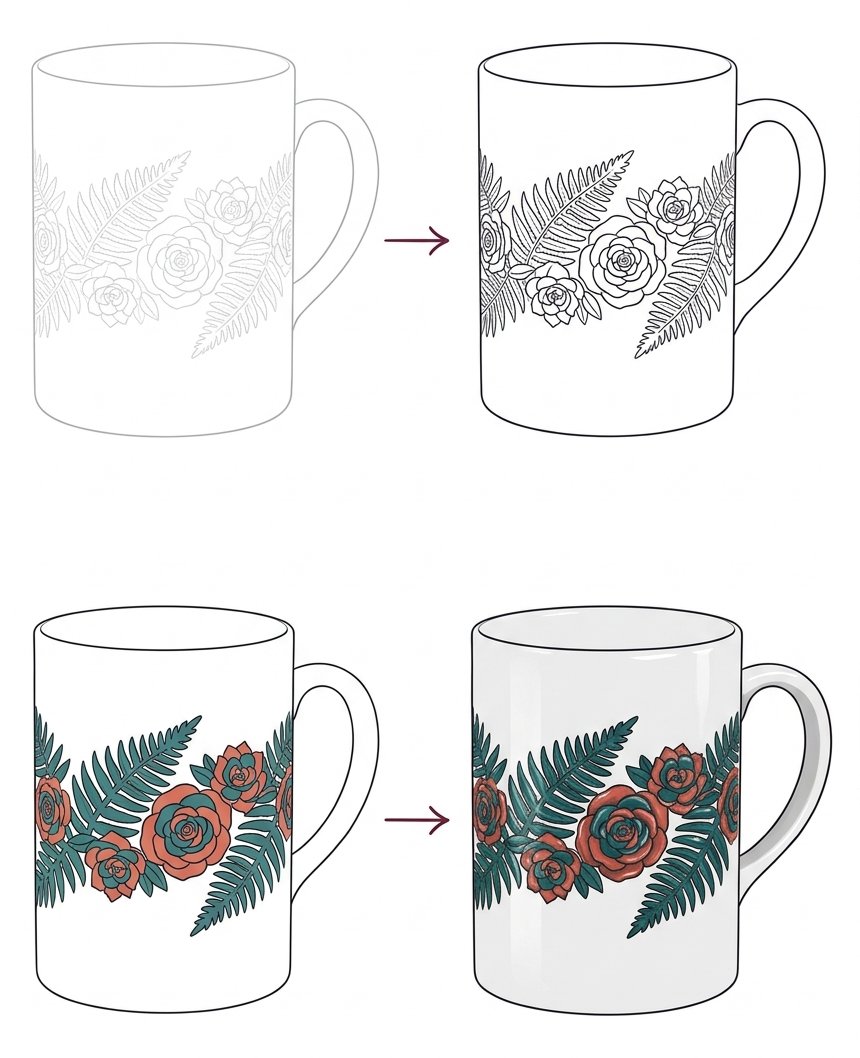
One mug, four stages, and only the last one is the colour you meant.
A raw glaze drinks the brushstroke, which is why paint your own pottery ideas get rehearsed on paper
Now the thing that makes studio painting feel unfair.
A raw glaze is dry and thirsty. The brush touches it and the colour sinks straight in.
That surface takes pigment the way fresh plaster takes it. Errors are impossible to fix, and the colours stay brilliant because of it.
You cannot wipe it. You cannot go over it. The stroke you make is the stroke that fires.
So the stroke gets practised somewhere cheap. Run the same curve 20 times on the free sheet with a pen.
Around number 12 it stops wobbling. That is not a saying. It is just what happens.
I practise the hardest line only. Usually one long stem, or the outer ring of a rosette. Everything else I can repair with a second coat.
Load the brush properly and move once. A brush that stops halfway leaves a dark ridge exactly where it paused.
Rest your little finger on the piece as you go. A hand floating in the air wobbles. A hand touching something does not.
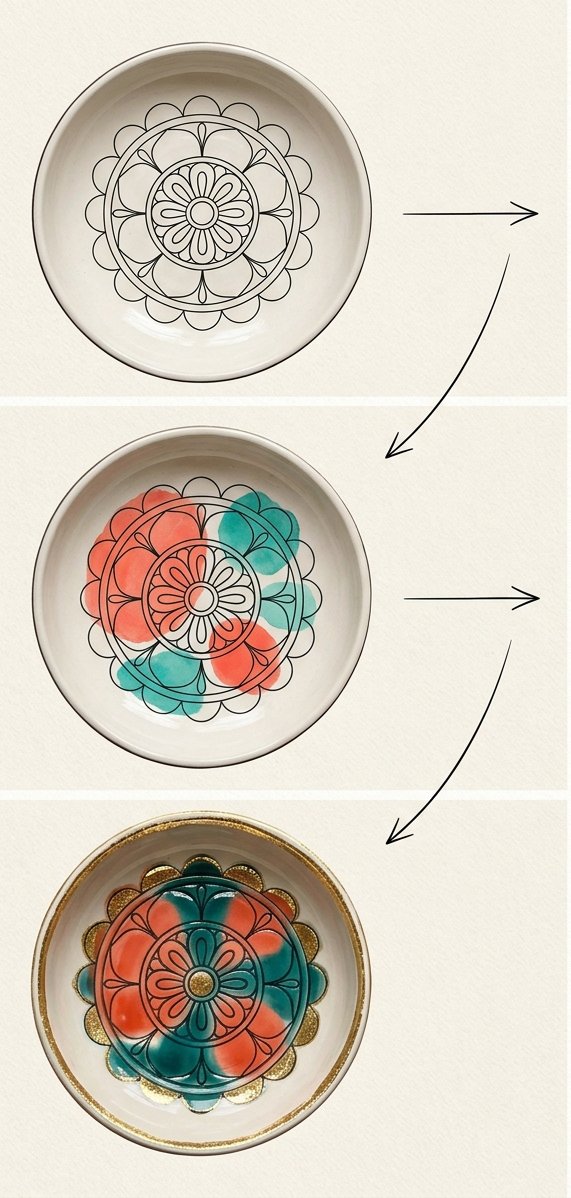
Line, then colour inside the line, then the kiln. Nothing clever, just that order.
Giorgio Andreoli painted in one colour and opened the kiln to another
This is the strangest part of the craft, and it is genuinely delightful.
Giorgio Andreoli worked at Gubbio from about 1495. In 1518 he perfected a lustre in gold and deep carmine.
It took a further small firing to appear at all. Until that firing the piece showed nothing of the colour it was going to be.
He was so good at it that other towns sent him their work. Pieces travelled from Faenza, Urbino and Pesaro to be lustred in his workshop.
Think about what that means. The most admired colourist in Italy also painted blind, and waited on a kiln, exactly like you will.
So stop judging the piece in the studio. It is meant to look chalky and wrong.
Check the number on the little pot instead, not the colour in it. (I have twice painted two different shades of what I was sure was the same green.)
Let each coat go matt before the next. A shiny patch is still wet, and a wet patch lifts.
Sadler and Green let the paper do the drawing, then floated it away
There is a precedent for the paper doing the whole job, and it is an industrial one.
In 1756 John Sadler took Guy Green into partnership at Liverpool. They claimed they had spent 7 years perfecting a way of printing onto tiles.
Their method was plain. An engraved plate printed the design onto tissue in a heat-proof pigment. The tissue went face down on the piece and the sticky ink transferred across.
Then the paper was floated off in water, or left to burn away in the firing. Either way it does not survive. The drawing does.
They reckoned they could print upwards of 1,200 tiles in 6 hours.
Your kitchen version is slower and costs nothing. Scribble soft pencil on the back of your traced design. Lay it on the bisque, pencil side down, and go over the lines.
The graphite comes away onto the piece as a faint grey line. It fires off to nothing, so it never shows.
(I used a hard pencil the first time and got a dent instead of a line. Soft pencil. It matters.)
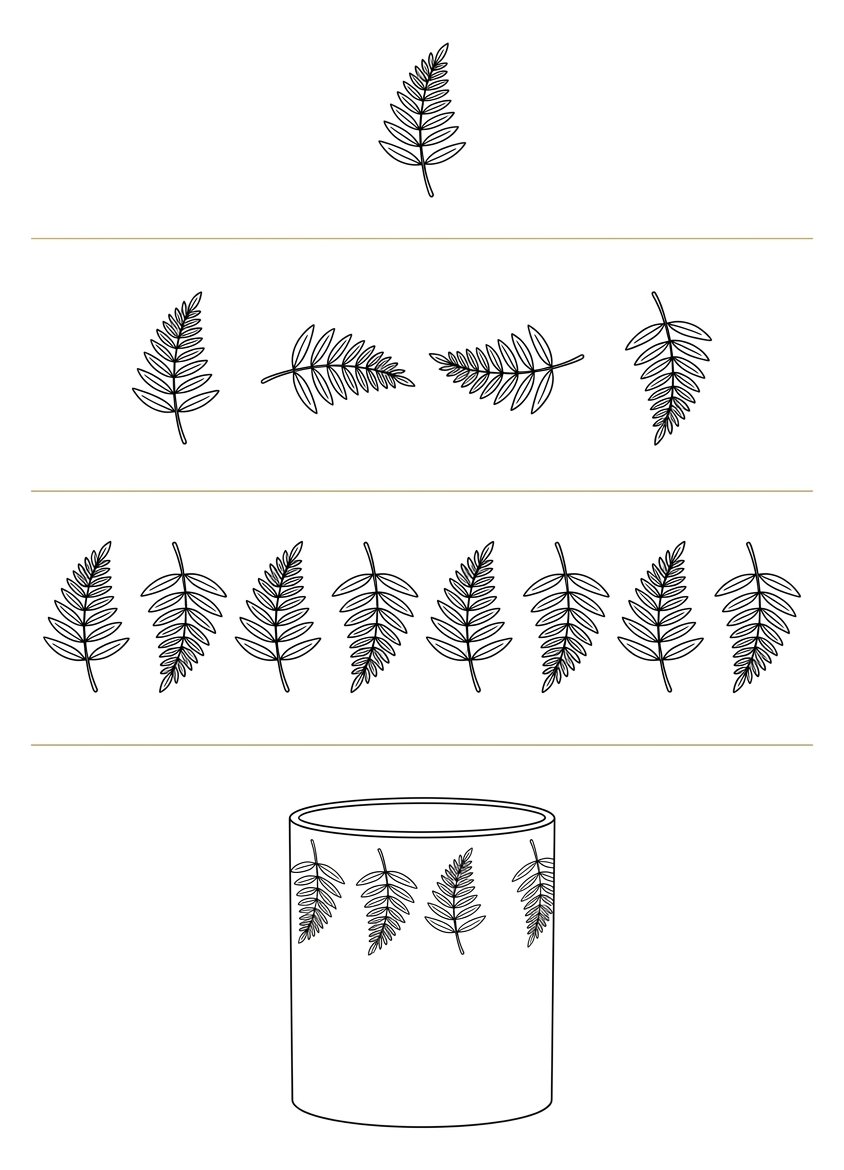
One motif, turned and repeated. That is a rim pattern and it takes 10 minutes.
Three finishes turn one drawing into three paint your own pottery ideas
One outline is not one idea. It is three, and this is where an evening stops feeling short.
Leave it as line. Outline only, no fill, on bare white. It reads as a sketch that somebody meant.
Or fill the shapes flat and leave the background white. Flat colour inside a clean outline is the whole boutique look.
Or flood the background and leave the motif white. That is the hardest to believe and the easiest to do.
(I did all three of one fern on three tiles. The plain one is the one people pick up.)
Pick the finish before you start. Changing your mind at coat two is how a mug turns muddy.
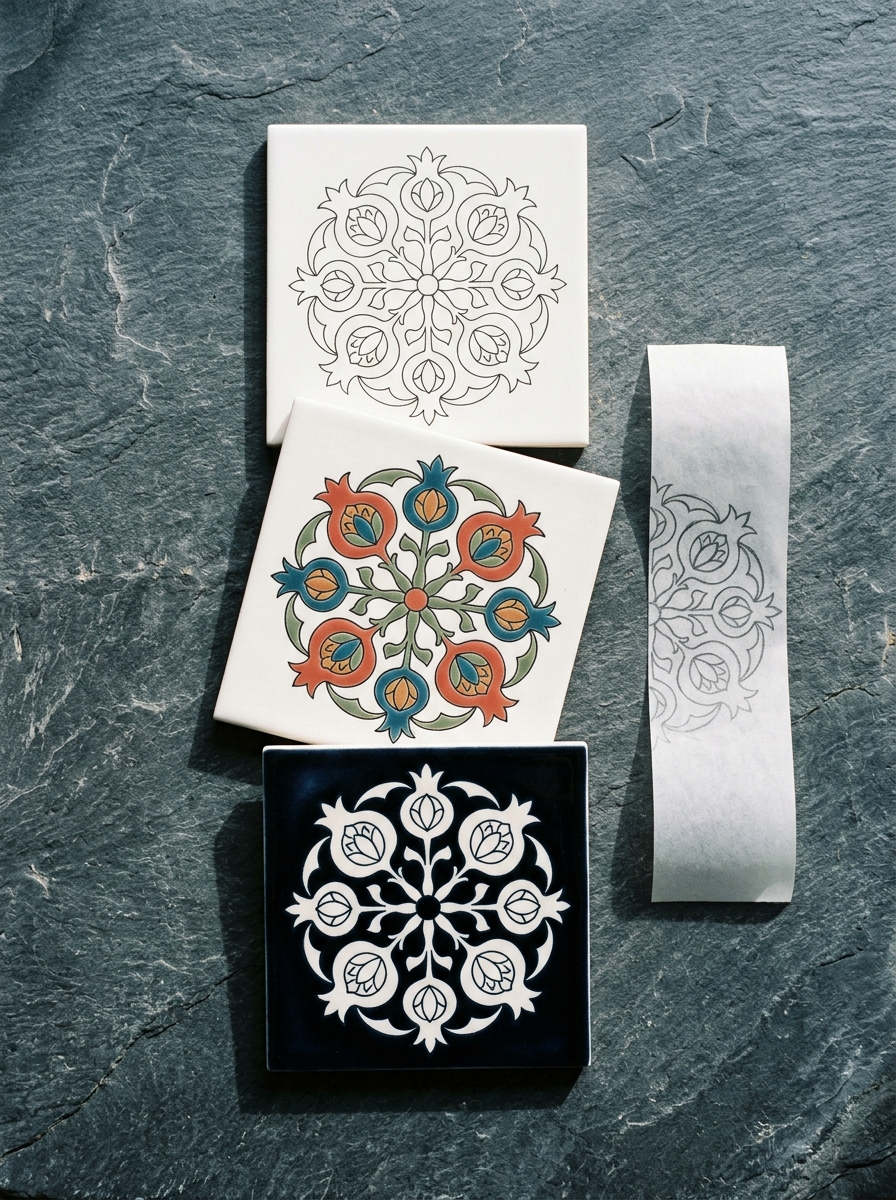
Same fern, three finishes, one traced line underneath all of them.
The paint your own pottery ideas that survive the kiln all share one order
Almost everything I have ruined went wrong in the same three places. So here is the order, and it is short.
Wipe the bisque with a damp sponge and let it dry. Dust under glaze looks like a blemish forever.
Transfer the design with the pencil trick. Outline it in your darkest colour. Let that outline dry properly.
Then fill, one shape at a time, three coats each. Leave the shape next door empty until the first is touch dry.
Keep a thumb’s width clear of the rim. Sign the base if you like, small.
Hand it in and forget it for a week. That wait is part of the object, and there is nothing to be done about it.
Bernard Leach wrote about this in A Potter’s Book in 1940. Beauty comes out of the potter meeting the nature of the materials. The kiln is the materials answering back.
After the first piece the question changes. It stops being how, and becomes which drawing next.
Free Starter Pack
Get 10 free pattern templates for the band round a mug.
Sent tonight. Bands, dots and rim patterns built to bend round a curve.
Unsubscribe in 1 click, no hard feelings
<
That is the only real shortage here. Not skill, and not paint. Line drawings simple enough to survive a curve. The 100 Collection is where I go for the next one, because every piece has a trace guide behind it.
100 finished ink pieces, and a trace guide behind every one
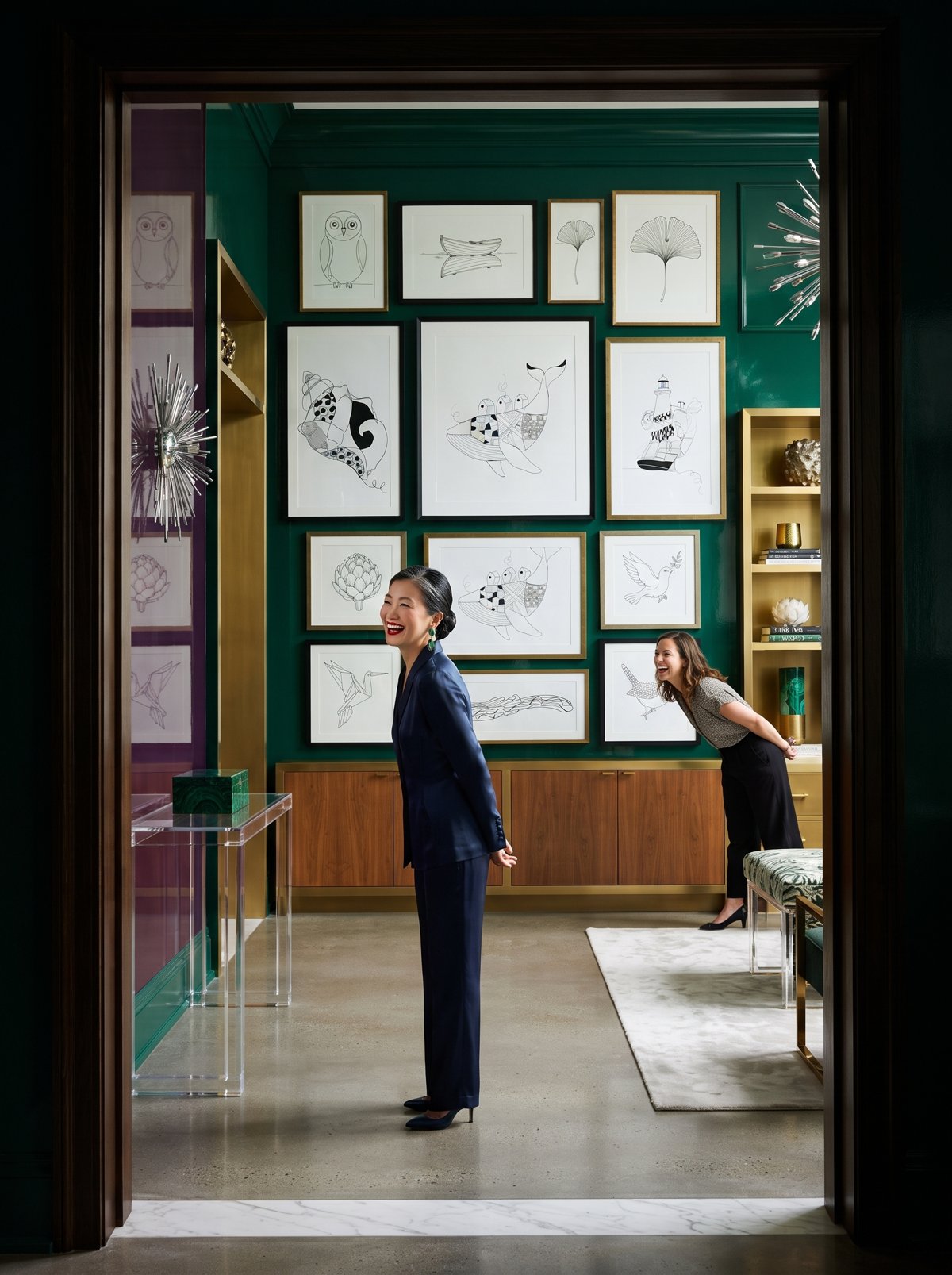
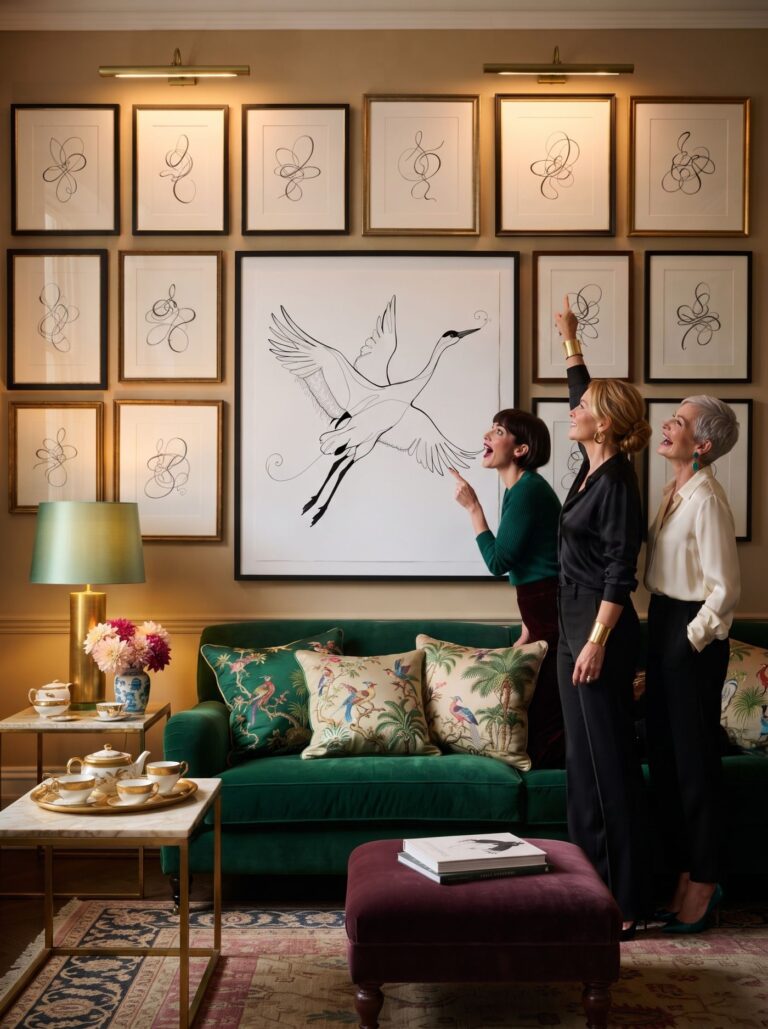
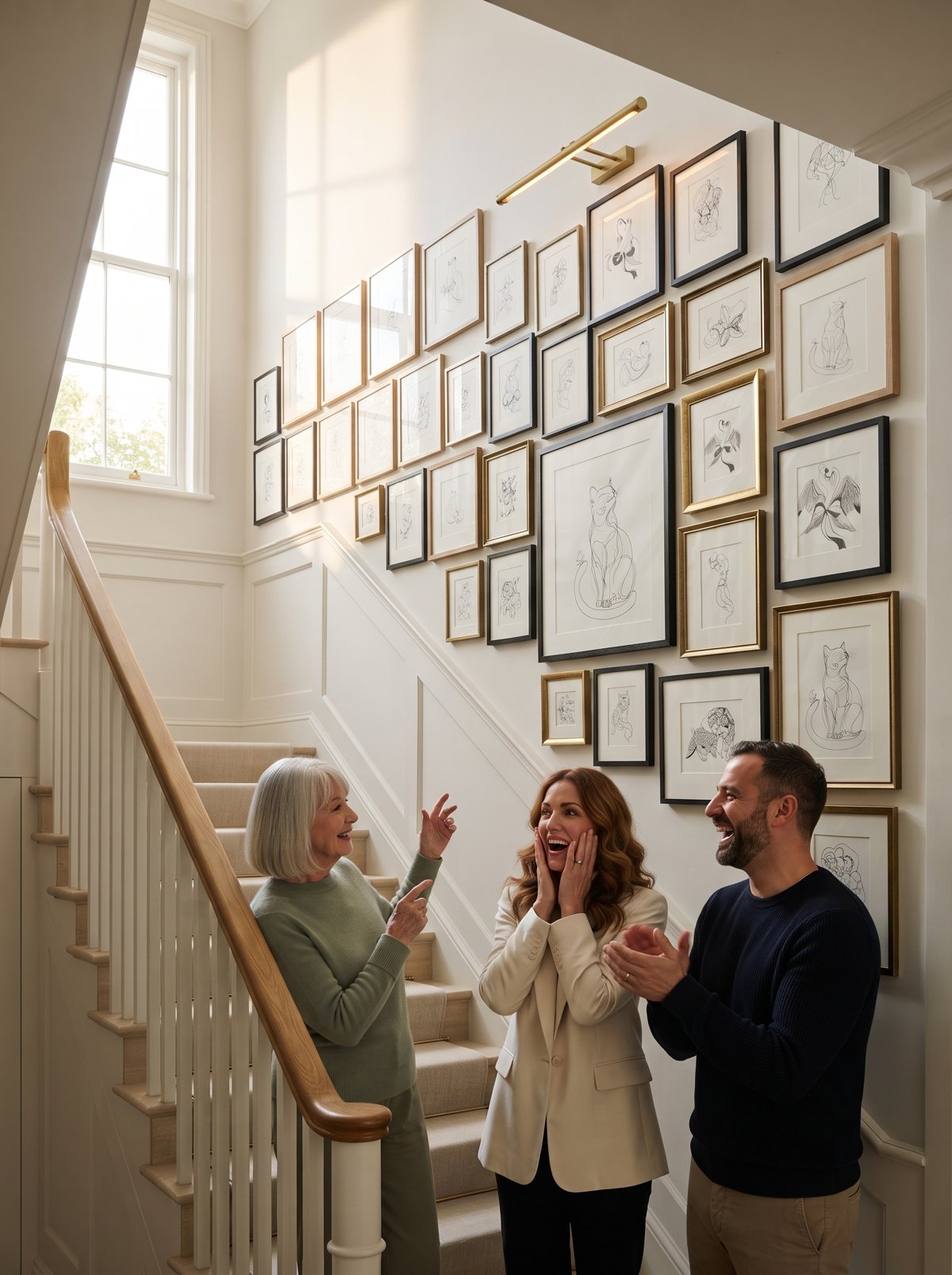
Trace one tonight at the kitchen table. When the hand knows it, carry it into the studio.
Instant download · print at home
<
Somewhere under a town a kiln is coming slowly up to heat, with your mug in it, three shelves down. It will not hurry for anyone. In the morning it opens, and hands back a colour you have never actually seen before.
“Beauty will emerge from a fusion of the individual character and culture of the potter, with the nature of his materials.”
Bernard Leach, A Potter’s Book, 1940[/QUOTE_ATTR]
Mirabelle wrote this. No training, strong opinions, many pens. Peer reviewed by a cat who inspected every mug in the house and chose the one I was using.