In 1704 a French engineer stopped at a château on his way along a canal and copied the floor. Most geometric patterns to draw begin exactly where his pencil did, on a square with one diagonal in it.
That is already a repeat. You made two decisions and the page has started moving.
One mark, one grid, and a choice about which way the mark faces. That is the whole engine. (I held out for years, waiting to be talented. A straight edge turned out to be enough.)
Below are 65 patterns, sorted by the evening you are actually having. Not by shape, and not by difficulty.
Download the grid sheet first. It is already ruled, so you can start on the pattern instead of the measuring.
Download the free grid sheet →
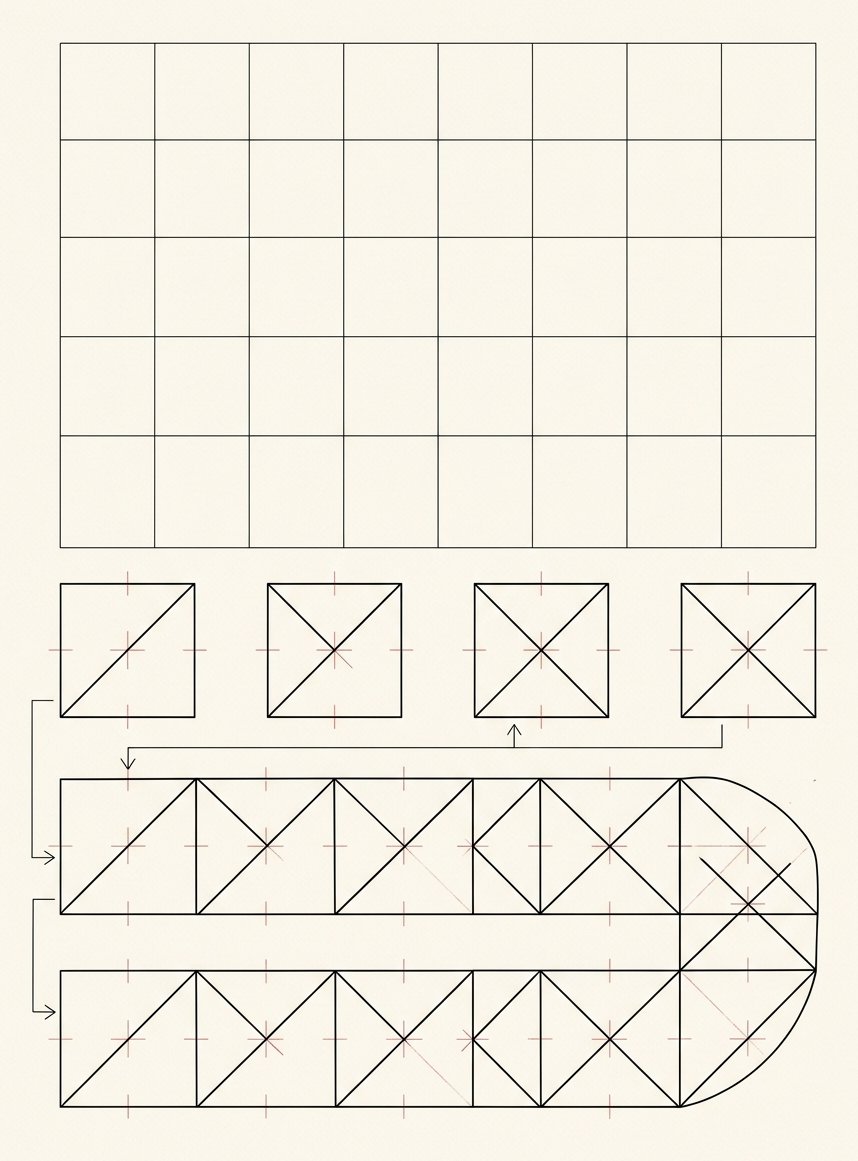
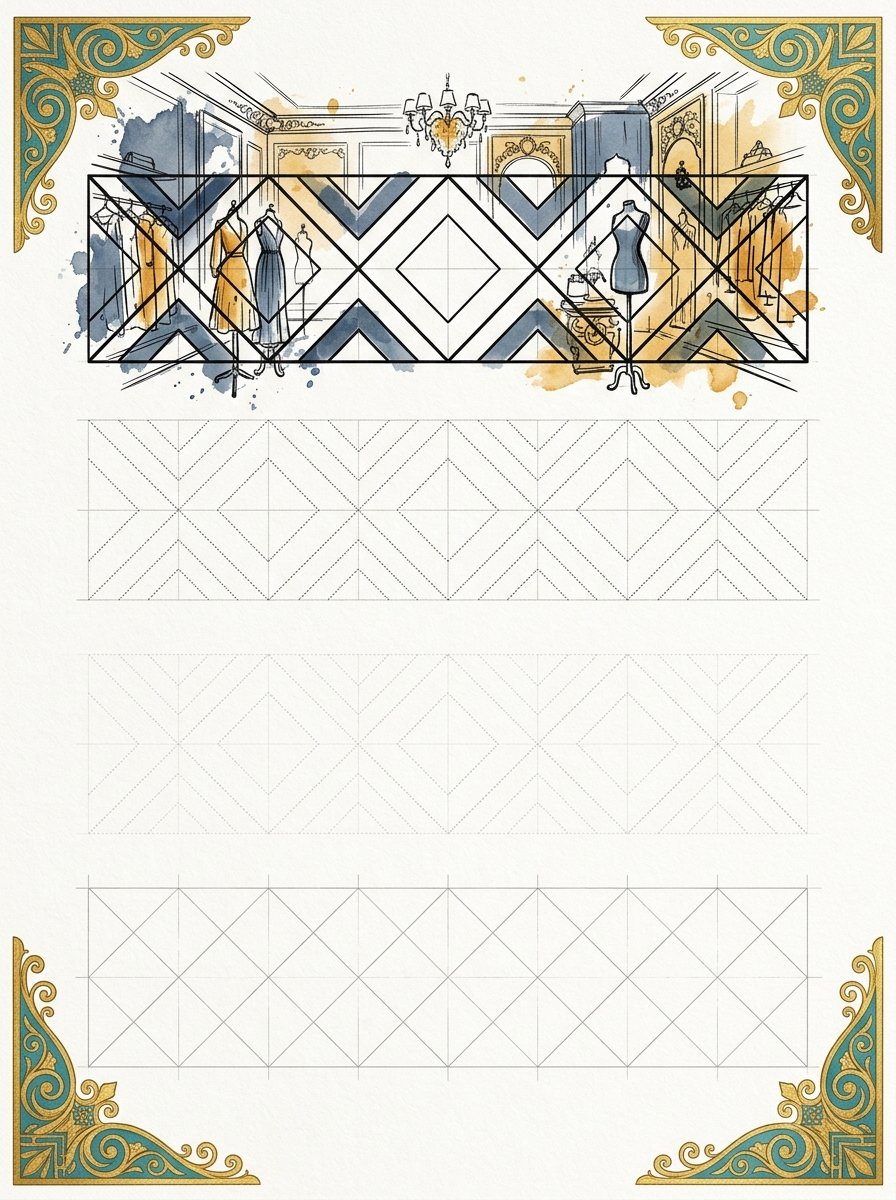
The sheet has a ruled grid at the top and 3 rows of workings under it. Row 1 turns one diagonal four ways. Row 2 stacks those turns into a band. Row 3 lets the band bend.
In the print box choose actual size, never fit to page. (A shrunk grid is a grid you cannot rule along.)
Work the rows in order and repeat row 2 most. It is the row that teaches the hand to keep a gap the same width twice running.
You do not need graph paper for any of this. Any ruled grid will do, and a hand-ruled one is better. The squares come out slightly uneven, and the pattern is warmer for it.
Work at the size of your hand, not the size of the page. A small block finished beats a large one abandoned. (I have abandoned some very ambitious grids.)
A ruled square is a decision about the edges, and it leaves the middle empty. That is where the Ultimate Zen Doodle Mastery Toolkit comes in. Every rule on this page was pulled out of it. It holds the fills that go inside a shape once the shape is settled.
The Collection
Fill every square you have just ruled, with a fill that suits the shape.
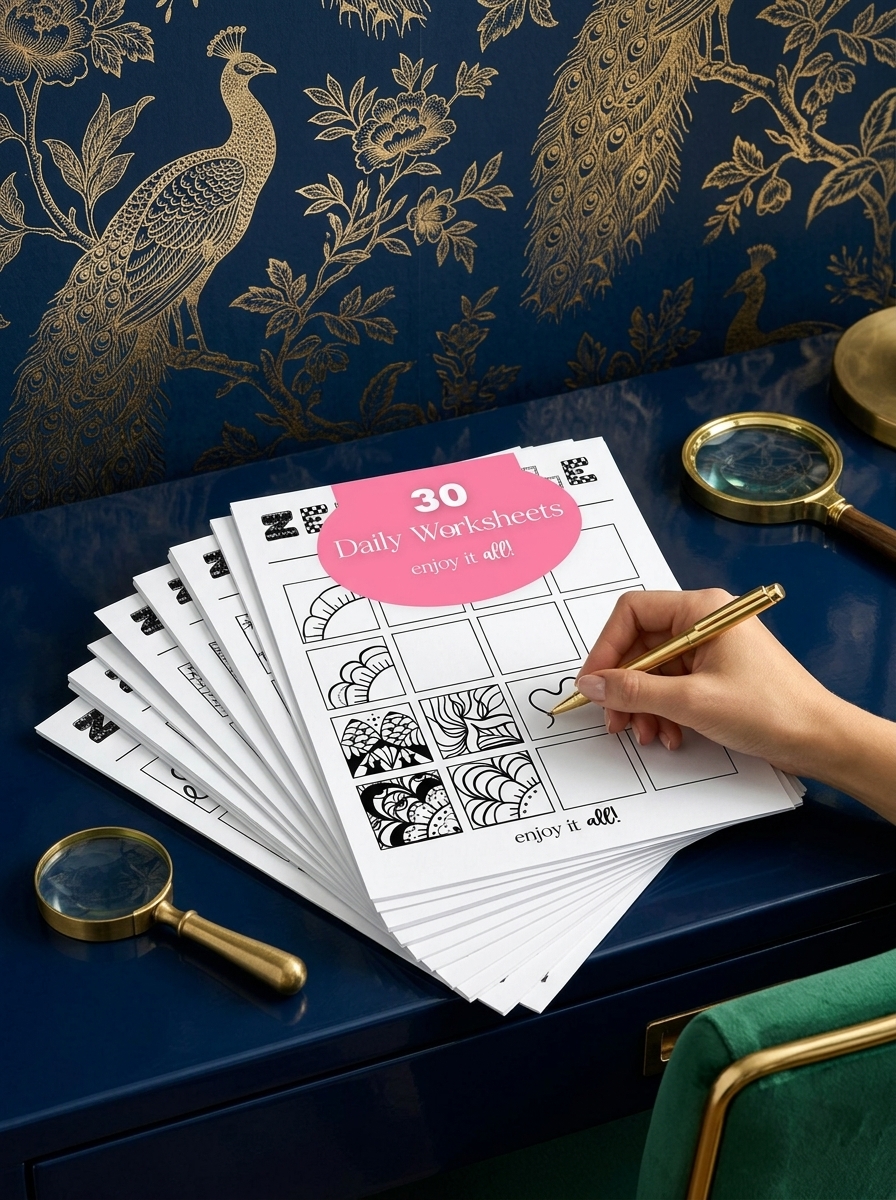
Use it on the evening the grid is ruled and the squares are still bare. Inside: the zen doodle method in 3 steps, 30 daily worksheets and a bank of bold fills. What you get: a fill for every square, and a page worth pinning up.
Back to the ruler. Every group below names the state you are in, then the patterns that suit it, and what ruins each one.
Which geometric patterns to draw fit into 10 minutes and a ruler?
These 21 need a straight edge and nothing else. No compass, no curves, no measuring twice.
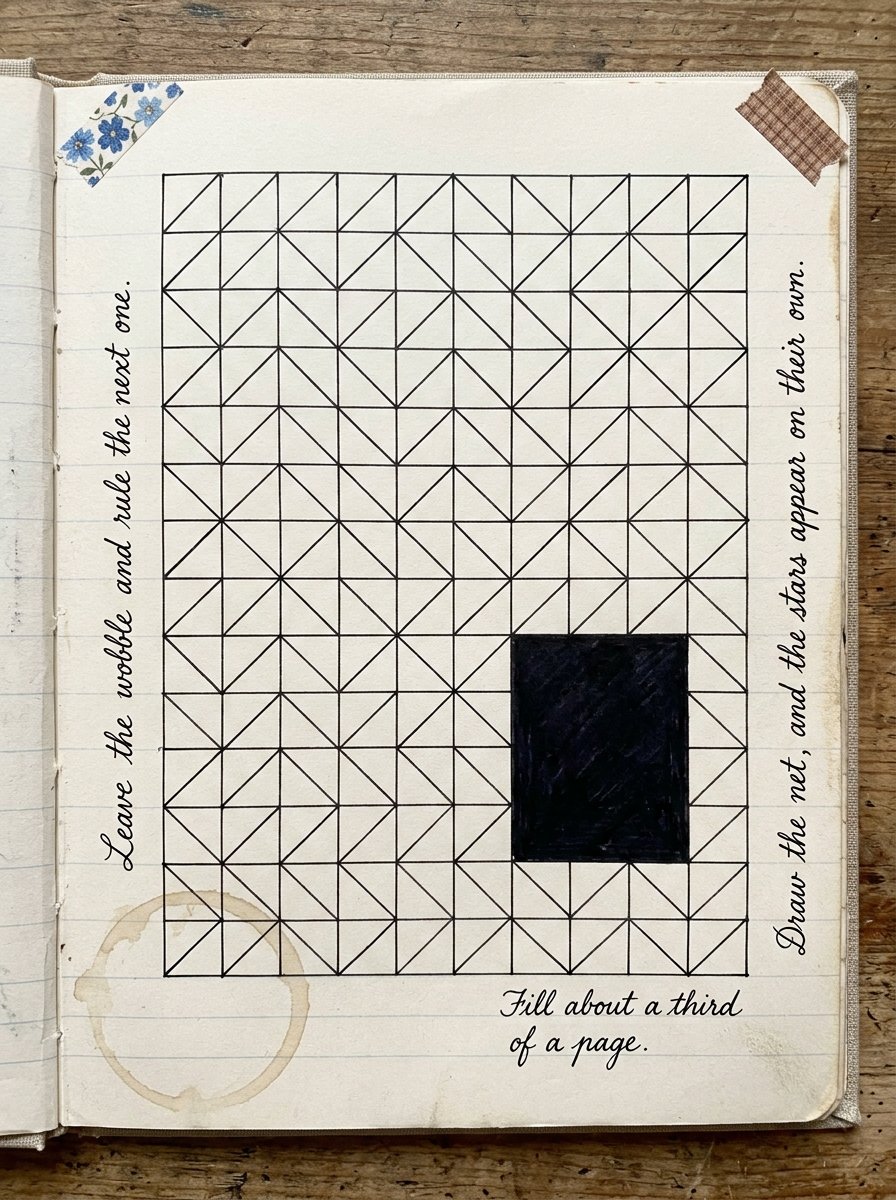
Start where the whole idea starts. The single diagonal is one line corner to corner in a ruled square. The half-turn tile is that same line with the next square turned a quarter. The quarter-turn field keeps turning it the same way along the row. All three are ruined by fixing a wobble. Leave the wobble and rule the next one.
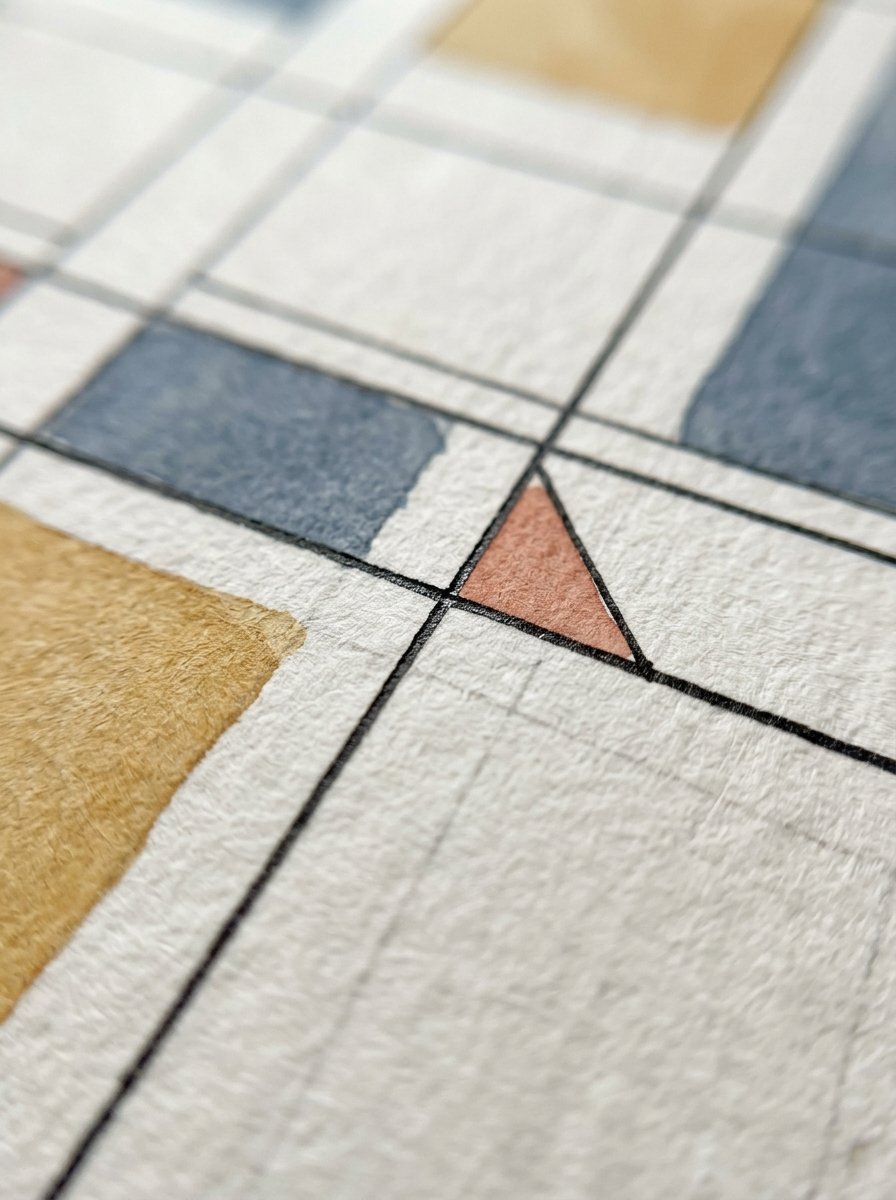
Then the bands, which only ask you to keep a gap. The chevron band is two ruled lines meeting at a point, repeated. The zigzag rule runs that point along a line without lifting. The double rule is two lines with a gap you hold steady. The ladder band drops rungs across that gap. The gap is the thing that goes wrong, never the line.
Stacking comes next. The stepped stair climbs in equal jumps. The brick offset shifts each row by half a brick. The running bond repeats that shift down the page. The rail fence lays bands at alternating angles. I ruin these by starting at the top left every time. Start in the middle and the drift has somewhere to go.
The woven four are the calmest of the lot. The herringbone leans short strokes in turns. The basket square crosses two bars over and under. The weave over-under alternates which bar sits on top. The plait band runs three of those bars along one line. Turning the paper, not the hand, is what keeps the lean even.
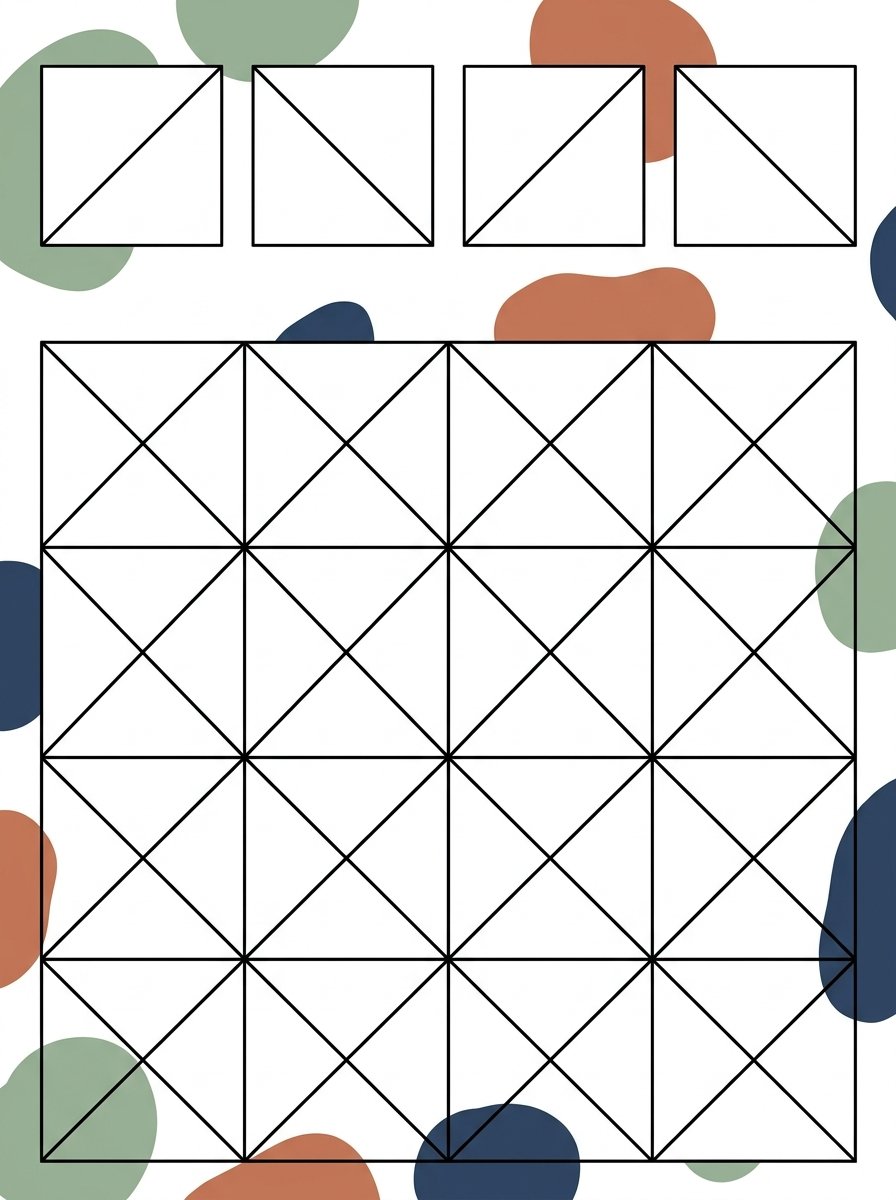
6 more and the group is done. The checker fills alternate squares solid. The half-drop square slides every second column down. The triangle row alternates solid and hollow. The diamond chain links lozenges at their points. The cross-hatch square sets two rules at an angle. The comb drops teeth from one long line. (I have ruled combs at 11pm purely to avoid going to bed.)
Why does one diagonal line give you 64 different tiles?
In 1704 a French engineer was inspecting a canal and stopped at a château on the way. Stacked in the rooms were plain square floor tiles, each one split corner to corner into two colours.
He started counting arrangements on the spot.
He worked out that 2 of those tiles can sit together 64 ways. Then he reduced the 64 to 32 real figures. Then to 10, once you stop caring which way up the pair is.
He drew 100 finished designs out of it and engraved 30. His name was Sébastien Truchet and the memoir is still there, printed in the Academy volume for that year.
He was not inventing 64 patterns. He was turning one tile 64 ways.
That is the permission hiding in this whole subject. You are not short of ideas. You are short of turns. (Which retires my entire excuse about having no imagination.)
So rule a grid of squares and put one diagonal in each. The only decision per square is which corner the line runs to. Do a page of that before you try anything below it.
Which geometric patterns to draw fill a whole evening?
These 23 are the ones that keep going. They repeat a curve or a count, so the hand settles and the head goes quiet.
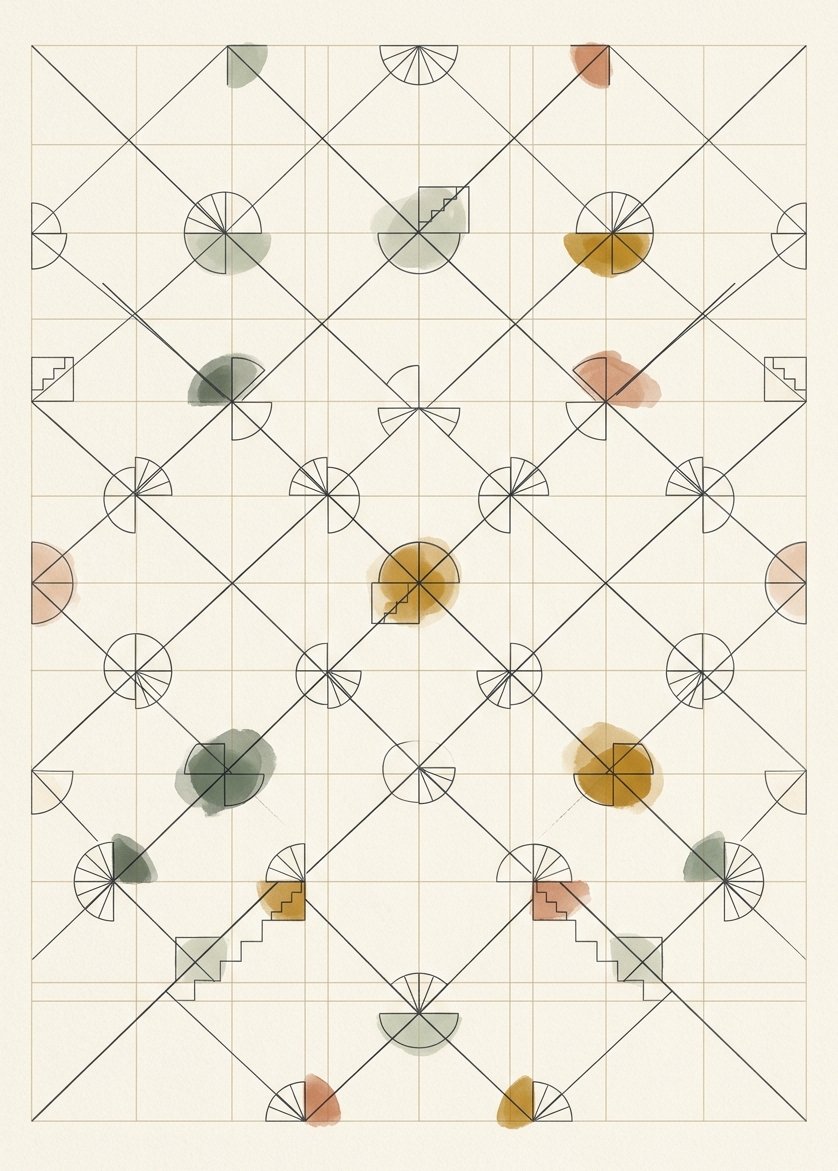
The arcs come first. The scale row is half circles overlapping like roof tiles. The fish scale shrinks them as they climb. The fan arc runs ribs from one point to a curve. The rainbow stack nests arcs inside each other. Space them by eye and they drift. Mark the centres first.
Then the ones that wind. The coil turns inward at an even rate. The spiral square does the same with corners. The concentric square sits squares inside squares. The nested diamond turns those 45 degrees. The rate is what matters. Change it halfway and the shape goes lopsided.
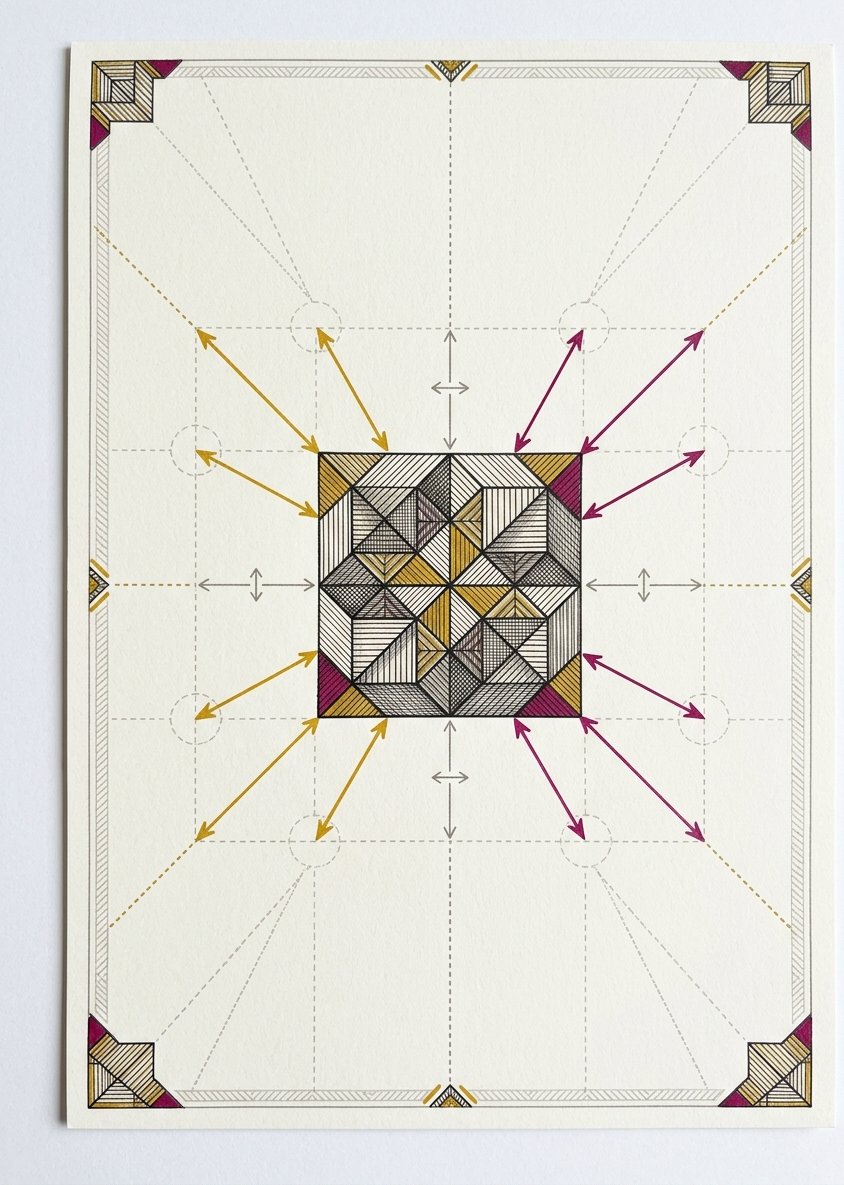
The travelling patterns are the real evening-fillers. The wave rule repeats one shallow curve across the sheet. The ripple field stacks those waves down the page. The contour nest nests shapes inside shapes like a map. The maze walk turns only at right angles. The greek key repeats that turn as a band. The meander lets it wander and come back.
Then the turning ones. The pinwheel spins four triangles round a centre. The windmill does it with bars. The star tile meets 6 points in the middle. The octagon net leaves a small square at every join. I get these wrong by drawing the star first. Draw the net, and the stars appear on their own.
5 to close the group, and they are the ones I reach for when I want no decisions at all. The hexagon field tiles with no gaps. The honeycomb thickens its walls. The triangle grid rules three directions across a page. The lozenge band leans a row of diamonds. The stipple corner crowds dots into one corner and thins them out.
How do you decide a repeat before you draw it?
A weaver cannot improvise. The structure has to be settled before a single thread goes down.
So weavers write a draft. It is a notation on squared paper, and every filled cell is an instruction. The cloth simply obeys it afterwards.
Anni Albers joined the Bauhaus weaving workshop in 1922 and spent a working life on this. Her book On Weaving came out in 1965 and covers 4,000 years of the craft, draft diagrams and all. Tate holds her work and her words.
Her sharpest line is a definition. Pattern work, she said, deals with repeats of contrasting areas.
The unit of thought is the filled square, not the clever stroke.
Which tells you where to look when a repeat dies. Fix the contrast of the areas, not the detail inside them. (I have added detail to a dying pattern for a solid hour. It is the drawing equivalent of tidying a room by moving one pile.)
So plan it on the grid before you ink it. Shade the squares that go dark, lightly, in pencil. Then ink only what you shaded.
Free Starter Pack
Get 10 free fills for the squares you have ruled.
Sent tonight. Bold stripes, checks and scallops, each one cut to sit in a square.
Unsubscribe in 1 click, no hard feelings
Which geometric patterns to draw make a page look finished?
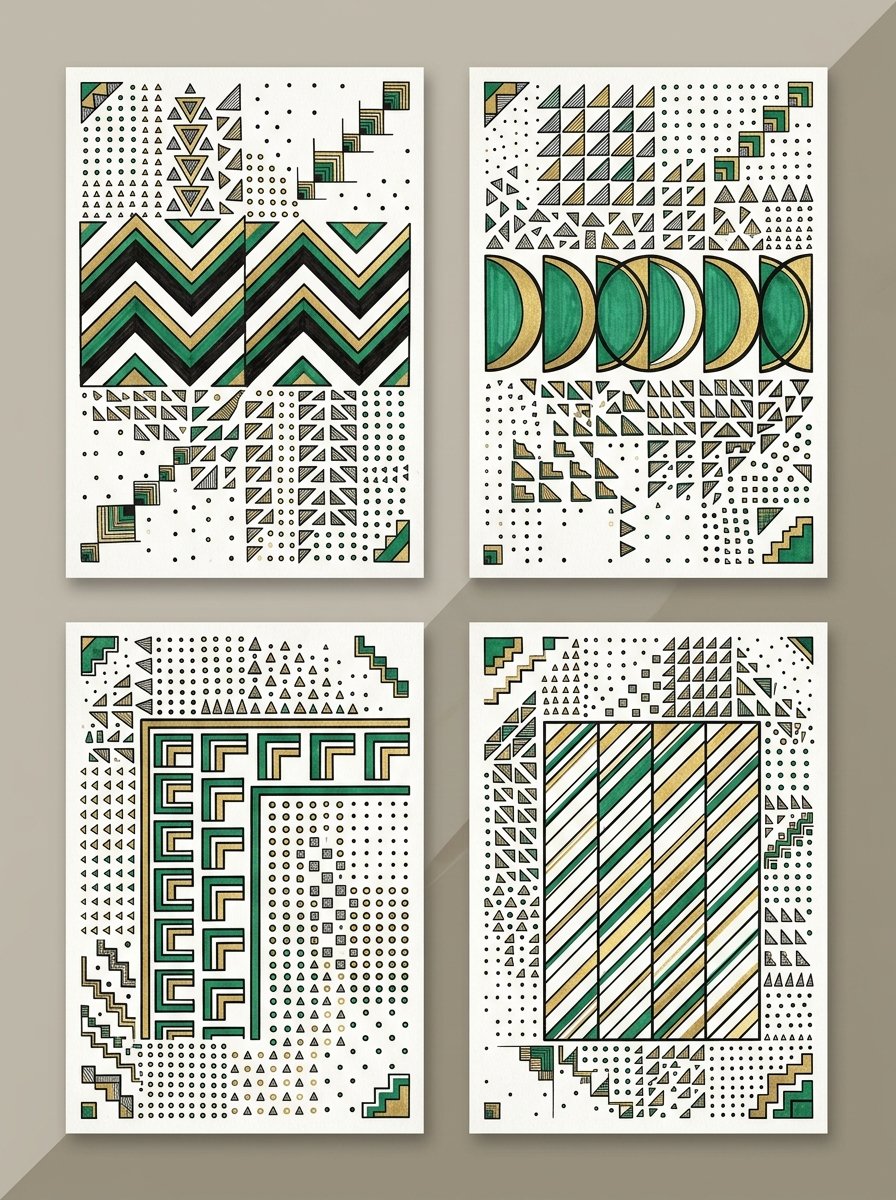
These 21 are the closers. They are not new patterns so much as decisions about weight, edge and empty space.
Frames do most of the work. The border frame runs one repeat all the way round. The corner bracket keeps the pattern in an L and leaves the rest alone. The double border nests one frame inside another. The seam line lays a single ruled line along a boundary you already have. A frame goes wrong when it meets itself. Plan the corner before the sides.
Weight comes next, and it is the fastest fix on this page. The solid block inks one whole square. The half-fill takes the diagonal and fills one side. The alternating fill blacks every second cell. The negative band fills everything except the band. Fill about a third of a page. At half it goes muddy, and I have proved that more often than I would like to write down.
Then the softer ones. The gradient dots crowd at one end and thin at the other. The dot field keeps them even. The outline thicken goes back over a shape once it is finished. The drop shadow rule doubles one edge only. Outlining last covers a multitude of wobbly edges, which is most of why it works.
The last 9 are arrangement. The medallion centre puts one bigger unit in the middle. The quartered square splits a shape four ways and fills each differently. The mirrored pair draws a motif once and flips it. The offset repeat shifts the next row deliberately.
The scale change runs the same motif large, then small. The stacked bars pile bands with air between them. The star point inks one ray solid. The empty square leaves one cell blank on purpose. The last quiet corner leaves a whole corner unworked, and it is the hardest one here.
How do you hang shapes on a line instead of drawing objects?
Most beginners draw finished objects and then panic about the spacing. There is an older way round it.
In 1951 a furnishing linen called Calyx went on show at the Festival of Britain. Lucienne Day designed it and Heal and Son printed it. It took a Gold Medal at Milan that year, and an American design award the next. The V&A holds both the cloth and her original drawing.
What was new was the structure. She built a scaffold of thin lines across the whole cloth. Then she hung abstracted cup shapes at the junctions.
The museum puts it plainly. The shapes cannot be read as easily as a proper botanical drawing, and that is the point of them.
Draw the connecting lines first. Decide what sits at the junctions second.
It also lets you off the hook entirely. The shape only has to look like its family. It never has to be a correct drawing of anything. (This was worth more to me than any pen I have ever bought.)
So rule your armature across the sheet first, faintly. Then work out what goes where the lines cross. The spacing is already solved before you draw a single shape.
How do you use the free grid sheet tonight?
The sheet at the top of this page is the short version of all 65. A ruled grid, and 3 rows of workings under it.
Print it at actual size. Put one diagonal in the first square and turn it in the second. Keep going to the end of the row and stop there.
Then pick one row and repeat it. A single unit is a study. The same unit 8 times along a ruled band is a pattern.
Repetition is the trick, and it is not a skill. It is one decision you make and then keep. Mirror it, offset it by half a step, or run it straight.
The ruler sorts the shapes. The 18 fills in the pattern guide pick up exactly where it puts you down.
I ruled my first proper grid on the back of an envelope. I got 9 squares into a space meant for 8. (The 9th is still there, slightly crushed, looking rather pleased with itself.)
A ruled grid is one evening. The Ultimate Zen Doodle Mastery Toolkit is what fills it after that. The method in 3 steps, 30 daily worksheets, and a bank of fills for the squares you have already drawn.
30 worksheets, and a bank of fills for every square you rule
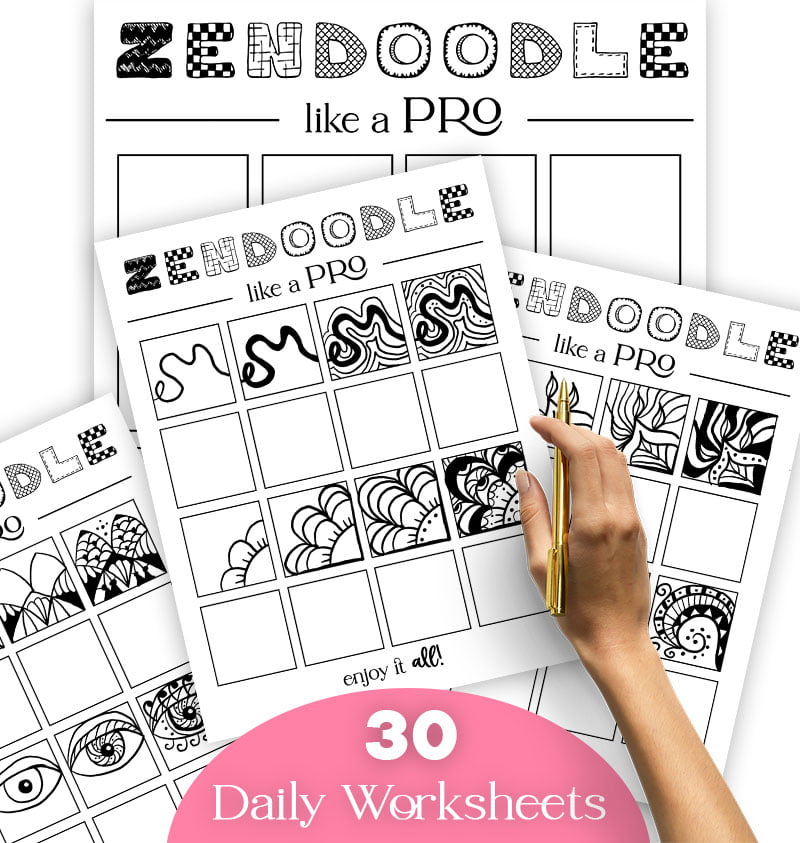
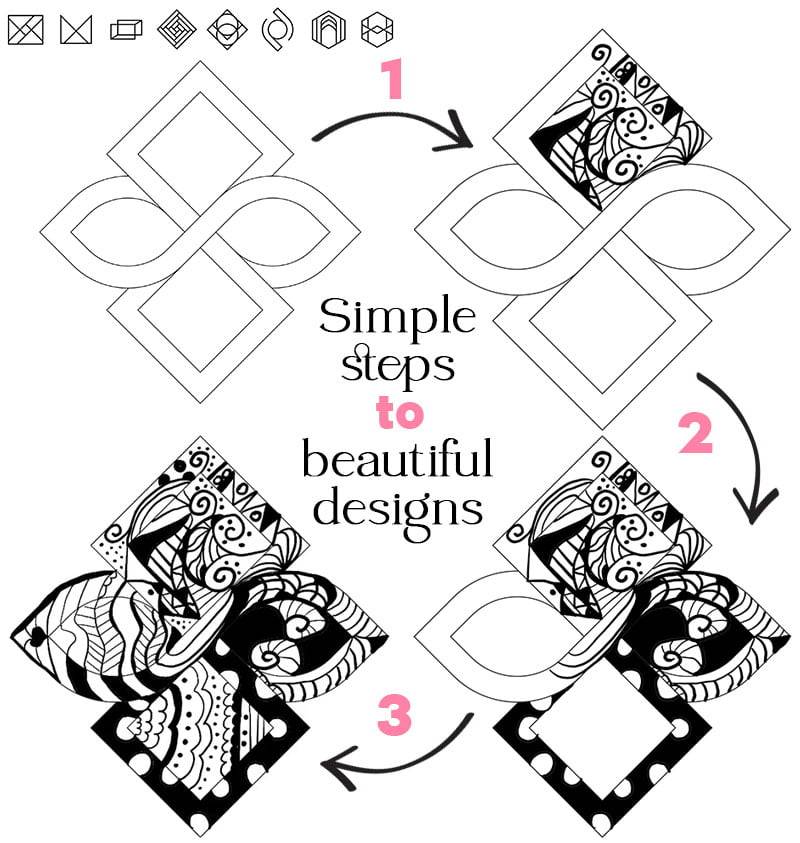
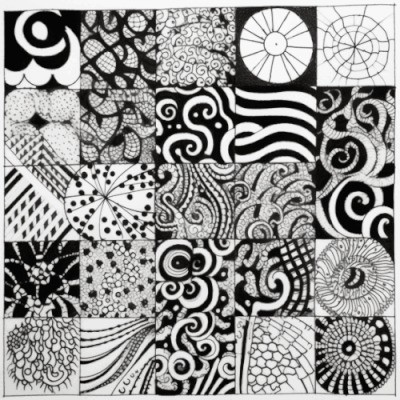
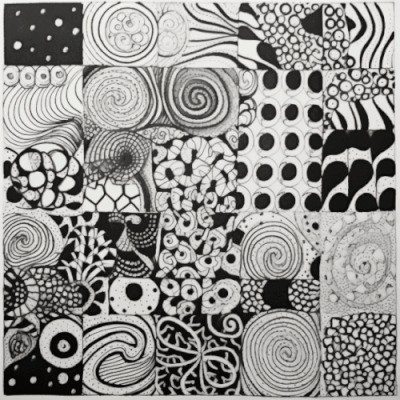
Rule your grid tonight and turn the diagonals. Then open one worksheet. Each one teaches a single fill in 3 steps. Do one an evening, and by the weekend every square on the page has a fill of its own. I print mine, and I copy them freehand too. The freehand ones are the ones I kept.
Instant download · print as often as you like
A ruler has no opinion about the evening. It knows where straight is, and it will go there with you as many times as you care to ask.
“I tried to put my students at the point of zero.”
Anni Albers
Mirabelle wrote this. No training, strong opinions, many pens. Peer reviewed by a cat who walked across the ruler and changed the pattern.