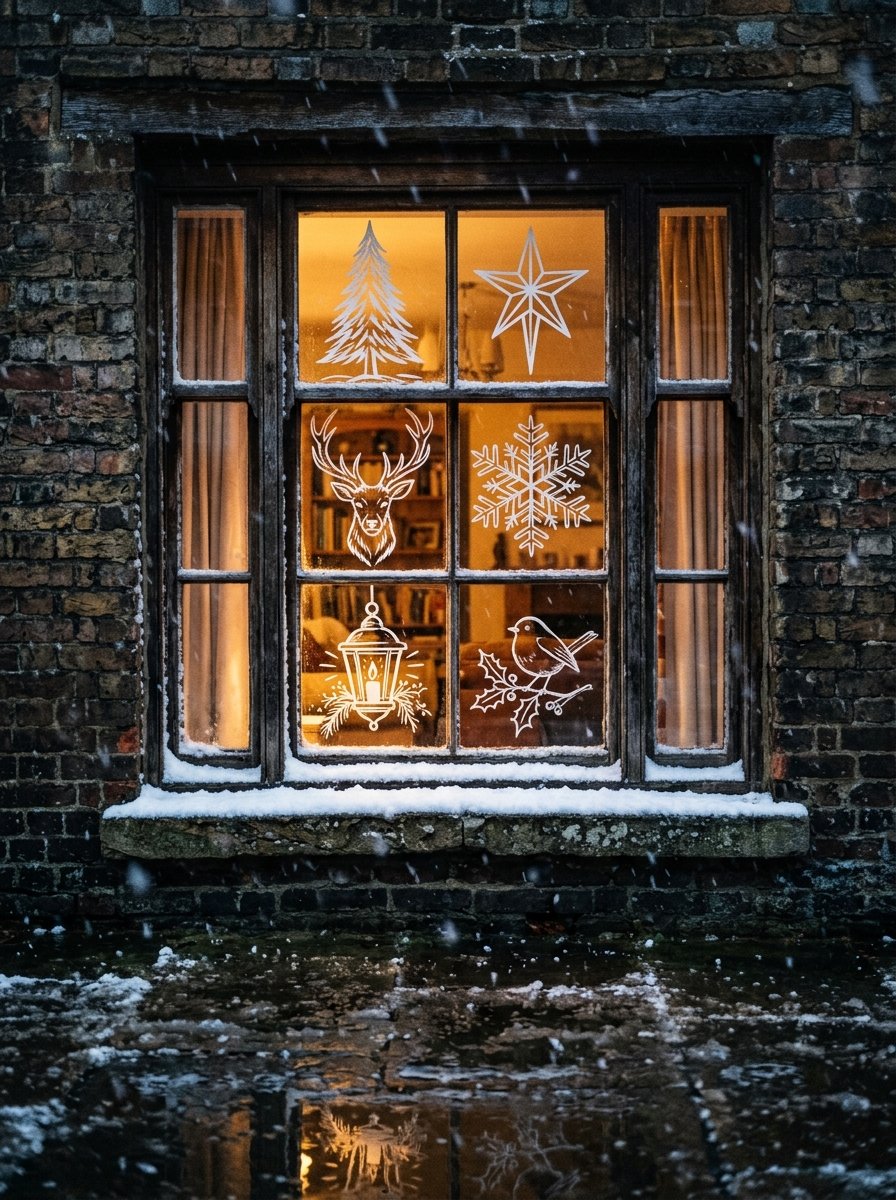
A cold window is the only tracing table in the house that comes with a view. The best christmas window painting ideas are not drawn at all. They are copied straight through the pane.
Glass is the only surface in the house you can see through. So the drawing sits on the far side and is still there on this side. Your hand never invents the shape. It follows it.
(I freehanded a star on the front window one December. It arrived looking like a starfish with a grievance.)
That is the method. Everything under this is detail, and 93 things to trace.
Download the free window template sheet →
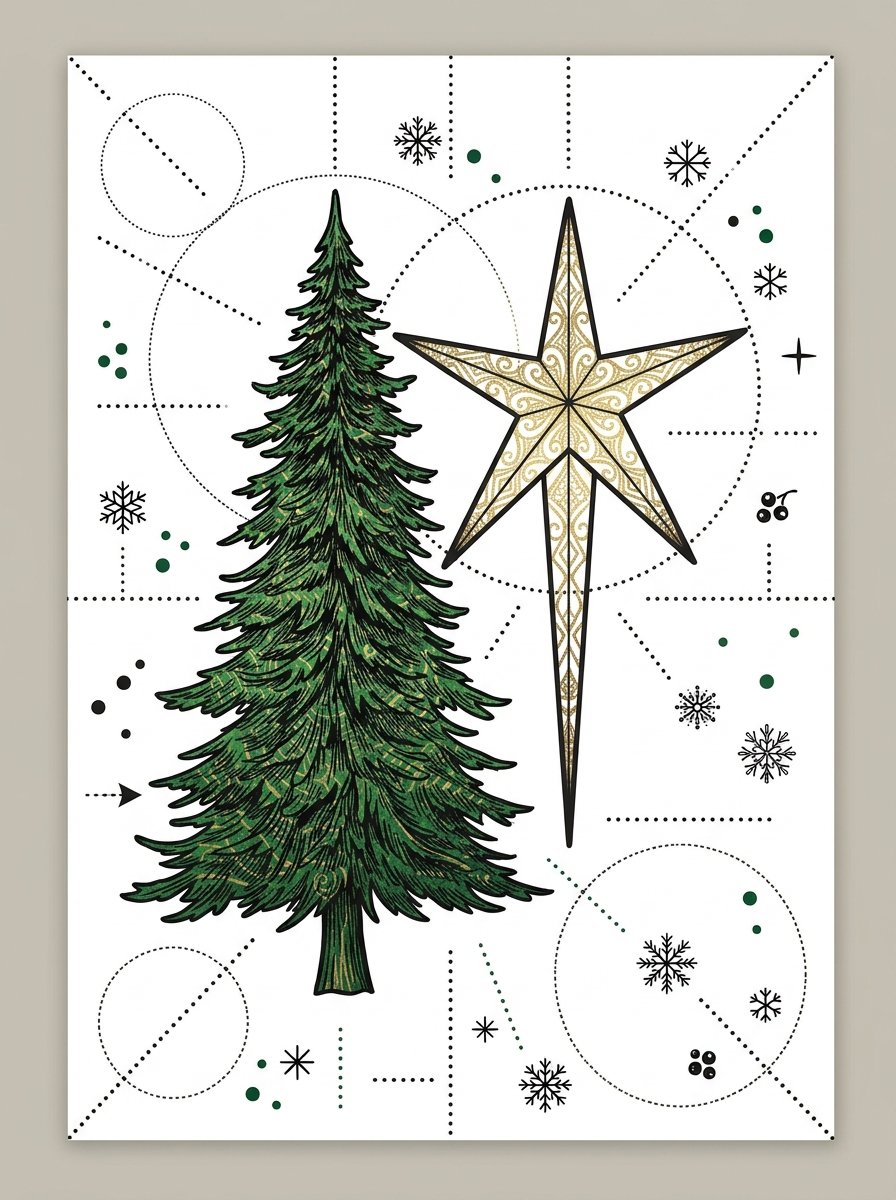
Print it at full size, never scaled to fit. A window motif wants to be big, and the shrink setting is the one that ruins it. Tape the sheet to the outside of the glass with the drawing facing in.
Most Christmas window painting ideas ask for a steady hand, and the glass makes that unnecessary
Here is the claim you have probably absorbed. A window is huge, vertical and slippery. Paint runs on it. So you need a steady hand, and years of them.
All of that is true about the glass. Not one word of it is about the skill.
A pane has one property a wall does not. You can see through it. A drawing taped to the far side is still visible from this side, at full size, in the right place.
So the line does not have to be invented. It only has to be followed.
I resisted this for a long time, on the grounds that it felt like cheating. It is the same thought I have had about every useful thing I have ever learned.
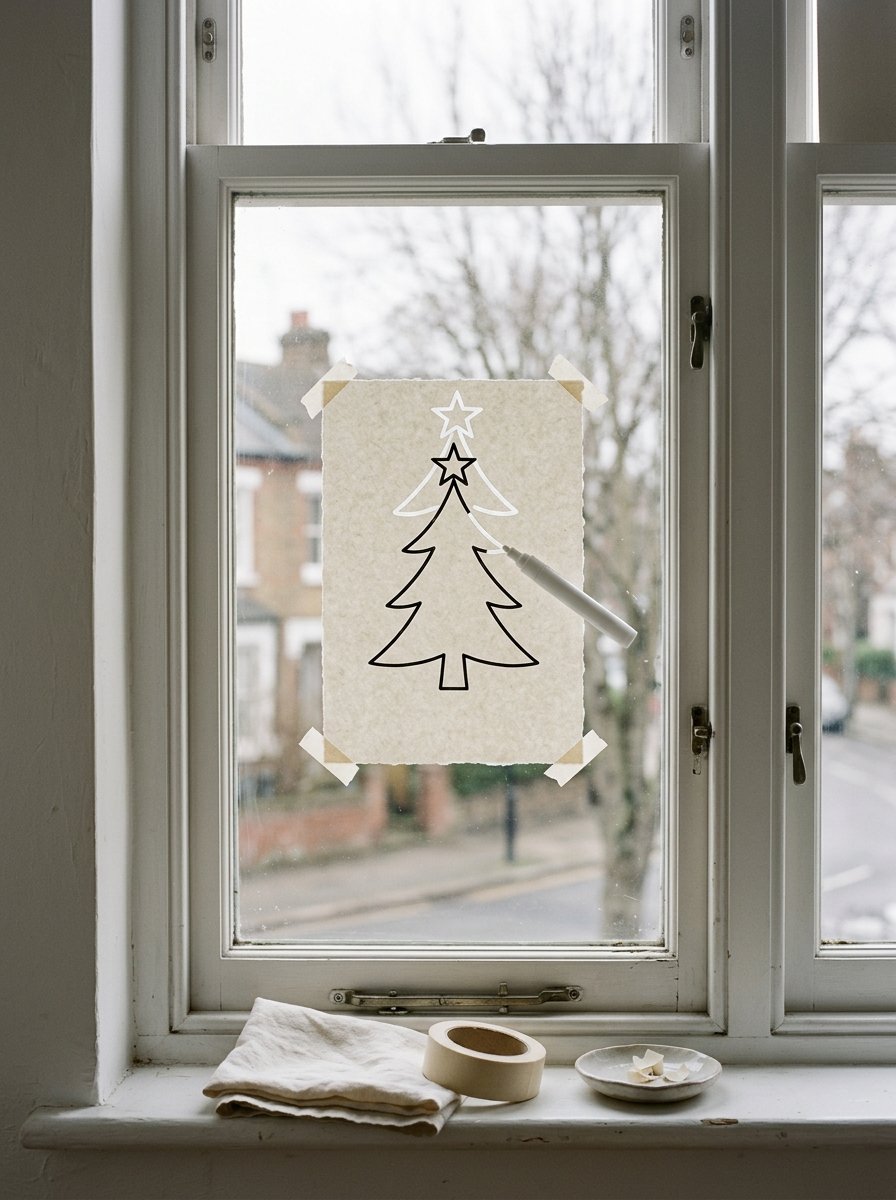
The template does the deciding. Your hand does the moving. Those are different jobs, and only one of them is hard.
The template does the deciding. Your hand does the moving.
The sheet above carries a fir and a star. That is 2 panes. A house has more panes than that, and by the second evening you will want a robin, a fox, or something with antlers.
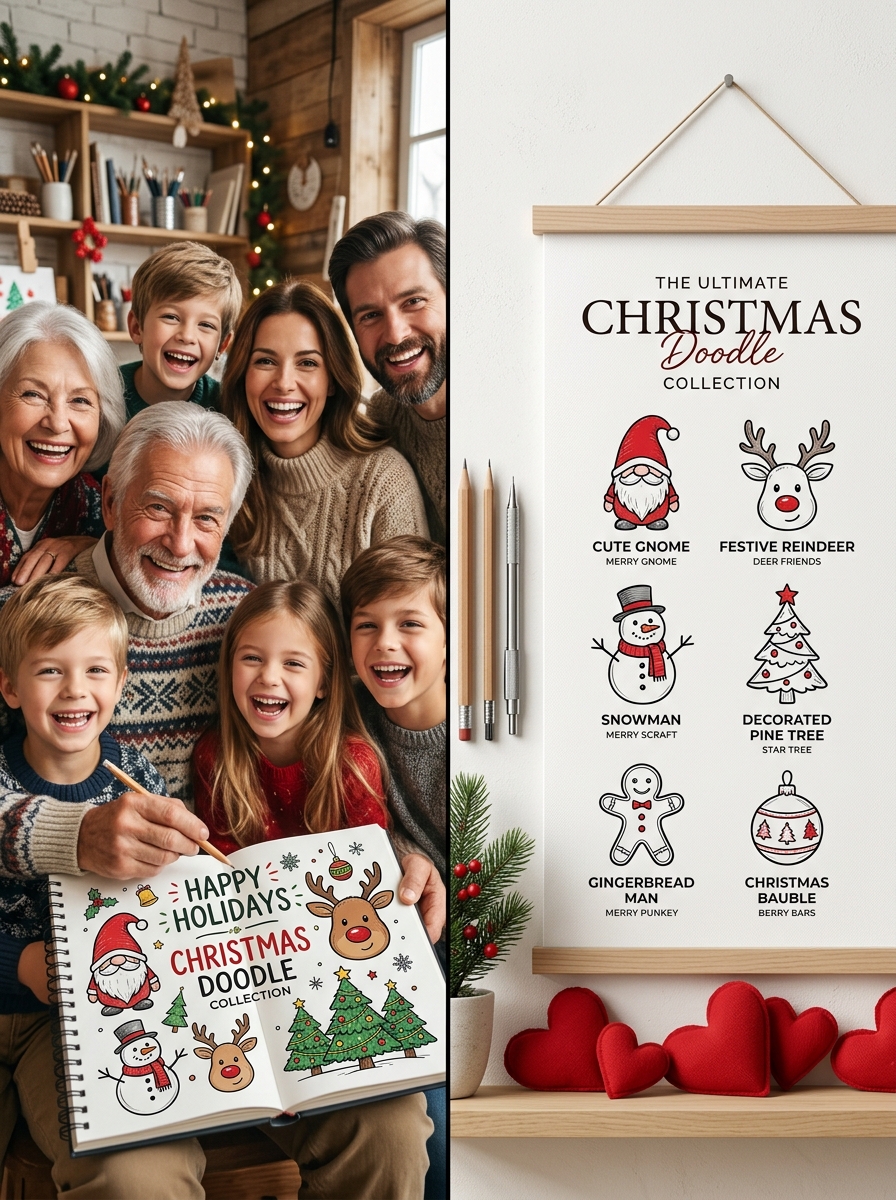
The Collection
What goes on the pane once the tree and the star are done?
ULTIMATE CHRISTMAS DOODLE COLLECTION — a gnome, a fox, a snowman, a bauble. For the night the front pane is finished and the kitchen one is still empty. (The gnome is the one I tape up first. His hat covers a multitude of wobbles.) What you get: bold Christmas outlines that still read through glass, and the patterns that fill them.
Now, the trades that painted the biggest surfaces of all.
The trades that painted the biggest surfaces never drew a line twice
Fred Fowle joined a fairground ride works in 1929 and painted rides for the rest of his working life. Skids, octopuses, hoopla stalls. Surfaces that lived outdoors and got rained on.
He did not start on the ride. He sketched the design on paper. Then he pricked along the lines and dusted blue powder through the holes.
What landed on the ride was a dotted ghost of the drawing. Then came the part that matters. The black outline went on in one sweep.
Under that outline sat 12 coats of paint. He would not accept fewer. (12 coats. On something that spent its whole life being rained on and admired at speed.)
So the most confident line in the trade was laid over marks that were already there. You can read the method in full at Eye magazine.
Do this tonight and you will feel it in a minute. Trace your outline once, lightly. Then go over it a second time, fast, without stopping.
What you will see is a line steadier than your usual line. It is steadier because you were following, not deciding.
The fix, when it reads thin from outside: thicken only the outer edge. The inner edge is what the eye uses for the shape.
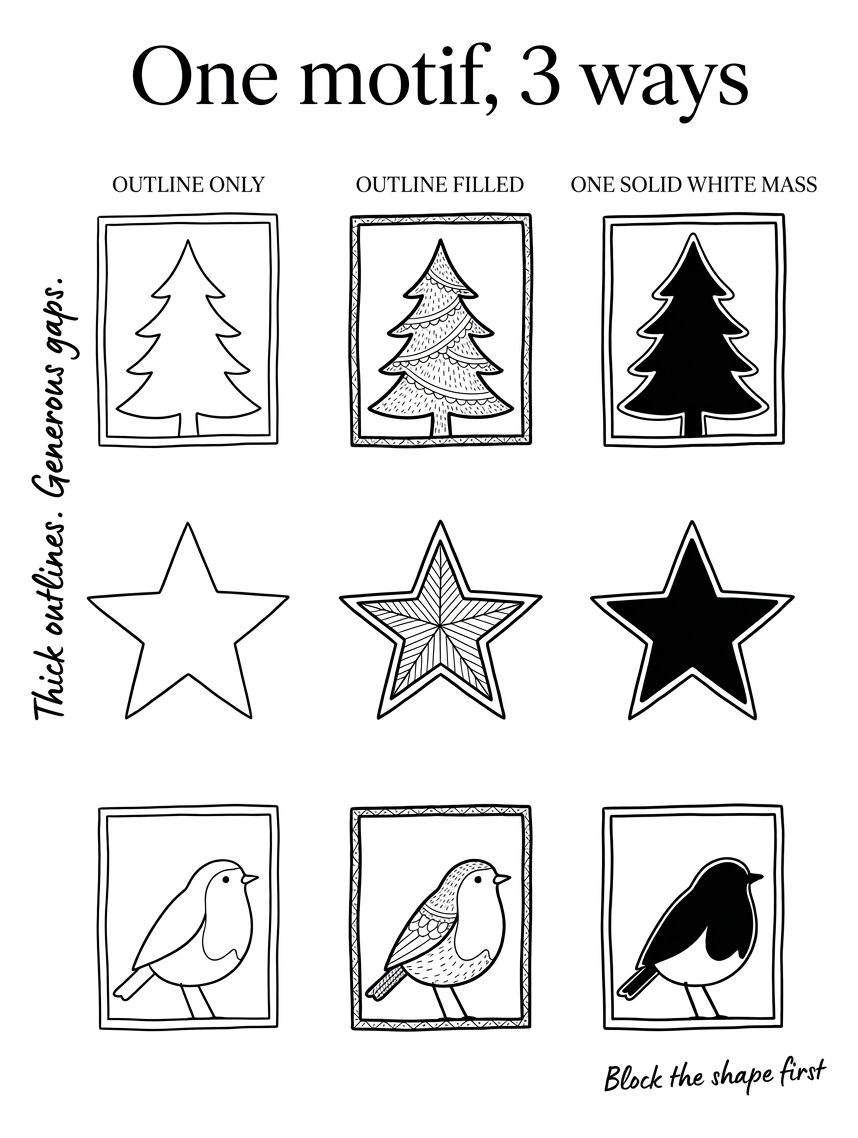
One motif, 3 ways. Outline only, outline filled, and outline with one solid mass. The third one is the one the street can see.
White is built in layers, and the loose sparkle goes on last
In 1900 a man in Chicago published a manual for shop windows. He had not yet written the book about Oz.
L. Frank Baum’s recipe for a snowstorm is really a list of layers. Cotton batting across the floor of the window. Dusted over with powdered mica. Lights hidden underneath it, some of them red.
And then, last of all, three or four pounds of goose-down thrown in front of electric fans.
(Three or four pounds. Of goose-down. Indoors.)
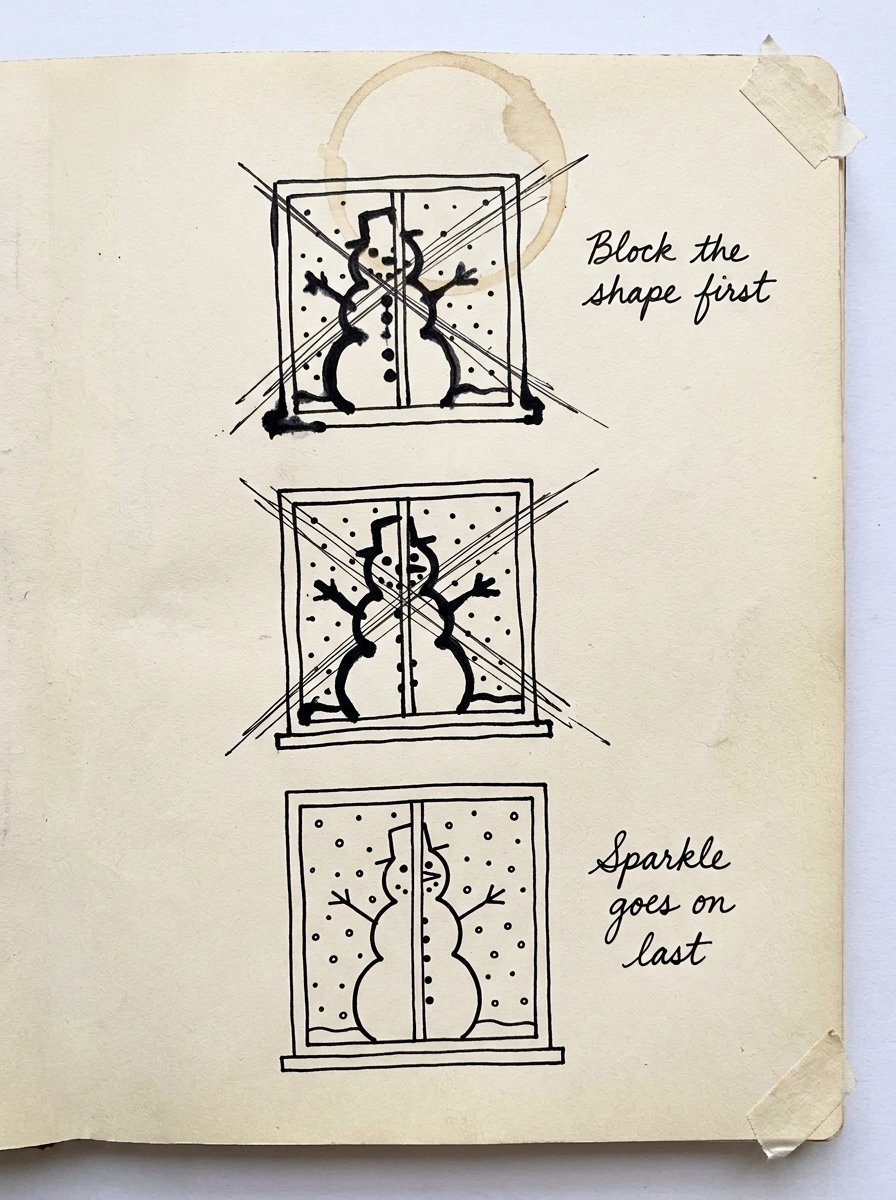
The order is the whole lesson. The solid white goes down first. The fine sparkle goes on top of it, at the end.
On a window it works the same way. Block your shape in solid white and let it dry. Then put the dots, the frost marks and the fine lines over it.
Do it the other way round and the second coat lifts the first. I have muddied a perfectly good snowman by decorating him before he was dry.
Here is my favourite part. Earlier in the same book, Baum gives a whole chapter to stopping windows frosting up. Real frost ruined the display. Fake frost was the product. You can read the whole manual for nothing.
Real frost ruined the display. Fake frost was the product.
A petal is one loaded stroke, not a shape you draw
Canal boats in England carry roses and castles on almost every flat surface they own. Phil Speight has been painting them for 40 years.
His instruction for a rose is almost rude in how short it is. Load the brush with plenty of paint. Paint each petal in one smooth stroke.
Hold the brush upright. Use your other hand to support your wrist. Press the brush down and pull it, and as you pull, lift it slowly away.
So a petal is a pressure change. It is not an edge you draw and then fill. The brush makes the shape on the way past.
(I practised this on a saucer first. The first 6 petals were dreadful. The 7th turned up on its own and I have no idea what I did differently.)
He says he has never knowingly painted the same castle twice. His method is written out here, stroke by stroke.
On a vertical pane this matters more than it does on paper. Paint on paper sits where you put it. Paint on glass starts moving.
Cold glass fights back in 3 predictable ways
Nobody mentions this part, and it is why a first window goes wrong.
The first is condensation. A warm room against a cold pane makes the inside of the glass sweat. Paint will not sit on a wet pane.
Wipe it dry and work quickly. (Baum’s answer in 1900 was an electric fan in the corner. Ours is a tea towel and a bit of speed.)
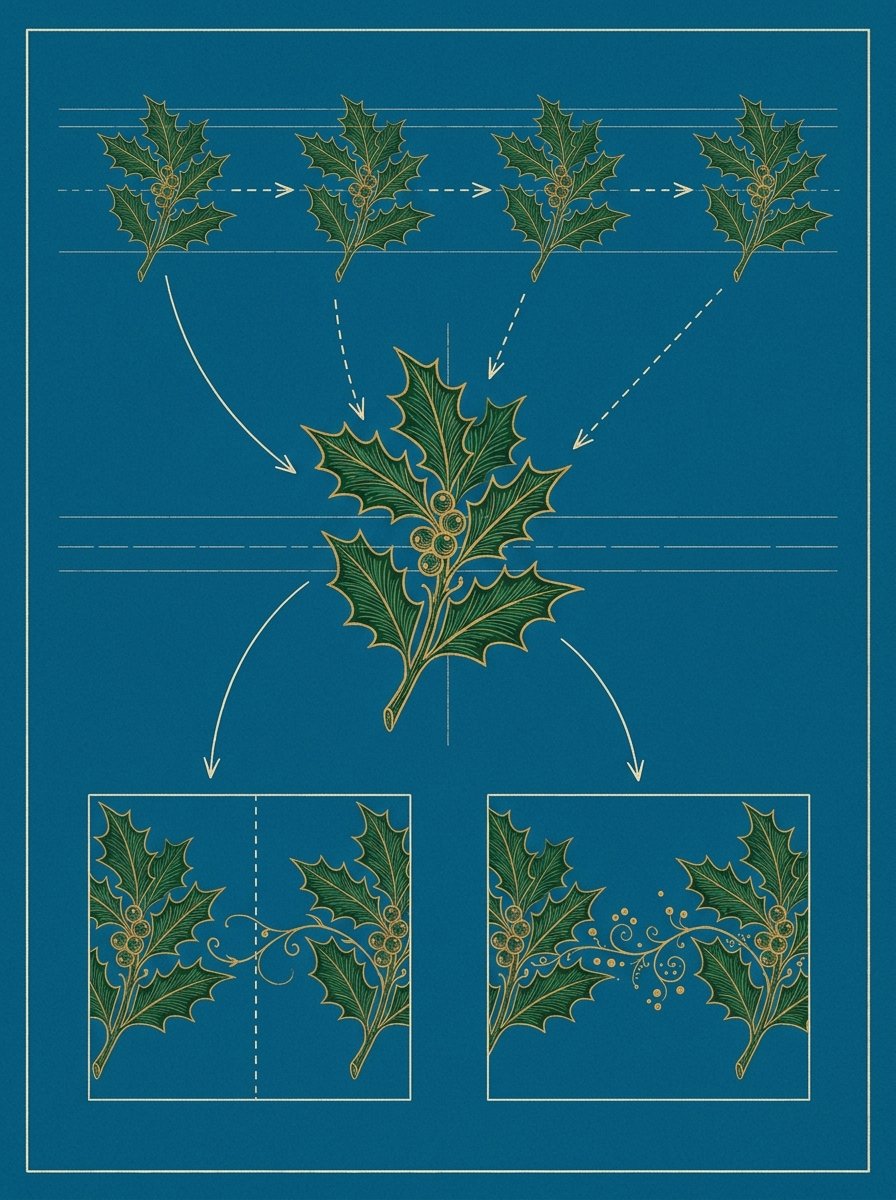
A holly sprig repeated along the top glazing bar. One motif, spaced, is a border, and a border makes a plain pane look finished.
The second is the squeak. A marker dragged across dry glass chirps, skips, and lays a dotted line instead of a solid one.
Press lighter and slow down. The squeak is the pen telling you it is starved at that angle, not that you are doing it wrong.
The third is beading. Paint on a vertical pane gathers itself into a bead and then goes for a walk downwards.
Use less on the brush than feels right. Fill a shape in 2 thin passes rather than one generous one.
I lost a whole reindeer this way. A single fat drip travelled 30 centimetres before I noticed it had left.
Christmas window painting ideas have to read from the pavement, not from the sofa
Go outside and look at your own window from the gate. This is the only review that counts.
Fine detail disappears at that distance. A bold silhouette does not.
So the test is quick. Hold your thumb up at arm’s length and cover the design. If you can still say what it is, it works.
Thick outlines. Generous gaps. One solid mass somewhere in the middle.
(The prettiest thing I painted last winter was a spray of very small berries. From the street it read as dirt.)
Baum knew exactly who he was painting for, and it was never the person inside the shop. His rule was that an attractive window half sells the goods before anyone comes in.
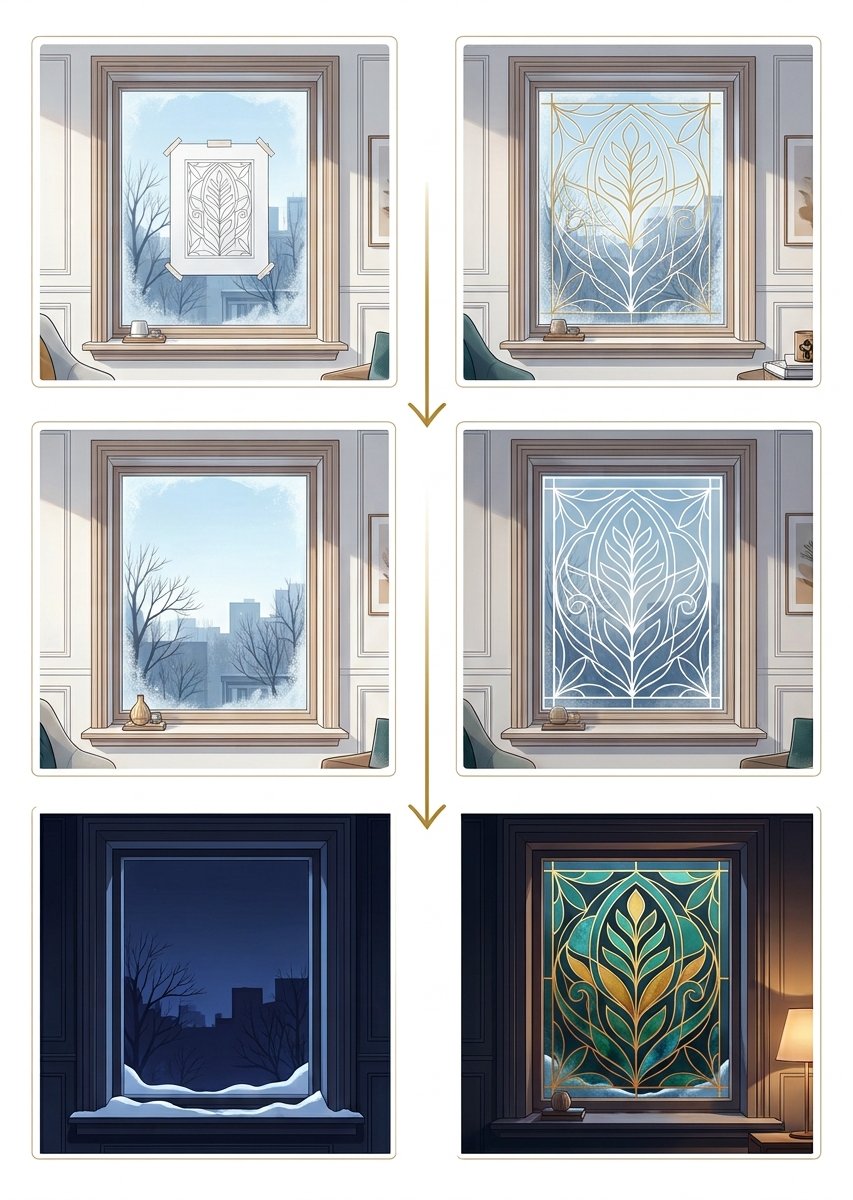
The same pane, 3 evenings apart. Bare, traced, then lit from behind once it is dark.
Which pane you are standing at decides the design, and here are all 93
You do not need a plan for the whole house. You need one pane and 20 minutes. Work through these in whatever order the rooms come.
Start at the big front window, because it is read from the street and wants the boldest shapes. A tall fir, a pair of firs, a star with 5 long points. Then a crescent moon, a stag’s head, a leaping hare.
Then a single bauble on a long thread, 3 baubles at different heights, a snowflake with 6 arms. Finish with a lantern, a robin, a bell, a candy cane and a sledge. Big and simple, one motif per pane.
The kitchen window is seen close up, usually from the sink, so it can carry detail. A holly sprig, a mistletoe drop, an orange slice. Then a clove-studded orange, a cinnamon bundle, a gingerbread man.
Then a gingerbread house, a teapot with steam, a mince pie. Add a sprig of rosemary, a pinecone, a walnut and a jug of cream. Keep these low, at standing eye level.
Door glass is narrow and tall, so give it things that hang. A swag of greenery, a hanging wreath, a bell pull. Then a candle in a jar, a stack of parcels, a ribbon bow.
Then a key on a ribbon, a boot, a lantern on a hook. Finish with a string of lights, a row of icicles, a fir garland and a house number inside a wreath. One vertical beats three small ones.
Small cottage panes take exactly one motif each, and that is the pleasure of them. A single star, a single snowflake, a single bauble. Then a wren, a mouse, a hedgehog.
Then a fox, a squirrel, an owl. Add a cat on a sill, a candle, a heart and a tiny fir. Centre each one properly, because a small pane shows every wobble in the placing.
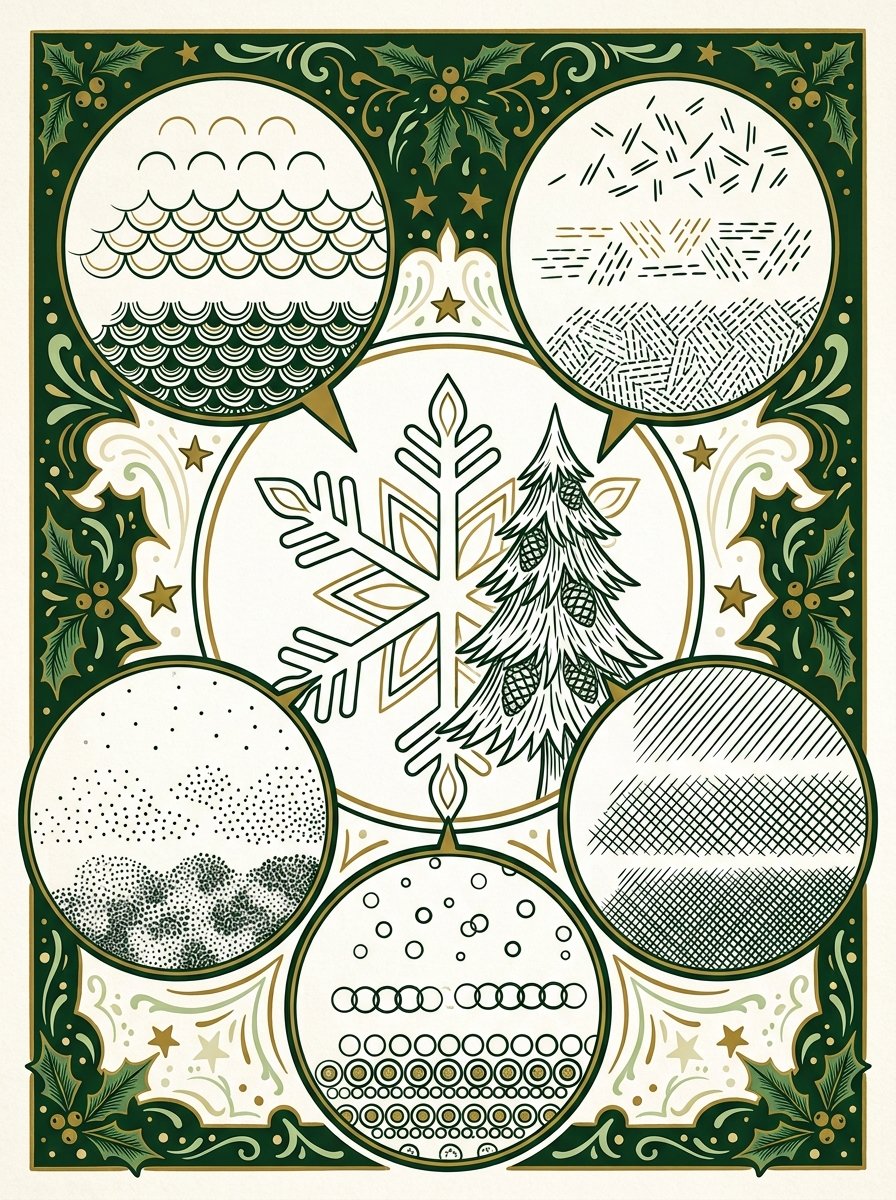
Any of those shapes will take any of these fills. Build them big and open, or they close up into a grey smudge from the gate.
A stair or landing window is seen from below, so the design should float rather than sit. A hanging star, a paper chain, a goose in flight. Then a swallow, a pair of doves, a falling sprig.
Then a crescent moon with one star, a cluster of icicles, a snow cloud. Add a swinging lantern, a bell on a ribbon, a feather and a ribbon spiral. Push everything higher than feels correct.
A frosted or bathroom pane is the easiest of the lot, because white on cloudy white cannot go badly wrong. A fern frond, a frost star, a frosted web. Then a thistle head, a seed head, a bare branch.
Then a pair of skates, a woolly hat, a mitten. Finish with a scarf, a snowman, a penguin and a polar bear. Outline only here, and no fills at all.
The back door and the porch come last, and they are the ones nobody expects. A trail of boot prints, a trail of paw prints, an ivy trail. Then a berry cluster, a log basket, a watering can with fir in it.
Then a bicycle with a wreath on it, a milk bottle, a post box. Add a letter with a stamp, a little house with smoke, a snowy picket fence and a gate with a bow. Finish on one lit window, painted at knee height where a person arriving actually looks.
That is 93, and not one of them has to be invented by you tonight.
Free Starter Pack
10 pattern templates for filling a shape once the outline is on the glass.
Sent tonight. Small marks that still read from the far side of the street.
Unsubscribe in 1 click, no hard feelings
The checklist that keeps Christmas window painting ideas up until January
Almost everything that goes wrong happens at the two ends, not in the middle. So I wrote the order out and taped it inside a cupboard door.
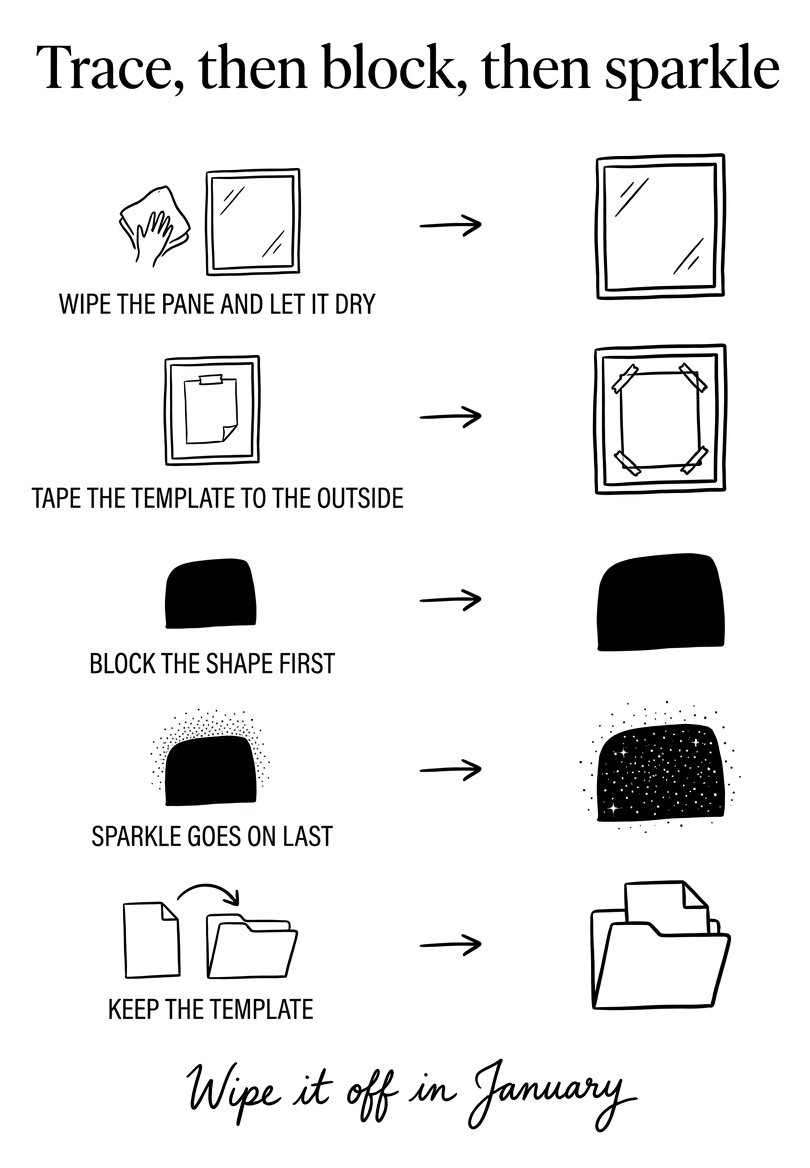
Wipe the pane and let it dry completely, because a smear is invisible until it is under white paint. Tape the template to the outside. Trace, then block, then sparkle, in that order.
What to keep: the template, the caps, and one photograph taken from the gate. What to wipe: the smears at the start, and the whole thing in January with a damp cloth.
Glass cleaner is the one thing to leave in the cupboard. It smears a chalk line sideways instead of lifting it.
Keep that order and the worst case is a design you are not in love with. Ignore it and you get a window that looks like weather.
By the third pane you stop thinking about method at all. You start wondering what else would look good lit from behind at 5pm. That is what the 50 Draw-Along Keepsake Postcards are for.
Bold Christmas outlines that survive being seen from the street

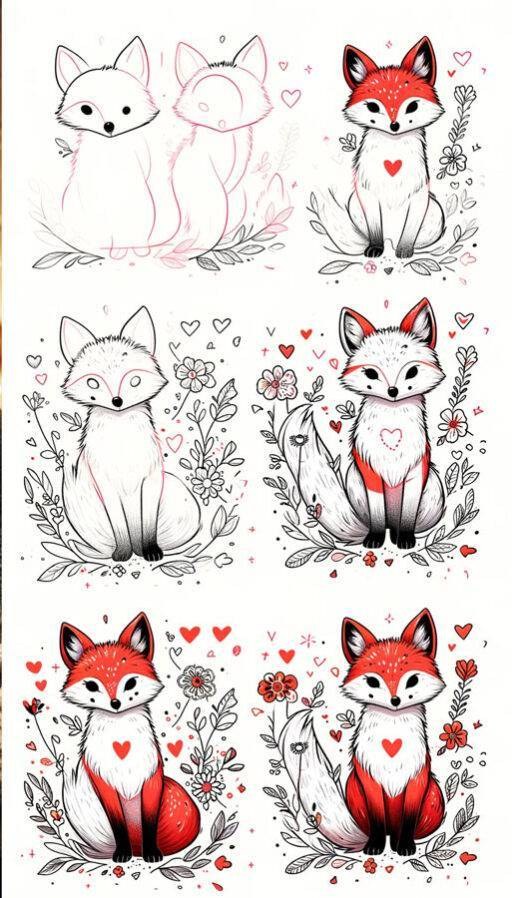
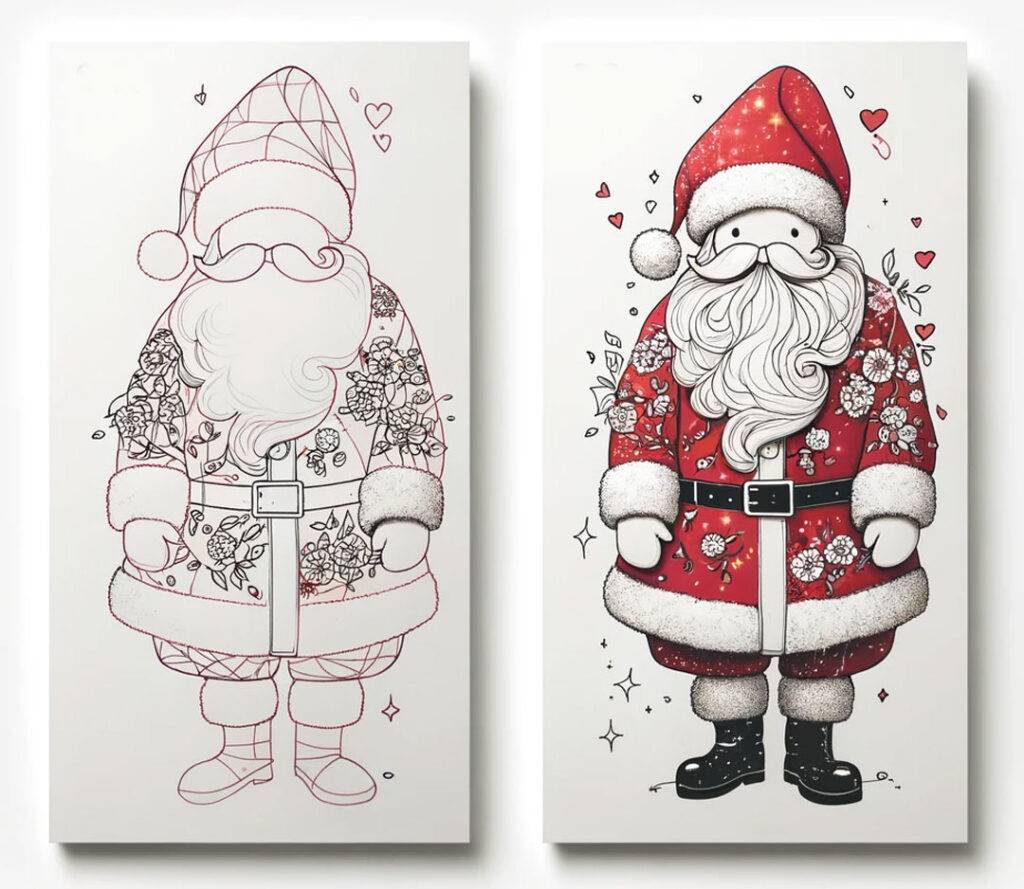
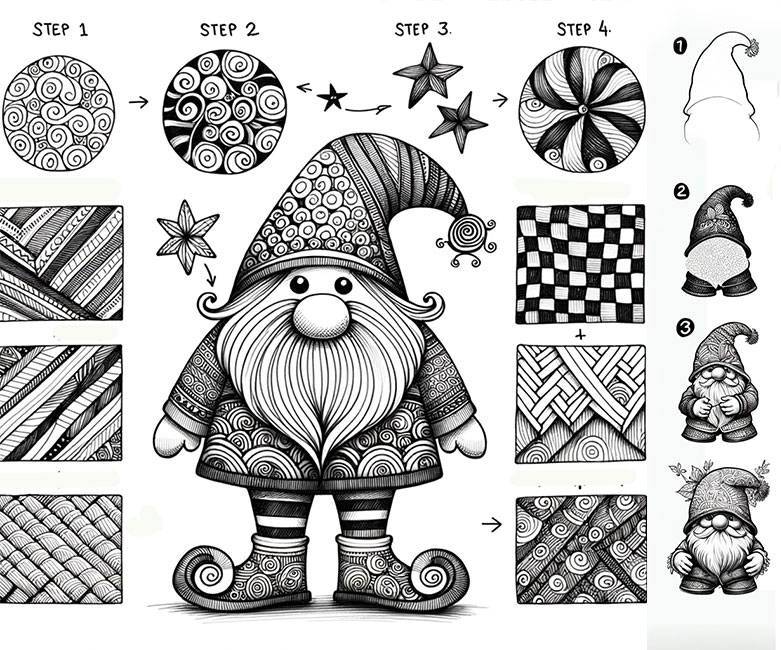
Start with the snowman and tape him to the kitchen window. Inside: the Christmas characters, their fill patterns, and a step guide for each one. The set runs from a gingerbread man to a bauble with three different fills.
Open the Christmas Doodle Collection →
Instant download · print as often as you like
The window keeps working after you have gone up to bed. It holds your star against the dark all evening, for anybody walking past who needs a reason to look up.
“You will not only have a regular snow storm, but a blizzard …”
L. Frank Baum, The Art of Decorating Dry Goods Windows and Interiors, 1900
Mirabelle wrote this. No training, strong opinions, many pens. Peer reviewed by a cat who watched the glass from the radiator and offered nothing.