You do not have to draw feathers. Not one of them. The bird will still read as a bird, and faster than the one you have been labouring over since Tuesday.
What goes down instead is a shape. The whole bird as one flat silhouette, filled in solid, with nothing happening inside it.
A man built a fifty-year career on exactly that and then said the quiet part out loud. Asked how he painted birds, he answered: “I have never counted the feathers in the wings, for that is not what my pictures are about. I just count the wings.” His name was Charley Harper. He called it minimal realism, which is a very calm way of saying he had looked at the problem and decided most of it was optional.
The question was never whether you can render a wing. It is whether you can see the bird as a shape first. That is the whole of bird sketching, and it takes about ten minutes to learn.
Here is what is below, in order:
- The three-shape method — silhouette, one colour block, one set of marks. That is the entire sequence.
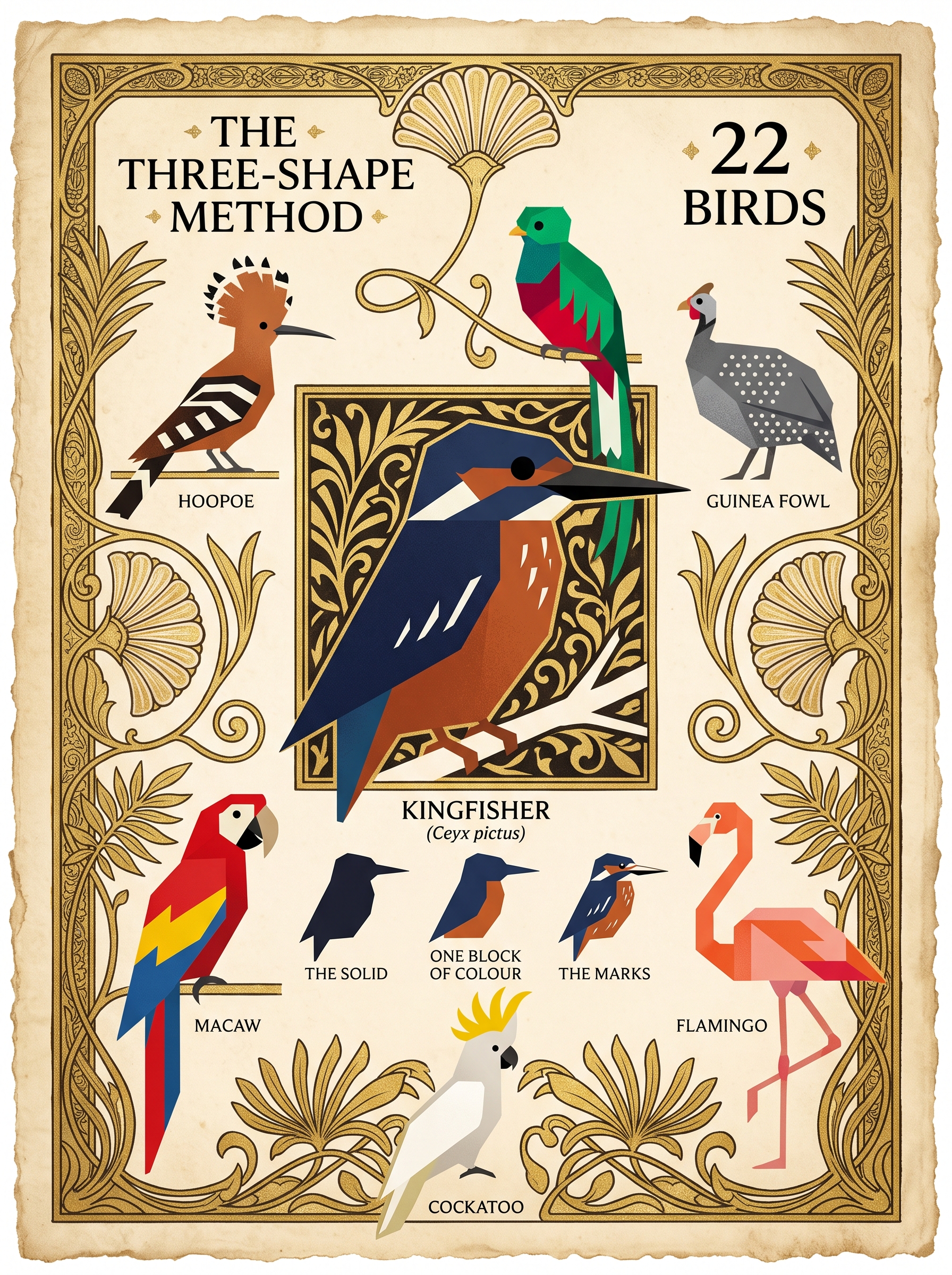
- 22 birds, grouped by shape-logic — not by species, because species is an ornithology problem and shape is a drawing one.
- Where the shape actually goes wrong — and it is never the wing. It is the angle of the whole body.
- A free kingfisher sheet — printable, three steps, yours before you have agreed to anything.
Start with the kingfisher, because it is the most forgiving bird in the set. It is essentially a dart with opinions.
Download the free kingfisher sheet
One sheet teaches one bird, and one bird teaches the method. What it cannot teach you is the bit that arrives on the fourth or fifth attempt — the moment the shapes stop being an exercise and start being a set of birds you would actually put on a wall, in the same palette, at the same size, looking like they belong to each other.
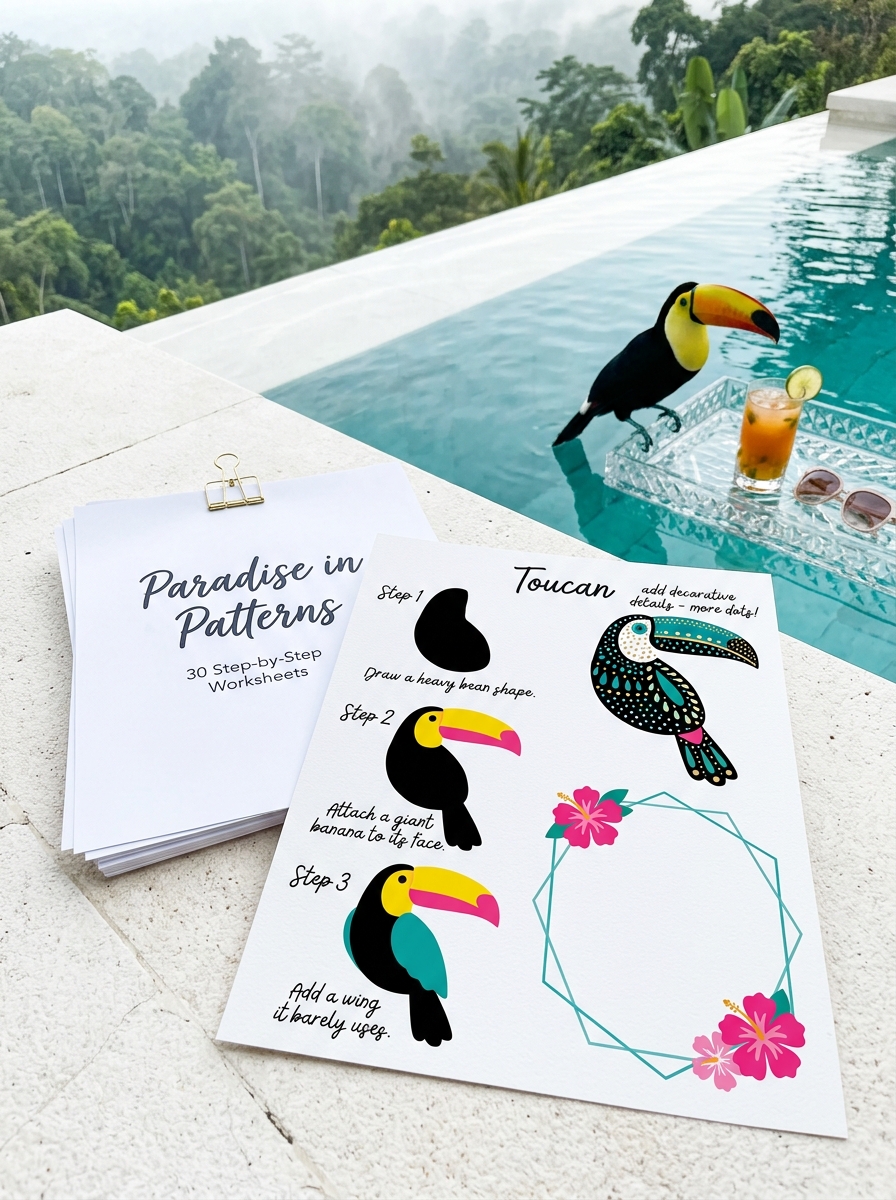
The Collection
PARADISE IN PATTERNS — macaws, hoopoes, and a great deal of unnecessary colour.
The set for the grey stretch of the year when the light gives up at four and everything outdoors is the colour of a car park. A guinea fowl is, structurally, a teardrop somebody covered in dots and then walked away from. What you get: 22 birds you can finish in an evening each, and a wall of flat bright shapes that makes a room look chosen.
Back to the method, because it is shorter than you are expecting.
The secret: he was not simplifying, he was refusing
Harper drew birds from a home studio in a city not famous for birds, and for years he drew them for the lifestyle magazine of a car company, which remains one of my favourite facts about anybody. In 1974 he collected sixty of them into a book with sixty short pieces of writing to match. He was very funny about it, which is rarer in bird artists than you would hope. (The genre runs heavily to reverence. Somebody has to be normal about a duck.)
The useful part is what he said he did not see. Asked about the anatomy, he listed what a trained eye is supposed to notice — scapulars, auriculars, primaries, tail coverts, tarsi — and said he saw none of it. What he saw were shapes, colour combinations, patterns and textures.
He was not simplifying a bird he could not draw. He was refusing a level of detail that was never doing the work in the first place.
That distinction matters, because “simplified” sounds like a compromise, and this is not one — it is a man refusing to do unpaid work. A solid navy wedge with an orange belly is not a lesser kingfisher. It is a faster route to the same recognition, and recognition is the only thing a drawing of a bird has ever been asked to do.
He also made a joke at his own expense that I think about often: he said he was the only wildlife artist who had never been compared to Audubon. He is right, and it was never an accident.
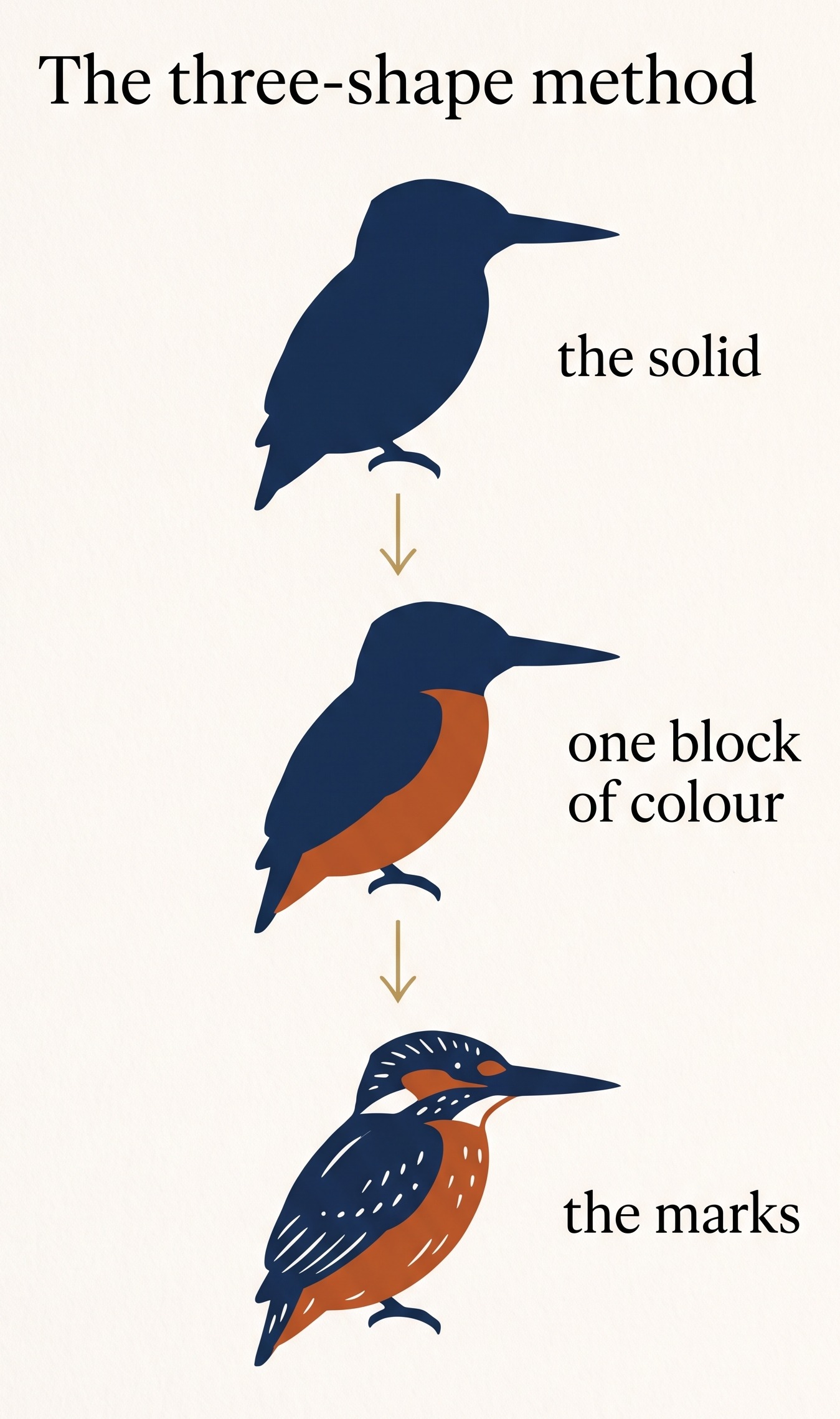
The three-shape method, start to finish
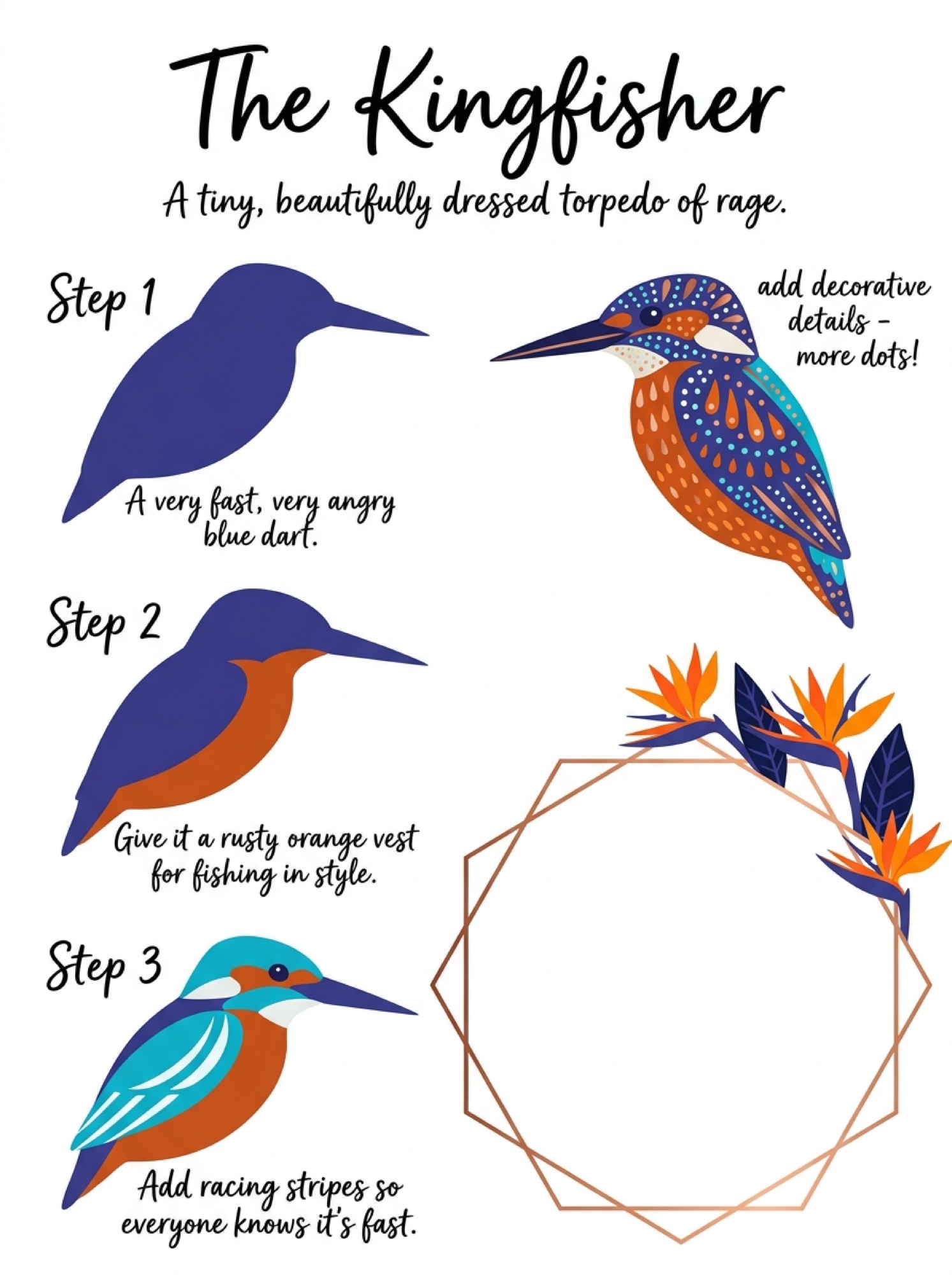
Every sheet in this collection runs the same three moves, and the captions on them are doing real teaching, so I am quoting them rather than paraphrasing.
- Step one — the solid — the whole bird as one filled shape. On the kingfisher sheet the caption reads “A very fast, very angry blue dart.” That is the instruction. Draw the dart.
- Step two — one block of colour — a single second shape laid over the first. “Give it a rusty orange vest for fishing in style.”
- Step three — the marks — stripes, dots, a slash of white. “Add racing stripes so everyone knows it’s fast.”
Three moves. No stage where you are asked to think about a feather. The reason this holds up under a pen rather than a brush is that every move is a decision you can make before the nib touches paper — and a line drawn after a decision looks nothing like a line drawn during one.
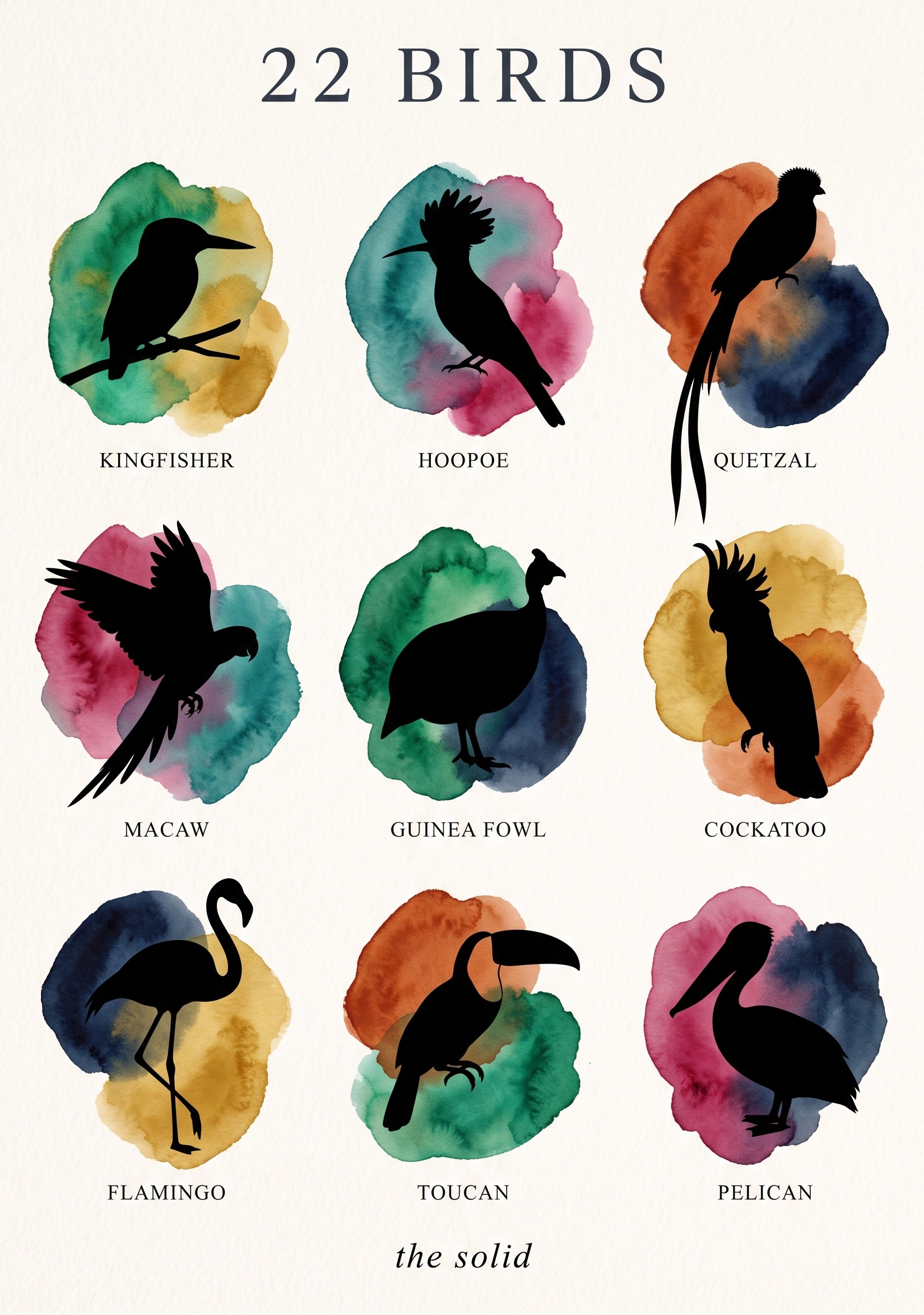
Twenty-two birds is not twenty-two problems. It is one problem in twenty-two costumes.
Get that sequence into your hand once and the other twenty-one birds stop being twenty-one problems. They become one problem in twenty-one costumes.
22 birds, grouped by the shape they start from
Grouping by species tells you nothing about how to draw. Grouping by silhouette tells you everything, so bird sketching sorts them this way instead.
The darts — one taper, beak to tail
- Kingfisher — the whole body is one wedge. The beak is not an addition, it is the pointed end of the wedge.
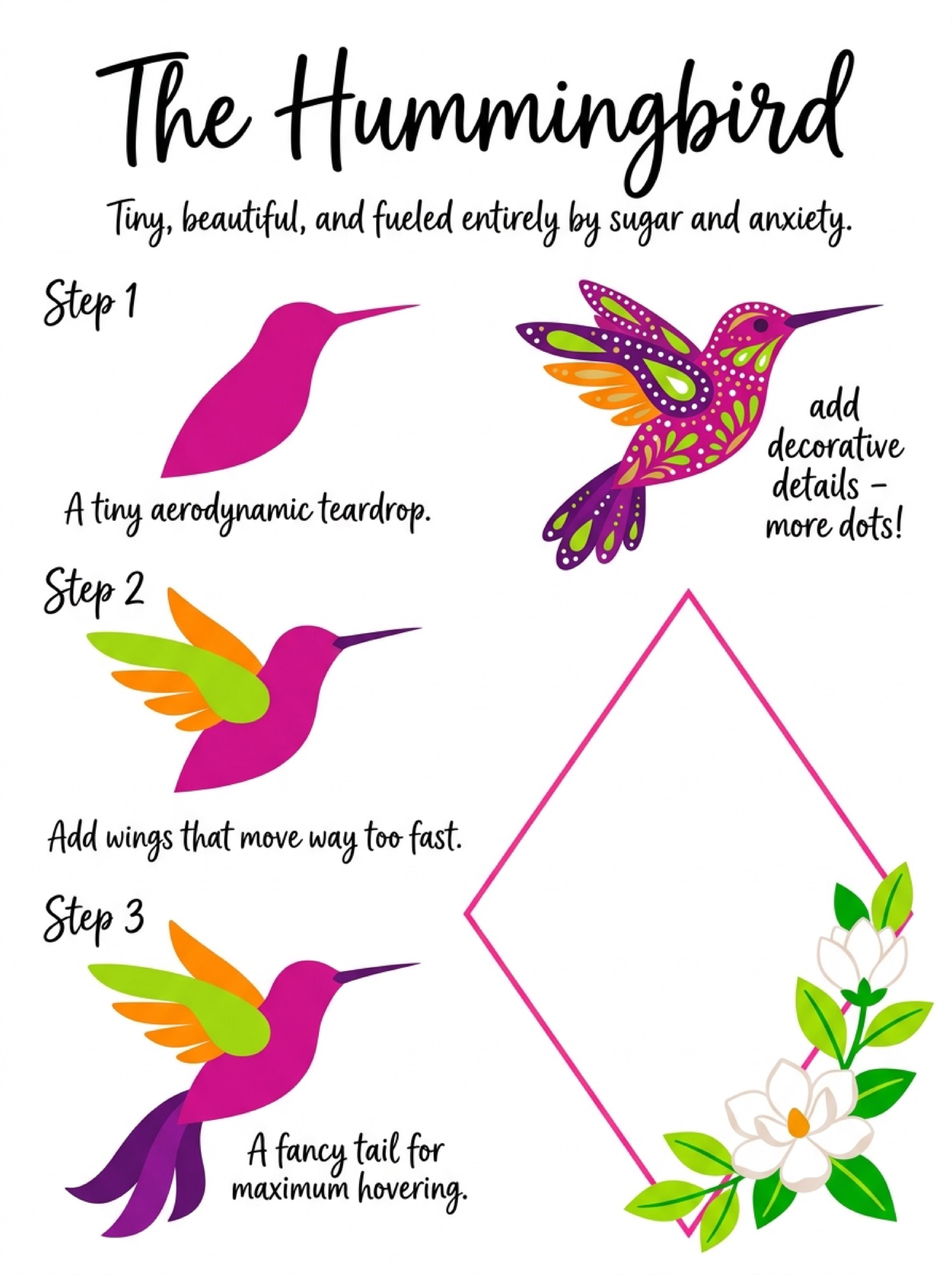
- Hummingbird — the same wedge, tilted, with the wings as two commas rather than two wings.
- Sunbird — a hummingbird that has committed to a curve. The bill is the curve continuing.
- Motmot — a dart with a long tail and two absurd racket-shaped ends, which are two ovals and nothing more.
- Ibis — the dart stretched until it is elegant. The bill does a third of the drawing for you.
If a dart bird goes wrong it is almost always because the taper was drawn as two separate lines meeting at a point, rather than one shape that happens to narrow. Draw the outline in one pass and the beak arrives on its own.
Download the free hummingbird sheet
The beaks that arrived first
In this group the bill is bigger than the head, so you draw the bill first and hang a bird off the back of it. It feels wrong. It is correct.
- Toucan — roughly forty per cent beak. Draw that forty per cent first and the rest is a soft black comma.
- Hornbill — the same idea wearing a hat. The casque is one more shape on top, not a texture.
- Puffin — a beak with a bird attached, and the beak is three flat stripes of colour.
- Pelican — the pouch is the shape. The bird is the handle.
- Macaw — the only one where the eye does real work — a pale ring on a dark head, put in last.
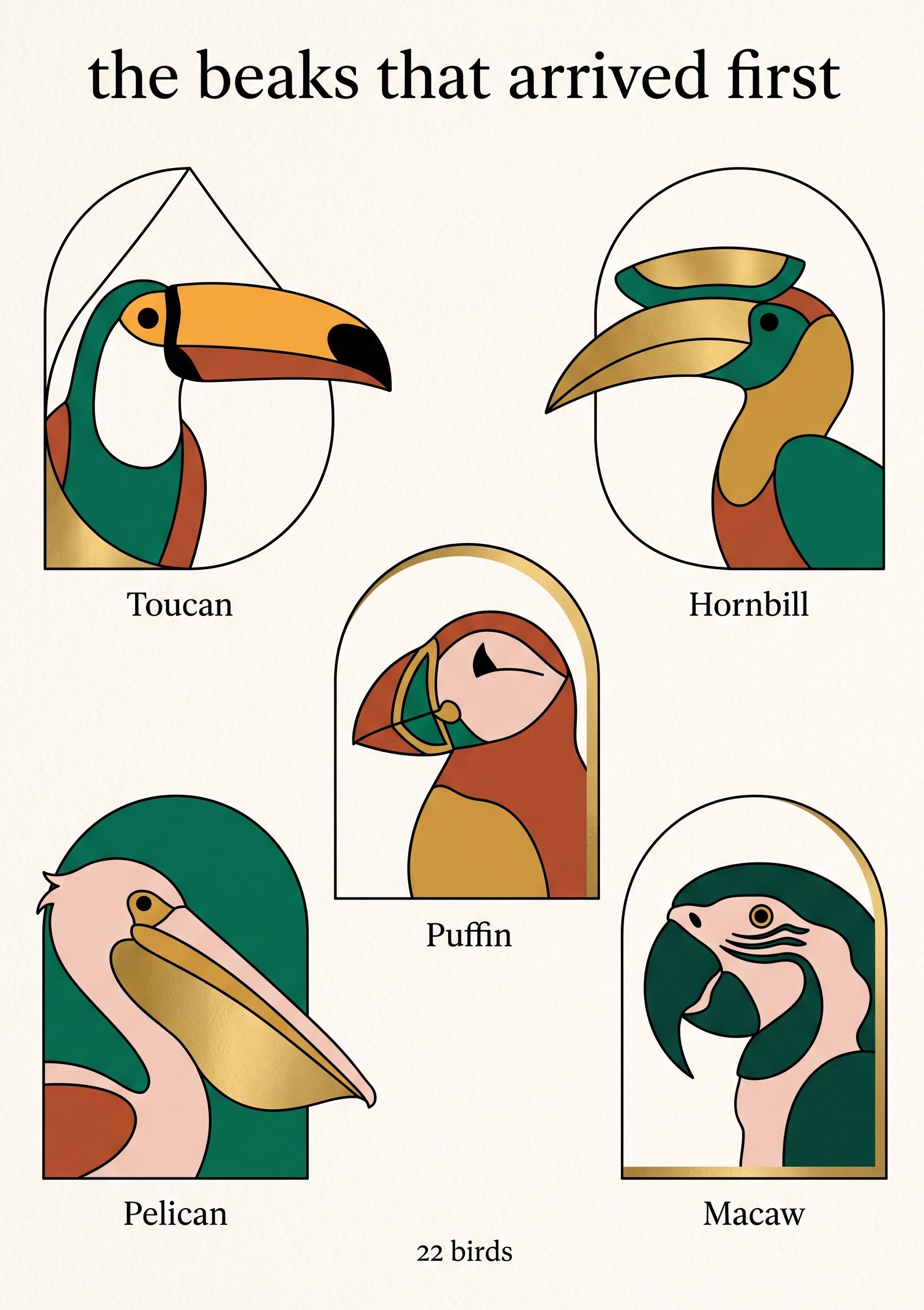
These are the birds people photograph and then feel unable to draw, which is backwards for bird sketching. A big beak is a gift. It is the one part of a bird that is already a simple shape before you have done anything to it.
The ones wearing something on their head
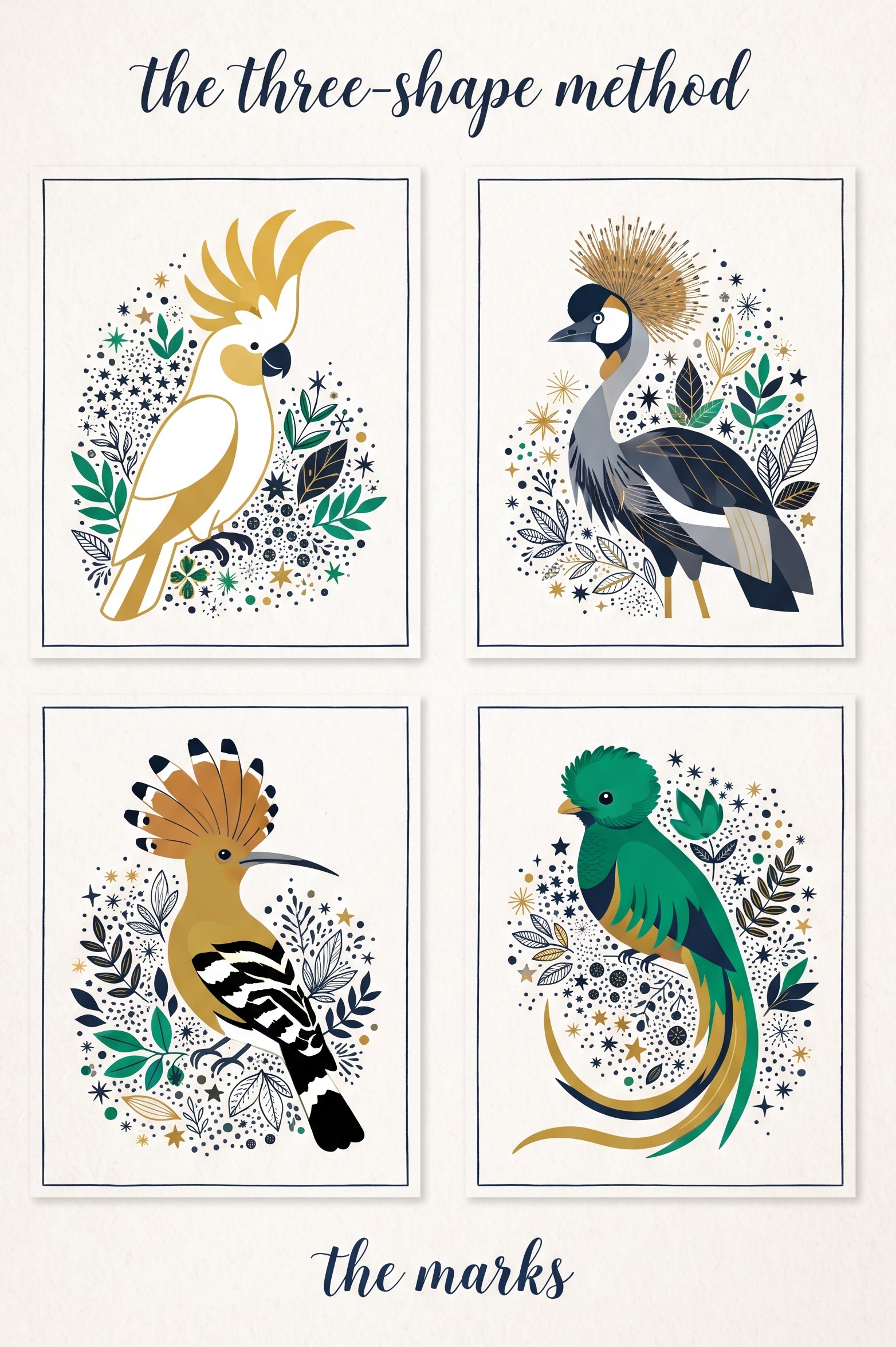
- Cockatoo — body, then one crest, drawn as a single sweep rather than a set of feathers.
- Crowned crane — the crown is a halo of short strokes. Do them last, quickly, and do not tidy them.
- Hoopoe — a fan, opened. One arc and the strokes inside it.
- Quetzal — the tail is longer than the bird and it is the whole composition. Give it the room.
- Lyrebird — two long curves and everything between them can stay empty.
The flourish always goes on last and always goes on fast. A crest drawn slowly reads as anxious, every time, and no amount of accuracy rescues it.
The round ones and the standing ones
- Guinea fowl — a teardrop, a tiny head, and then dots. The dots are the entire personality.
- Lovebird — two circles that overlap. Nothing else is required and nothing else helps.
- Kookaburra — a heavy oval with a heavy bill, drawn as though it is settling rather than perching.
- Bird of paradise — the body is small and boring. Everything is in the plumes, so give them three quarters of the page.
- Flamingo — one continuous S, then a body. The legs are two lines and should stay two lines.
- Cassowary — a shape you will not believe until you look it up. It is not a mistake.
- Ostrich — the neck is the drawing. The body is a cushion on legs.
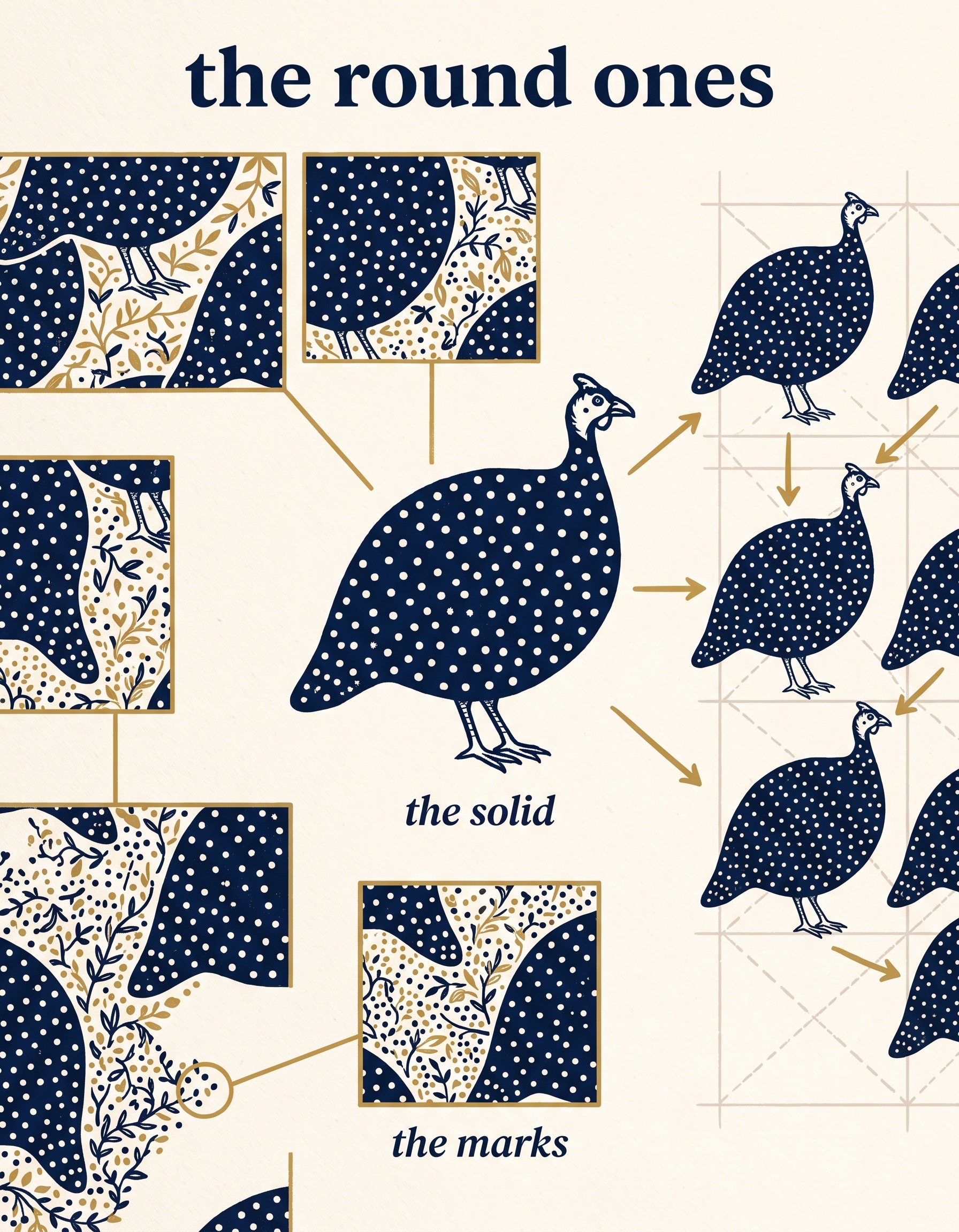
Between them these four groups cover all 22 birds in the folio, and none of the groups needs a technique the previous one did not already teach. That is the point of sorting them this way.
Where the shape goes wrong, in the order it happens
Nothing on this list is about feathers, which is the part worth noticing. (Things that are also not the problem: your pen, your paper, your eyesight, and the fact that you did not do art at school.) Every one of them happens in the first thirty seconds, before there is anything on the page detailed enough to blame.
- The body is drawn upright. Almost no bird stands vertical. Tilt the whole silhouette fifteen or twenty degrees before anything else and half the problem never appears.
- The head is a separate circle. Draw the head and body as one continuous outline. The moment there is a join, there is a neck, and the neck is where drawings of birds go to die.
- The eye is centred. It sits further forward and higher than feels right. Put it where it looks slightly wrong and check it after.
- The legs are drawn to the ground. They do not need to arrive anywhere. Two lines that stop are read as legs; two lines that land on a carefully drawn branch are read as a diagram.
- The marks go on too early. Stripes, dots and texture belong on a shape that is already finished. Put them on a shape you are still deciding about and you will commit to the wrong shape to protect the marks.
None of these is a skill problem. Every one of them is a sequence problem, and a sequence can be repaired without getting any better at drawing.
Read back through those and none of them is a skill problem. They are all sequence problems, which is genuinely good news — a sequence can be fixed on the next attempt without getting any better at drawing.
The mistake I made twenty-two times
I drew the whole set once with every bird facing left. Every single one. I did not notice until I laid them out on the floor to photograph them and realised I had produced a queue.
The fix took four minutes and it was not redrawing anything. I turned six of the sheets over, traced them from the back, and put those six back into the set facing right. Nobody has ever asked. But the arrangement stopped looking like a chart and started looking like a wall, and that difference is entirely down to which way the beaks point.
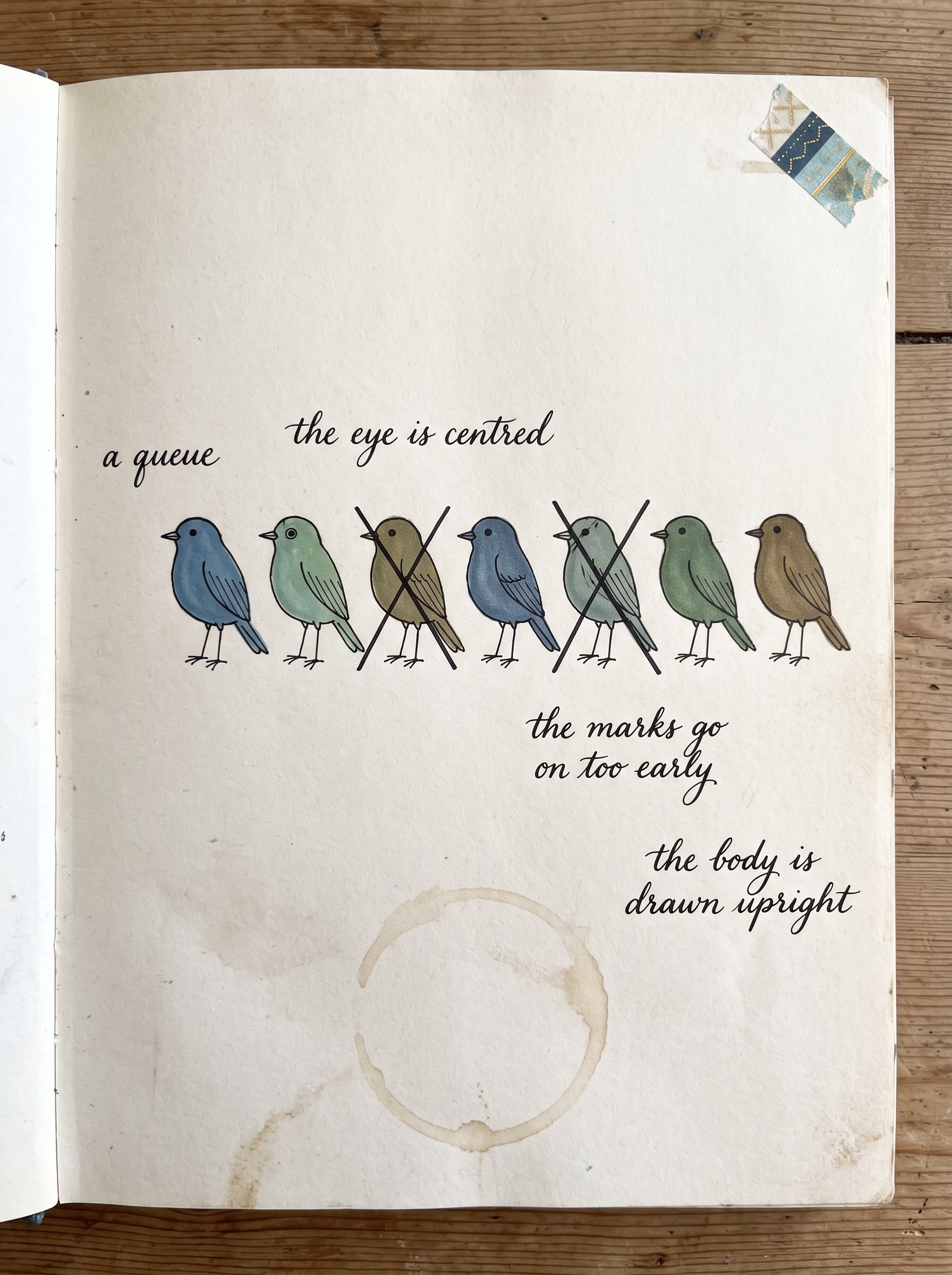
So: vary the direction as you go, not at the end. (This is the sort of advice that sounds like nagging until the afternoon you spend tracing six birds backwards through a window.) It costs nothing at the time and it is tedious to repair later, which is the most reliable definition of a good habit I know.
Do I need to be able to draw to start bird sketching?
No. The three-shape method is specifically the version of bird sketching that does not require it. You are drawing a silhouette, a block and some marks — three things a person can do on their first evening. The sheets carry a faint outline underneath, so the first attempt is a trace and the second is not.
What pen do I need for bird sketching?
Whatever is in the drawer. A fine black liner and a handful of colour is genuinely the whole bird sketching kit — which is inconvenient news for anybody hoping the problem was equipment. These sheets were built for pens rather than paint, which is why the shapes are flat — there is no blending step to get wrong, and nothing needs to dry before the next thing happens.
Which bird should a beginner sketch first?
For bird sketching the kingfisher, and then the lovebird. The kingfisher because the whole body is one shape, and the lovebird because it is two circles and finishing something quickly on your second attempt is worth more than picking something impressive and abandoning it.
Can I do this from a photograph, or do I have to be outside?
A photograph is fine and for this method it is arguably better. You are looking for the outline, and a still image lets you find it without a bird leaving mid-thought. The one thing worth doing outdoors is watching how a bird actually holds itself — the tilt, the weight, whether it is settled or about to go. That is the bit a photograph flattens, and it is the bit step one depends on.
Free Starter Pack
10 pattern templates. Step three is where they go.
Sent tonight. Stripes, dots, scales and dashes — the marks that finish a bird.
Unsubscribe in 1 click, no hard feelings
22 birds and 10 other creatures, every one built from flat shapes
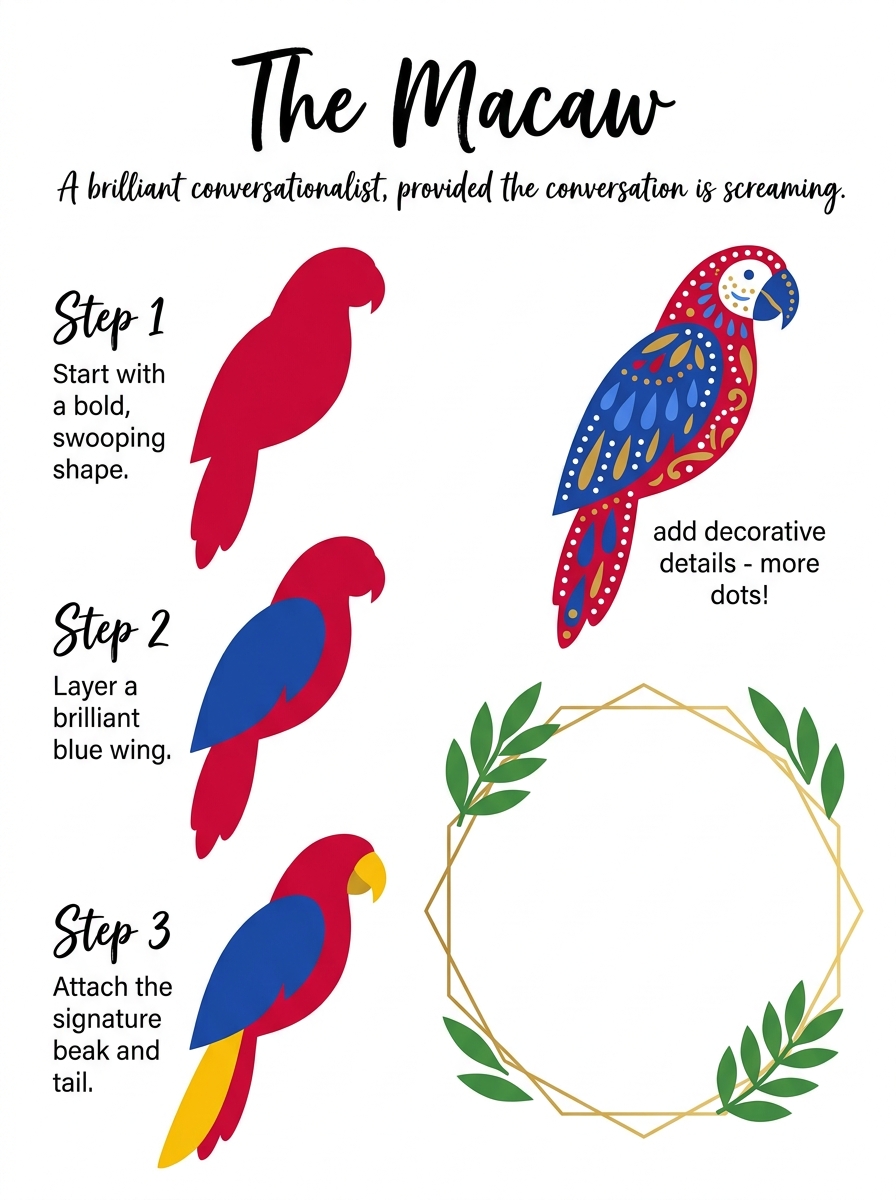
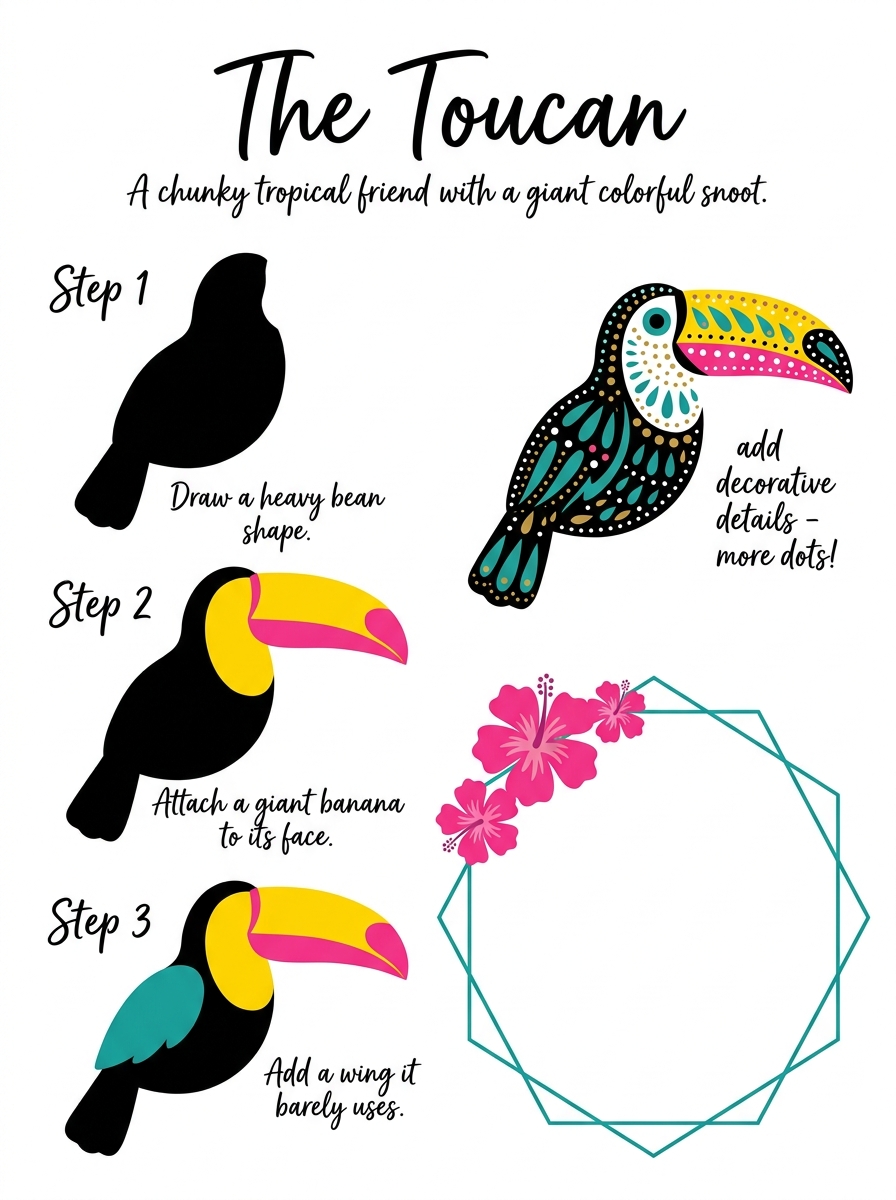
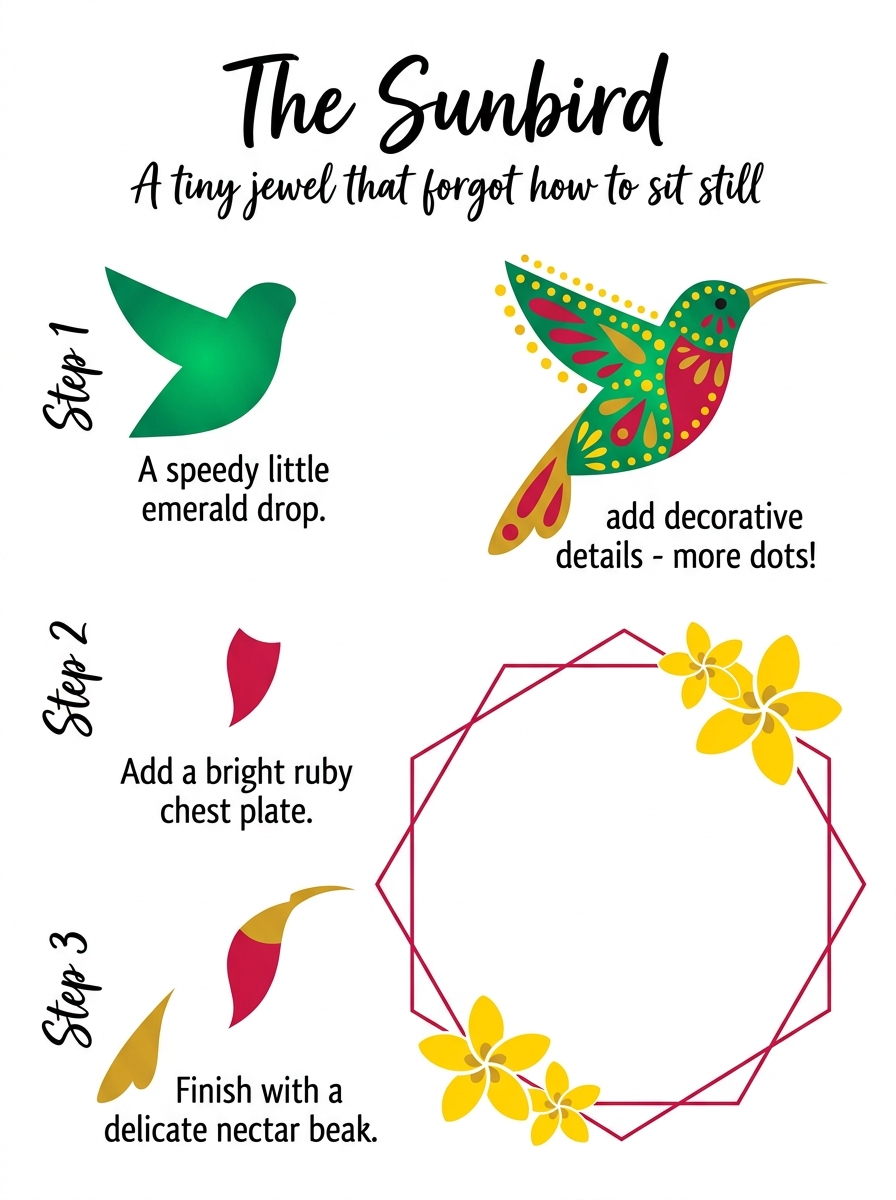
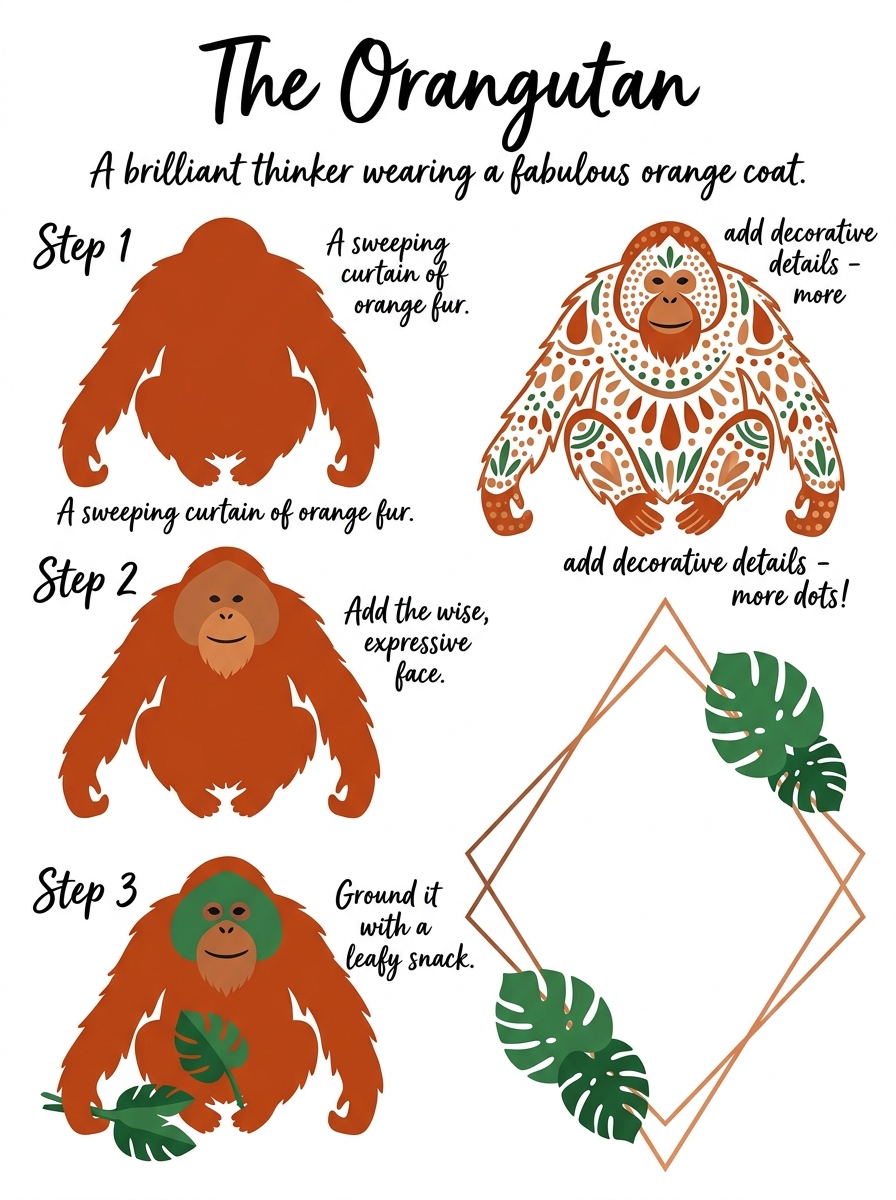
Tonight it is one kingfisher, drawn as a navy wedge while the kettle goes. By the weekend it is four birds in a row on the hall wall, flat and bright and nothing like the ones in the shops. Every silhouette, every colour block, every last racing stripe — the whole route from one shape to something worth hanging.
Instant download · print as often as you like
Twenty-two birds, and not a feather between them.
Mirabelle wrote this. No training, strong opinions, many pens. Peer reviewed by a cat who watched a real bird through the window and drew no conclusions.