

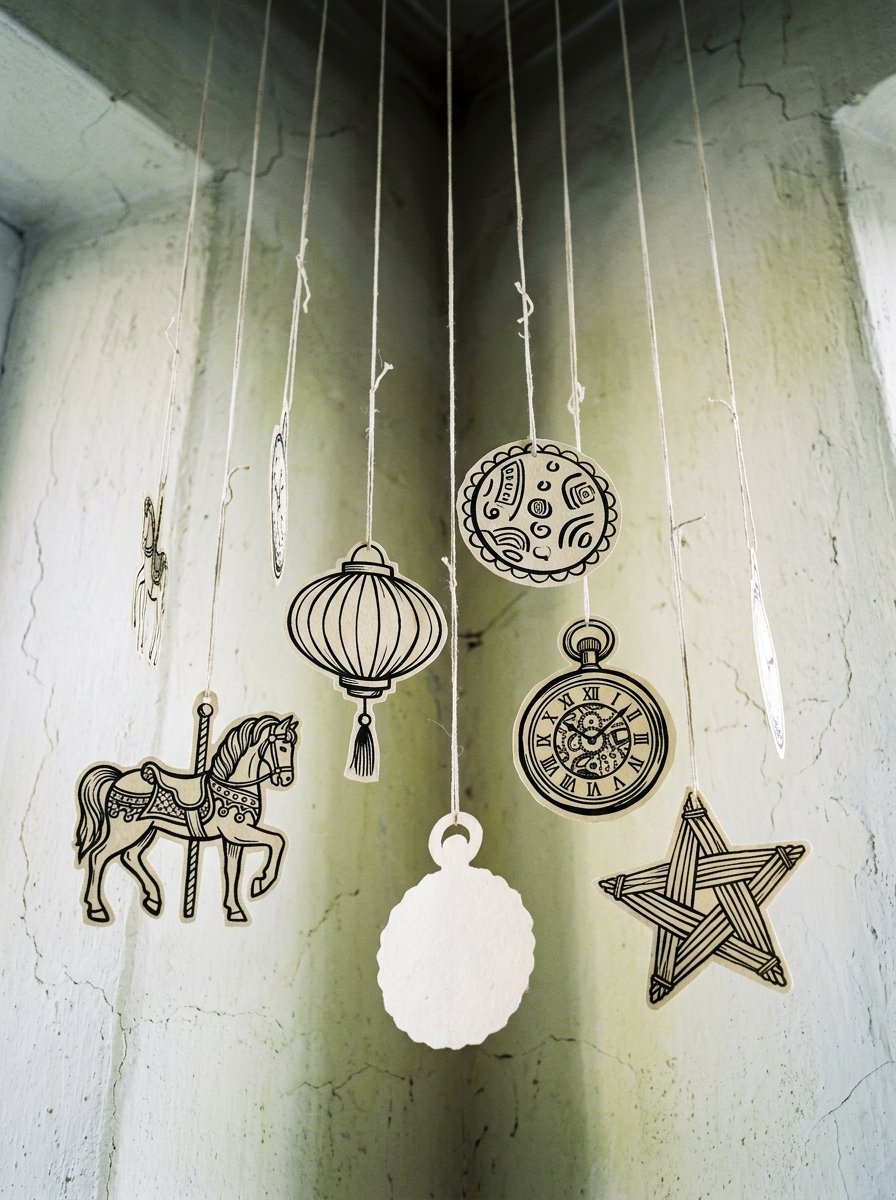
An ornament is the only drawing that has to work from behind. Most christmas drawing ideas for adults quietly assume it is going to stay flat.
Hang one up and it stops being flat. It turns.
A card has one front. An ornament has two fronts, an edge, and an underside nobody drew.
So the drawing has to survive being an object, and most good drawings do not.
I hung my first batch and spent the evening turning them all face out again.
Below: what four working traditions did about it, and 41 shapes that come through. The hang-test card is first.
Download the free hang-test card →

Choose actual size in the print box, never the option that scales it down.
(The scaling option will take a few millimetres off every side and say nothing.)
The card runs four tests, and every shape on this page has been through them.
Test one is the turn. Hold the shape up and rotate it once.
If the back is blank, the ornament spends half its life looking like a mistake.
Test two is the size. Most ornaments finish about as wide as a plum.
Fine detail closes up at that width. Three bold marks survive. The fine ones go grey.
Test three is the angle. A hanging shape is looked at from below, never level.
Test four is the edge, because the edge is the part people actually take hold of.
Those four tests are not a style. They are what the object does to the drawing.
A shape that fails one of them can still be drawn. It just stops working once it is up.
Which is why it is a card and not a list. You hold the thing against it.
I keep it by the scissors and check anything new before I commit ink.
The tests tell you which shapes survive. They do not hand you a subject.
And a subject is the part that goes wrong at 9pm, when nothing sounds worth drawing.
What the card cannot give you is a shape already argued down to one bold outline.

The Collection
Christmas subjects, and every one is already down to a single bold shape.
ULTIMATE CHRISTMAS DOODLE COLLECTION. A gnome, a reindeer, a bauble and a tree that hangs well. For the evening you want a subject already down to one shape. Inside: Christmas characters as clean outlines, each with the patterns that fill them. (A doodled bauble and a hung one are the same drawing doing two jobs.) What you get: a subject you need not invent at 9pm, already small enough to hang.
Now the four traditions, and each one solved a different part of the same problem.
The first thing an ornament does is turn round
Nobody hangs a thing and then holds it still.
It turns on the thread, it turns in a draught, and it turns every time somebody walks past.
Which means the back is not the back. It is the second front.
The German card-workers solved this before anybody asked them to.
The Deutsches Historisches Museum holds an embossed card elephant from around 1918, catalogued as card and paper, embossed and pasted.
The sheet went into the press slightly damp.
It was squeezed between an upper and a lower die whose bumps and hollows matched exactly.
Then it was punched out, and two hollow halves were glued back to back.
Dry card cracks in the press. That is why the damp mattered.
And because the halves were struck from matching dies, both sides are the same animal.
The back of an ornament is not the back. It is the side you have not drawn yet.
(I once drew a very good stag and hung it. It faced the wall for a fortnight, sulking.)
You have three honest options for the second face, and only three.
Draw the same shape again at half the size. Give it one bold mark. Or leave it bare and cut the edge instead.

The third option is the one I use most, and it is on the card above.
Christmas drawing ideas for adults have to work at the size of a plum
An ornament is small because it has to hang without pulling the branch down.
So every mark is competing for a space about as wide as your palm.
The silhouette trade worked at exactly this size and learned two hand speeds for it.
Isabella Beetham ran her shop at 27 Fleet Street in London from 1785 to 1809. She learned to paint from the miniaturist John Smart, and she is held to be one of the 2 great silhouette artists of her century. The record of her working method is unusually precise about her hands.
Frills and lace were made by slashing outward, past the edge of the black shape.
Short cuts, fast, going away from the body of the drawing.
Hair was the opposite. Long sweeping lines, laid with a single-hair brush, one hair at a time.
And gum arabic, which is the only thing on the piece that shines, went on almost nothing.
Two or three darkest accents. That was the whole allowance.
So: fast marks at the edge, slow marks through the middle, and shine on hardly anything.
(I gilded a whole ornament once. It read as a toffee wrapper from the other side of the room.)

Every shape in that grid is about as wide as a plum, which is the real working size.
Draw one at full page size first if you like. Then draw it again at plum size.
The second one tells you which marks were actually doing the work.
Cut the pieces loose before you decide where any of them go
The standing assumption is that you draw the whole ornament in one committed go.
You do not have to, and the people who were best at this did not.
Louis Saugy, 1871 to 1953, worked in the Pays-d’Enhaut in Switzerland, and the Musée du Pays-d’Enhaut records his working set-up in some detail.
He worked lying on a sofa with a thin portable green desk on his lap.
Small pointed scissors. A pair of tweezers. A hat pin.
He did not cut one folded sheet and hope.
He cut every element loose first. A cow here, a fir there, a figure, a fence.
Then he laid them all out and balanced the composition with a pair of compasses.
Only then did he lift each piece with the tweezers.
One point of glue, carried on the hat pin, and that was the whole fixing.
Too much glue and it browns through the paper. You can still see where he was generous.
Cut the parts loose and you are allowed to change your mind. Commit the line and you are not.
(I now cut everything out before deciding anything. My desk looks like a small paper crime scene.)
For a drawn ornament the translation is direct. Draw the parts on scrap, cut them out, shuffle them.
Trace the arrangement you actually like. That is the only version that gets inked.

Nothing on that bench is finished, and that is the stage this section is about.
The edge is the last thing you draw and the first thing anyone touches
A flat drawing has no edge. The paper just stops.
An ornament has a cut edge, and the cut edge is held, turned and looked along.
Hannah Robertson published The Young Ladies School of Arts in 1767.
Her filigree chapter is a set of hand instructions.
Paper was stained, glazed, then sent to a book-binder to be gilded and cut into very narrow slips.
Each slip was rolled into a coil and pinned down into a board of fir.
Fir, specifically, because the pins will not go into anything harder.
Then the rule that costs people their evening: let the glue dry before you take it off the pins.
And keep the glue off the work once the filigree is laid on, or it dims the gilding.
The gilded edge of the slip is the thing on show. The edge is the picture.
(I lifted a coil early to check it. It relaxed into a shape I can only call disappointed.)
For a drawn ornament: outline last, not first, and make the outline follow the cut.
Then leave a clear margin of bare paper outside it so the scissors have somewhere to go.

The left column is what happens when the line goes on first. You end up with two edges.
Two or three points of shine, and all of them near the edge. That is the whole allowance.
Nobody ever sees a hanging shape level
A card sits on a mantelpiece at eye height. An ornament hangs above it.
So it is read from below, at an angle, and foreshortened.
The top third of the shape faces you. The underside faces the floor and is never seen.
Which means a design centred on the shape reads as a design that has slipped.
Put the drawing above the widest line, not across it.
(I centred mine for a fortnight and could not work out why they looked half empty.)

The card above marks the three bands. The top third does the work.
The middle takes one mark. The underside takes nothing at all, and that is not laziness.
It is the only part of the object that no one is ever going to look at.
41 christmas drawing ideas for adults, sorted by what each one survives
These are grouped by which of the four tests they pass most easily.
Start in whichever group matches the evening you have.
Shapes that turn well have a profile worth seeing edge-on and a back worth drawing. (I drew 9 of these before I noticed I had given every single one the same flat underside.)
The carousel horse is the one to start with, because its two sides are genuinely different and nobody minds. The weathervane cockerel wants its tail drawn first or the body ends up too far left. The paddle steamer is mostly one long box, and the wheel goes on last.
The hansom cab is two large wheels and a wedge, and the wedge is smaller than you think. The zeppelin is the easiest shape on the page and the hardest to make interesting, so give it a band. The ferris wheel needs its rim ruled, because a wobbly rim reads as a broken one.
The origami crane already has a front and a back that differ, which does half the work. The paper boat is three straight lines and a triangle. The spinning top is a cone and a collar, and the collar is where the pattern goes. The hobby horse and the toy soldier both want a solid dark area, or they read as outlines of themselves.

That sheet is the warm-up I do before the small ones, and the change across it is the point.
Small shapes are the ones that reward three bold marks and punish everything else. I keep a plum on the desk while I draw them, which my family has learned not to ask about.
The pocket watch is a circle, a stem and a ring, and the ring is the only fiddly part. The carriage clock is a box with a handle, so draw the handle first and hang everything under it. The locket wants to be drawn open, because a closed one is just an oval.
The cameo is a silhouette inside a ring, which makes it the most forgiving shape here. The signet ring is two circles and a flat. The padlock is a rectangle and a hoop, and the hoop should be fatter than feels right. The door knocker is a ring, a plate and one shadow.
The sewing scissors are two blades and two loops, and the loops are never the same size. The bobbin is a spool with a waist, drawn narrow in the middle or it reads as a cotton reel. The tuning fork is two lines and a stem. It is the only one here you can finish in a minute.
Shapes for hanging high are the ones with a strong top and an underside you can ignore. (Nobody has ever looked up at a bauble and thought about its bottom third. I have tested this at length.)
The chandelier drop is a faceted teardrop, and the facets are straight lines, never curves. The pendant drop is the same shape with the facets left off. The paper lantern is a set of vertical ribs. The ribs must bow outward or it reads as a tin can.
The onion dome is a bulb on a stem, and the bulb wants a point. The hand bell is a skirt and a handle, with the clapper showing just below the rim. The dinner gong is a disc on a frame, and the disc gets the pattern while the frame gets nothing.
The hunting horn is one coiled tube, so draw the coil as a spiral and thicken it afterwards. The gramophone horn is a flower shape on a pipe. The tassel head is a cap and a fringe, and the fringe goes on in one direction only. The pom-pom is a circle with a ragged edge, and the raggedness is the whole drawing.

That is the order all 41 go through, and doing it out of sequence costs you the evening.
Shapes where the edge is the drawing are cut shapes, and the outline follows the scissors. My scissors are older than my marriage and I would defend them in court.
The quilled coil is a spiral, and the trick is that the outer turn is always fattest. The rolled paper rose is the same spiral, squashed. The filigree heart is an outline with the middle left open, which is much faster than it looks.
The pierced oval is a ring of holes, and the holes should vary or it reads as a doily. The scalloped disc wants an odd number of scallops. The pleated ruff is a row of narrow Vs, and they must lean the same way.
The cockade knot is two ribbons crossing and one centre. The paper rosette is a folded fan joined into a circle, so draw one fold well and repeat it. The straw star is 6 straight lines crossing at one point, and it is the most forgiving shape here. The fretwork panel is a grid with parts taken out, and the parts you take out are the design.
Free Starter Pack
Get 10 free pattern templates for the empty half of an ornament.
Sent tonight. Small fills that still read when the shape is the size of a plum.
Unsubscribe in 1 click, no hard feelings
Those fills are for the middle of a shape once the outline holds.
And the middle is most of what an ornament actually is.
What christmas drawing ideas for adults look like once they are up
A drawn ornament does not look like a shop one, and it should not try.
It is paper. It creases, it curls slightly in a warm room, and it turns more than glass does.
The ones that work are the ones that were designed to be turned.
Two fronts, one edge worth holding, and nothing at all on the underside.
The card drawing ideas post works from the same principle.
Subjects already argued down to one shape, then made small enough to turn.
(I hang mine on the same length of thread every year so they all turn at the same speed. This is not necessary. I do it anyway.)
Christmas subjects reduced to one shape each, and one shape is all an ornament holds


Pick one tonight and hold it against the hang-test card before you cut anything. Each character is one bold outline with its fill patterns printed alongside. Draw it once at card size, then again small enough to turn on a thread. I do the small one second every time, and it is always the better drawing.
Get the Christmas Doodle Collection →
Instant download · print as often as you like
A paper ornament weighs almost nothing and goes back into the same tin every January. It comes out each December slightly more creased, and slightly more insisted upon.
“Filligree is a very pretty work, and, when executed with judgment, will last hundreds of years.”
Hannah Robertson, The Young Ladies School of Arts, 1767
Mirabelle wrote this. No training, strong opinions, many pens. Peer reviewed by a cat who tested each hanging piece once and confirmed that all of them swing.