4,500 orchids, painted life size, by one woman in a room above a watchmaker’s shop. She started every single one the same way. Tropical flowers drawing turns on one count.
A hibiscus is 3 shapes. A cone, a fan of petals, a stalk.
A bird of paradise is fewer. One boat, two blades, one stem. A plumeria is a pinwheel and nothing else.
The biggest blooms carry the fewest parts. That is the useful fact, and you can check it on any photograph.
It is also why they survive a thick pen on a grey afternoon. There is nothing small in them to get wrong.
Below are 51 tropical flowers, 4 secrets from people who drew them, and a free sheet. The sheet comes first.
Download the free tropical sheet →
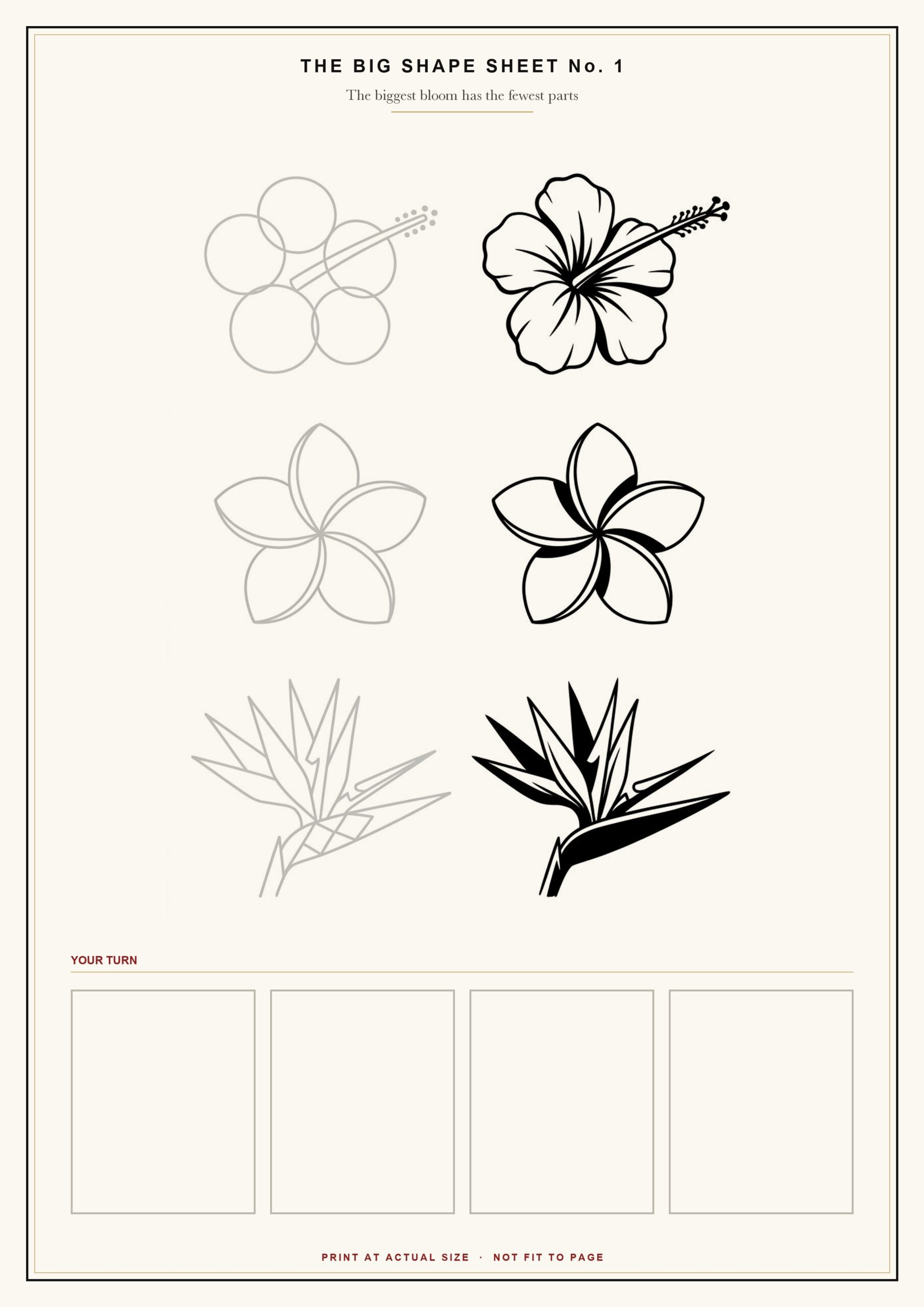
Print it at actual size, not fit to page. Scaled down, the shapes stop being worth tracing.
The sheet holds 3 blooms stripped back to their shapes. Hibiscus, plumeria, bird of paradise.
Each one appears twice. Once as the bare shapes, once finished in bold line.
Underneath there are 4 empty boxes. Those are the exercise, not decoration.
Work at the size of your hand, not your thumb. Small is harder. I spent about 20 evenings proving it.
Start with the biggest shape every time. If the first mark is small, the flower is already lost.
There is a quick test for any tropical flower. Squint at a photograph until the detail drops away.
What survives is the shape you draw first. On a hibiscus it is a flat disc. On a plumeria it is a 5-armed turn. On a bird of paradise it is one long boat.
Everything after that is decoration, and decoration is the easy part. Most drawings go wrong in the first 30 seconds, not the last 10 minutes.
None of this needs a photograph, either. Every person below worked from something cut, carried or remembered.
A sheet of shapes teaches the method and hands you nothing to point it at. That is the honest gap in it.
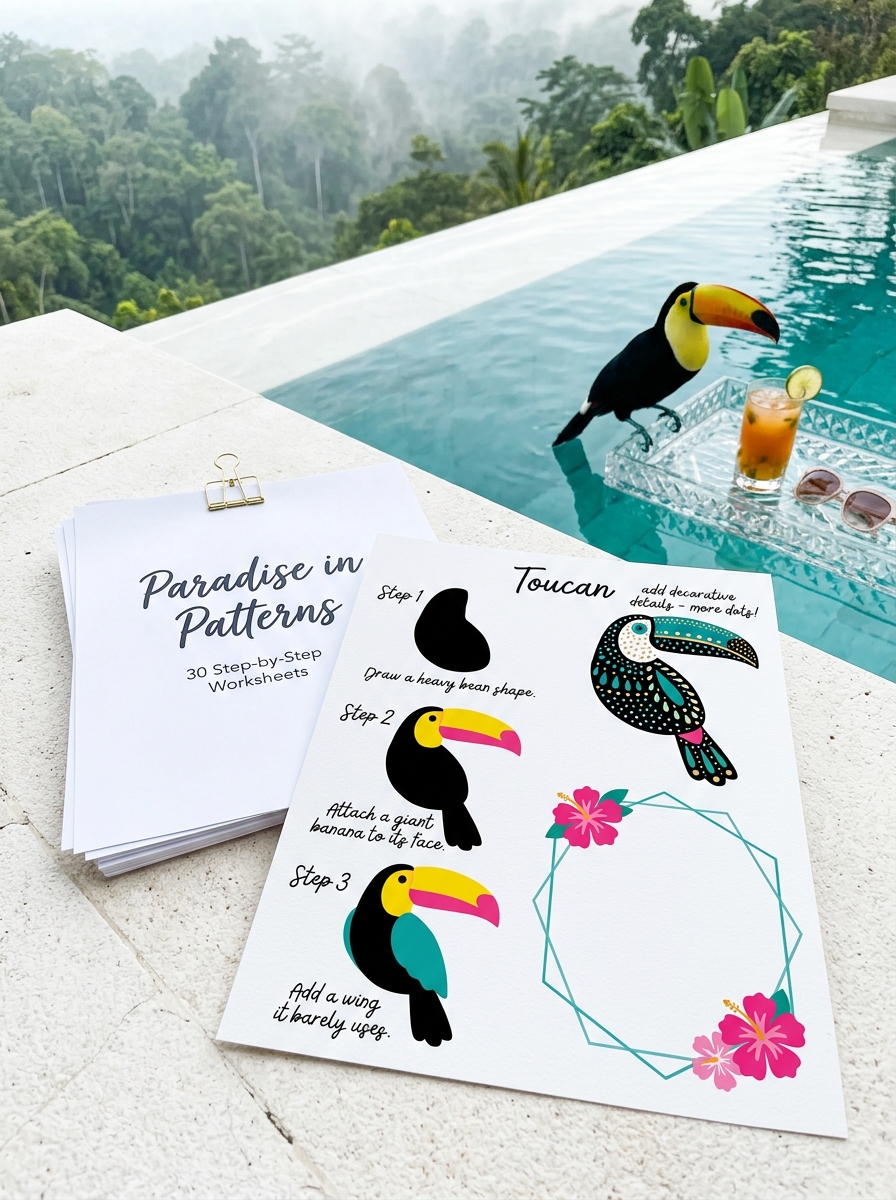
The Collection
32 creatures, and every one starts as a shape you can draw in one stroke.
PARADISE IN PATTERNS. Macaws, toucans, and one extremely unhurried sloth. Some evenings you want colour and no decisions at all. Inside: 32 creature sheets, each built from bold shapes in 3 steps. (The first shape is always easier than it looks.) What you get: an hour that is not scrolling, and a page bright enough to pin up.
So, the 4 secrets. Each one belongs to somebody who drew tropical flowers for a living. Each one changes what your hand does first.
Sarah Anne Drake proved tropical flowers drawing never needed the tropics
Norfolk, then a house in west London. Drake drew the tropics and never went near them.
She worked for the botanist John Lindley from 1830. The plants were carried to her, cut, in boxes.
She made over 1,000 drawings for Edwards’s Botanical Register, more than 300 of them orchids.
She also drew 16 of the 40 plates for James Bateman’s The Orchidaceae of Mexico and Guatemala, London, 1837. Those pages are about 58cm tall.
Loddiges nursery once staged an orchid display purely so she could see them. (A whole glasshouse rearranged for one woman with a brush. I think about that more than is reasonable.)
For your hand: turn the flower to face you and draw it flat. A cut specimen has no say in its angle. Neither should yours. Three-quarter view is where a tropical bloom loses its shape.
Tonight, three ways in. Draw a hibiscus square-on. The 5 petals then sit like a wheel.
Or run the orchids flat, each one a face. Cattleya, vanda, dendrobium. Then oncidium, phalaenopsis, and a slipper orchid for the odd one out.
Or work the 5-petal family, which is most of the tropics. Ixora, pentas, periwinkle, lantana. Then allamanda, mandevilla, oleander, jasmine. Then gardenia, desert rose and plumeria. They all open the same way.
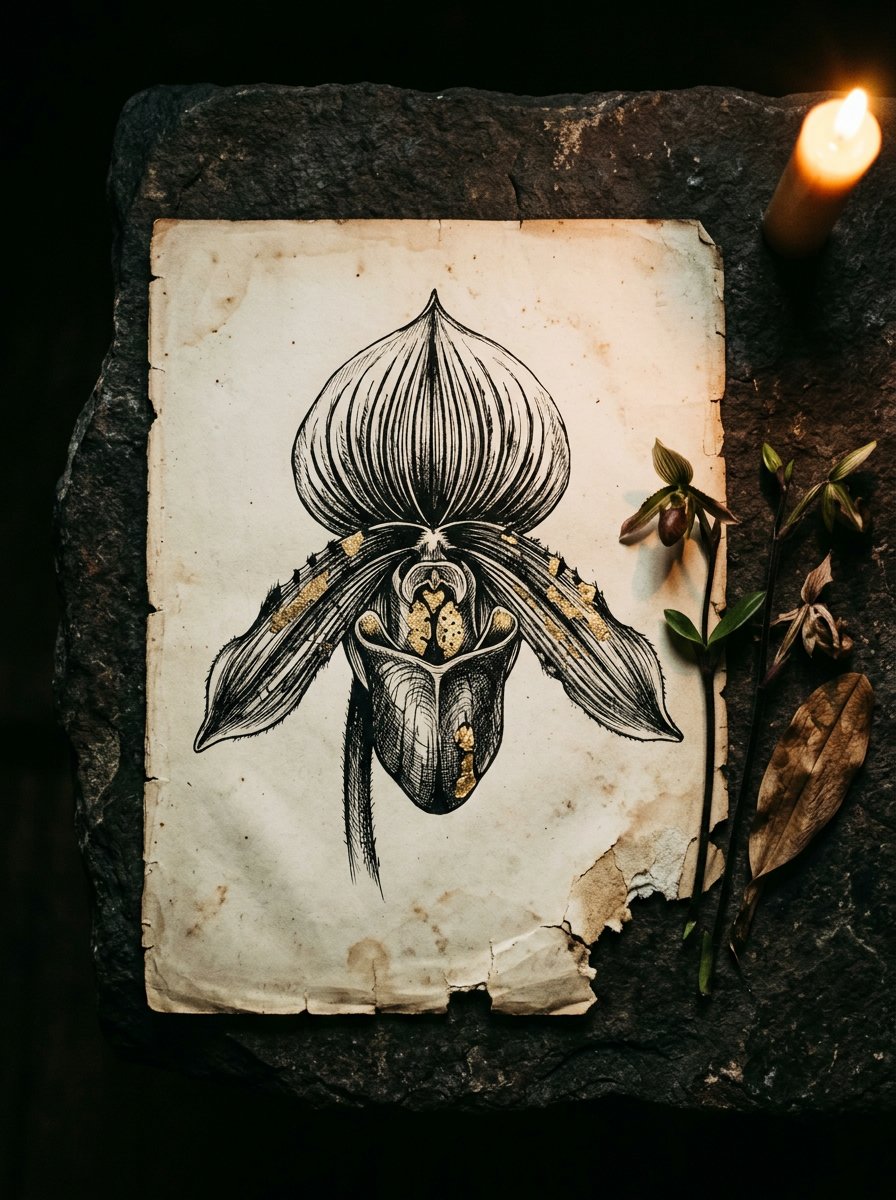
Flat-on is not a beginner’s compromise. It is what the reference plates always did.
The colour question comes next. It has a shorter answer than you would expect.
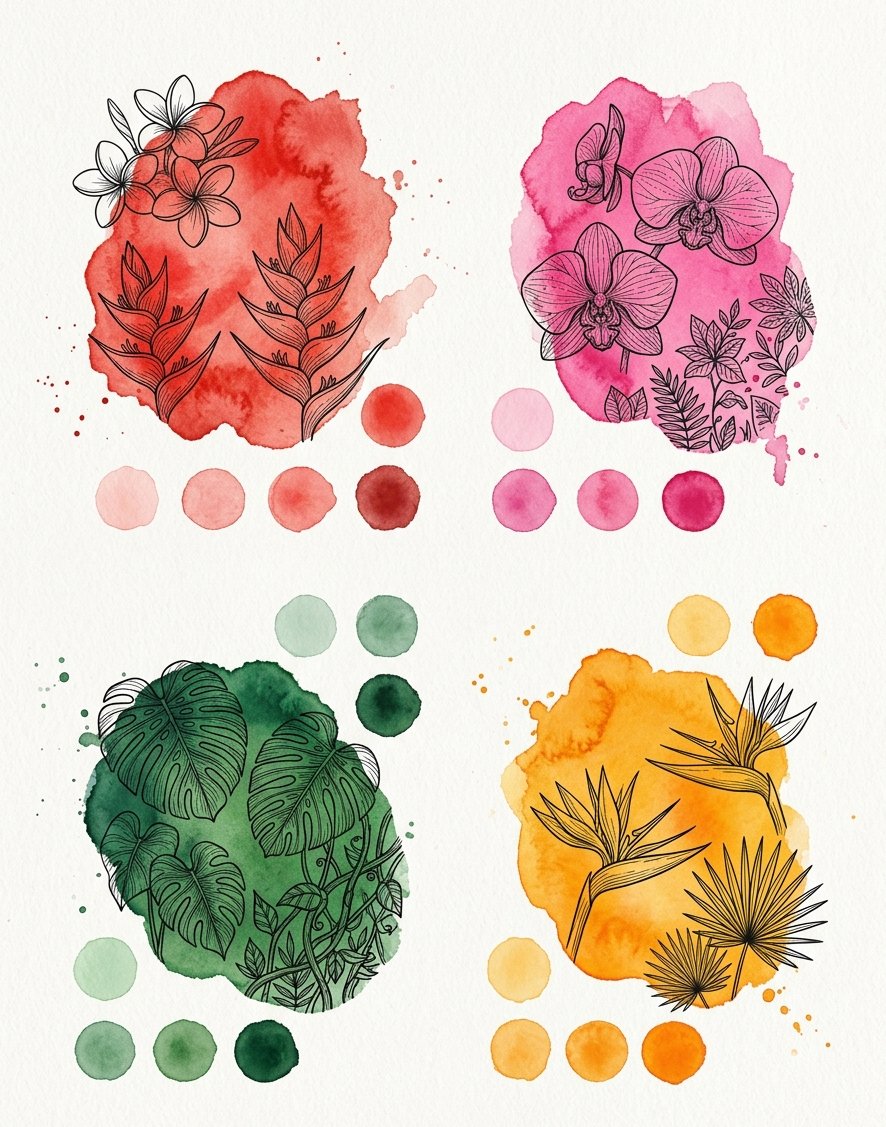
Pick 2 hot colours and one dark. I use no more than that.
Ellis Rowan painted in heat so wet her paints turned liquid, and kept working anyway
Queensland, the 1890s. Rowan had no formal training. She painted in watercolour, outdoors, fast.
Her own book records the conditions plainly. The heat was intense, she wrote, and the air so moist that her paints had gone quite liquid in their pans.
That is from A Flower-Hunter in Queensland & New Zealand, John Murray, London, 1898.
She worked anyway. She painted lying flat under a tree to stay cool. She sketched from a boat, hauling herself up by a branch to reach the bank.
In 1916, at 68, she made the first of several trips to New Guinea. She came back with a huge volume of work. In 1920 she hung 1,000 of her paintings in Sydney.
For your hand: speed is the technique, not a compromise on it. Lay the big shape in one stroke and do not go back for it. (I have never improved a petal by returning to it. I have tested that perhaps 40 times.)
Tonight, three ways in. Draw a heliconia in 2 strokes per bract, then stop.
Or take the gingers at speed, a minute each. Torch ginger, red ginger, beehive ginger, blue ginger.
Or block the architectural ones fast and let them stay rough. Bird of paradise, canna, bougainvillea. Then anthurium, flame vine and coral vine.
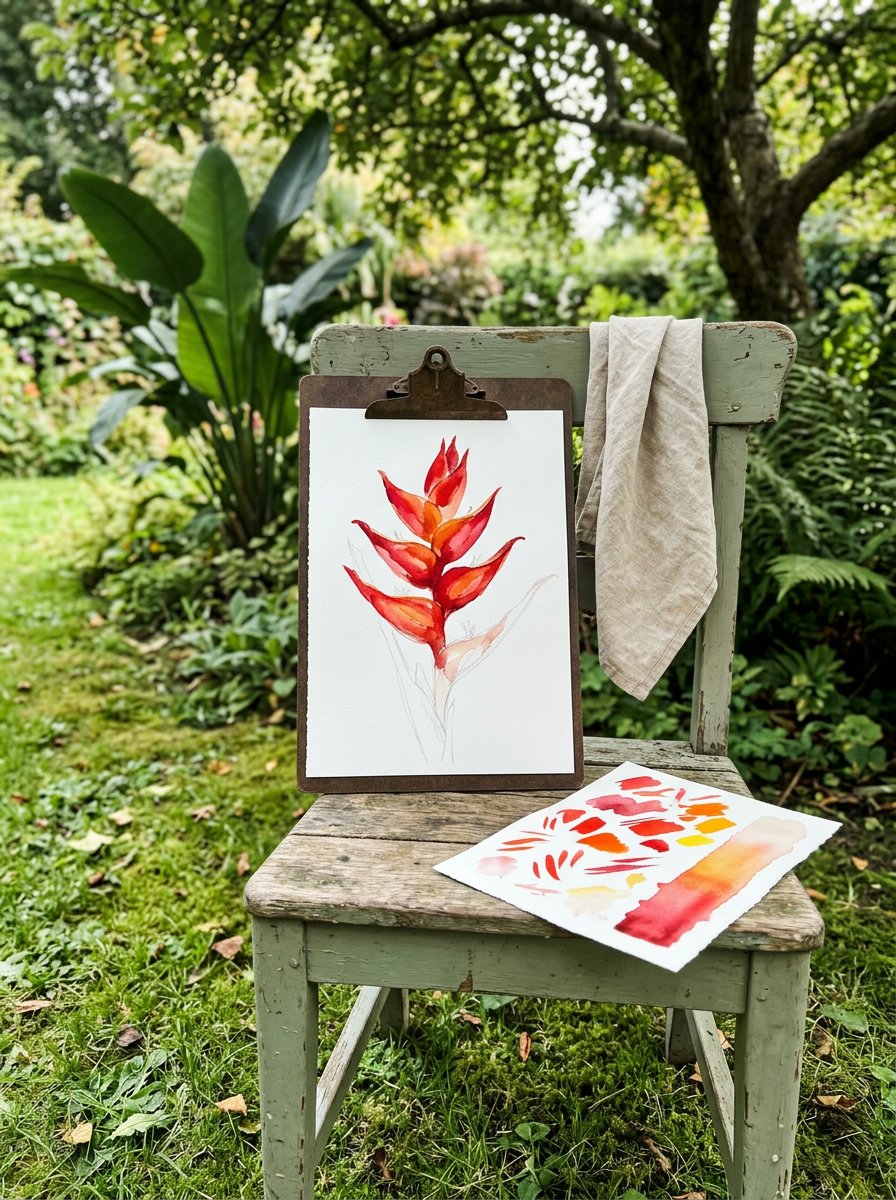
Rough is not the same as wrong. A slow one holds your hesitation.
A fast shape holds its character.
That is easiest to see on your own page, side by side.
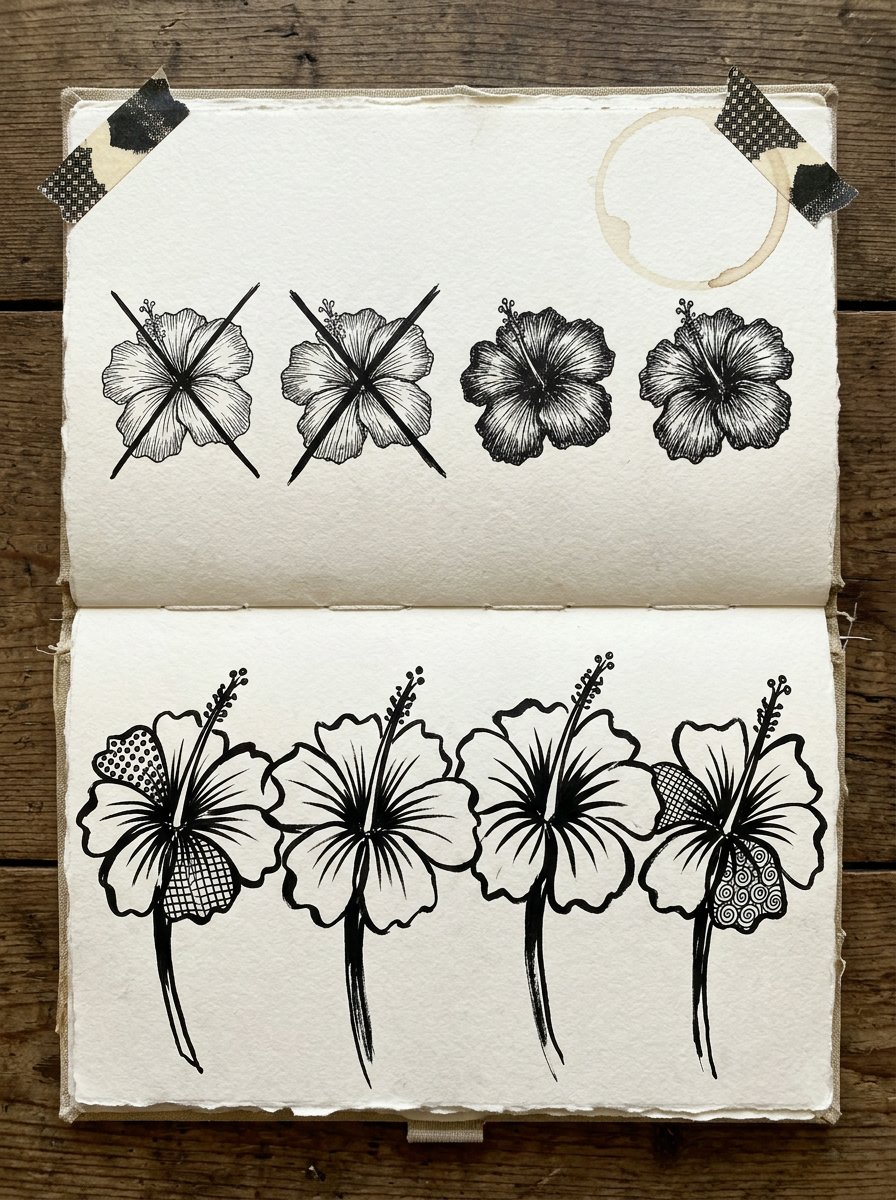
The top row was careful. The bottom row took a minute. I keep the bottom row.
Nellie Roberts painted 4,500 orchids at life size, and started every one the same way
Brixton, London. Roberts painted above what had been her father’s watchmaker shop.
From 1897 until 1953 she was the Royal Horticultural Society’s orchid artist. She was the first, and the longest serving.
Her job was to paint every orchid that won an award, life size, for the record. The estimate is at least 4,500 paintings.
She took the RHS Gold Medal in 1900. Two orchids carry her name.
Life size was the whole brief. No shrinking to fit the paper, no tidy margin.
For your hand: stop reducing the flower so it fits. Draw one bloom the size of your palm. (Mine came out postage-stamp small for a year, and I called it neatness.)
Tonight, three ways in. Fill a whole page with one protea and nothing else.
Or draw a single medinilla, passionflower or waterlily. Make it big enough to run off the edge.
Or take the strange ones at full scale, where the size is the joke. Glory lily, bat flower, shrimp plant. Then firecracker flower, powderpuff and chenille plant.
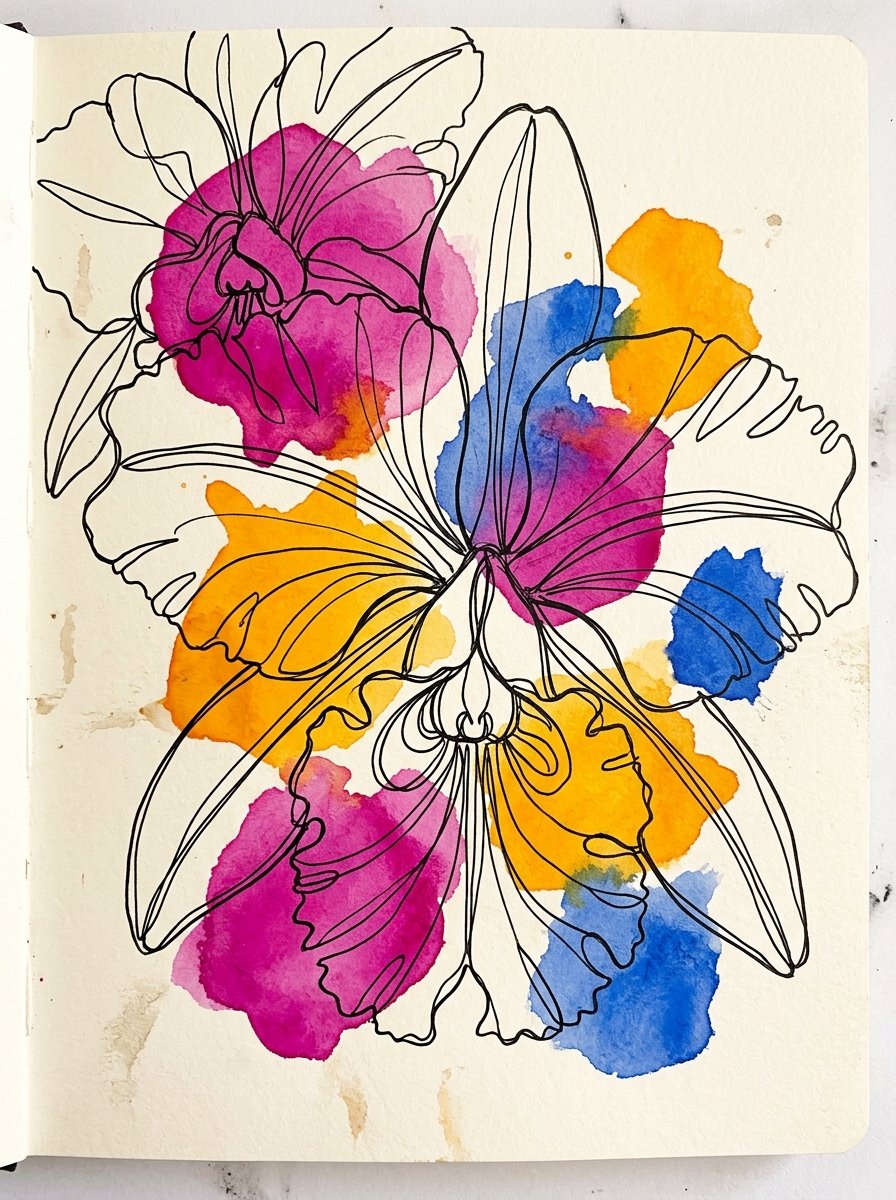
A small one reports it.
A big flower forgives a wobbly line.
Once the bloom is large, the inside of a petal becomes a decision.
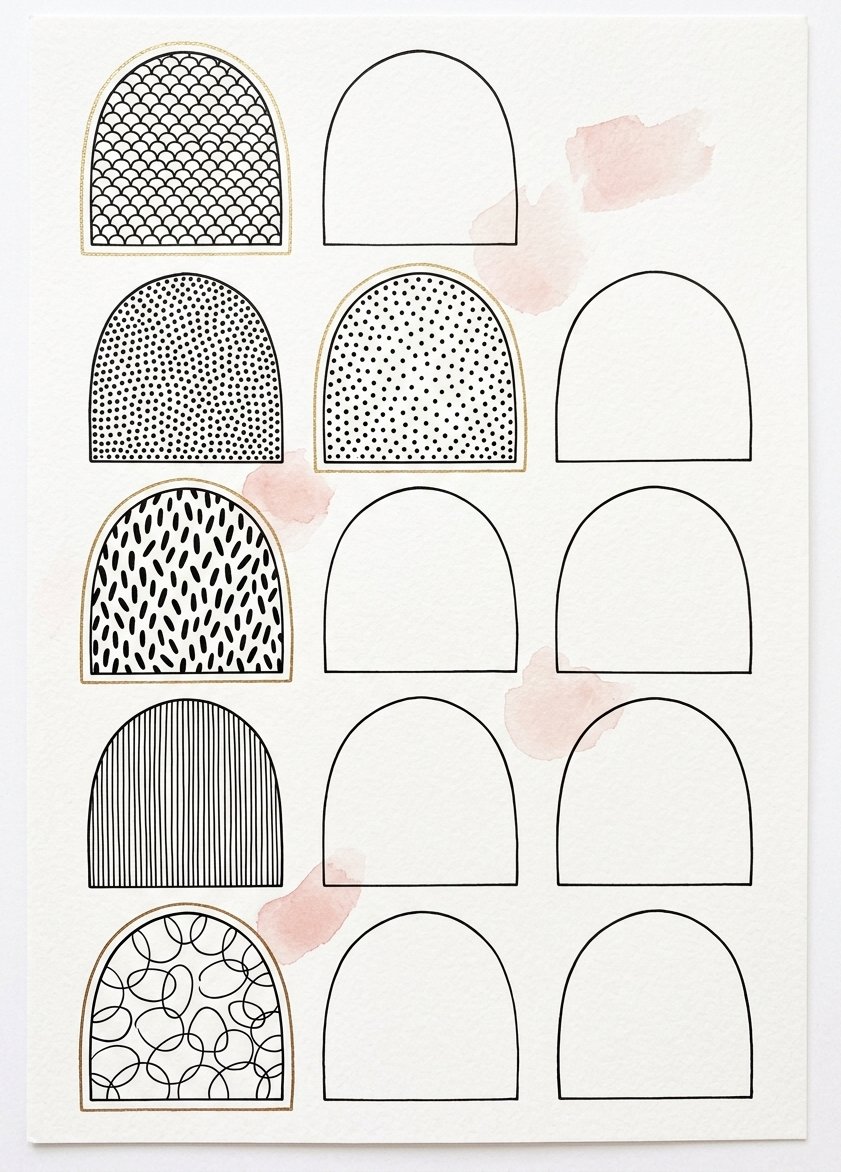
Fill one petal, leave its neighbour bare. That contrast is the drawing.
Berthe Hoola van Nooten made tropical flowers drawing loud on purpose in 1863
Java. Van Nooten published Fleurs, Fruits et Feuillages Choisis de l’Île de Java in Brussels in 1863.
Her plates do something most botanical work avoids. The leaves go dark and heavy. The flowers sit against them.
One account of her style calls it great precision and clarity with a touch of neo-Baroque exuberance. In plain terms, she let the foliage go almost black so the blooms could shout.
For your hand: put one solid dark area in every drawing. A leaf mass, a shadow under the bloom, the back of a petal. (Mine stayed politely grey for a fortnight before I trusted the black.)
Colour only reads when something beside it does not.
Tonight, three ways in. Draw a hoya cluster and fill every leaf solid.
Or take the flowering trees, where the dark canopy does the work. Flame of the forest, royal poinciana, African tulip tree. Then jacaranda and orchid tree.
Or run the vines against a black ground. Jade vine, cup of gold, yellow bells. Then brunfelsia, silk floss and queen of the night. That last one only opens after dark anyway.
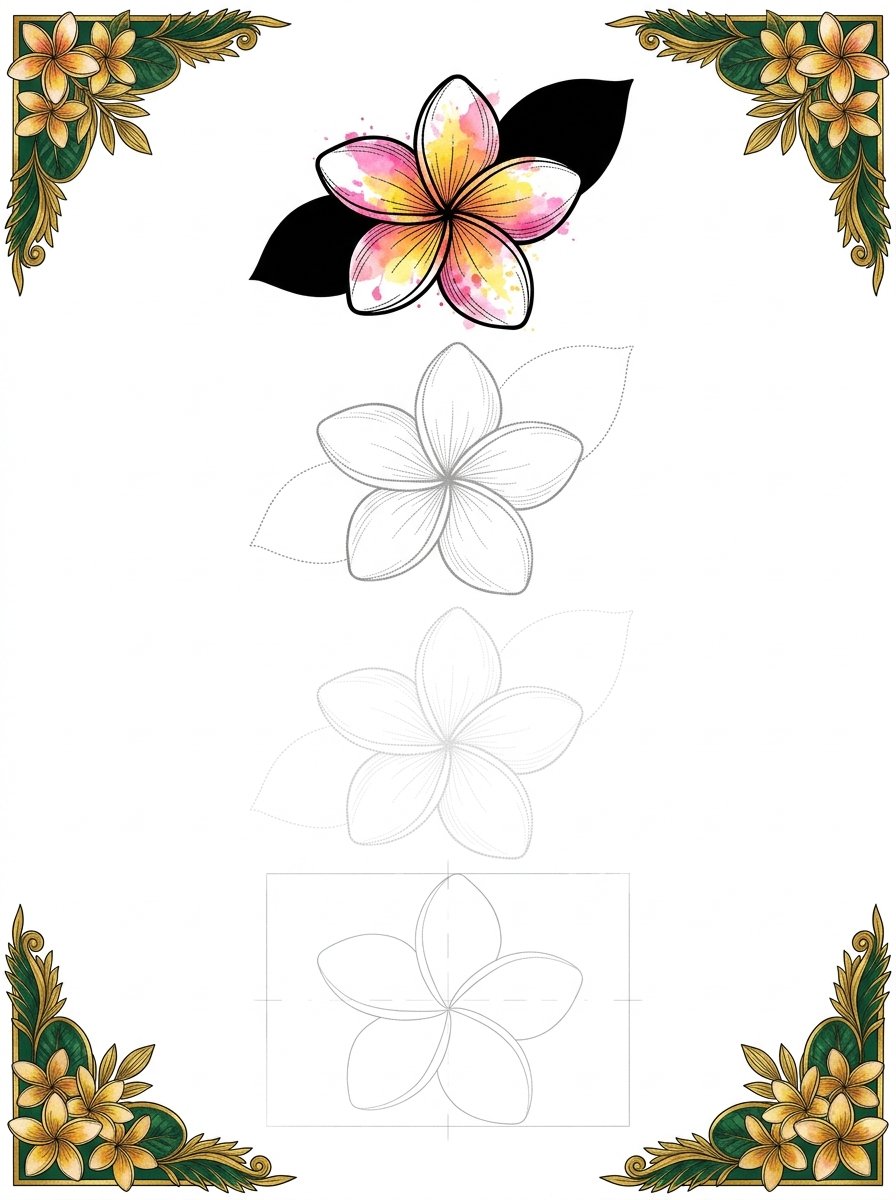
That fade is one flower 4 times, losing a little more line each pass. By the fourth you are drawing it from memory.
Free Starter Pack
Tropical flowers drawing needs fills: get 10 free pattern templates, sent tonight.
Stripes, checks and dots. Drop one inside a petal, a bract or a bare leaf.
Unsubscribe in 1 click, no hard feelings
Do that for a week and you have a wall, not a pile of practice.
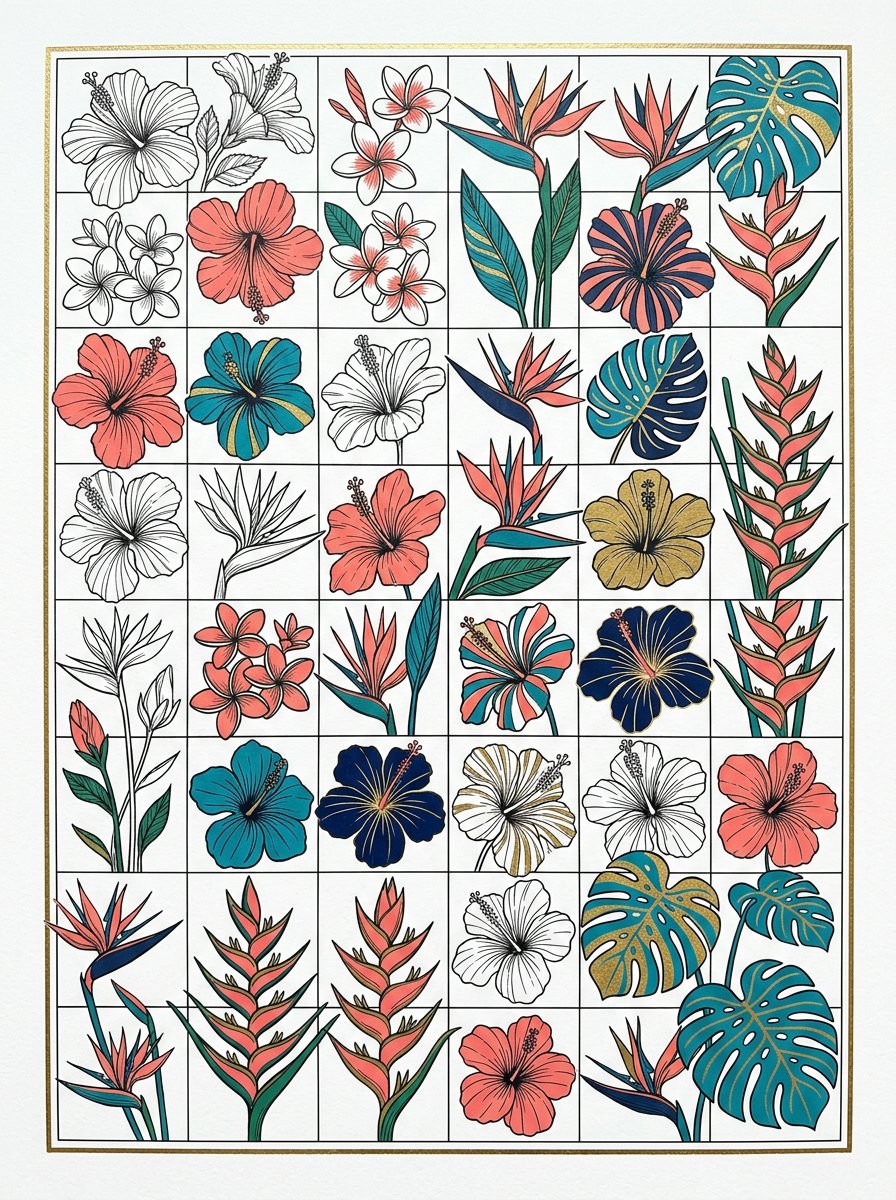
Which is the point where a single sheet stops being enough.
32 creature sheets, and every one is built from the same 3 bold shapes
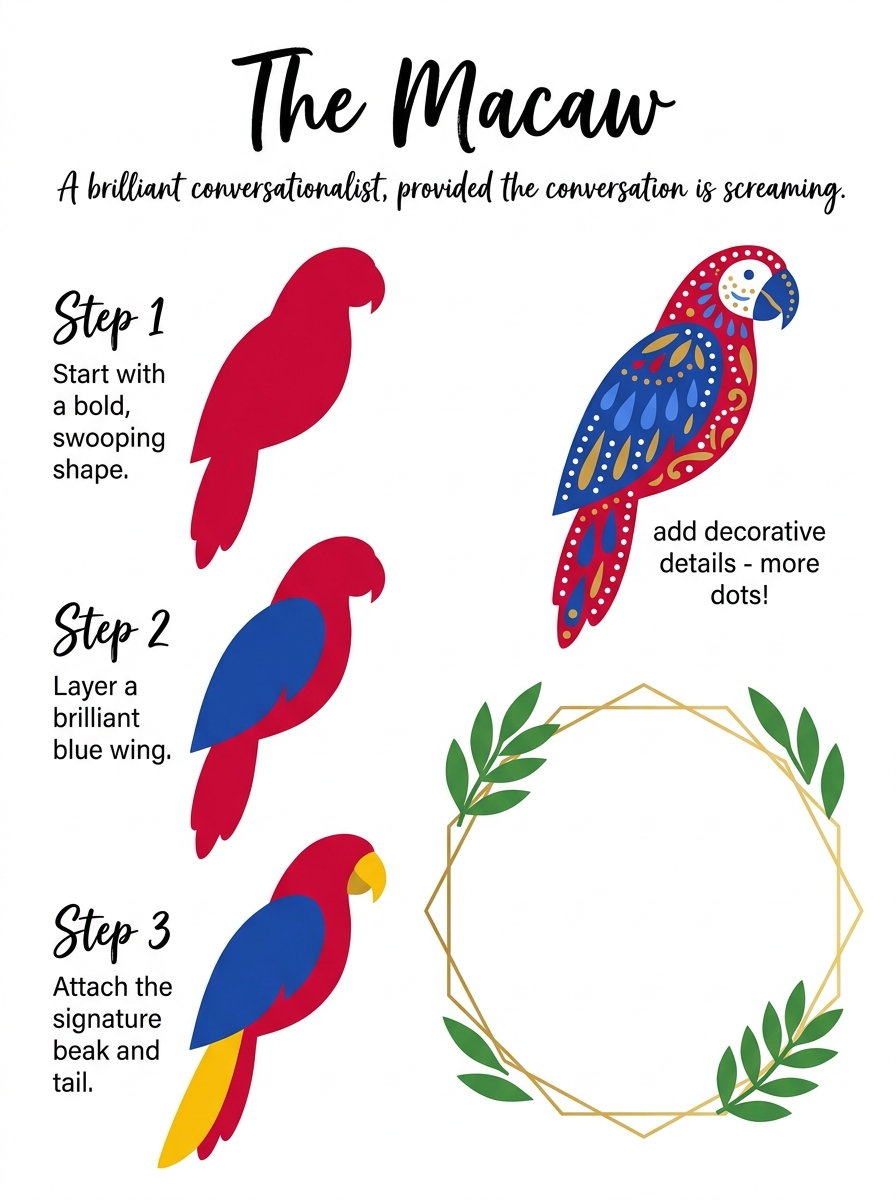
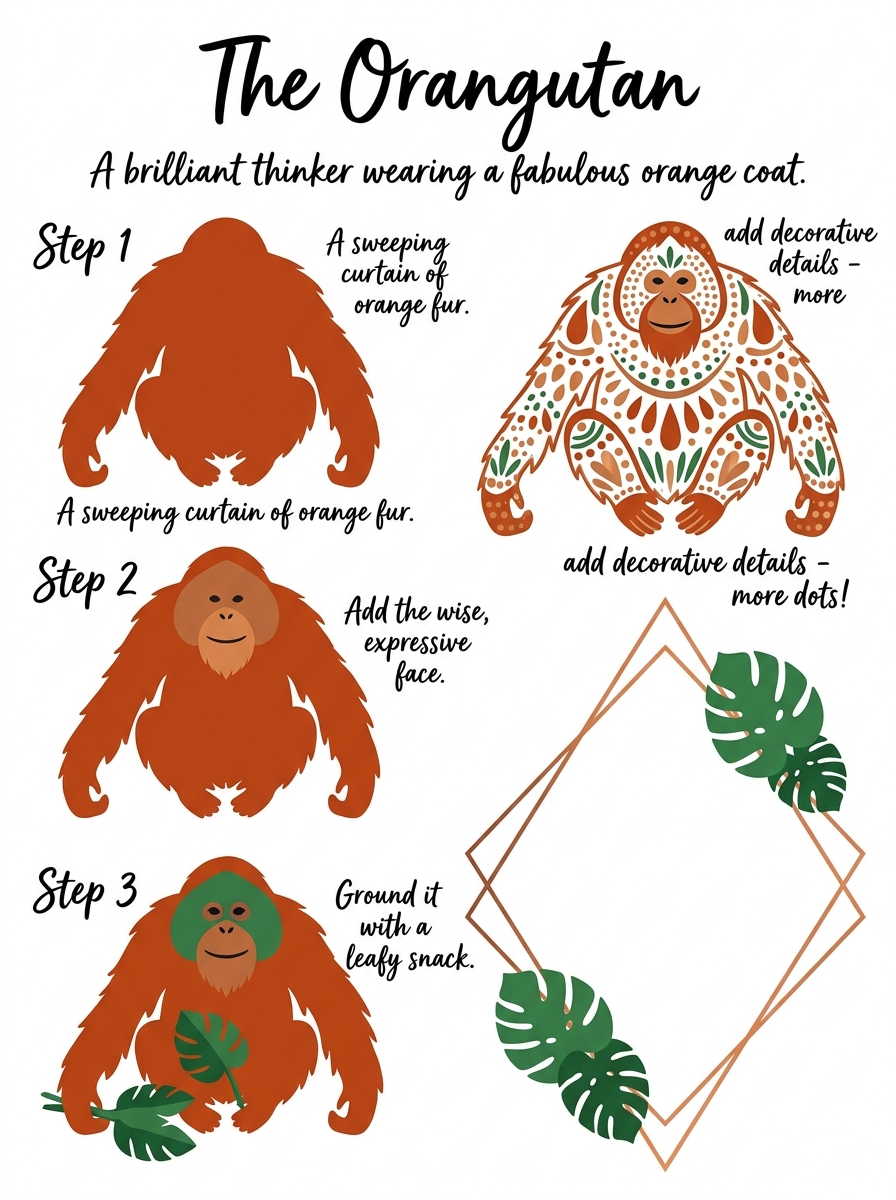
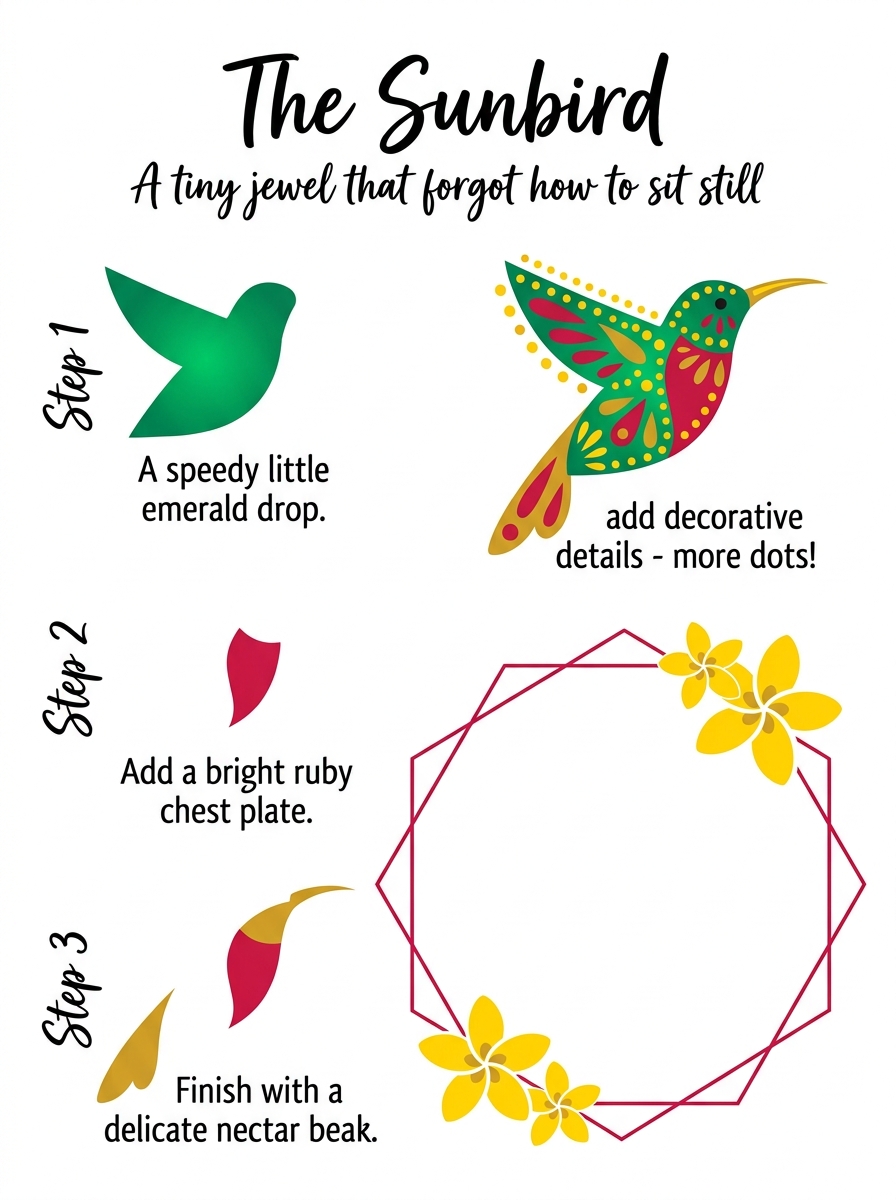
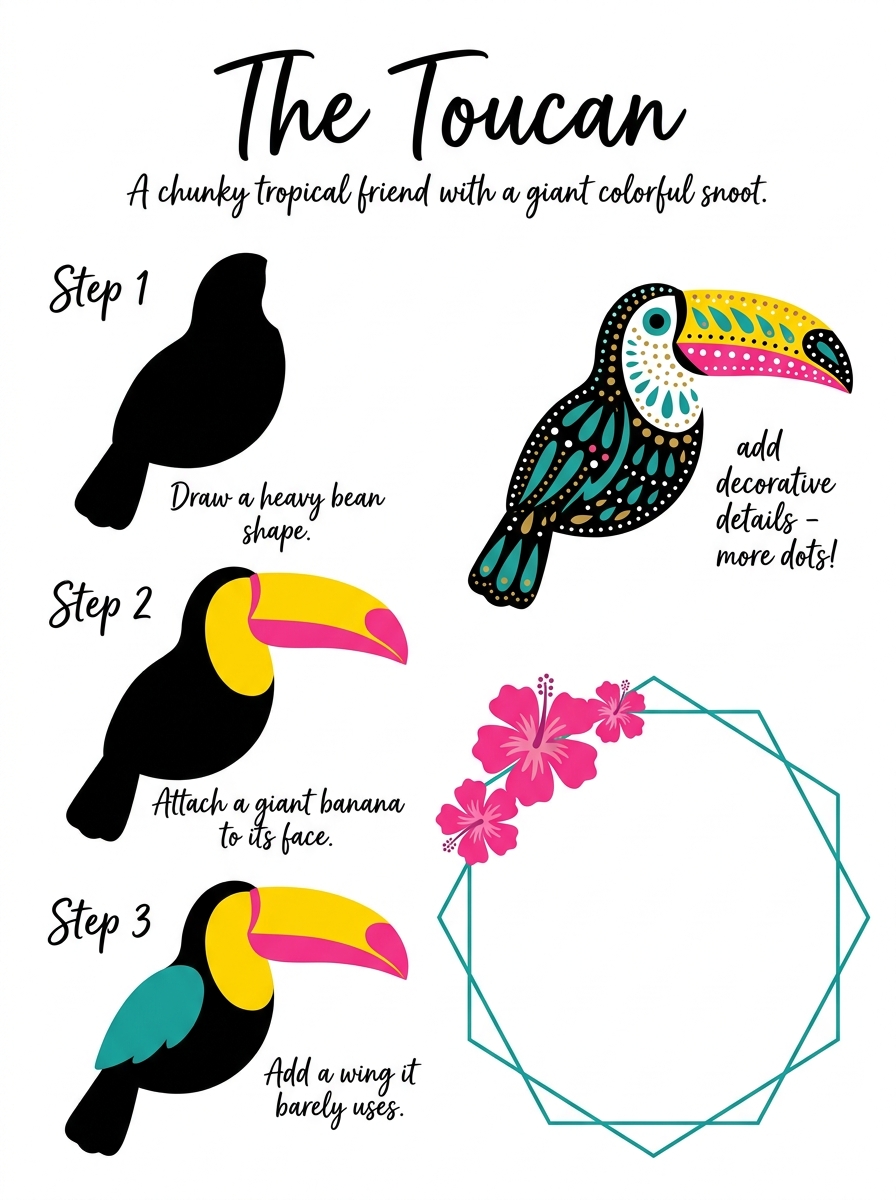
Draw the flower, then give it something to sit beside. Each sheet starts as a flat silhouette. Layer the colour, then add the dots. Do one an evening and the week ends bright. I keep the ones where the dots went slightly wrong.
Instant download · print as often as you like
Print the free tropical flowers drawing sheet and start with the biggest shape
Everything above collapses into one habit. Find the largest shape and commit to it first.
The free sheet exists to make that automatic. Hibiscus, plumeria and bird of paradise, each shown bare and finished, then 4 empty boxes.
Use the boxes in order. Do not skip ahead to the finished version. I still copy the bare shapes twice before adding any detail.
When a flower goes wrong, the first shape was too small or drawn too carefully. (It is never the petals. I have blamed the petals for years.)
Then pick any of the 51 above and give it one evening. A grey afternoon and a thick pen is the right equipment for this.
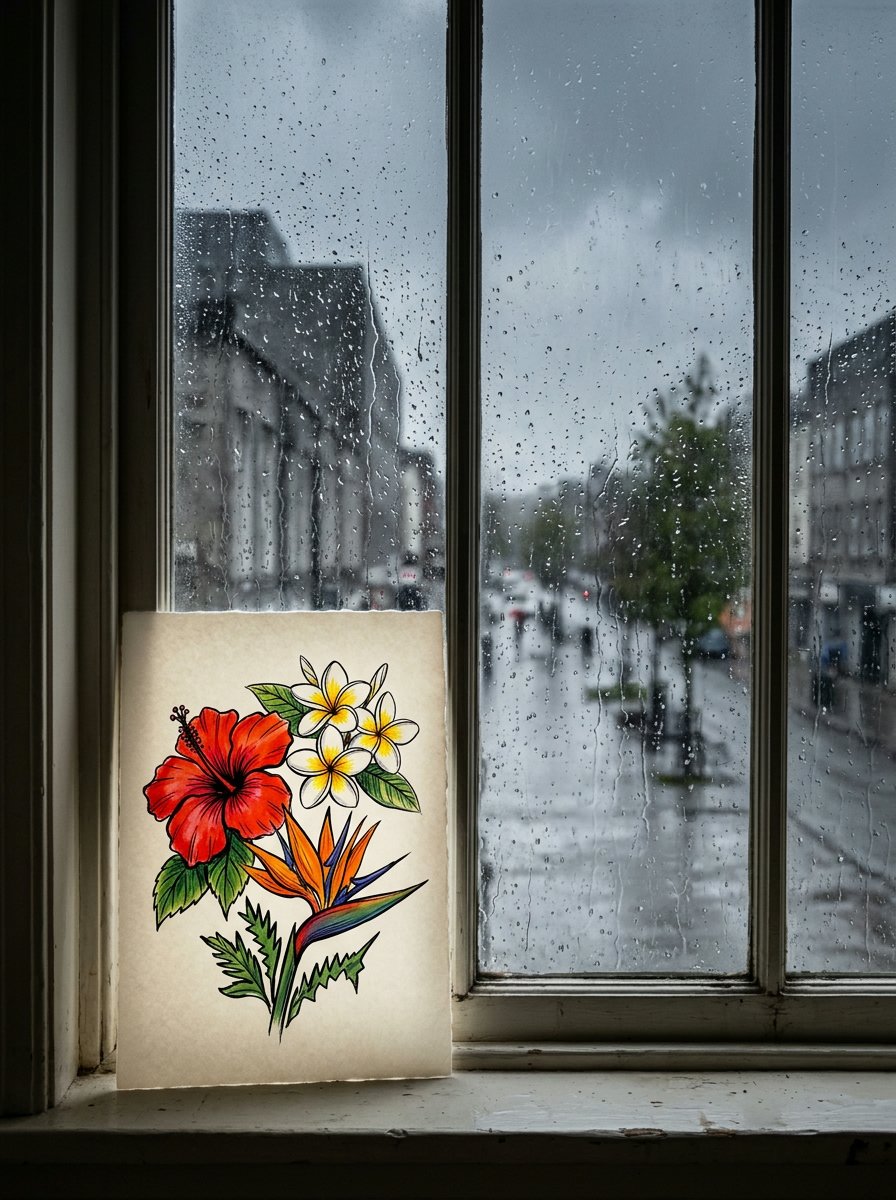
Outside, the afternoon goes on being grey about it. Inside, a flower opens at the speed of your hand.
“I entered, sketch-book in hand, by a narrow little pathway, probably made by an alligator.”
Ellis Rowan, A Flower-Hunter in Queensland & New Zealand, London, 1898
Mirabelle wrote this. No training, strong opinions, many pens. Peer reviewed by a cat who mistook the bird of paradise for an actual bird.