
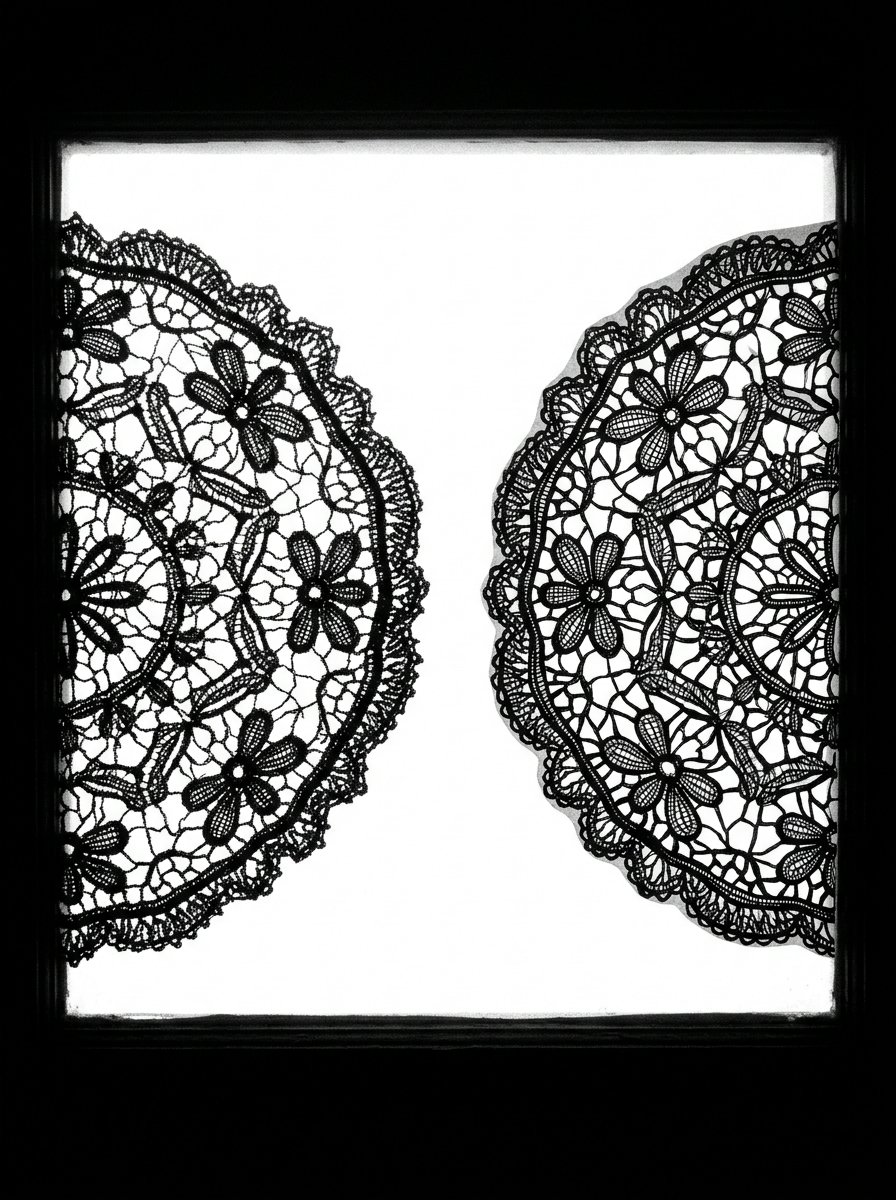
Lace is not thread. It is a very organised set of holes, and the holes are what you draw.
Lace is built that way too. A needle lacemaker tacks thread onto a sheet of stiff paper. She works buttonhole stitches over the lines. Then she cuts the tacking underneath and lifts the lace away. The paper is thrown out.
So the paper was never the lace. The gaps were.
Below are 5 secrets from people who drew lace for a living. Every one is about the gap.
Download the free lace pattern sheet →
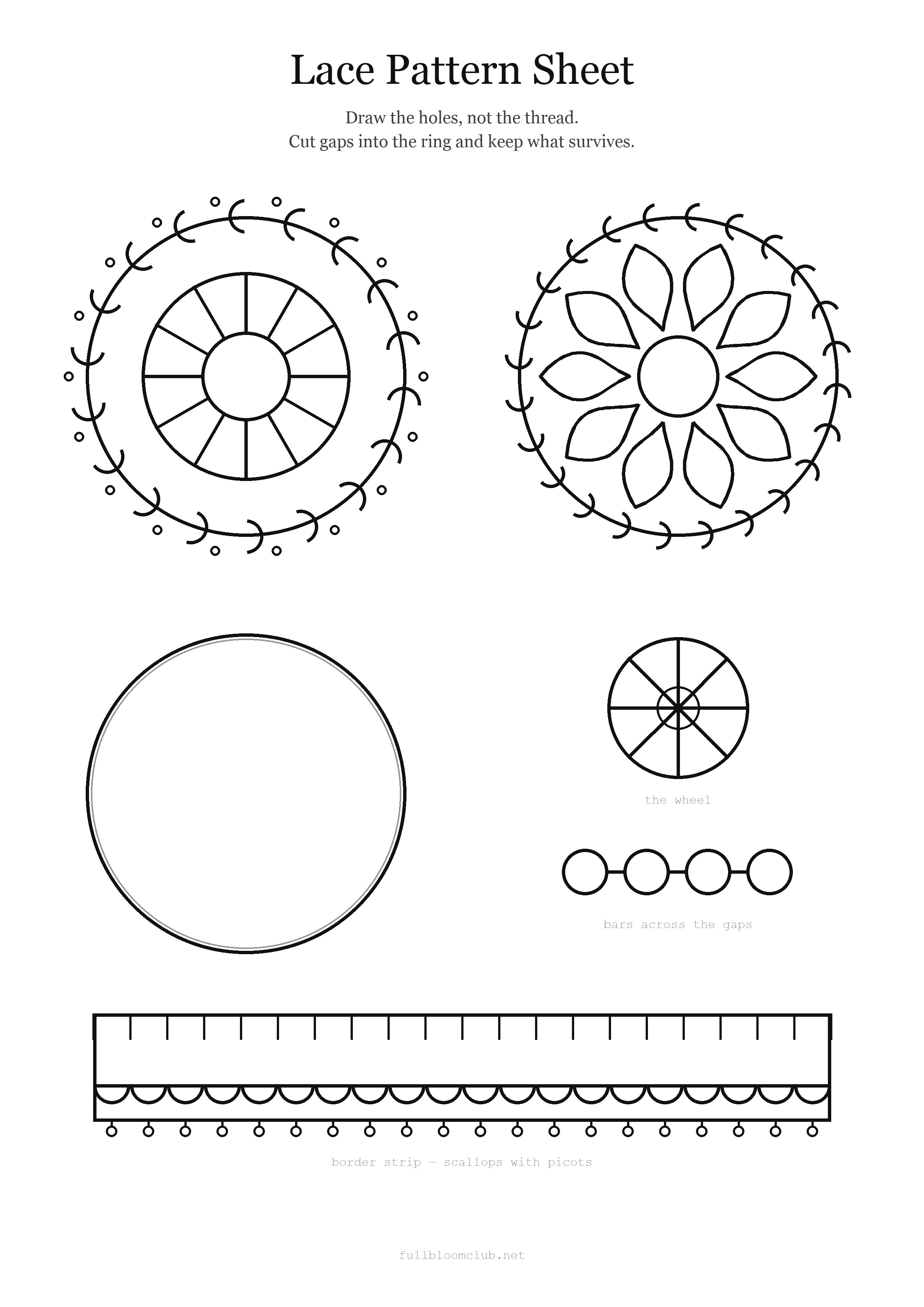
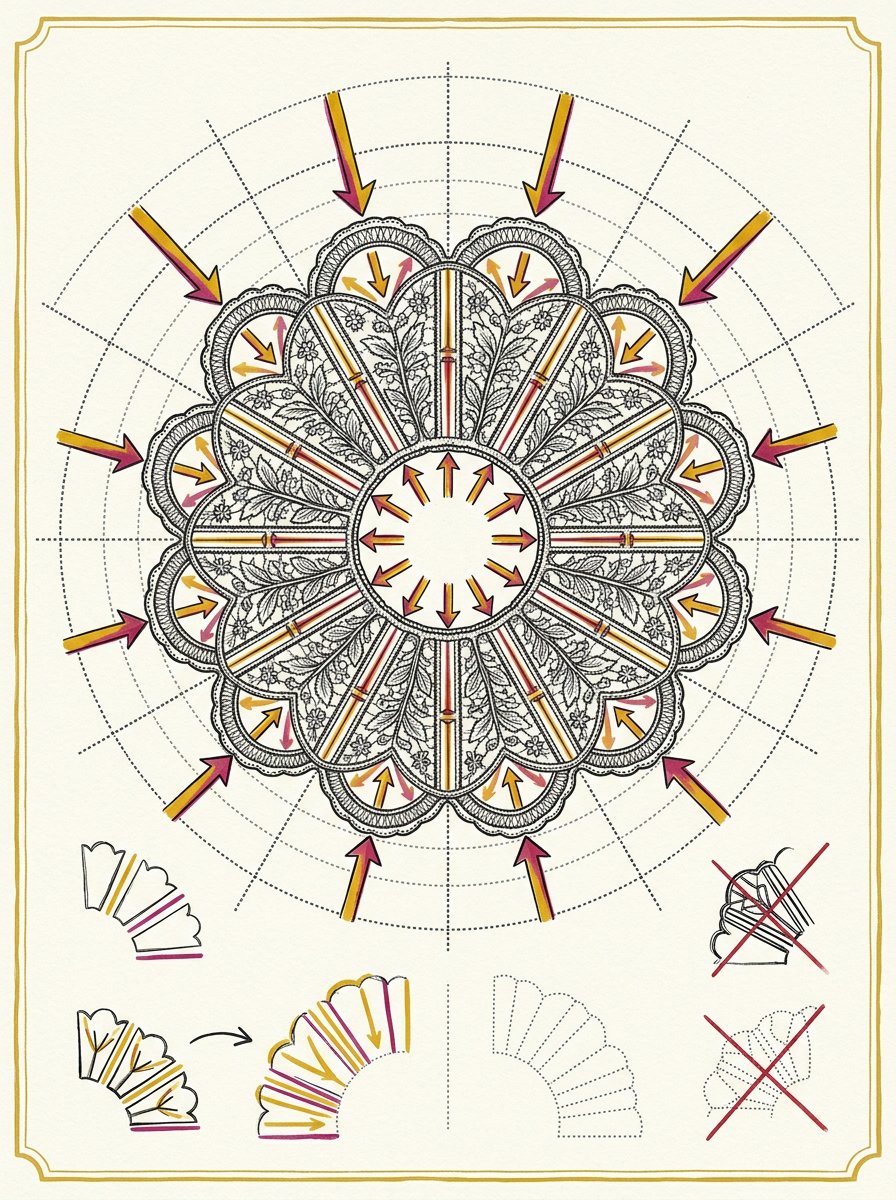
The sheet carries three printed rings and one border strip. A ring is a doily frame. You cut gaps into it and keep what survives. (Mine took 20 minutes. I stopped because my tea went cold.)
Federico Vinciolo printed his lace patterns as a grid in 1587 so the holes could be counted
Vinciolo held the monopoly on lace ruffs at the French court. In 1587 he published Les Singuliers et Nouveaux Pourtraicts, and it stayed in print until 1623.
The pages are not pictures of lace. They are grids. Black squares and white squares, like a crossword nobody has filled in.
A black square meant thread. A white square meant leave it. That was the whole instruction.
Here is what that does to your hand. Stop drawing outlines. Start deciding, square by square, what you keep. The decision is binary and fast.
Tonight, three ways in. Rule a grid of 20 squares by 20 inside a printed ring. Black in every other square. That is a checked ground in about a minute.
Or black in a diagonal run and let it stagger. The ground then reads as a lattice. Or black in a fat diamond in the middle and leave a clear halo round it.
Lace is the one pattern where the pen’s job is to decide what to leave alone.
The halo is the point. You did not draw it. You drew around it.
I ruled my first grid too small and spent the evening filling squares the size of a full stop. Rule them bigger than feels right. The gap has to be visible from across the room.
By the third ring you will want a different fill for every gap. Inventing one at 10pm is how a good page goes wrong.
The Collection
ZEN DOODLE MASTERY — rings, scallops, and something to put in every hole you cut.
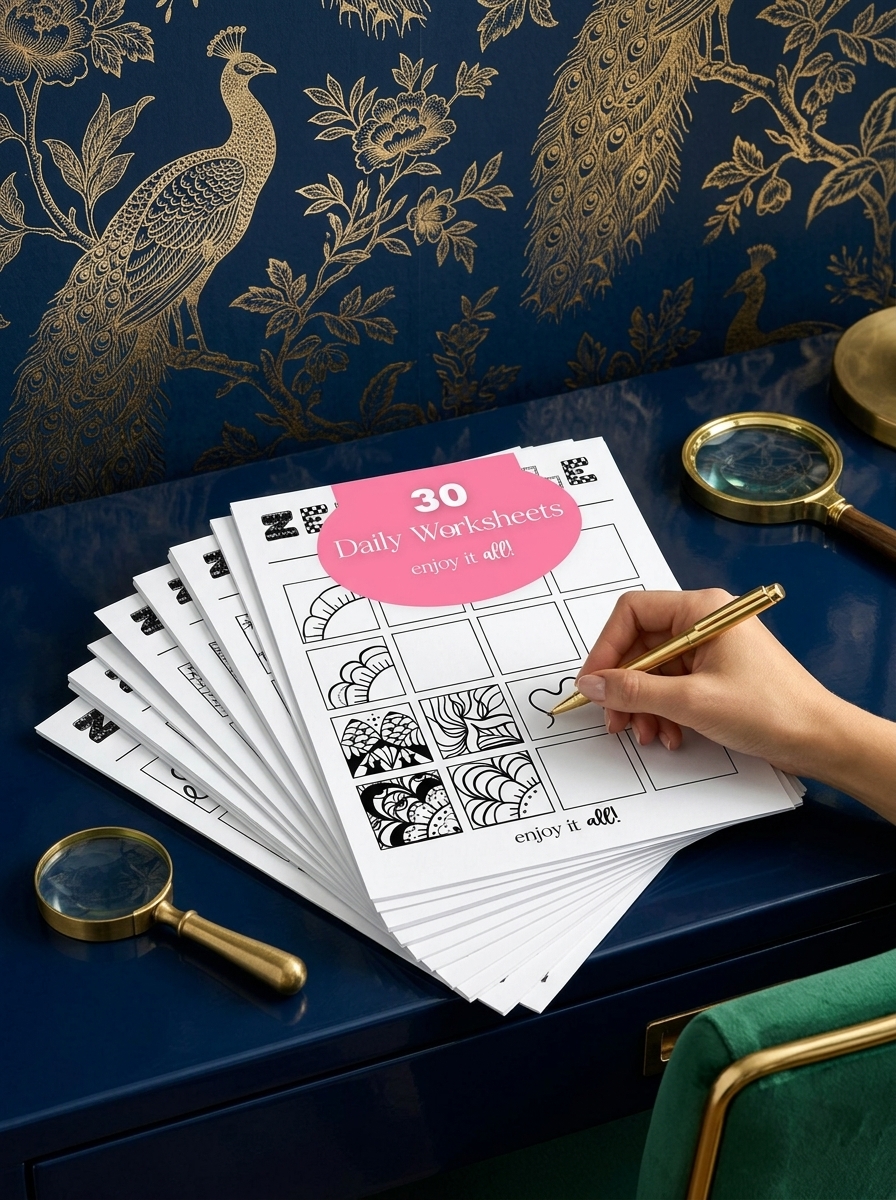
Borrow a fill for every gap you cut tonight. Inside: 30 daily worksheets, the method one step at a time, and banks of ready fills. (The banks exist so nobody has to invent a fill at 10pm.) What you get: a hole you are not frightened of, and a page that looks finished.
Here is the part a grid cannot teach you, and it is the part everyone looks at first: the edge.
Isabella Catanea Parasole cut her own printing blocks in Rome and put her name on the title page
Parasole was an engraver. She worked in Rome from the 1590s. She designed lace patterns and cut them into wood herself.
Studio delle virtuose Dame came out in 1597. Teatro delle nobili et virtuose donne followed in 1616, engraved from her own drawings.
Think about what cutting a block means. Everything you gouge away prints white. You are not carving the pattern. You are carving the holes, in reverse, on a block that will be flipped.
She did that for a living. Her hand thought in negative space before her pen did.
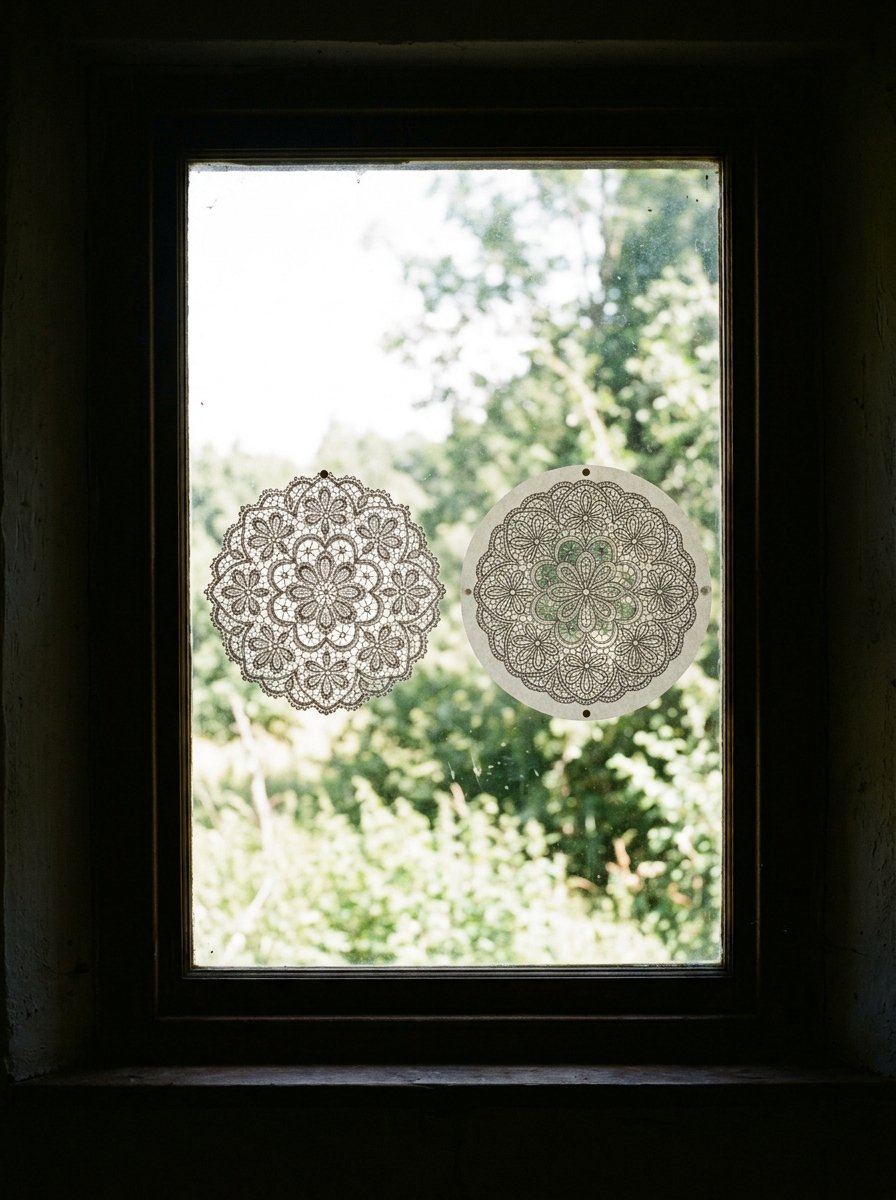
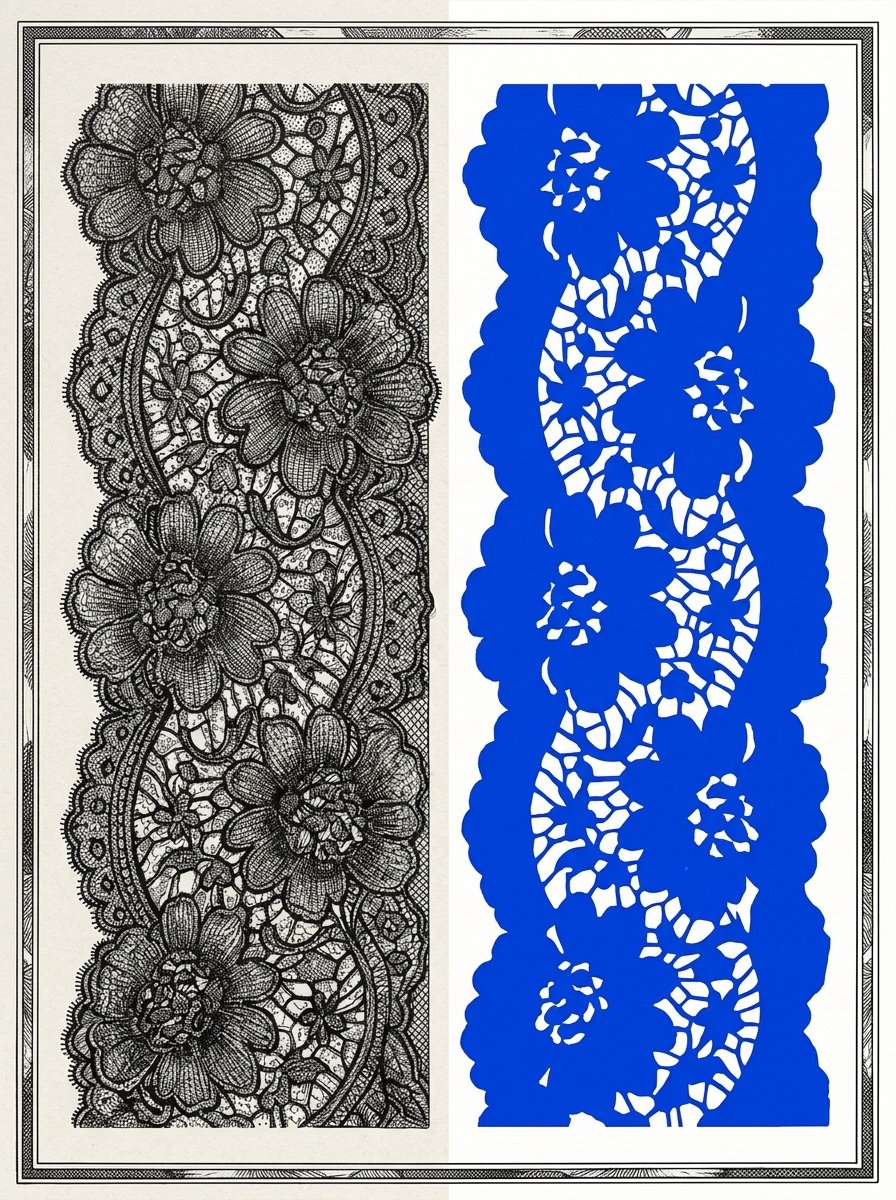
For your hand, the move is to shade a ground first and cut into it. Lay a dense fill over a whole section. Then open the shapes out of it with a white gel pen, or leave clean paper where the shape will go.
Tonight, three ways in. Fill a ring solid with close vertical lines. Then draw fat white teardrops through them. They read as holes punched in cloth.
Or scribble a dense ground and lift out a row of eyelets. An eyelet is a circle with tiny dashes round the rim. Or run a scallop edge along the border strip and hollow each one out. (I keep a white gel pen just for this. It is the only pen on my desk that gets lost.)
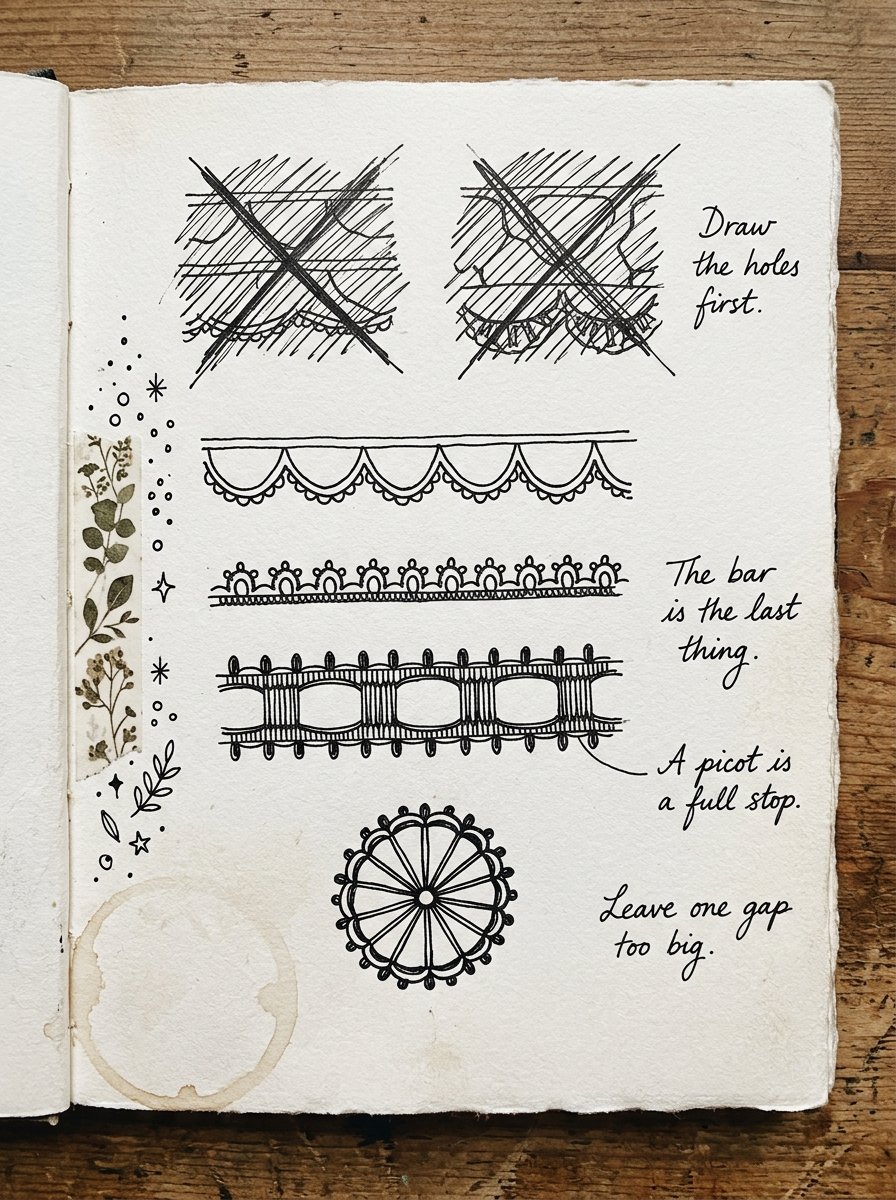
A scallop is a half circle with its flat side up. Draw the row of half circles first, all the same size, then decide what happens inside them. (I drew them different sizes for a week. It read as a hem that had been chewed.)
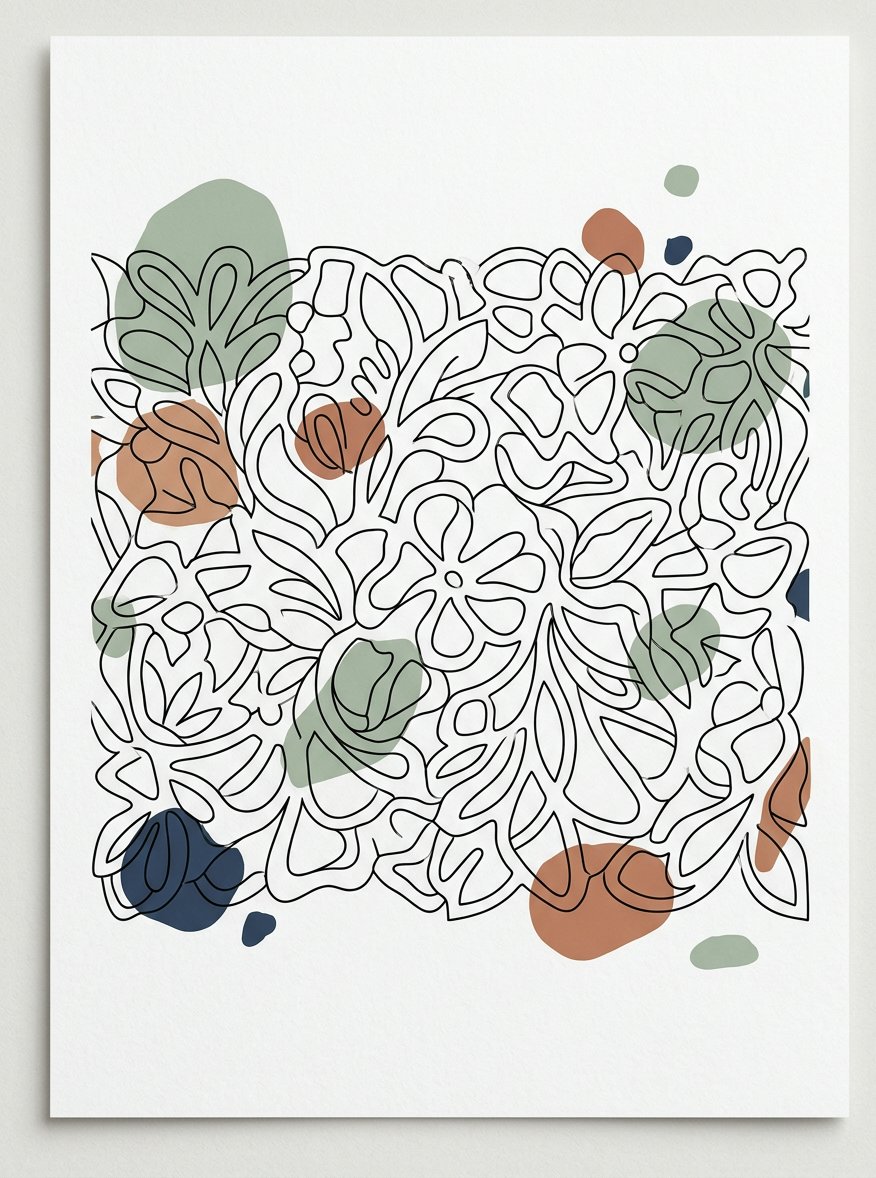
The Alençon workshops paid one woman only to draw the outline, and she never touched the lace
Alençon lace began as a royal workshop, set up by Colbert in 1665 to compete with the Venetians. Marthe La Perrière changed the method. By about 1675 the town had its own style.
The work was split between specialists. Each part was executed by a different worker, and the first of them was the traceuse.
Her whole job was the outline. She pricked the design and traced it onto parchment, and then it went to somebody else. She never made a stitch of the lace.
She drew the whole thing and never made one stitch of it.
That is the most useful fact here. The drawing and the filling are two different jobs. Doing both in the same 10 minutes is why lace comes out muddy.
So split them. Draw every outline first, across the whole ring, with nothing inside anything. Then put the pen down and look. Then fill.
Tonight, three ways in. Outline a ring of petal shapes round the printed circle. Leave every one empty for now.
Or draw only the bars that will connect them. A bar is a short straight tie across a gap. Or draw the border strip as bare outlines and fill it tomorrow. (That sounds precious. I do it anyway, and the page is always better for it.)
A bar is the last thing you draw, not the first. It ties two shapes across a hole, so the hole has to exist before the bar can span it.
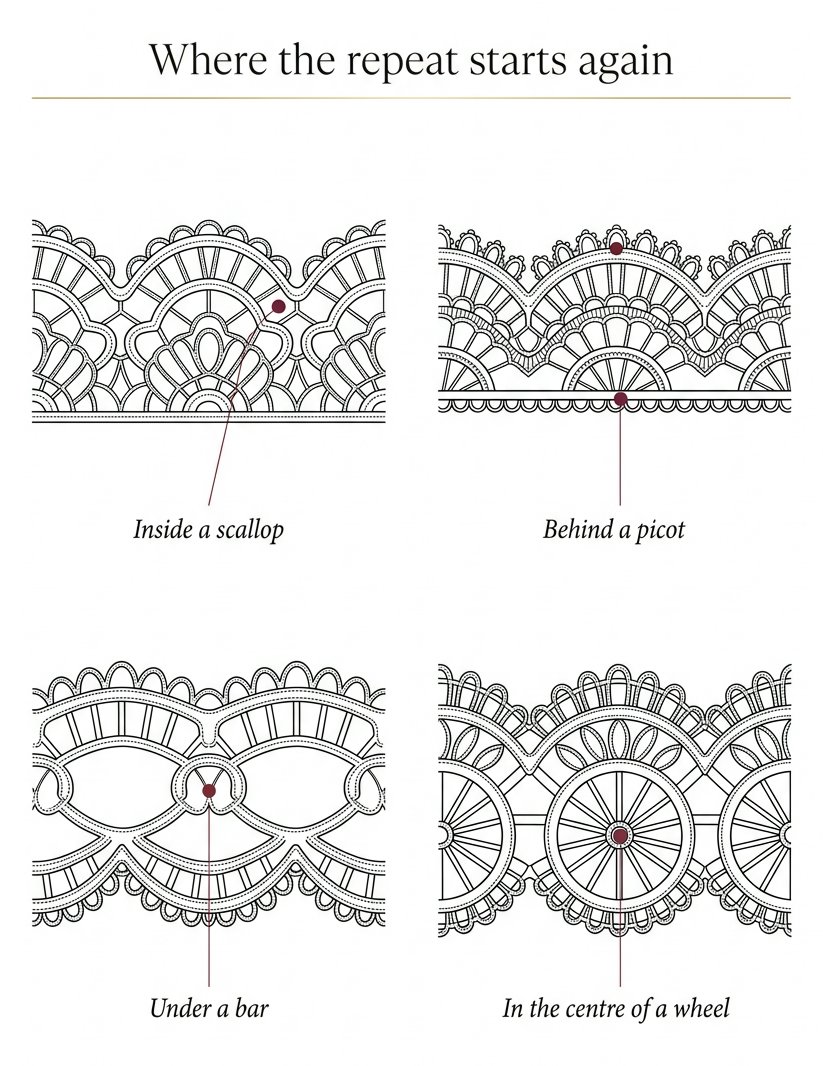
The repeat has to restart somewhere, and where you hide the join is a real decision. Inside a scallop is easiest. Behind a picot works because the eye stops at the bump. Under a bar works because a bar is already an interruption. In the centre of a wheel is hardest and prettiest.
Mary Ann Smith worked out how to draw lace by unpicking a piece of it in 1845
She had a piece of Italian lace and no instructions. So she took it apart, thread by thread, until she could see the order the stitches had gone in.
Then she taught it to the women of Youghal, in Cork. By 1852 the town had a lace school of its own.
Nobody handed her the method. She reverse-engineered it on a table with a needle, which is a very calm kind of nerve.
You can do the same with a photograph. Find lace on a cuff or a tablecloth, and do not copy it. Work out the order instead.
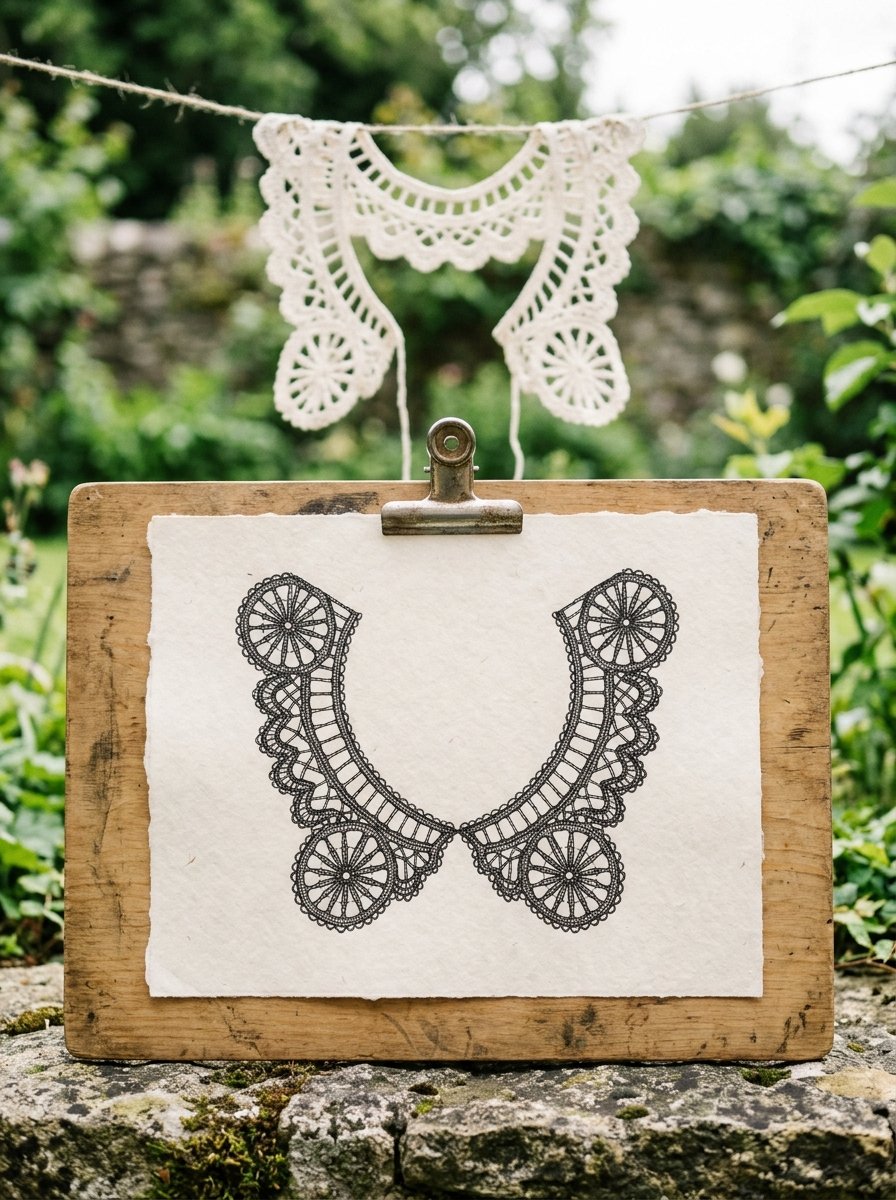
Tonight, three ways in. Pick one small section. Write down what was made first, second and third, in words, before you draw. (The first time I tried that I got the order backwards.)
Or copy only the gaps out of it and ignore every line. Or copy it once at four times the size. The order becomes obvious and your pen can follow it.
A picot is a full stop. It is a tiny loop on an edge, and its only job is to stop the eye running off the end. Put them on a scallop rim and the whole edge tightens. (I left them off for months and could not work out why my edges looked unfinished.)
The wheel is worth the trouble. A wheel is a hole with spokes crossing it, and it is the one motif that says lace instantly. Draw the circle, then a cross through it, then a second cross at an angle. Weave a small round darn where they meet.
Thérèse de Dillmont worked every pattern in her 1886 encyclopedia again before she printed it
Dillmont ran a textile school at Dornach, near Mulhouse, and kept shops in Vienna, London, Paris and Berlin. In 1886 she published the Encyclopédie des ouvrages de dames. It has since been translated into 17 languages.
She did not collect the patterns. She made every one of them herself, again, for the book. Her own line: “All the patterns given, even the most insignificant, were worked afresh for the purpose.”
That is somebody who had tested it. The confidence is earned, not encouraging.
For your hand, the lesson is to run the motif before you commit it. Not as practice. As proof.
Tonight, three ways in. Draw the same wheel 20 times down the margin of a scrap. Watch it settle around number 12.
Or run one scallop rim in three weights of pen. Pick the one that reads from arm’s length. Or draw a rose ground on a scrap first. A rose ground is a honeycomb of small linked rings, and it looks simpler than it is.
Evenness reads as graph paper. The wider gap is where the hand shows.
Leave one gap too big. A ground that is perfectly even reads as graph paper. One gap slightly wider than the rest is what makes the eye believe a hand did it. (This was an accident before it was a technique, and I am not going to pretend otherwise.)
Free Starter Pack
How to draw lace without inventing a fill: get 10 free pattern templates, sent tonight.
Stripes, scallops and dots. Drop one into a ring, a petal or the space under a bar.
Unsubscribe in 1 click, no hard feelings
How to draw lace tonight: print the sheet and start with the first ring
The three rings get harder down the page. The first has a wide band and few divisions, so there is room to be clumsy. The second is divided into petal shapes waiting for a ground. The third is a bare circle, for the evening you want to decide everything yourself.
Draw the holes first. The bar is the last thing. A picot is a full stop. Leave one gap too big. That is the whole method, and it fits in the margin.
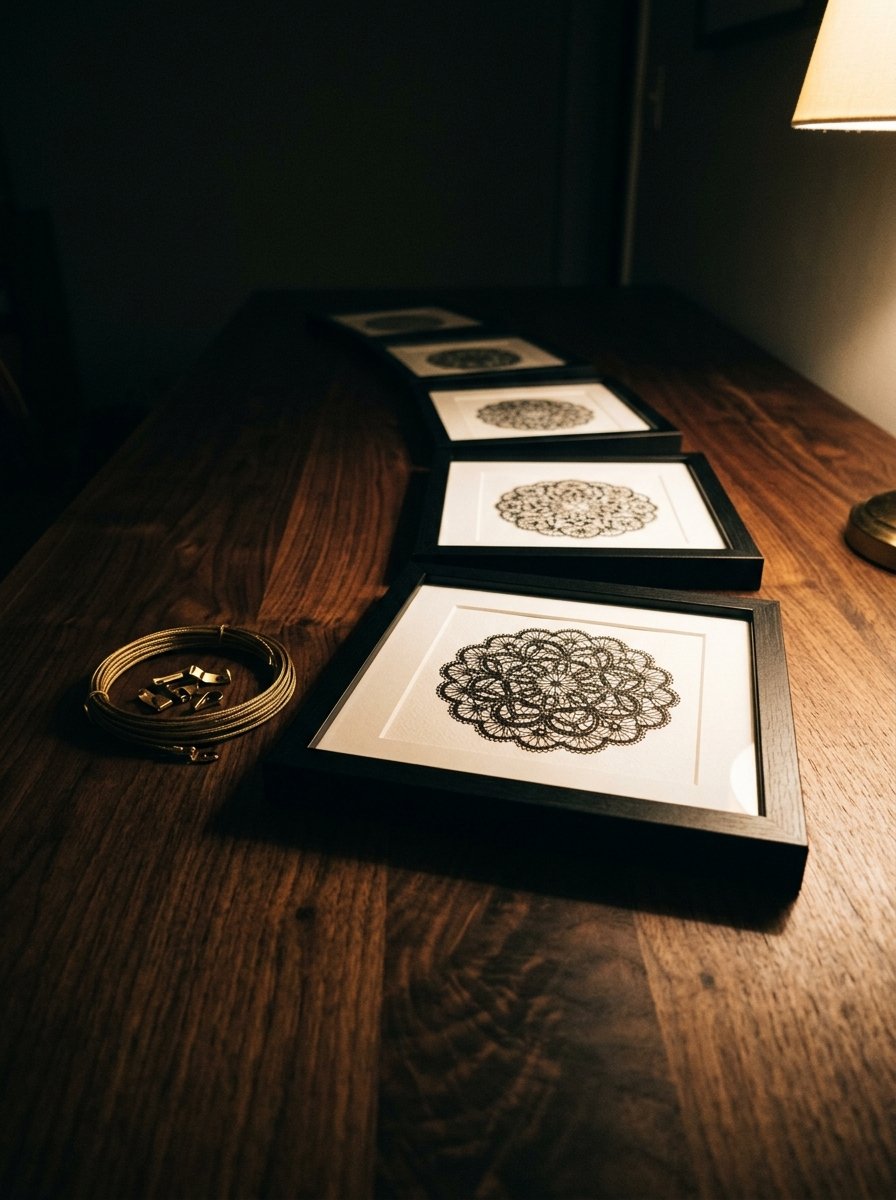
Work outward from the centre and stop one ring early. A doily with an unfinished outer round still reads as lace. A doily with a crowded edge reads as a doily somebody panicked at. (I stop a round early every time now. Nobody has ever noticed the one I left off.)
Every gap you cut still needs something inside it
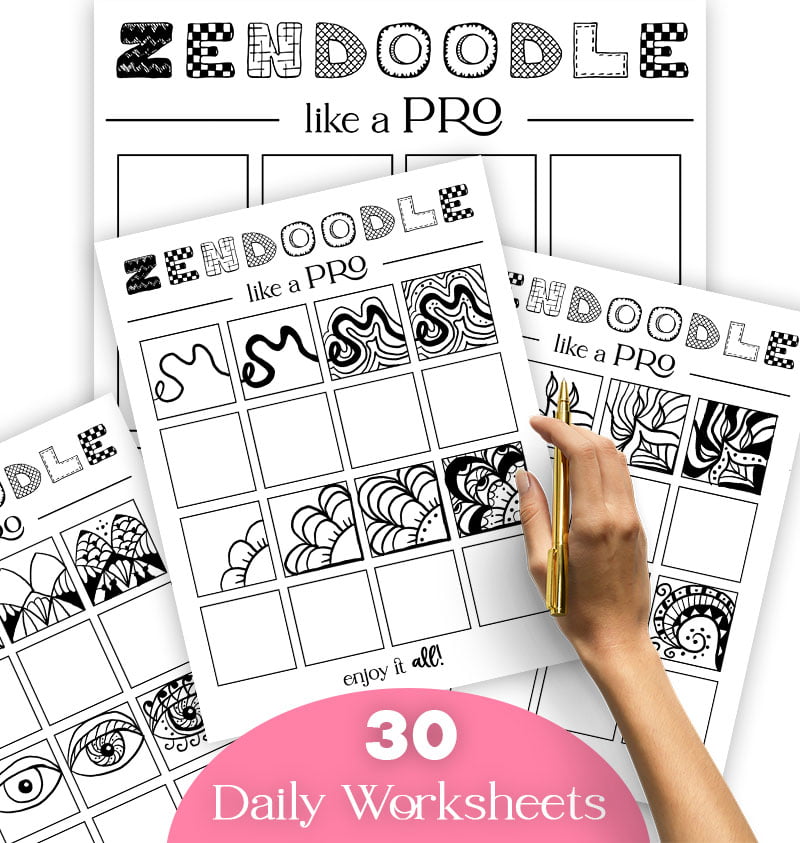
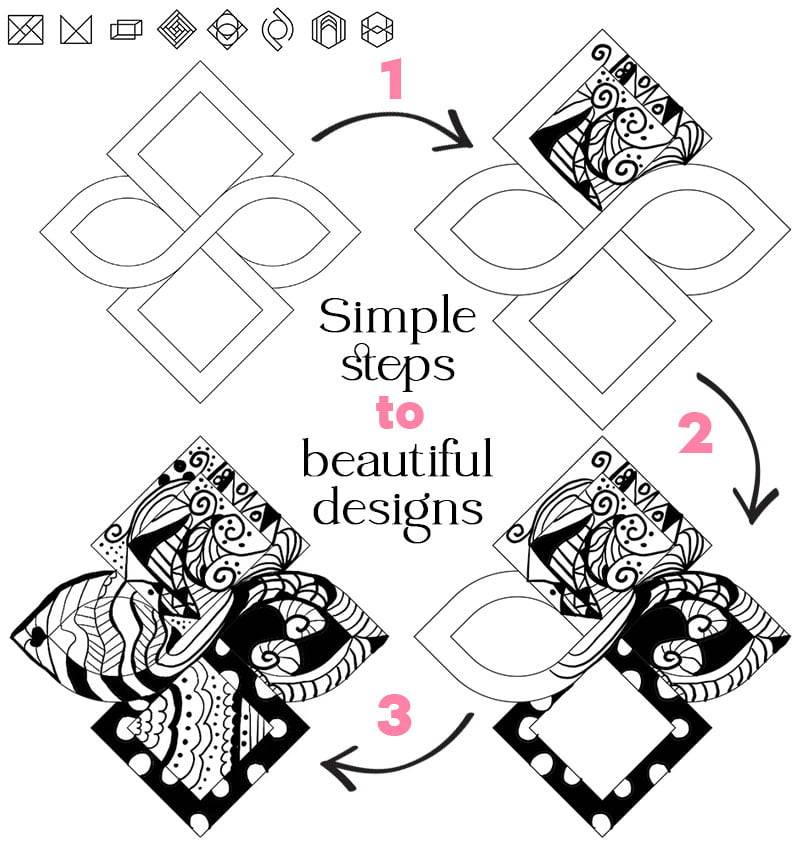
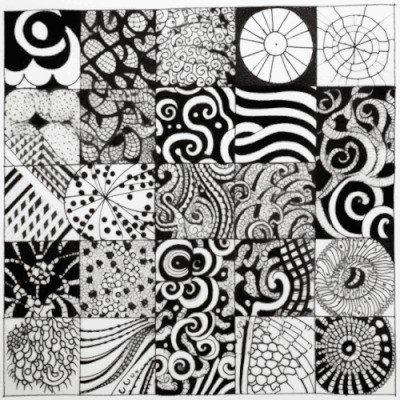
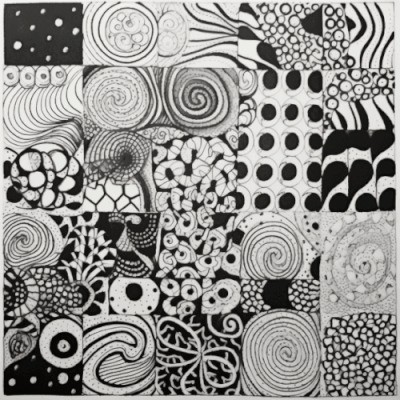
Cut the gaps, then reach for a fill instead of inventing one. Do one worksheet an evening. By the weekend the rings are full and nothing looks hesitant. Inside: pattern guides, 30 daily worksheets and the pattern banks.
Instant download · print as often as you like
The hand learns it by subtraction. Every evening it takes a little more away. The pattern arrives on its own, like a path worn into grass by people who were only going home.
“All the patterns given, even the most insignificant, were worked afresh for the purpose.”
Thérèse de Dillmont, Encyclopedia of Needlework, 1886
Mirabelle wrote this. No training, strong opinions, many pens. Peer reviewed by a cat who found the doily and improved it by lying on it.