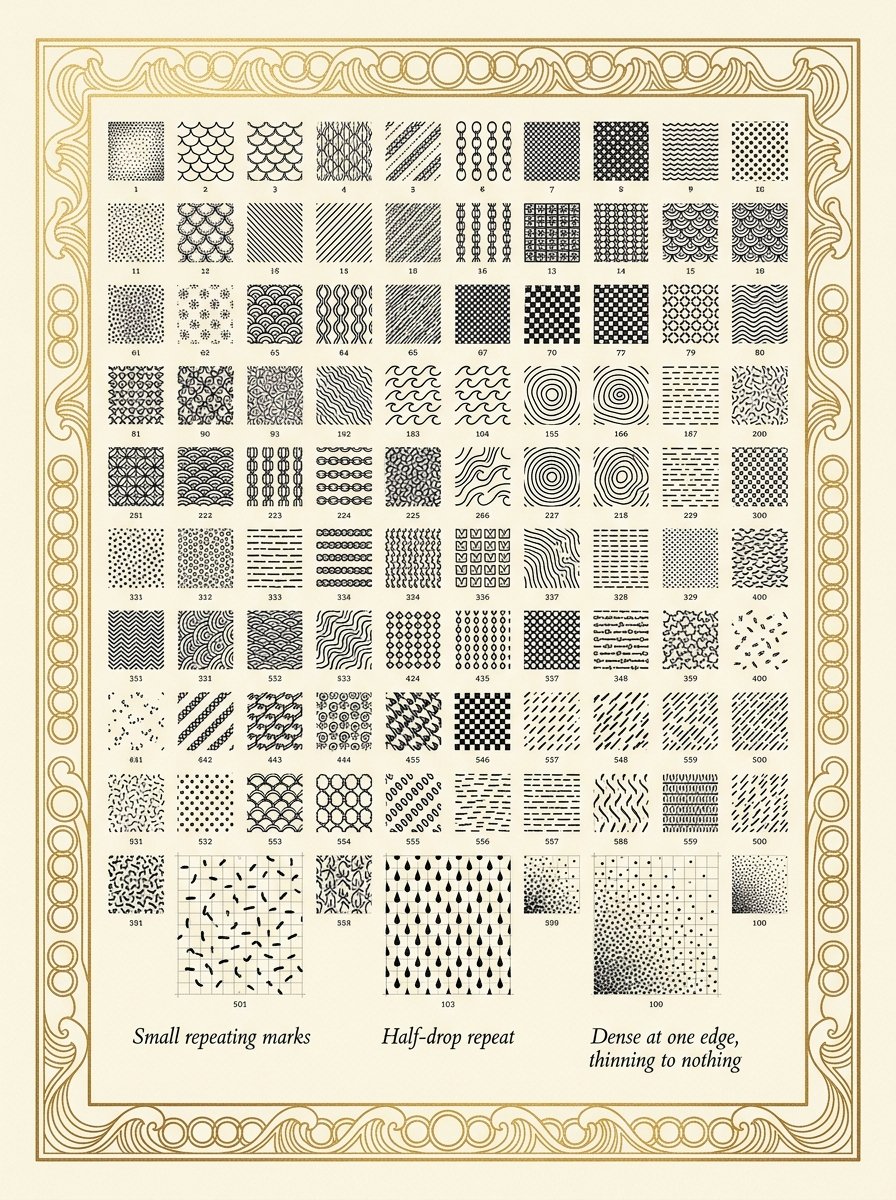
In 1824 Hokusai published a book with no pictures in it.
No wave, no Fuji, no people. 46 plates of small repeating marks — dots, wave crests, hatching, chains of tiny linked circles — printed as working material for the people who dyed cloth for a living. Boston keeps a copy.
The most famous draughtsman in Japan spent part of his 60s designing what is essentially very good wallpaper, and did not think it beneath him.
Which is the first secret, and everything else stands on it. Abstract drawing for beginners is not the shallow end of real drawing. It is where the people who could draw anything went when they wanted to think.
Below: 10 secrets of abstract drawing for beginners, one for each artist who found it out, and three things to do with each one tonight.
- Hokusai, 1824 — patterns are not the shallow end.
- Sonia Delaunay, 1911 — the first mark is not made by you.
- Cy Twombly, 1953 — draw in the dark.
- Kandinsky, 1913 — turn it round.
- Hokusai again, 1817 — the size is a decision.
- Agnes Martin — use the ruler, keep the wobble.
- Matisse, 1947 — stop drawing, start cutting.
- Josef Albers, 1963 — a colour is decided by its neighbour.
- Malevich, 1915 — where it hangs is part of the work.
- Delaunay and Cendrars, 1913 — make a set, not a piece.
Download the free fill sheets →
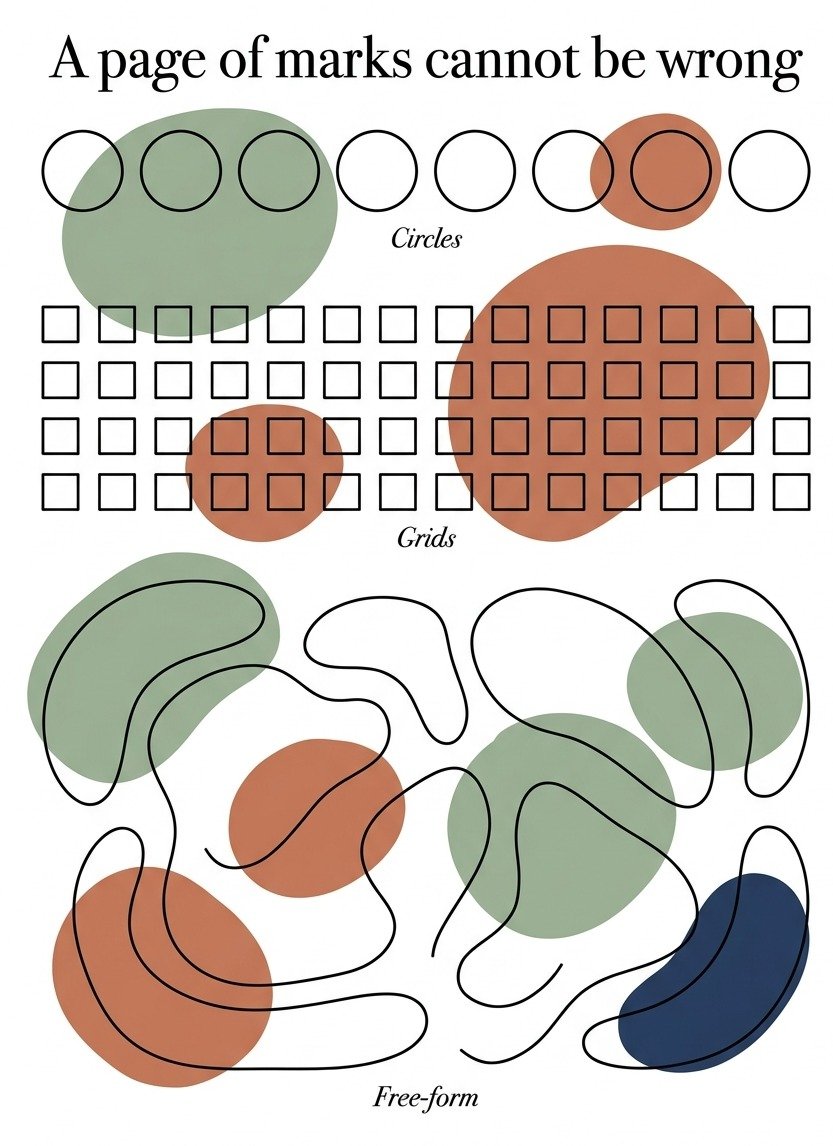
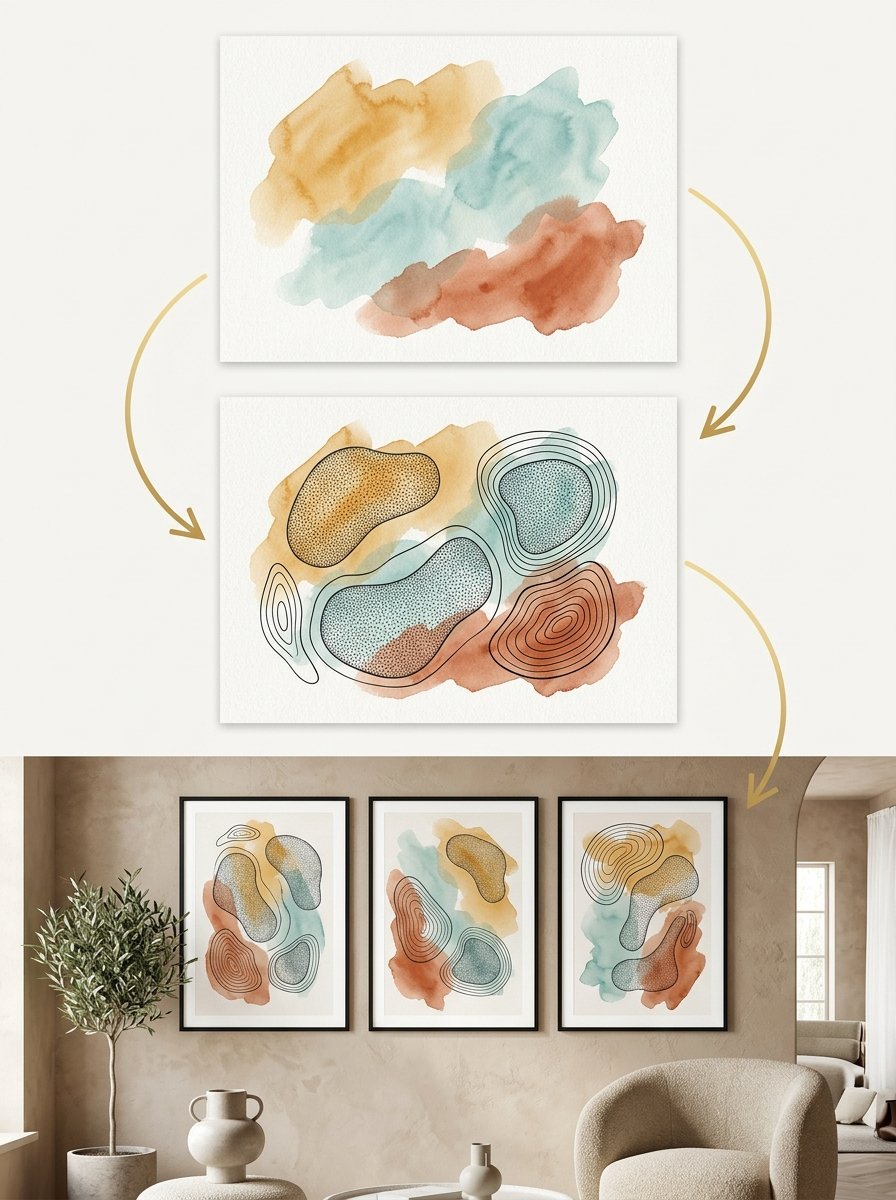
Start with the circles. Empty shapes, already outlined, waiting to be filled.
One shape, filled slowly. That is the entire activity, and every secret below is a different way in.
A face can be wrong. A horse can be wrong. A page of marks cannot be wrong — it can only be more interesting or less, and interesting arrives years before skilled does.
The 10 run out fast, though, and that is the honest problem with an evening like this. You get through 5 of them in a week and then you are in front of a blank sheet again, deciding — the part of the evening that never gets drawn.
The Collection
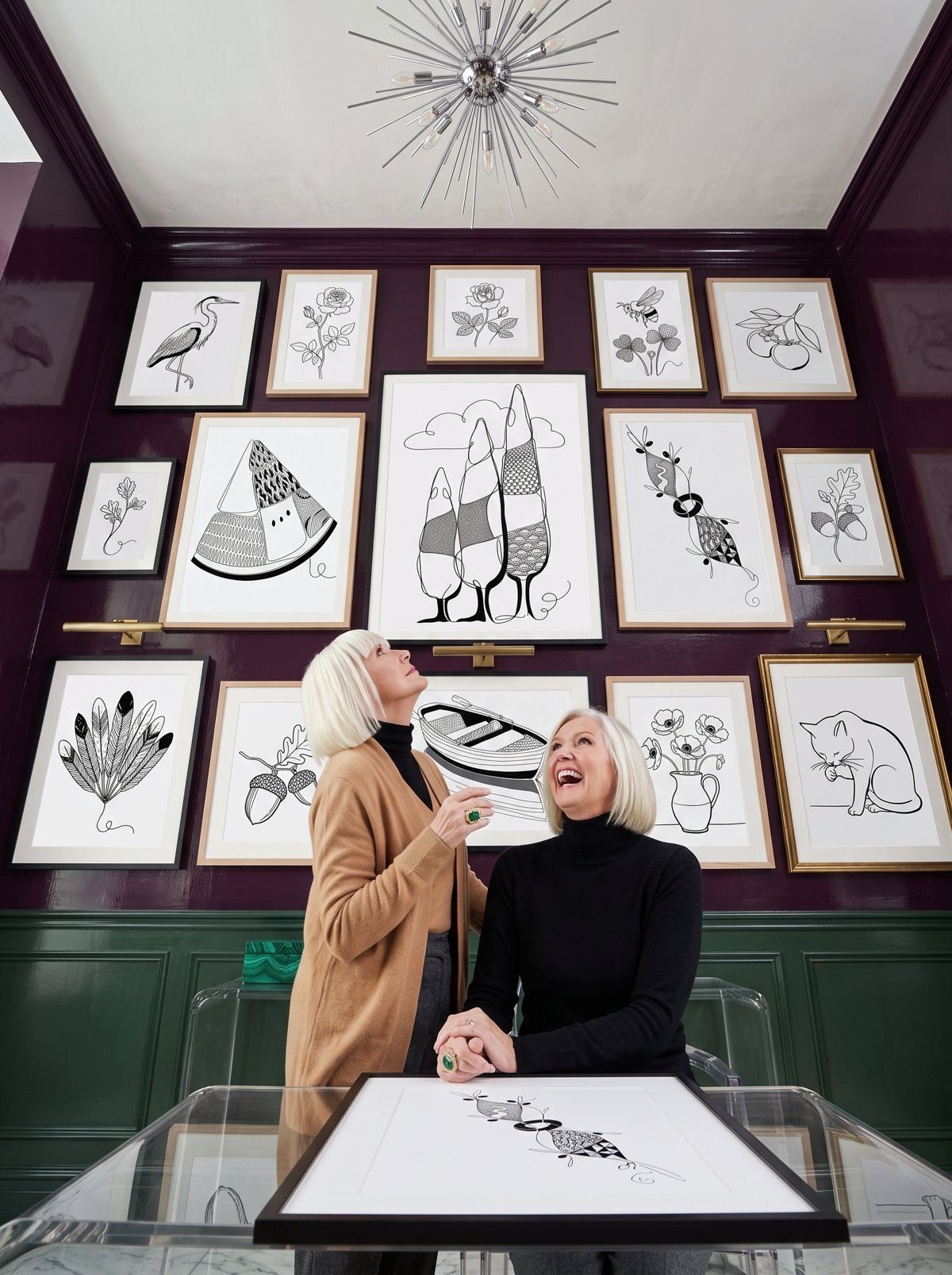
THE 100 COLLECTION — a shelf of finished pages that never needed an idea first.
The set for the evening a rule runs out and you want the next one already chosen. 100 finished pieces, and every one arrives 3 ways: the art, a tracing sheet, and a worksheet that shows the build. (I have never once opened it and found nothing I wanted to draw.) What you get: something waiting every evening, and 100 pieces that look like one collection rather than 100 attempts.
Back to the secrets. Nothing here is a style you have to understand before you start — abstract drawing for beginners is a hand movement, and the first one was printed and sold in a shop in 1824.
1 — Patterns are not the shallow end. Hokusai printed a whole book of them.
Shingata komonchō, New Textile Patterns, 1824. It sits in the Museum of Fine Arts in Boston and it is 46 plates of pure repeat with no subject anywhere in it.
He was 64 and at the height of everything. He made it for dyers, so that the small patterns on a kimono would be worth looking at close up.
The most famous draughtsman in Japan spent part of his 60s designing very good wallpaper, and did not think it beneath him.
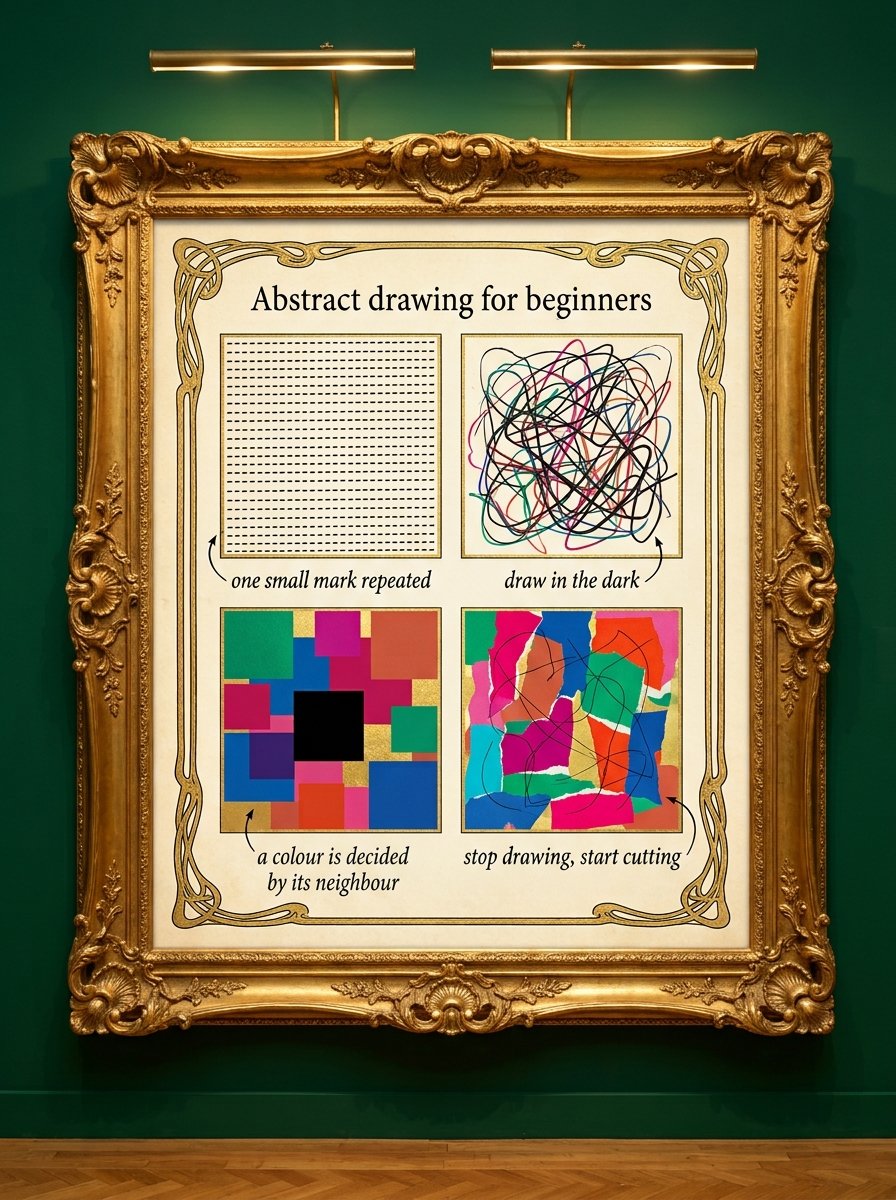
The lesson is not that patterns are easy. It is that one small mark repeated is a picture, and the spacing does the job a subject would normally do.
Tonight, three ways in. Rule 6 stripes down the page and give each one a different mark. Or repeat one small motif in a strict grid, small enough that 40 of them fit, until distance turns it into cloth. Or shift every second row down by half — a half-drop repeat — so the eye stops finding the grid.
2 — The first mark is not made by you. Sonia Delaunay proved it with a baby blanket.
In 1911 she had a son and made him a blanket out of about 70 scraps of cloth — squares and triangles, whatever was in the house — arranged by colour rather than by pattern, the way she had seen blankets made in peasant houses.
Then she looked at it and realised it resembled the paintings her husband and his friends were arguing about in Paris. So she stretched it and hung it.
It is in the Musée National d’Art Moderne, it is routinely called one of the first abstract works of the century, and she was still cheerfully pointing this out in 1962.
Nothing about it began with an idea. It began with the pile of offcuts already on the table.
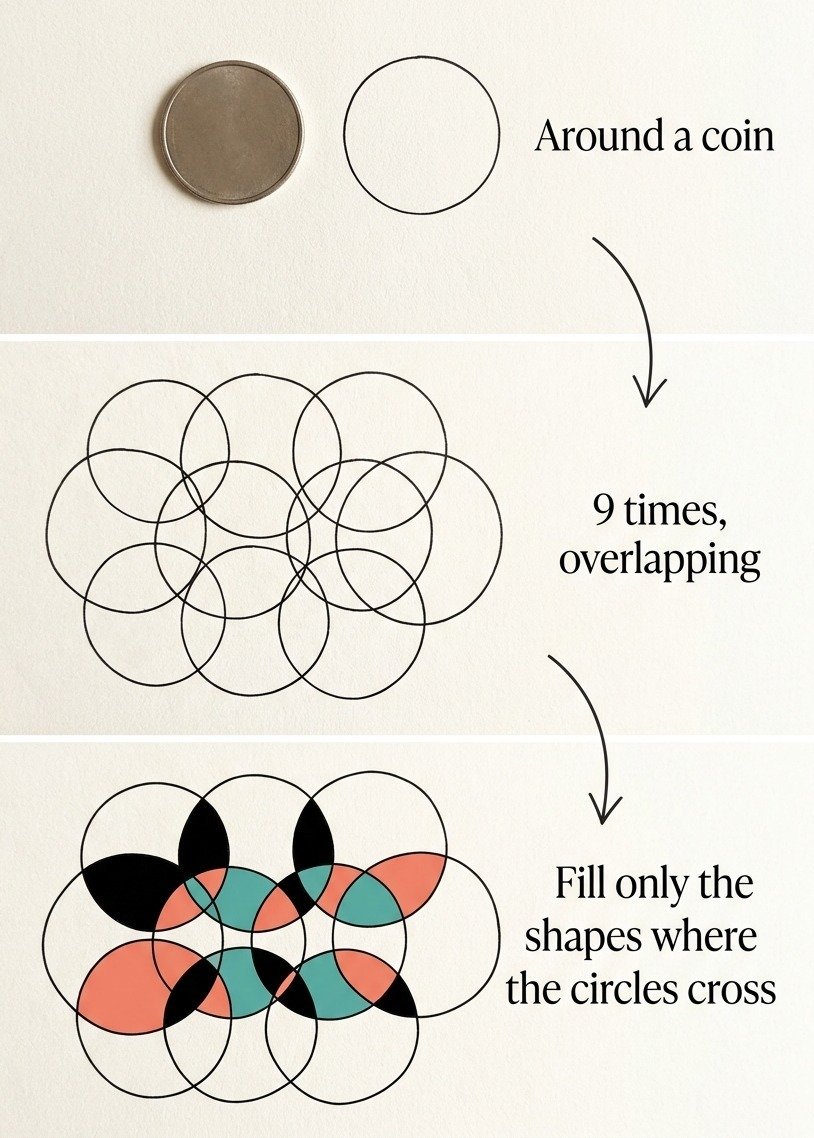
Tonight, three ways in. Draw round a coin 9 times, overlapping, then fill only the shapes where the circles cross. Or tear a strip off the sheet, draw along the torn edge, fill above the line and leave everything below it bare. Or draw round whatever is on the table — keys, a spoon, a leaf — lift them off, and fill only the overlaps.
3 — Cy Twombly rented a hotel room so that he could draw in the dark.
He was drafted in 1953 and spent the next year as an army cryptologist, at Camp Gordon in Georgia and then at the Pentagon. At weekends he took a hotel room in Augusta and drew at night with the lights off.
The point was not atmosphere. It was to destroy his own competence — to get rid of the practised, graphically expert hand and leave nothing but the sensation of the line. Those blind drawings became his first solo show in 1955, and everything after it.
Every beginner alive is trying to draw better. He spent a year deliberately drawing worse, and it worked.
(I have tried this with the lights genuinely off. The first attempt looked like a seismograph having a difficult night, and the second one is still on my wall.)
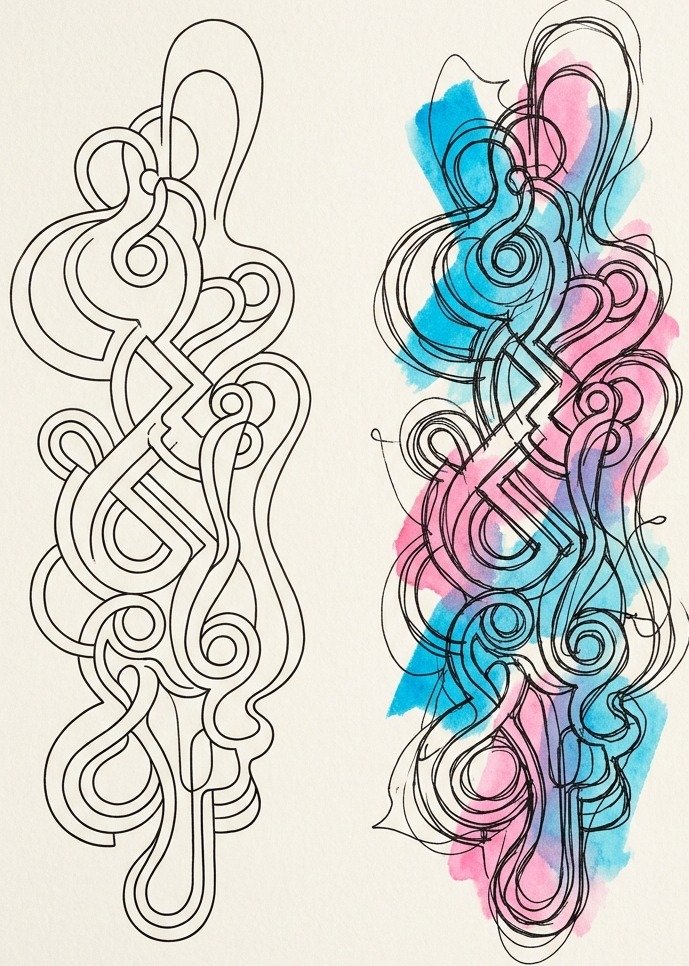
Tonight, three ways in. Turn the lights off and draw for 60 seconds. Or keep your eyes on a spot on the wall and never once look at the paper. Or scribble as slowly as you physically can, until it stops behaving like a scribble.
4 — Kandinsky did not recognise his own painting, and that is the test.
He came into his Munich studio at dusk and saw, in his own words, an indescribably beautiful picture drenched with an inner glow. He could not work out what it was of. He wrote that he hesitated, and then rushed at it.
It was his own painting, leaning against the wall on its side. He put the whole episode into Reminiscences in 1913, and went back the next day to try to get the same effect in daylight.
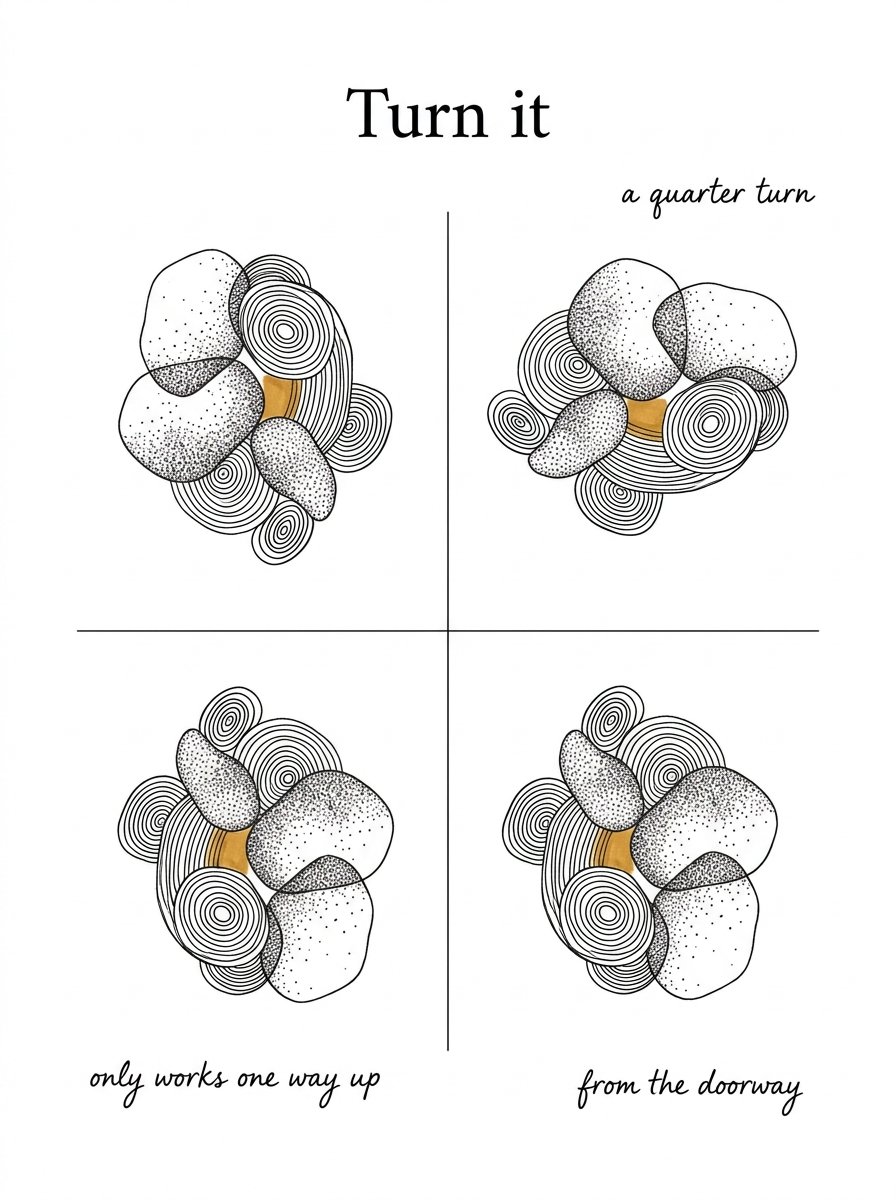
That is the most useful habit in abstract work and it costs nothing. If a drawing only works one way up, the subject is still doing the work. Turn it.
Tonight, three ways in. Rotate the page a quarter turn every few minutes while you fill it. Or start it upside down on purpose. Or stand it across the room and judge it from the doorway, which is the only honest distance there is.
5 — The size is a decision. Hokusai made one 18 metres wide to sell a book.
On 5 October 1817, in a courtyard beside a temple in Nagoya, he and his students laid out enough paper to cover a tennis court and painted a face on it: about 18 by 11 metres, roughly 120 tatami mats, the eyes 180cm across. Ink went on with brooms.
The finished sheet was hauled upright on ropes so the crowd could see it. He had advertised the whole thing in advance, because it was a sales stunt. He had a printed sketchbook out at the time — the Hokusai Manga, sold in volumes in ordinary shops — and a crowd that had just watched him paint a face the size of a house was a crowd that bought copies.
And to settle the question of whether the man could actually draw or only cover ground, the story that has followed him ever since is that he then painted two sparrows on a single grain of rice.
The biggest drawing ever made in Japan was a shop window for a sketchbook you could buy in town.
Tonight, three ways in. Take one composition to nearly the whole of an A4 sheet — a small mark on a big page looks like practice, the same mark at full size looks like a decision. Or redraw it at 4cm, postage-stamp size, and finish before the tea goes cold. Or make one enormous sweeping mark from the shoulder rather than the wrist, and build everything else small around it.
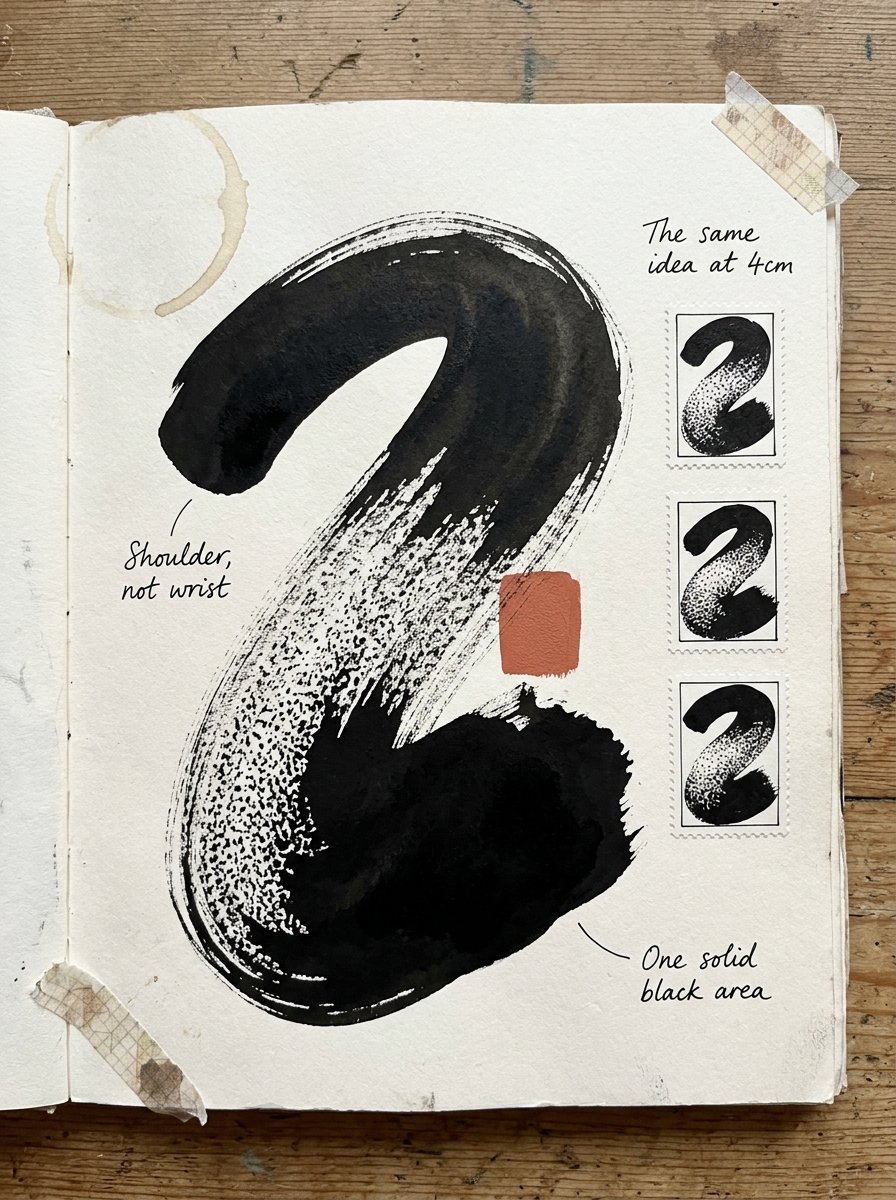
6 — Agnes Martin used a ruler and the line wobbled anyway. That is the whole effect.
Her canvases were 6 feet square — a size, she said, that you can walk into. She drew standing up, ruling every line against a metal edge.
Look closely and not one of them is straight. The pencil follows the weave of the linen and wanders, so a structure that ought to read as mechanical reads as a hand instead.
She said the work is about perfection as we are aware of it in our minds, and that the paintings themselves are very far from being perfect. The structure is meant to be exact. Your version of it is not.
Tonight, three ways in. Draw a shape, then a line 2mm outside it, then another, and another, until the page is full. Or fill one closed shape with dots, dense along one edge and thinning to nothing at the other. Or draw the same mark 10 times without stopping and keep only the last one, which is the one your hand has stopped arguing with.
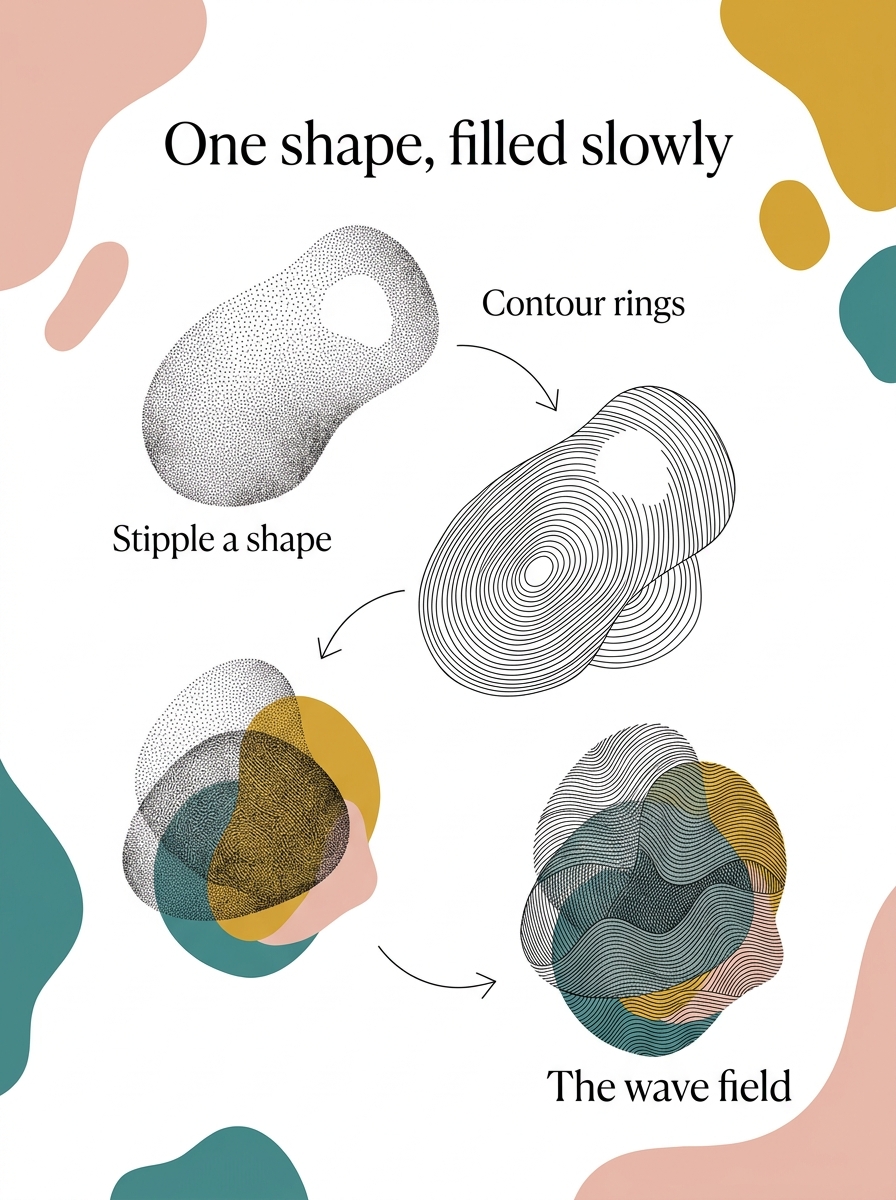
7 — Matisse stopped drawing and started cutting.
By 1947 he was making Jazz, and he had swapped the pencil for scissors. He called it drawing with scissors, and said that cutting straight into vivid colour reminded him of the direct carving of sculptors.
It is not a craft downgrade. Cutting joins the line to the colour in one movement, with no outline first and fill afterwards — which is exactly where most beginner pages go stiff.
Tonight, three ways in. Finish a page, cut it into 9 squares, shuffle them and glue them down in the wrong order. Or tear coloured paper into about 70 scraps and move them round the table before a single line is drawn, then draw round them once it hums. Or build a whole new composition only from the offcuts of the last one, with nothing new drawn at all.
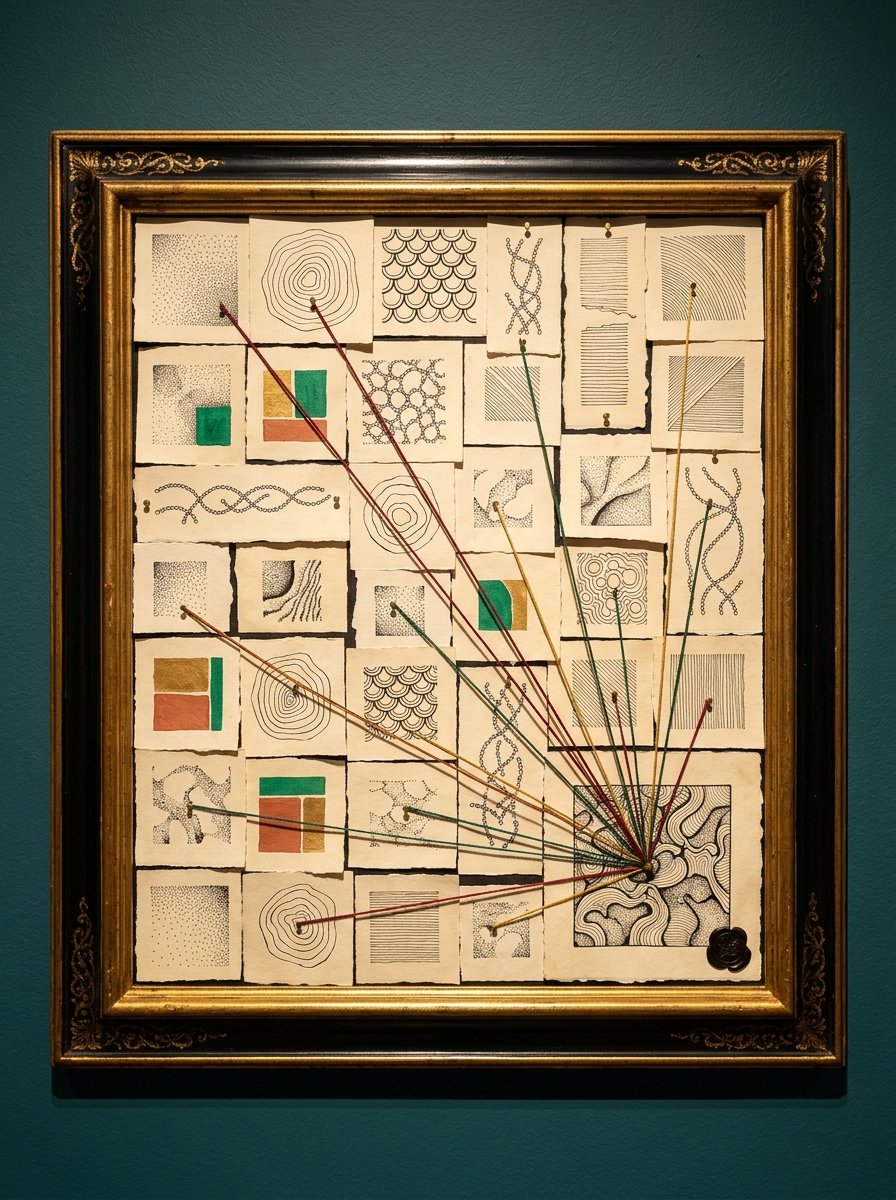
(I have cut up something I liked and improved it. I have also cut up something I liked and not improved it, and those pieces are in a drawer, where they are staying.)
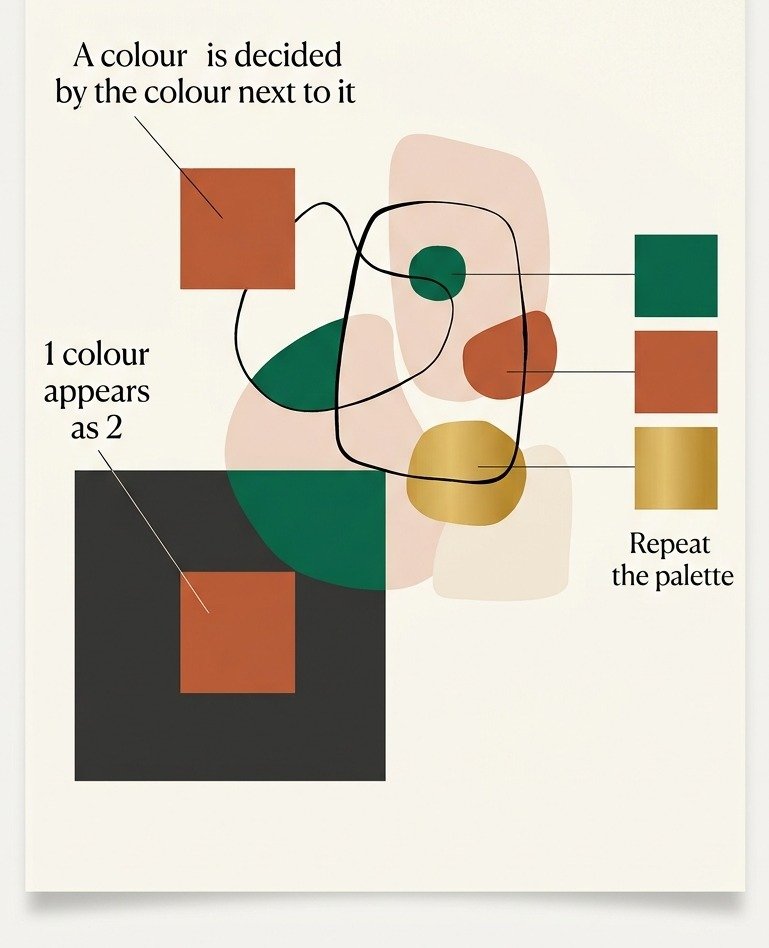
8 — A colour is decided by the colour next to it. Josef Albers spent 30 years proving it.
Interaction of Color, published by Yale in 1963, is the summary of a teaching course he ran for three decades. Most of the 200 or so plates in it were made by his students rather than by him.
The famous exercise is called 1 colour appears as 2. Put the identical square on two different grounds and it will not look identical — it changes hue, weight and temperature, and knowing that it is happening does nothing to stop it.
For a page of marks this is the entire game. You are not choosing an accent colour. You are choosing what it sits on.
Tonight, three ways in. Put the whole piece in black with one small area in a single colour, so it reads as a decision rather than an accident. Or paint the same colour twice, once on cream and once on charcoal, and look at the two of them together. Or repeat the palette across everything you make this week and let the pieces become a family.
9 — Where it hangs is part of the work. Malevich picked the corner reserved for icons.
The 0.10 exhibition opened in Petrograd on 19 December 1915. Malevich showed 39 works, and hung Black Square high in the corner of the room — the krasny ugol, the corner where a Russian household hangs its icon.
Nobody needed that explaining at the time, which is why it caused the trouble it did. He called the painting a bare icon without a frame.
You are not hanging anything in an icon corner. But the principle survives intact: a drawing changes value depending on where it ends up, and deciding that is part of making it.
Tonight, three ways in. Give the piece one genuinely solid black area, or it will grey out from the doorway. Or leave a lung — one region kept deliberately empty, so the eye has somewhere to sit down. Or prop it where you walk past it for two days before you spend anything at all on a frame.
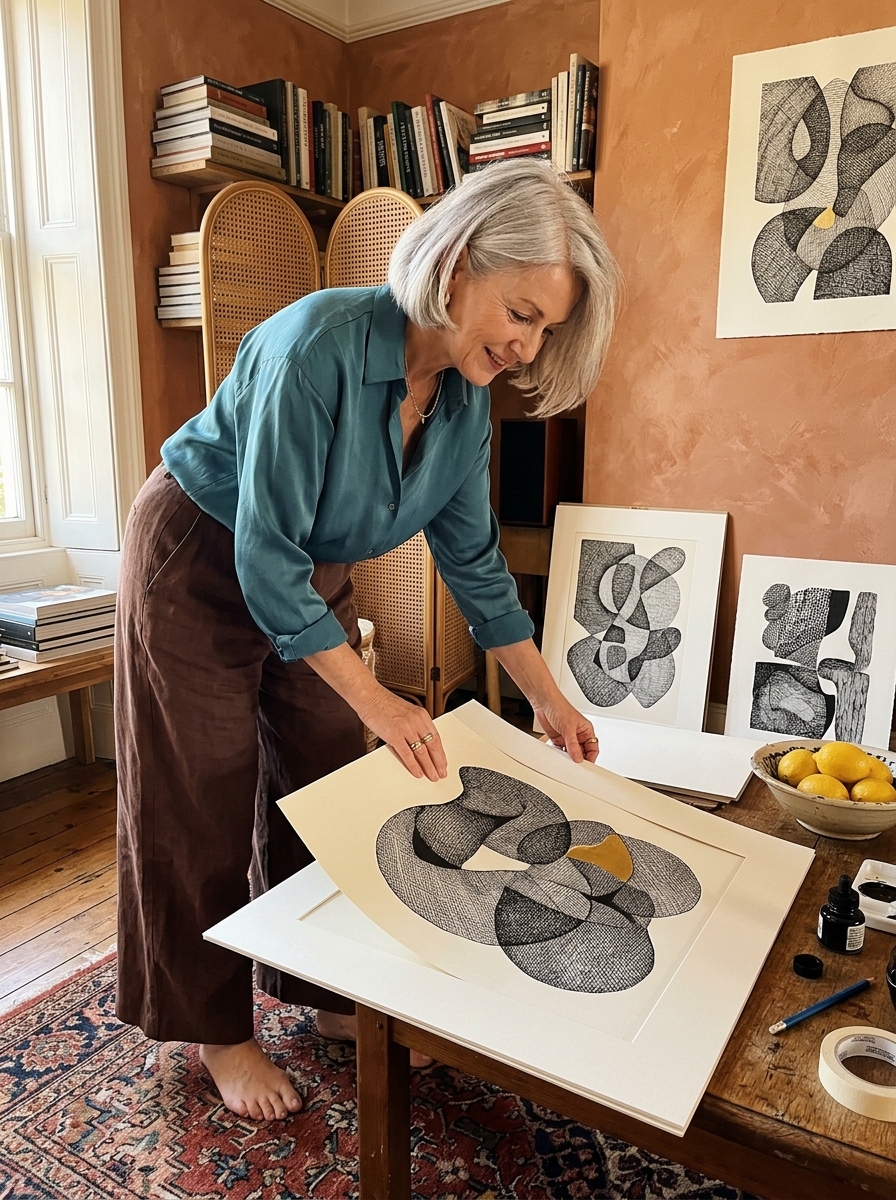
10 — Make a set, not a piece. Delaunay and Cendrars planned an edition the height of the Eiffel Tower.
In 1913 she and the poet Blaise Cendrars made a poem you unfold: two metres of paper, his words down one side and her colour down the other. They planned 150 copies, because 150 of them laid end to end would come to the height of the Eiffel Tower.
They managed about 60. The tower stayed exactly where it was. (I have never been fonder of a piece of arithmetic.)
The ambition is the useful part. One drawing is a drawing. Three of them, same size and same ink, is a scheme — and a scheme is what changes a wall.
Tonight, three ways in. Make the set of three: same size, same ink, three different fills. Or run one small motif 36 times across a single sheet, every one slightly wrong, and let the wrongness be the texture. Or take the same outline onto three sheets and fill it three completely different ways.
How do you know when an abstract drawing is finished?
When the next mark would only be there to prove you were still working.
There is no likeness to complete, so the finish line is not in the drawing. It is in you, and it arrives about three minutes before you believe it has.
The practical version is Kandinsky’s. Stand it across the room, look from the doorway, and turn it. If it holds up sideways, it is done.
Does an abstract drawing have to mean something?
No, and the ones that try to usually announce it.
The 1824 pattern book means nothing whatsoever; it was made for dyers. The blanket meant a warm baby. Meaning is what other people find in a thing afterwards, and they are remarkably good at it. You are allowed to simply like how the dots look, and that is why abstract drawing for beginners is the kindest possible place to start.
Free Starter Pack
10 empty shapes, waiting to be filled. Circles, grids and free-form.
Sent tonight. The deciding has already been done on every one of them, so the only thing left is the filling.
Unsubscribe in 1 click, no hard feelings
That is 10 secrets and 10 evenings, and then the deciding starts again. The real bottleneck in abstract drawing for beginners was never talent — most of us know 4 or 5 fills, because nobody ever handed us more.
100 pieces, 3 ways each
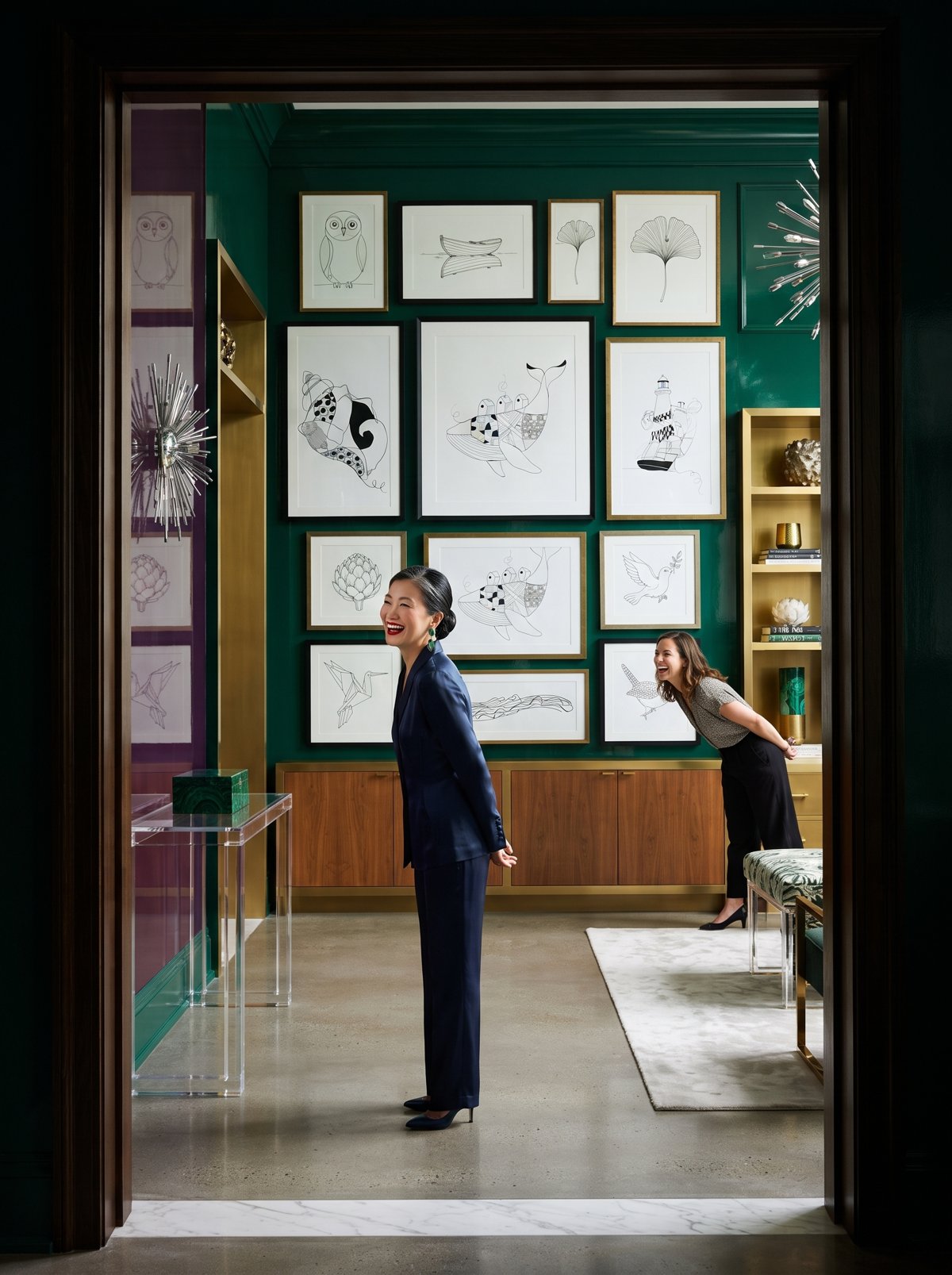
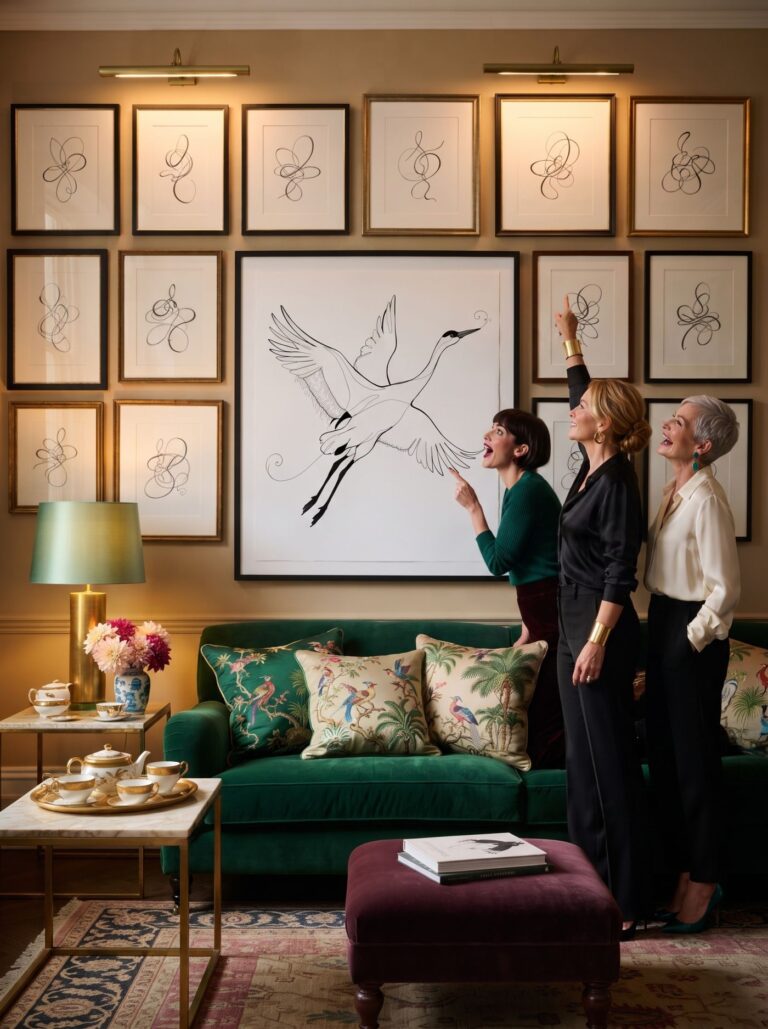
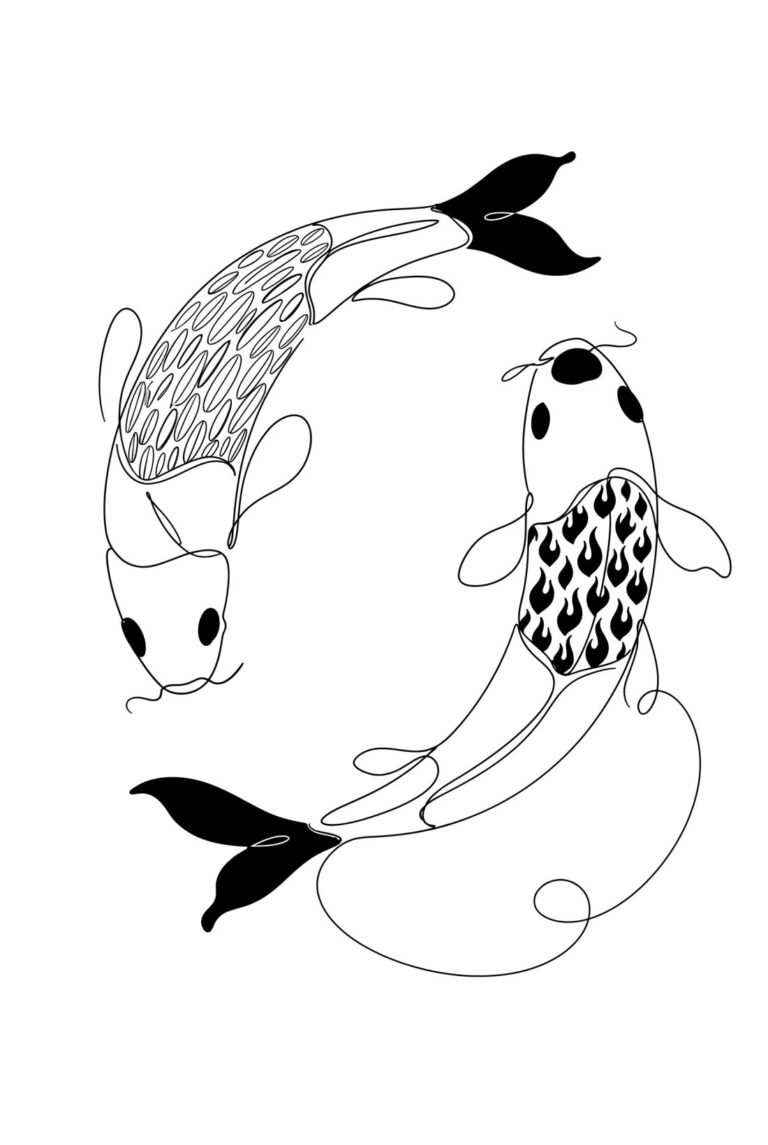
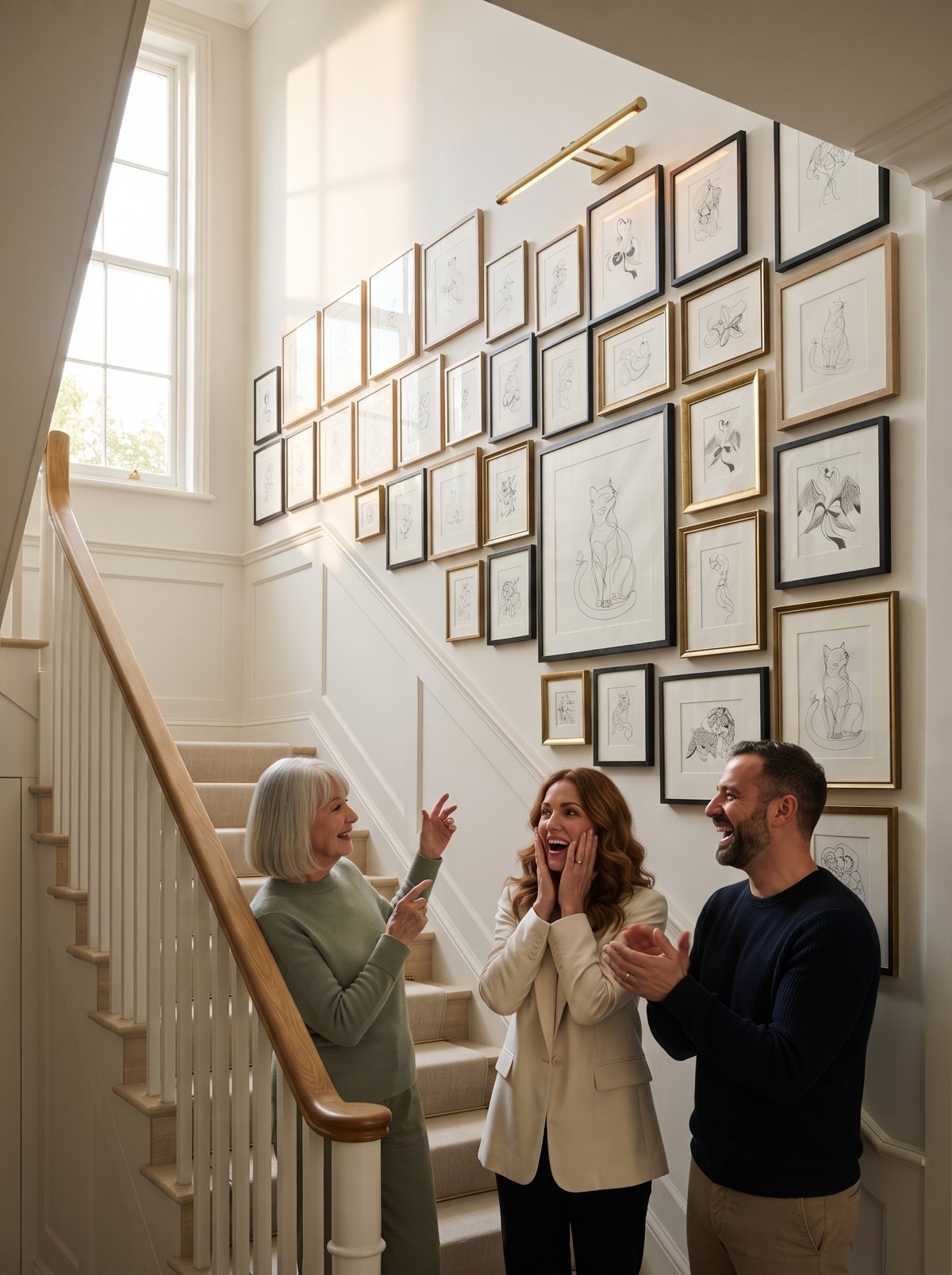
Tonight it is one shape and one rule, worked until the room goes quiet. By Sunday there are 3 on the wall in the same ink at the same size, and no two of them agree. Cranes, moons, stones, grasses and feathers, 100 in all, each with its sheet and its worksheet, ready to print.
Instant download · print as often as you like
The desk does not know how old you are. It only knows whether somebody sat down at it, and it has never once asked what for.
“Beauty and perfection are the same. They never occur without happiness.”
Agnes Martin
Mirabelle wrote this. No training, strong opinions, many pens. Peer reviewed by a cat who considers 30 ideas excessive and 1 sunbeam sufficient.