15 paintings of the same wheat stacks, hung side by side in one small room in Paris. Only the season had changed. Most drawing prompts for adults leave that part out.
A prompt tells you what to draw. The season decides how easy it will be.
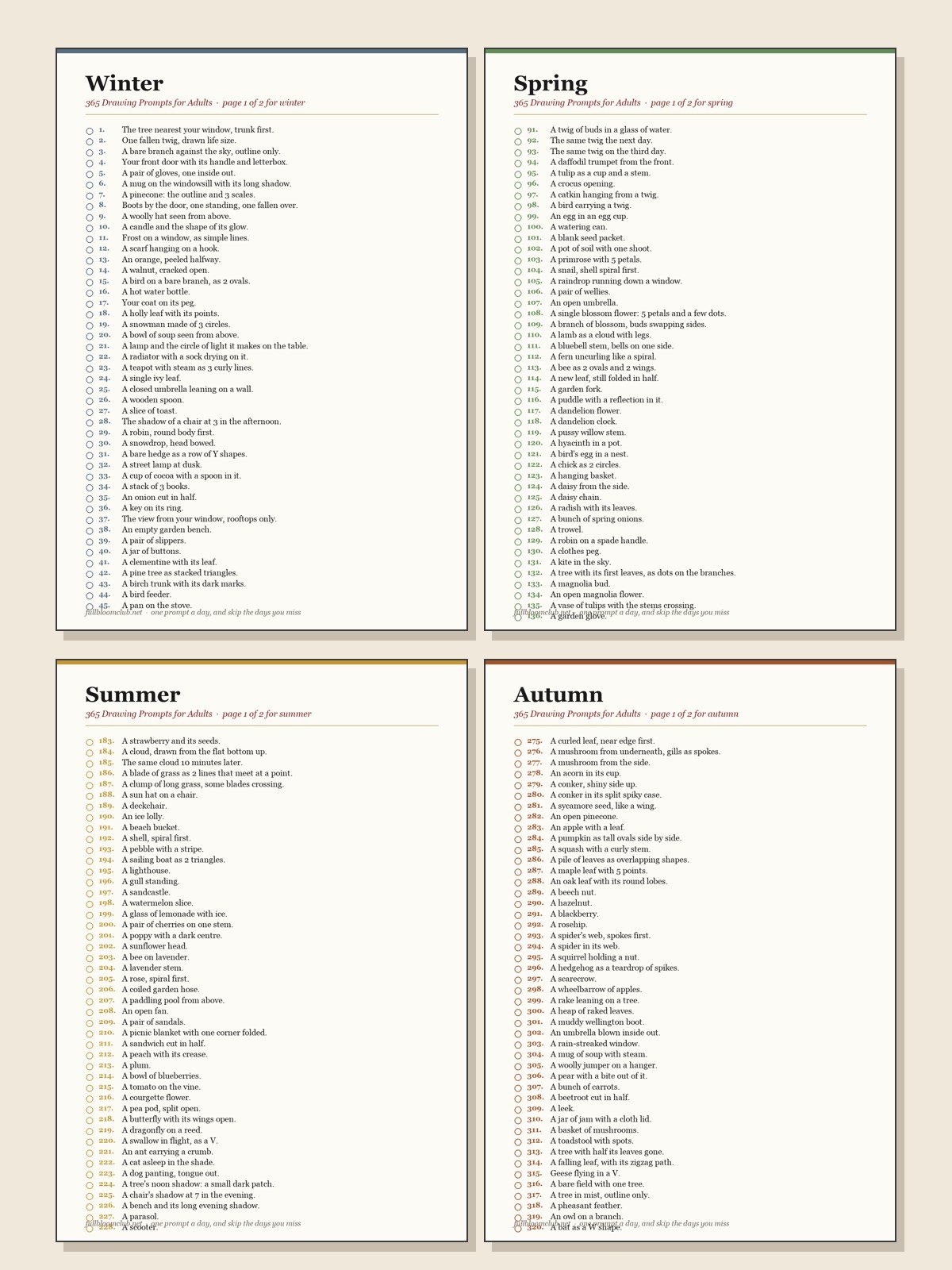
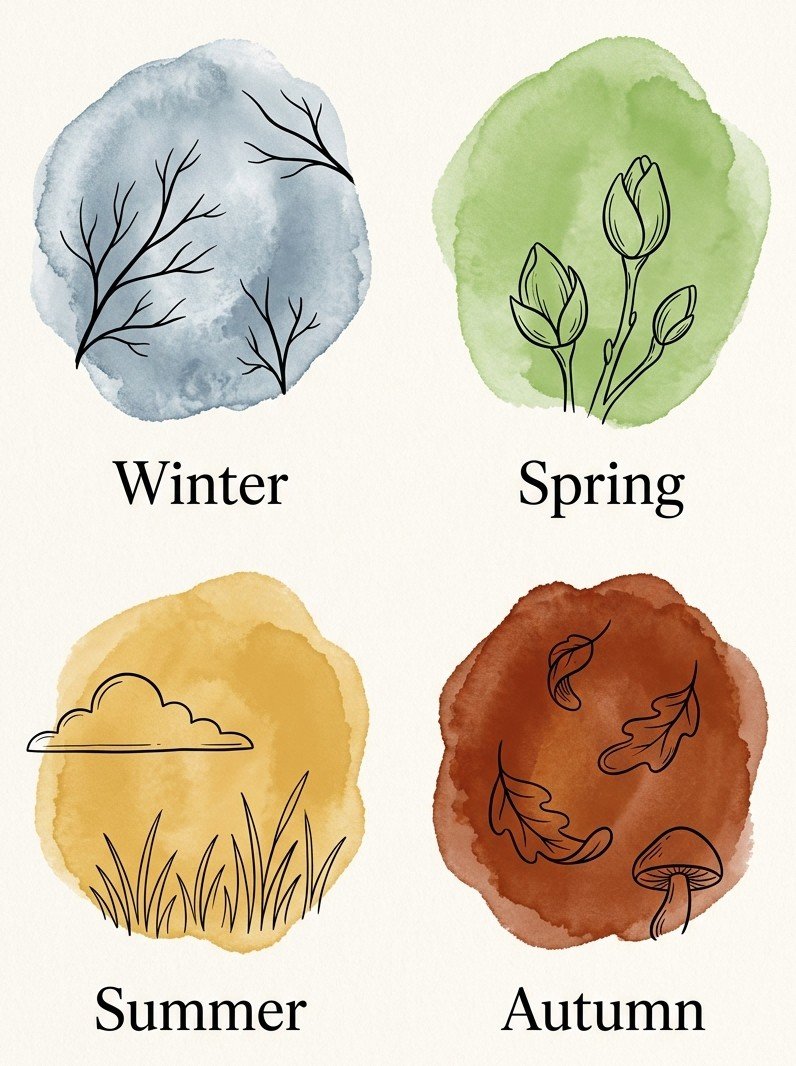
So the 365 prompts in the free PDF are sorted by season. Winter prompts use bare branches and long shadows. Spring uses buds. Summer uses clouds and grass. Autumn uses curled leaves and mushrooms.
(I started mine on 1 January, like everyone. Start on today’s date instead. This week’s prompts will then match what is outside.)
 Save
SaveThe PDF of drawing prompts for adults has 8 pages, 2 for each season. Each prompt is one line. Each one needs only a pen and a few minutes.
Print it and pin it somewhere you pass every day. Do one prompt a day, and skip the days you miss. (Doing 3 on Sunday to catch up is how a calendar turns into homework.)
Below are 8 drawing secrets, 2 for each season. They explain why these drawing prompts for adults are sorted the way they are. Each secret ends with 3 prompts from the PDF to try this week.
I kept a year of these in one sketchbook, one drawing a day. The drawings from the first month are shaky. By the third month my lines were steadier, and I did nothing clever. I just kept turning up.
A one-line prompt tells you what to draw. It does not show you how to start. Some evenings that is fine, because the idea is all you need. Other evenings you read “draw a teapot” and have no idea where the first line goes. On those evenings, a drawing with the steps already shown is the easier way in.
The Collection
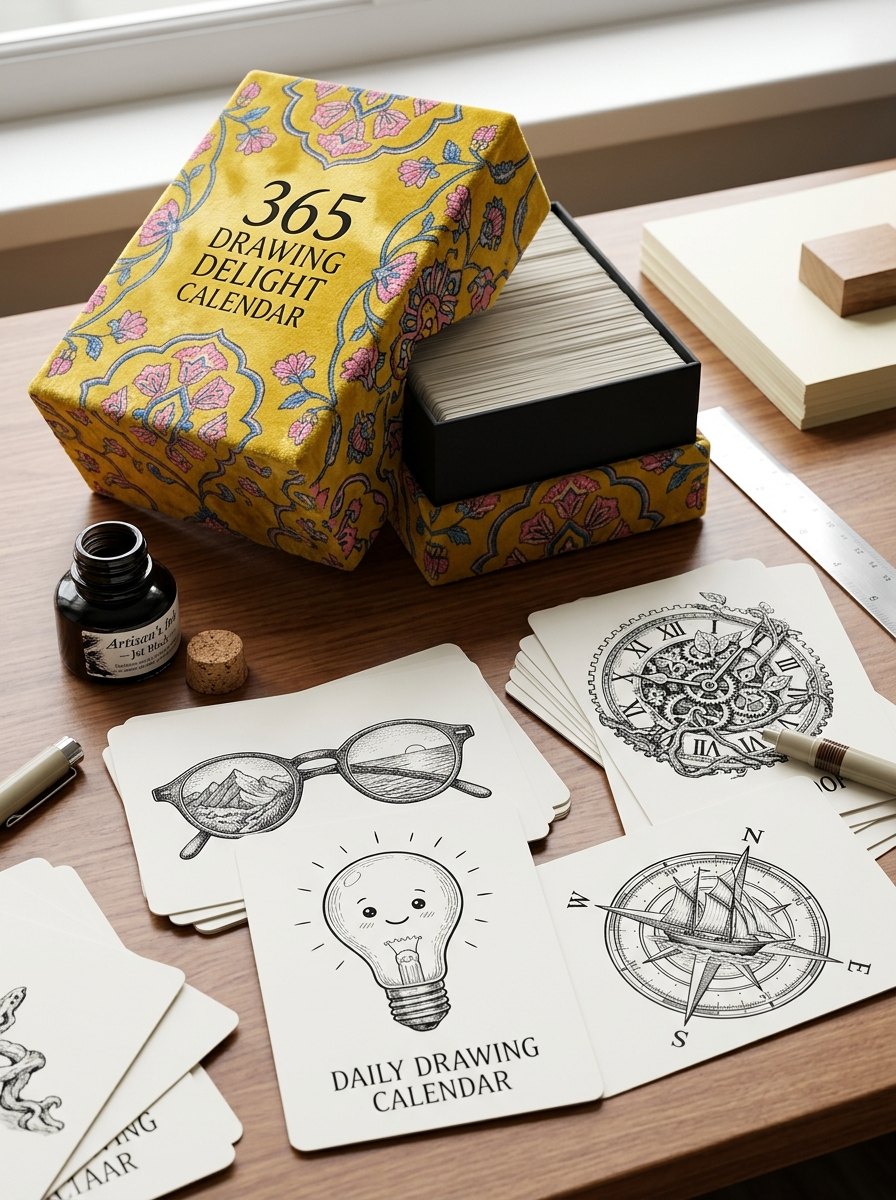
THE 365 DRAWING DELIGHT CALENDAR — cats, birds, lightbulbs, and a new drawing for every day of the year.
Want one thing to draw every day of the year, with the steps shown? Inside: 365 drawing ideas, each with step-by-step instructions and a how-to video. (There is no wrong day to start.) What you get: something to draw every day, and a sketchbook that fills up.
Now the secrets, starting with winter. They work in any order, so jump to the season you are in.
 Save
SaveEach season also has its own colours, shown above. If you only have a black pen, every secret below still works.
Winter: draw trees now, while you can see how they are built
In winter a tree has no leaves in the way. You can see every branch. It is the best time of year to learn how a tree is put together.
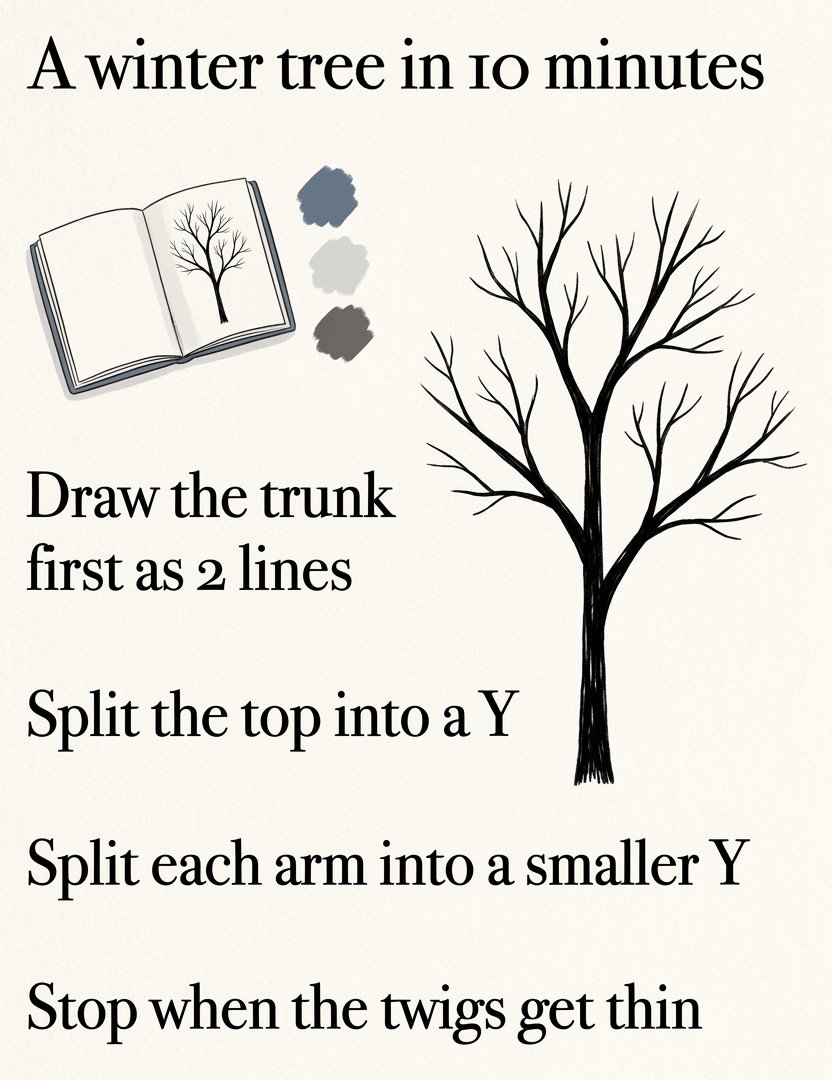
The secret is one rule. Every branch is thinner than the branch it grows from. And almost every split looks like the letter Y.
Here is a winter tree in 10 minutes. Draw the trunk first as 2 lines. Split the top into a Y. Split each arm into a smaller Y. Keep going, and stop when the twigs get thin.
(My first winter tree had branches the same thickness all the way out. It looked like a coat rack.)
 Save
SaveYour eye fills in the finest twigs by itself. If you draw every single one, the tree starts to look like wire.
This week, try: draw the tree nearest your window, trunk first. Then draw one fallen twig, life size. On Sunday, draw the same tree again from memory and see which branches you kept.
Every branch is thinner than the branch it grows from.
Winter: let the long shadow show you the shape
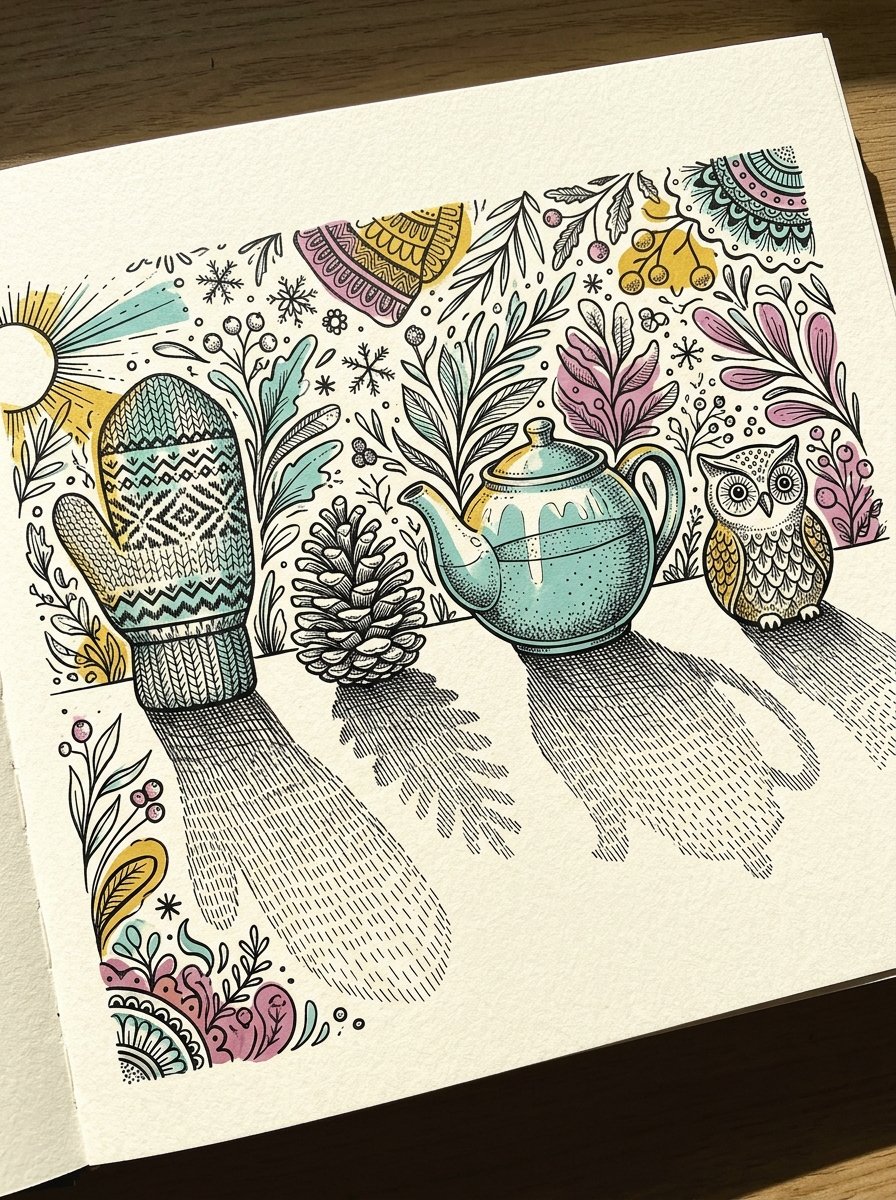
Winter sun stays low in the sky, even at lunchtime. Low sun makes long shadows. A long shadow is a second outline of the object, stretched across the table.
Draw the shadow before you finish the object. A correct shadow makes the object sit down. Leave the shadow out, and the object floats.
Claude Monet spent more than a year on this. In 1890 and 1891 he painted the tall wheat stacks outside his house at Giverny, again and again. He worked at several easels at once as the light changed.
The Art Institute of Chicago calls the winter views the core of the series. In May 1891 he hung 15 of these paintings side by side in one small room in Paris.
In pen, shade only the shadow side of each object. Use short lines that all lean the same way. (Mine leaned every way at first. The mug looked hairy.)
 Save
SaveThis week, try: a mug on the windowsill with its long shadow, in the middle of the afternoon. Then boots by the door, one standing and one fallen over. Then put a bottle of milk under a low lamp and draw the shadow first.
Draw the shadow before you finish the object.
Spring drawing prompts for adults: draw the buds before they open
A flower is hard to draw. A bud is easy. A bud is one simple shape, like a small egg or a teardrop.
Buds on a twig usually take turns. One sits on the left. The next sits a little higher, on the right. Draw the twig as one line first. Then add the buds, swapping sides as you go up.
(I once drew every bud on the same side. The twig looked like it was leaning away from a draught.)
When a bud starts to open, it is still a teardrop, with a small split at the tip. Draw the split as a short V. That V is the only new line you need.
 Save
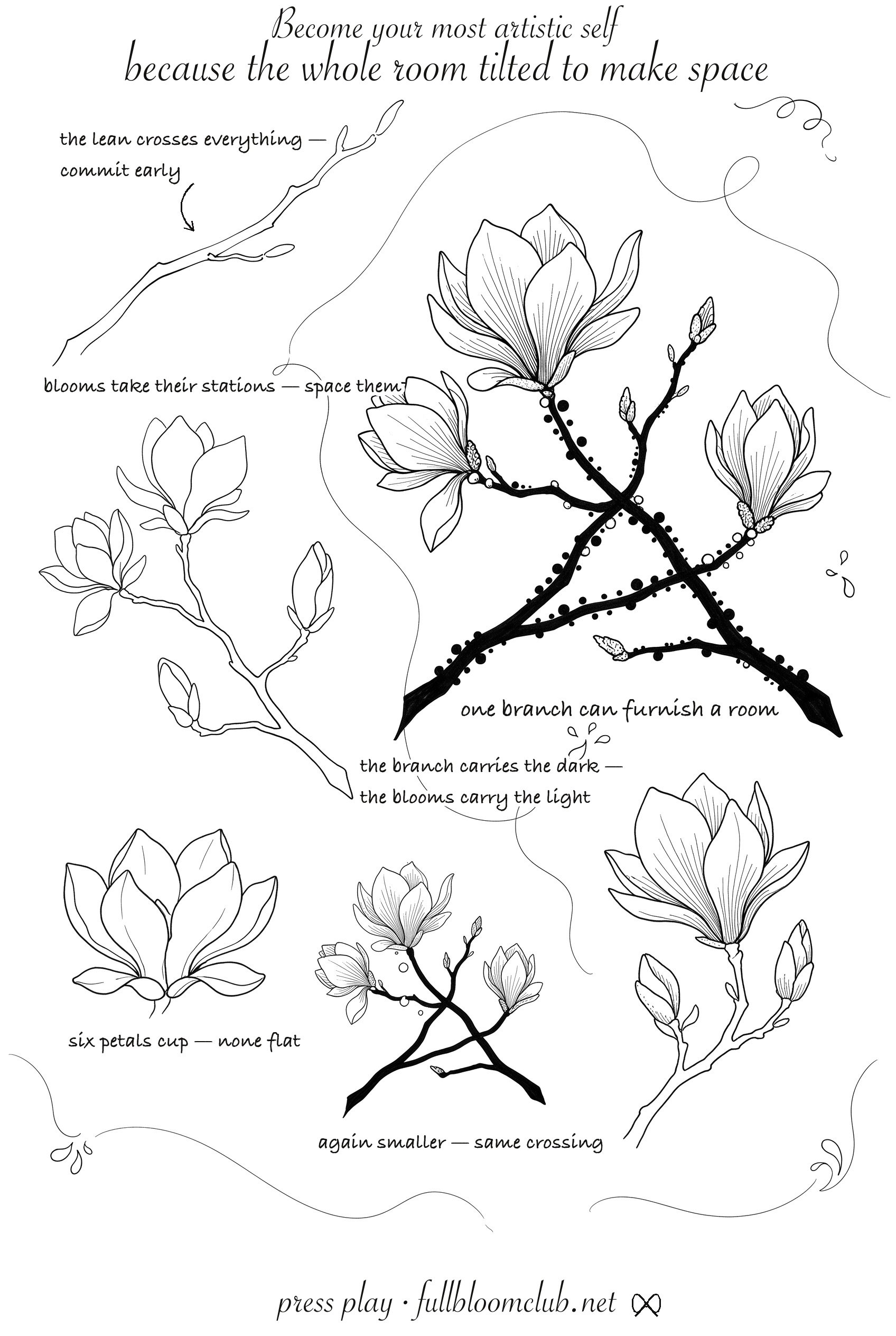
SaveThe magnolia sheet above shows the same idea on a bigger branch. The closed buds come first, then the open flowers.
This week, try: a twig of buds in a glass of water. Then a magnolia bud, if you can find one. Then a tulip, drawn as a cup and a stem.
Spring: draw the same twig 3 days in a row
In spring a twig changes every day. A bud that is shut on Monday can be open by Thursday. One drawing shows you a bud. Three drawings show you how it opens.
Put the twig in a glass of water. Draw it on the left of the page. The next day, draw it again in the middle. On the third day, draw it on the right. Write only the day under each one. (Not the date, not the weather, not what the garden was doing. Just the day.)
Edith Holden kept this kind of record for a whole year. In 1906 she painted and wrote about the plants and birds near her home in England, season by season.
Her notes were printed in 1977 as The Country Diary of an Edwardian Lady. Her publisher says it has been a classic of nature writing ever since.
I tried this with one horse chestnut twig. The sticky buds took 4 days to open. My 4 small drawings of it are the most useful page in my sketchbook.
This week, try: the same twig on 3 days in a row. Then a fern uncurling like a spiral. Then a branch of blossom, with the buds swapping sides.
Summer: draw in the morning or evening, when shadows are long
At midday in summer the sun is almost overhead. Shadows shrink to a small dark patch right under things. Everything looks flat.
So draw outdoors before 10 in the morning or after 5 in the evening. The shadows are long again, and shapes look solid.
If noon is the only time you have, add a small dark oval under each object. That little patch stops it floating. (I drew a whole summer of things at noon and wondered why they all looked like stickers.)
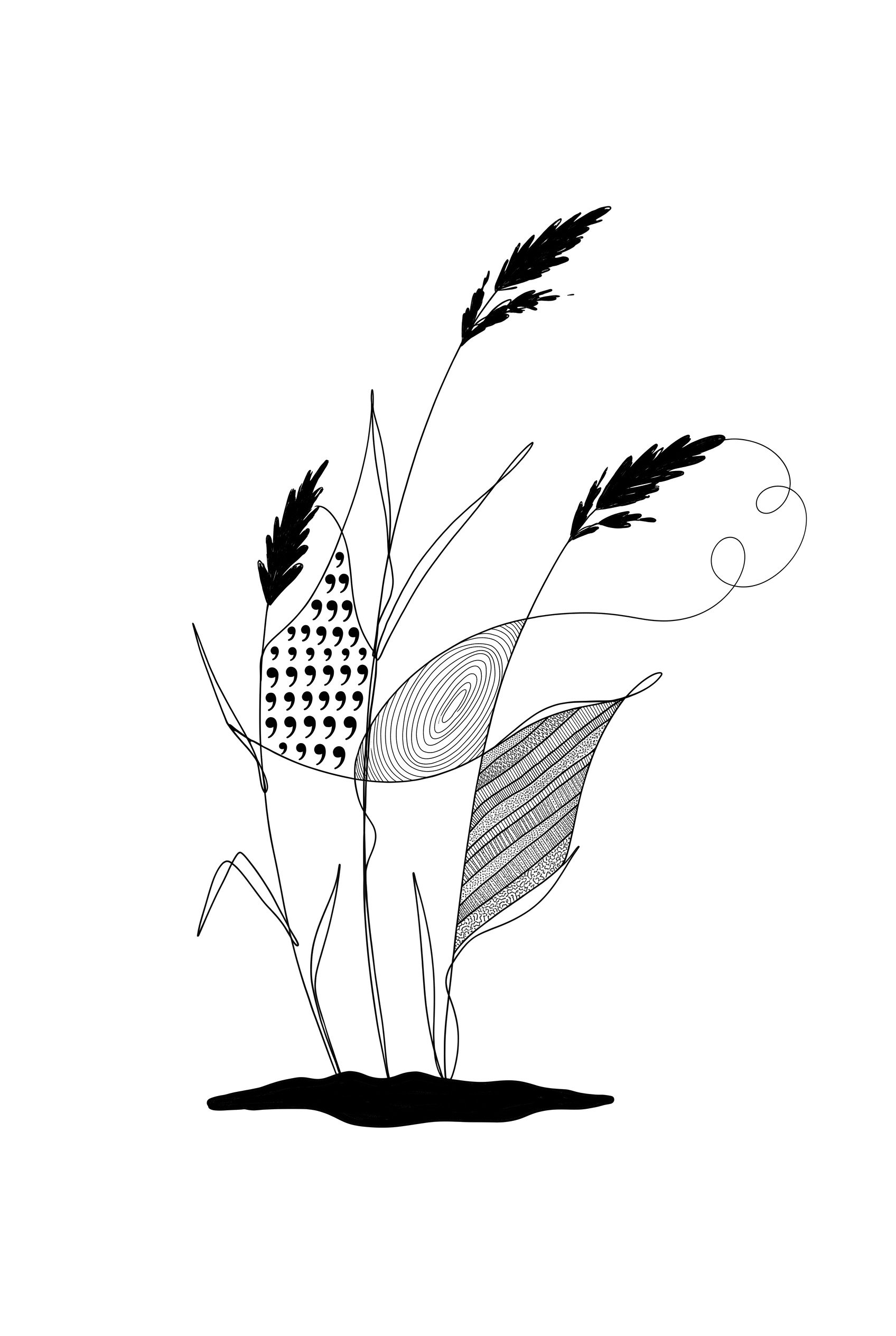
Grass is the easiest summer subject. Draw each blade as 2 lines that meet at a point. Let some blades cross in front of others. Grass that never crosses looks like a comb.
 Save
SaveThis week, try: a clump of long grass, some blades crossing. Then a bench and its long evening shadow. Then a strawberry and its seeds.
Summer: draw a cloud from its flat bottom up
Most summer clouds have a flat bottom and a bumpy top. Beginners draw bumps all the way round. The cloud turns into a sheep.
Draw a soft, straight line for the bottom first. Build the top from overlapping bumps, big in the middle and smaller at the sides. Then shade just under each bump.
Clouds move while you draw. Give yourself 10 minutes, then stop, even if it is not finished.
John Constable called this “skying”. In 1821 and 1822 he made quick oil sketches of the sky from high ground at Hampstead. On the back of each one he wrote the date, the time and the wind.
One study at the Yale Center for British Art is labelled on the back: “Sept 13th one o’clock. Slight wind at North West.”
(I now write the time under every cloud I draw. After a month the sketchbook doubles as a weather diary.)
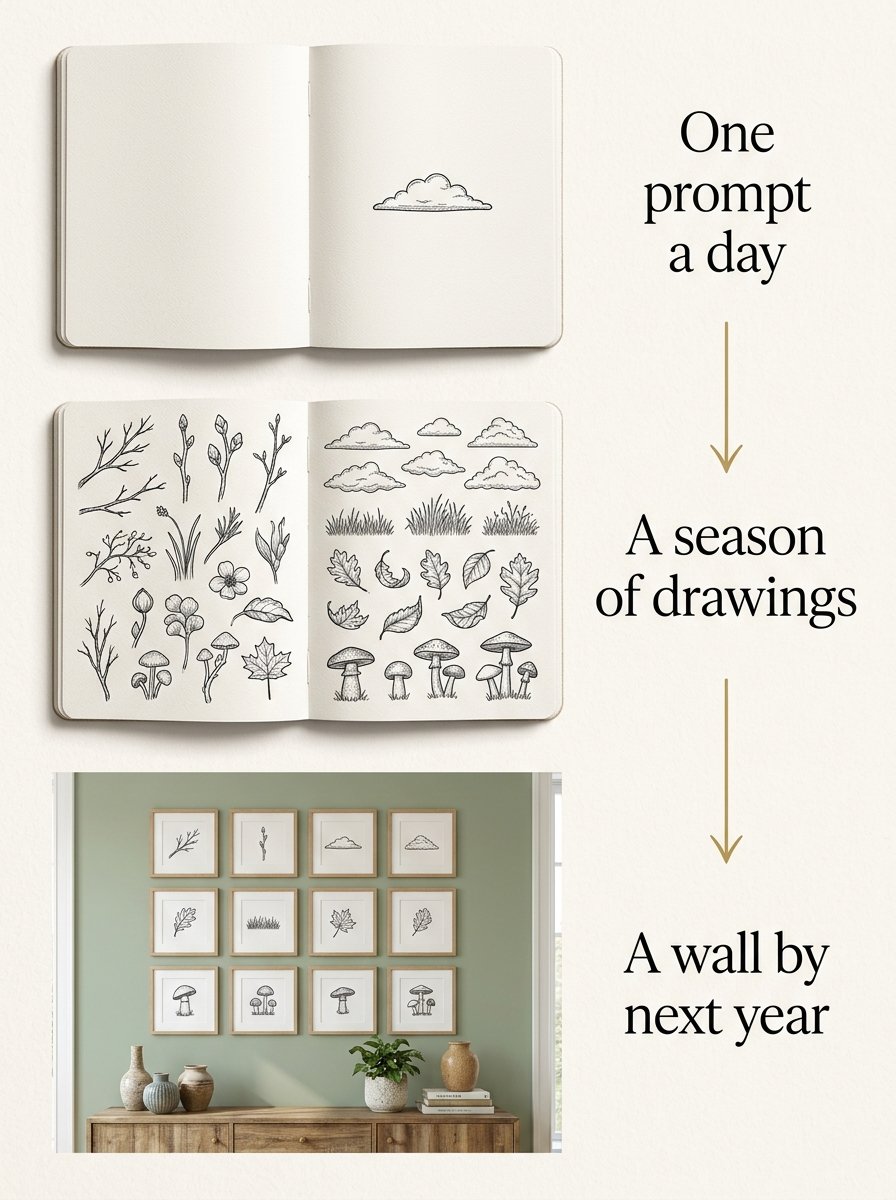
Try it for a season. One prompt a day. A season of drawings. A wall by next year, if you want one.
 Save
SaveThis week, try: a cloud, drawn from the flat bottom up. Then the same cloud 10 minutes later. Then a thunder cloud, tall with a flat top.
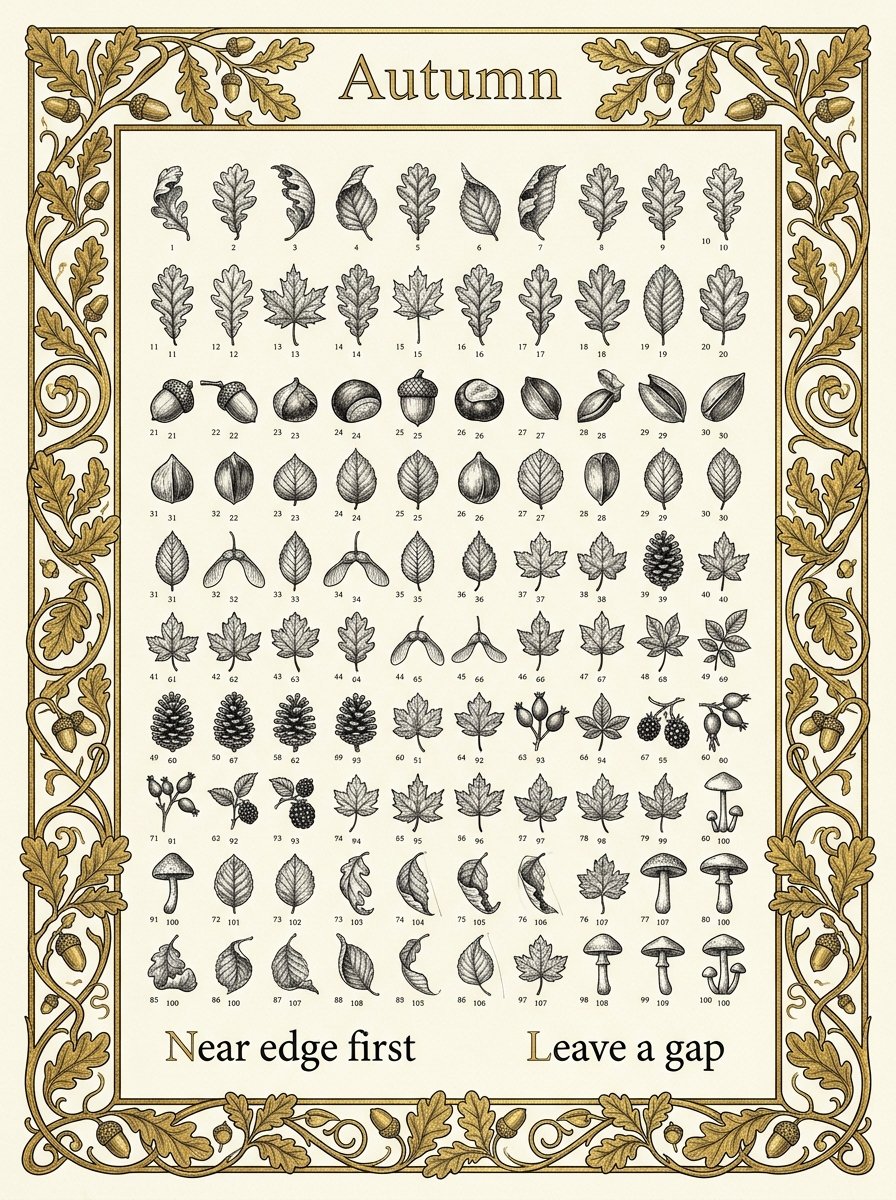
Autumn drawing prompts for adults: draw the near edge of a curled leaf first
An autumn leaf curls as it dries. Part of the leaf now hides behind another part. This is where most leaf drawings go wrong.
Draw the edge nearest to you first, as one full line. Then draw the rest of the leaf. Where the far edge goes behind the near edge, stop the line. Leave a gap.
That gap is what makes the curl look real. A line that carries on through makes the leaf look flat and see-through.
Draw the centre vein last. Where the leaf curls, the vein curls with it. (For a week I drew the vein first. Every leaf came out as a flat fish.)
 Save
SaveThis week, try: a curled leaf, near edge first. Then a red leaf and a yellow leaf overlapping. Then a pile of leaves as overlapping shapes.
Where the far edge goes behind the near edge, stop the line.
Autumn: turn a mushroom over and draw it from underneath
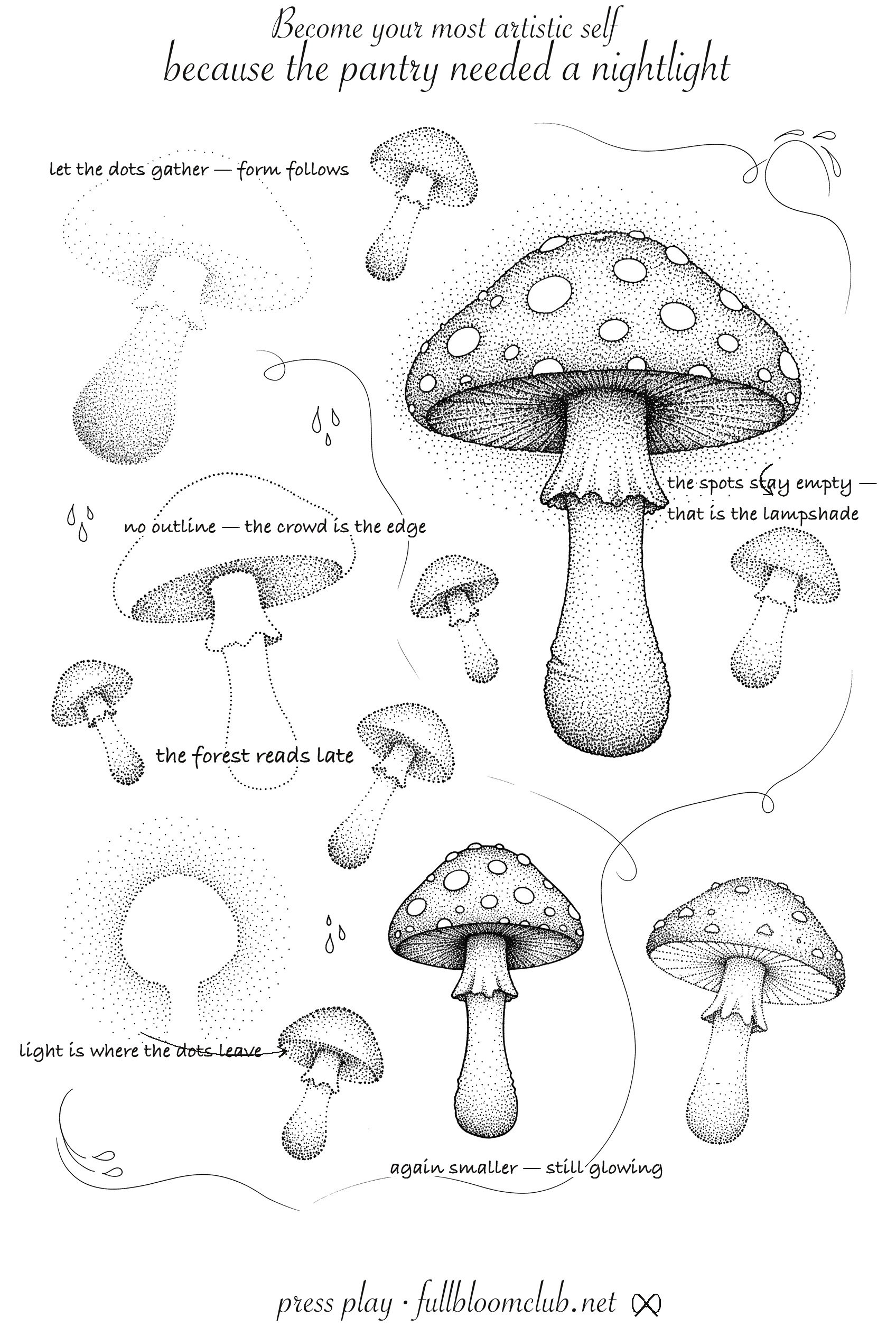
Most people draw a mushroom from the side, as a dome on a stick. Turn one over instead. Underneath, thin lines called gills run out from the stem like the spokes of a wheel.
Draw the stem as a small circle. Draw the rim of the cap as a big circle around it. Then draw the gills as straight lines from the small circle to the big one. Space them evenly, then add a shorter line between each pair.
Beatrix Potter drew fungi for years, long before her rabbit books. She learned about them from a local postman on family holidays at Dalguise.
The Armitt Museum, which holds her fungi paintings, says she made over 250 drawings of fungi. She made over 40 of mosses too.
(Shop mushrooms work perfectly well for this. Nobody checks where yours came from.)
 Save
SaveThis week, try: a mushroom from underneath, gills as spokes. Then a mushroom from the side. Then a conker in its split spiky case.
All year: use these drawing prompts for adults from today, not from 1 January
Open these drawing prompts for adults at the season you are in. Draw one prompt a day, in order or not. If you miss a day, skip it.
Keep all your drawings in one sketchbook. Leave the bad ones in. Later they show you how far your lines have come. (They are also the only proof you have. Tear them out and the book claims you were always good at this.)
Some prompts take 3 minutes. Some take 20. Both are fine.
If you would like something sillier, try these 10 quirky drawing prompts featuring animals.
 Save
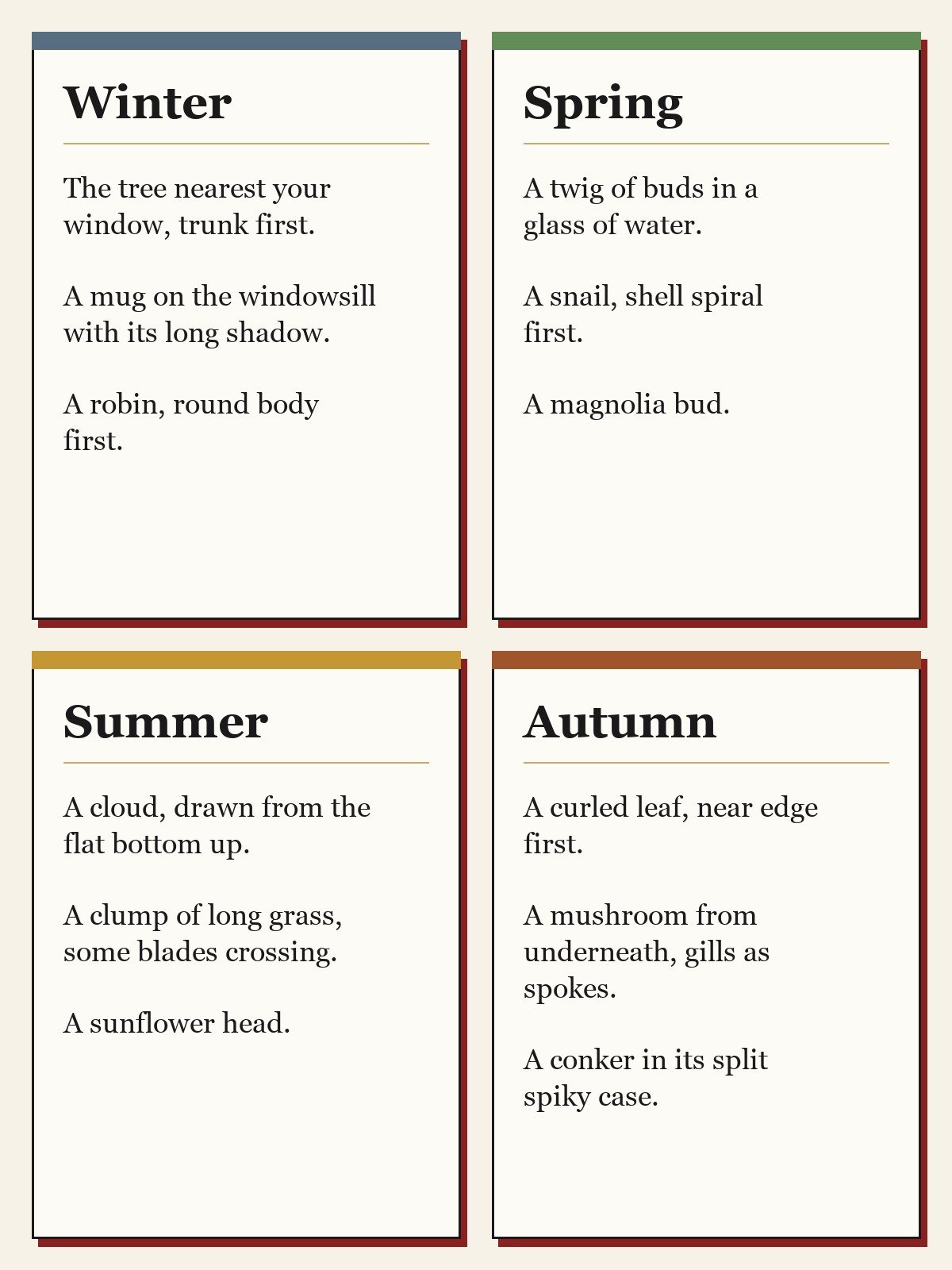
SaveThe cards above show 3 prompts from each season. The PDF has the other 353.
Some drawing prompts for adults leave a big empty shape, like a leaf, a cloud or a mushroom cap. A simple pattern is an easy way to fill it.
Free Starter Pack
Get 10 free pattern templates to fill the shapes you draw.
Sent tonight. Use them inside a leaf, a cloud or a mushroom cap.
Unsubscribe in 1 click, no hard feelings
A season goes by fast. The 365 Drawing Delight Calendar gives you a drawing for every day of the year. Each one comes with the steps and a how-to video, so no evening starts from a blank page.
A drawing for every day, each with the steps shown
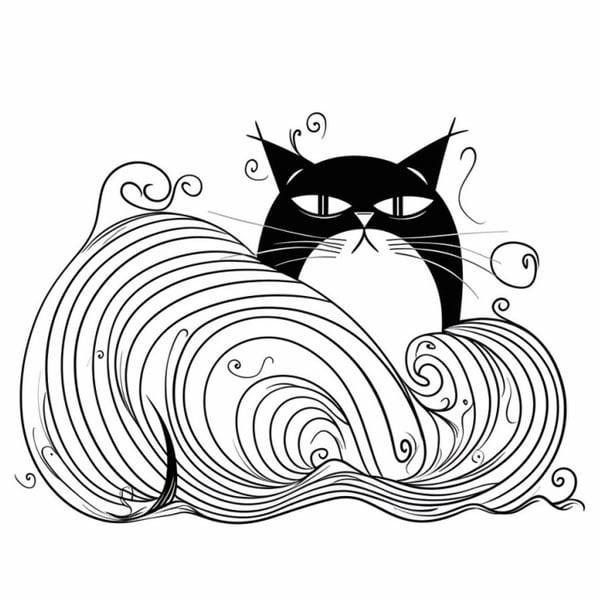
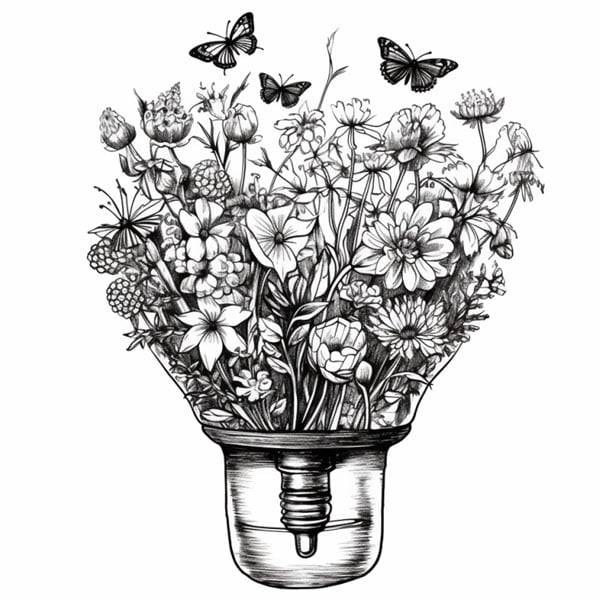
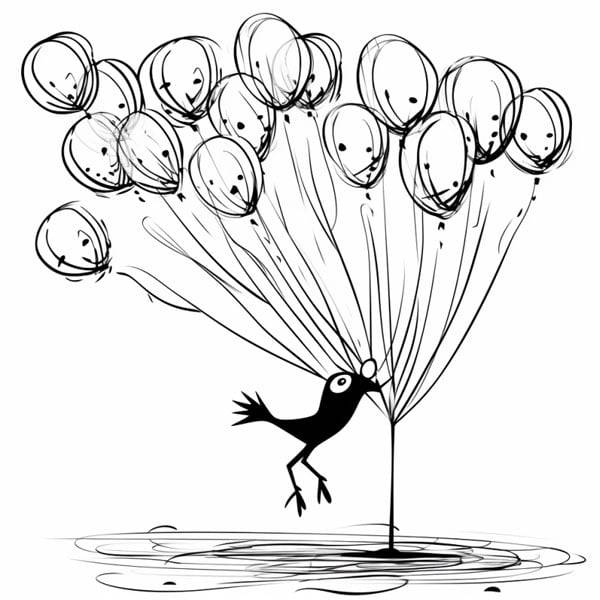
Start with today’s drawing. Follow the steps, or watch the video. Come back tomorrow for the next one. There are flowers, animals, faces and characters, each ready to print or draw freehand.
Instant download · print as often as you like
The tree outside the window changes a little every day. Someone sitting at a table with a pen is one of the few people who will notice.
“The world is wide; no two days are alike, nor even two hours.”
John Constable, in C. R. Leslie’s Memoirs, 1845
Mirabelle wrote this. No training, strong opinions, many pens. Peer reviewed by a cat who only read the winter section, from the radiator.