

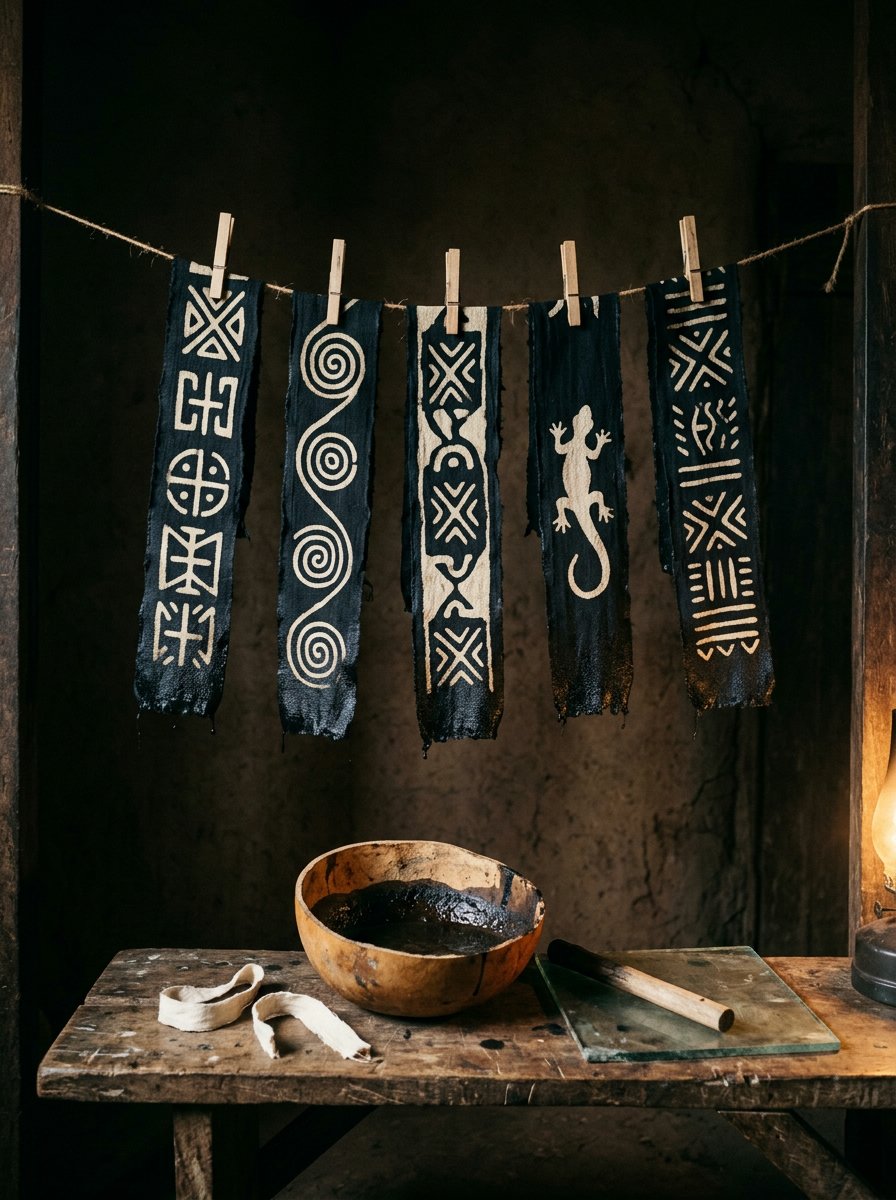
The pattern on a mud cloth is the one part the maker never touches. Mud cloth patterns and meanings run backwards, and that is the whole trick.
The maker does not paint the pattern. She paints everything around it.
The shape you are looking at is the part she never touched.
I drew these the ordinary way for a week. (My first sheet looks like a fence. It is still in a drawer.)
Below: the 4 stages of a real cloth, the names that are written down, and why the meanings argue.
Download the free symbol chart →

Print it at actual size, not fit to page. (The box will offer to shrink it. Decline.)
The chart is dark on purpose. The pale shapes are the cloth.
That is not a styling choice. It is what the object is.
Every name on it is one a museum has printed beside a real cloth.
There are 6. Not 40, and not the tidy alphabet the shopping pages offer.
Where the longer lists come from is further down. They are not quite lies.
They are guesses that hardened.
Tonight the chart does one job. It hands you a shape and the ground around it.
Ink the ground. Leave the shape. That is the method, and it takes a minute to learn.
Trusting it takes longer, which is a different problem.
The cloth is Bamana, from Mali, and its name is bogolanfini.
Bogo is earth, lan is with, fini is cloth. Cloth made with earth, which is literally the case.
Men weave it in narrow strips. Women do the dyeing.
A strip is about a hand’s width, and the strips are sewn edge to edge into one cloth.
That seam decides where a pattern is allowed to sit, and almost nobody mentions it.
I copied one of these patterns onto a birthday card once, before I knew any of that.
I outlined the shape and filled the middle in, like a colouring book.
It came out looking like a logo.
What was missing was not skill. It was the order of operations.
What a chart cannot hand you is a page of shapes already sized to sit inside a narrow strip.

The Collection
30 worksheets, and every one is a shape waiting to have its inside decided.
ZENDOODLE MASTERY. Fills, borders, and the late hours. For the evening a shape is finished and the middle is empty. Inside: 30 sheets that hand you the outline. The only decision left is what goes in it. (The empty middle stops people. It is the only interesting part.) What you get: something to do with your hands at 11pm, and a wall of pages with dark you chose.
Now the 4 stages, because the third one is where the pattern actually turns up.
Mud cloth patterns and meanings start in a yellow bath nobody sees
The first stage leaves no mark at all.
The woven cloth is soaked in a bath made from mashed n’gallama leaves.
It comes out yellow, dries in the sun, and goes back in a second time.
Nothing has been drawn yet. This step is a fixative, not a colour.
The V&A record for one of these cloths sets the sequence out plainly.
Yellow first, then mud, then a wash, then the white.
(I find this oddly reassuring. The first move in the whole craft is to make a page, not a mark.)
Your version of the leaf bath is a toned page.
Work on cream or buff paper, or lay one flat wash of pale tea colour and let it dry.
White paper fights you here, because the finished motif has to read as paler than its ground.

The mud goes on the ground, and the pattern is what she leaves alone
The mud is collected from a riverbed and fermented in a jar, sometimes for a year.
Then it is painted onto the cloth. Not onto the motif. Around it.
The mud reacts with the yellow and turns a deep brown, close to black.
Once it dries it is washed off, and the motif is still sitting there in yellow.
She is not drawing the pattern. She is drawing everything that is not the pattern.
The documented working order is smaller than you would expect.
The ground is outlined first with a stick or a fine brush.
Then the inside of that outlined ground is filled with a wider tool.
Then it is washed, and the dark areas are gone over a second time.
One pass is never black enough. That is the part I got wrong for a month.
(My early ones looked grey and apologetic, like a pattern that had heard a rumour about itself.)
On paper this is exactly the same job. Outline the ground, fill it, then go over it again.

Nakunte Diarra, 1941 to 2020, braced her cloth over half a calabash and worked without a ruler
Nakunte Diarra worked at Kolokani, in the Beledougou region of Mali.
She had been making these cloths since the 1950s, and she is the best documented maker there is.
The Cleveland Museum of Art records one small habit of hers that changes everything.
She preferred to paint with the cloth braced over half a calabash gourd.
Her younger students worked flat, on tables.
So the surface under her hand was curved, and it moved.
She also worked freehand. No rulers, no guides, no drawn grid underneath.
A curved surface under the cloth, no ruler on top of it, and the lines still arrive straight.
Her near-black came from iron-rich mud out of one particular stream near the village.
Not any mud. That stream.
Try the curve yourself before you decide it is a disadvantage.
Put a cereal bowl under your paper and ink a band around a shape.
You will work in shorter strokes, from the wrist, and the line gets livelier.
(I did this expecting a mess and got the best border I had made all month. Deeply annoying.)

Jokun Suko made a straight line in fermented mud, which takes years
Jokun Suko worked at Torokoroni, and the museum note about her is unusually blunt.
Cleveland says a straight line in this pigment takes years of apprenticeship.
Fermented mud is not ink. It drags, it pools, and it dries at its own pace.
She was also working over the rounded edge of a calabash, like Diarra.
Her cloth called Celu Ju is named for the bottom of a fishing net.
The mesh on it is all long diagonals, which are the hardest marks to keep honest.
Three photographs from 1986 show her making it, which I think about more than is reasonable.
Here is the useful part for your hand.
Rule two faint pencil lines and ink the band between them.
Do not try to hold a long straight edge freehand on your first evening.
Diarra earned that. You can borrow a pencil line and rub it out afterwards.

The white comes last, and it is painted straight onto the shape
After the wash, the motif is still yellow against a dark ground.
A caustic paste is then painted carefully over the motif alone.
It sits for about a week, gets washed out, and the yellow has turned white.
So the pale shape you admire is the last thing to happen, not the first.
(There is a whole life lesson in there and I am going to leave it where it is.)
On paper you get this stage free, because your paper is already pale.
Which means the only real question is how far out the dark has to go.
Too tight and the shape reads as an outline with a heavy edge.
Go a finger’s width out and it stops being a line and starts being a ground.
That is the moment the motif appears without you having drawn it.

Why mud cloth patterns and meanings do not agree with each other
Here is the part the shopping pages skip.
One researcher, Barbara Hoffman, collected from both women named above.
She acquired a cloth from Jokun Suko at Torokoroni in 1986.
She acquired another directly from Nakunte Diarra at Kolokani in 1988.
Two villages, two makers, two vocabularies that do not fold into one dictionary.
The museum records name concrete, local, specific things.
A Mauritanian woman’s leather head pillow. The bottom of a fishing net. A jealous man’s teeth.
The shopping pages name virtues instead. Good fortune, courage, wealth, prosperity.
Not one of the pages I read cites a source for any of it.
One states that a twirl means life and is widely understood everywhere. It gives no evidence.
The motifs are named. Named is not the same as universal, and the difference is the whole problem.
There is a scholarly book on these cloths called The Silence of the Women.
I have not read past its title, and the title is doing a great deal of work.
So I am not going to hand you a decoder ring.
I wanted one. I went looking for one. (What I found was 4 pages confidently disagreeing.)
Draw the marks because they are good marks. Use the names that are actually recorded.
Say you are not sure about the rest, which is what the people who study this say.

6 mud cloth patterns and meanings that are written down beside real cloth
These 6 are the ones I can point at an accession number for.
Koumi Diosseni Kandian is two diamonds joined by parallel lines. It is called the long-necked one, after a Bamana figure who fought the French in the Beledougou. Ink the parallel lines first. I drew the diamonds first for a fortnight and the neck kept arriving too short.
File kolo ni is the broken calabash, a bowl shape with a piece lifted out of its rim. The break is the motif, so make it obvious. A timid gap just looks like a wobble.
Mari is the crocodile, a chain of linked lozenges with a ridged back. Draw the chain as one run of joined diamonds, then add the ridge. Adding the ridge first turns it into a saw, as I can confirm.
Surakamuso Kunkoro Talan is the Mauritanian woman’s head pillow, and Cleveland associates it with wealth. It is a banded rectangle with rounded ends. The bands want to be even, so mark the middle one before the rest.
Celu Ju is the bottom of the net, a diagonal mesh. Rule one direction across the whole shape, then the other. Working it square by square is how you get a net nobody could catch anything in.
Ce cele da ro nyi is the jealous man’s teeth, two rows of triangles facing each other across a gap. The gap is the point. (Mine met in the middle the first time, which reads less like jealousy and more like a zip.)
A seventh name, Turusina, sits on that same Cleveland cloth. I left it off the chart. I could not source its sense well enough to print it. A cloth the Met holds was commissioned in 1969. Its maker was Gneli Traoré, who has a whole monograph to herself.

Are mud cloth patterns and meanings always the same?
No, and that is the honest answer rather than a hedge.
The mark families repeat, because the tools and the strips repeat.
Diagonals, bands, dot grids, toothed rows and linked diamonds turn up everywhere.
The names attached to them move between regions, families and individual makers.
(I would love to tell you otherwise. It would have made the chart much longer.)
Where should the seam go in your version?
Down the page, and you should decide before you ink anything.
Rule two vertical lines about a hand’s width apart and treat that as one strip.
A motif lives inside a strip. It stops politely at the edge.
When a pattern crosses a seam on the real cloth, the join interrupts it, and it reads as damage.
So design in columns, not across a whole page.
I keep a strip ruled on a scrap and test every new shape inside it first.
Free Starter Pack
A dark ground needs something inside the shape: get 10 free pattern templates.
Sent tonight. Fills that hold up next to a solid dark ground, for the shape you just cleared a space around.
Unsubscribe in 1 click, no hard feelings
Those fills are what goes inside a shape once its ground is holding the edge for you.
30 outlines already drawn, so the ground is the only thing left to decide


Pick one tonight and ink the ground instead of the shape. Each sheet hands you a finished outline and an empty middle. Fill around it, go over the dark twice, and stop. I still reach for these when I want to draw and not to invent.
Instant download · print as often as you like
A cloth like this spends its whole making under somebody’s hand. The pattern turns up at the end, once the dark has finished arriving around it. Nothing on the page is in a hurry. Neither is the shape you are leaving alone.
“To create a straight line with this fickle, fermented mud pigment requires years of apprenticeship and practice.”
The Cleveland Museum of Art, on Jokun Suko
Mirabelle wrote this. No training, strong opinions, many pens. Peer reviewed by a cat who sat on the dark half and left it lighter.