In 1007 somebody broke into the stone church at Kells at night and stole the gospel book. The annals of the time call it the chief relic of the western world. They did not take it for the pictures. They took it for the cover, which was gold and set with jewels. Nobody, then or since, has been able to work out how to draw Celtic knots by looking at one.
It turned up two months and twenty nights later, buried under a sod. The cover was gone and has never been seen since. The pages were fine.
The thieves took the only part of it that had a price. What they left behind is the knotwork, and it is the reason anybody queues to see that book today.
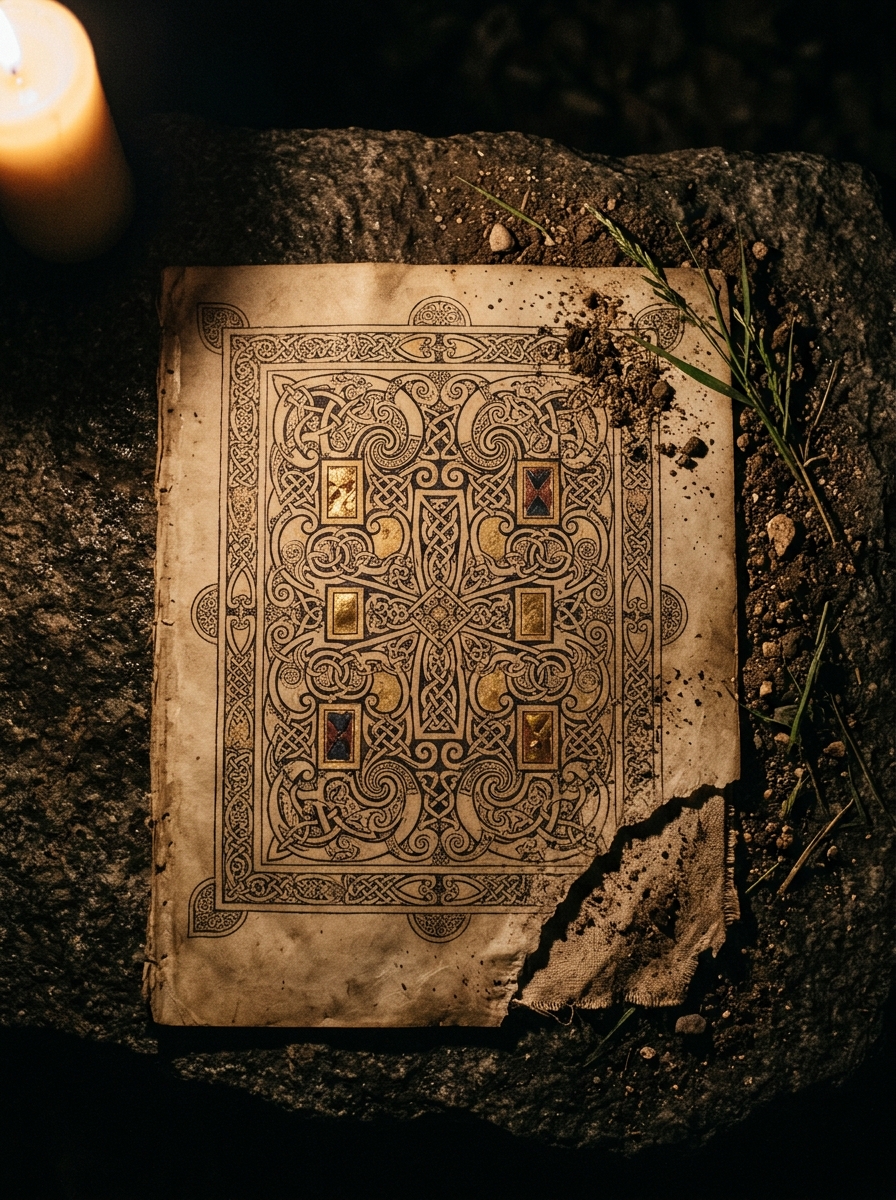
The gold went. This is what they left in the ground.
Here is the strange part. Nobody ever wrote down what the knots meant. No key, no glossary, no monk explaining himself. Every meaning you can look up now — the motherhood knot, the love knot, the Dara knot — was invented in the twentieth century. The genuinely old ones arrived with no instructions at all.
So what we actually know about a Celtic knot is what it does. Take any one of them and try to find where the line starts. You cannot. It goes over, under, over, and comes back to itself having been nowhere, and there is no first stroke anywhere in it.
That is what is going on your kitchen table tonight. And nobody looking at it will be able to work out where you began either.
So here is how to draw Celtic knots, and the first thing to know is that you are not going to draw a single curve. Not one. Every curve you can see in a Celtic knot is a corner where a straight line bounced, and the line only ever travels at 45 degrees.
What you draw is dots, then a few short bars saying where the line is forbidden to go. The knot is what is left over.
For 700 years nobody could work out how it was done.
A Welsh churchman went to Kildare in the 12th century, looked at a gospel book for a long time, and concluded that no human hand had been near it. An angel had done it. That verdict has been quoted as praise ever since.
The official explanation was an angel. The actual explanation was a ruler.
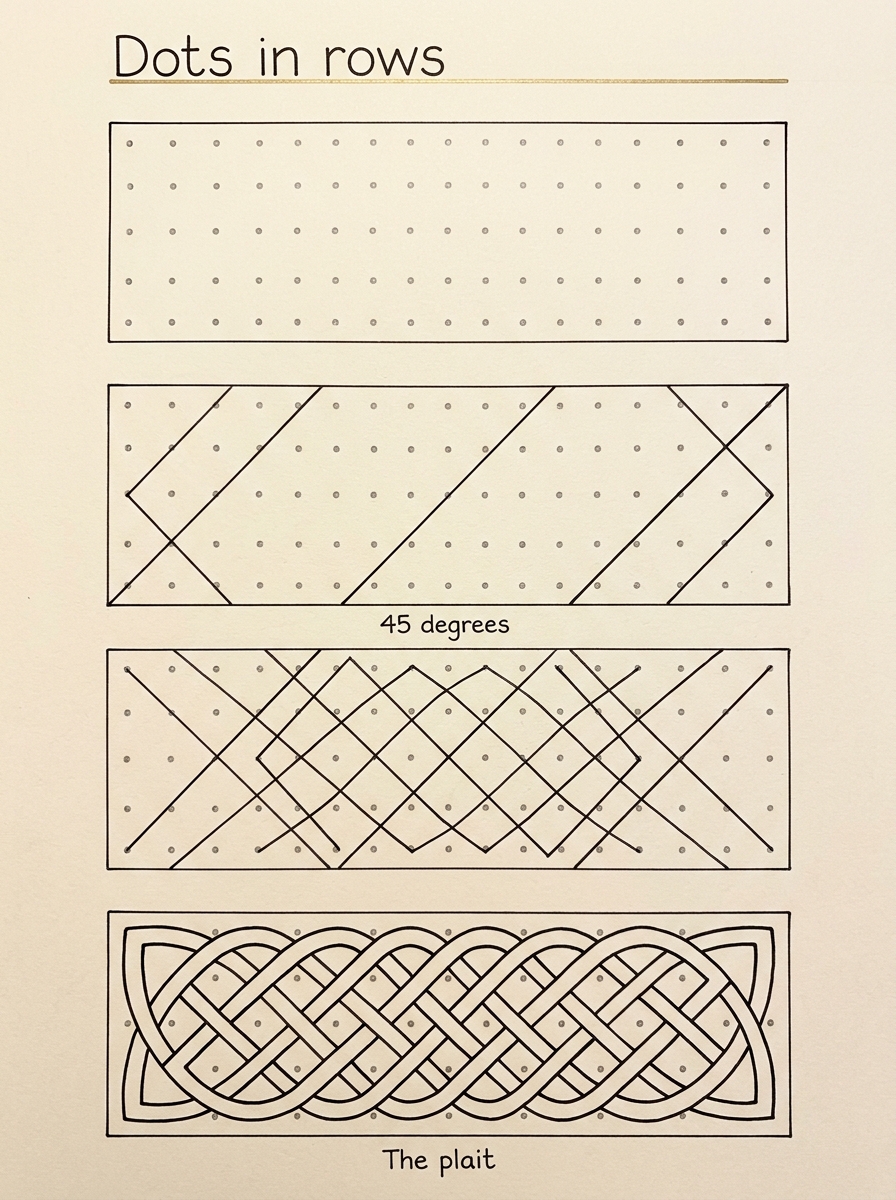
Dots, then diagonals, then the weave. Nothing on this page was drawn as a curve.
The surrender held until somebody sat down and counted
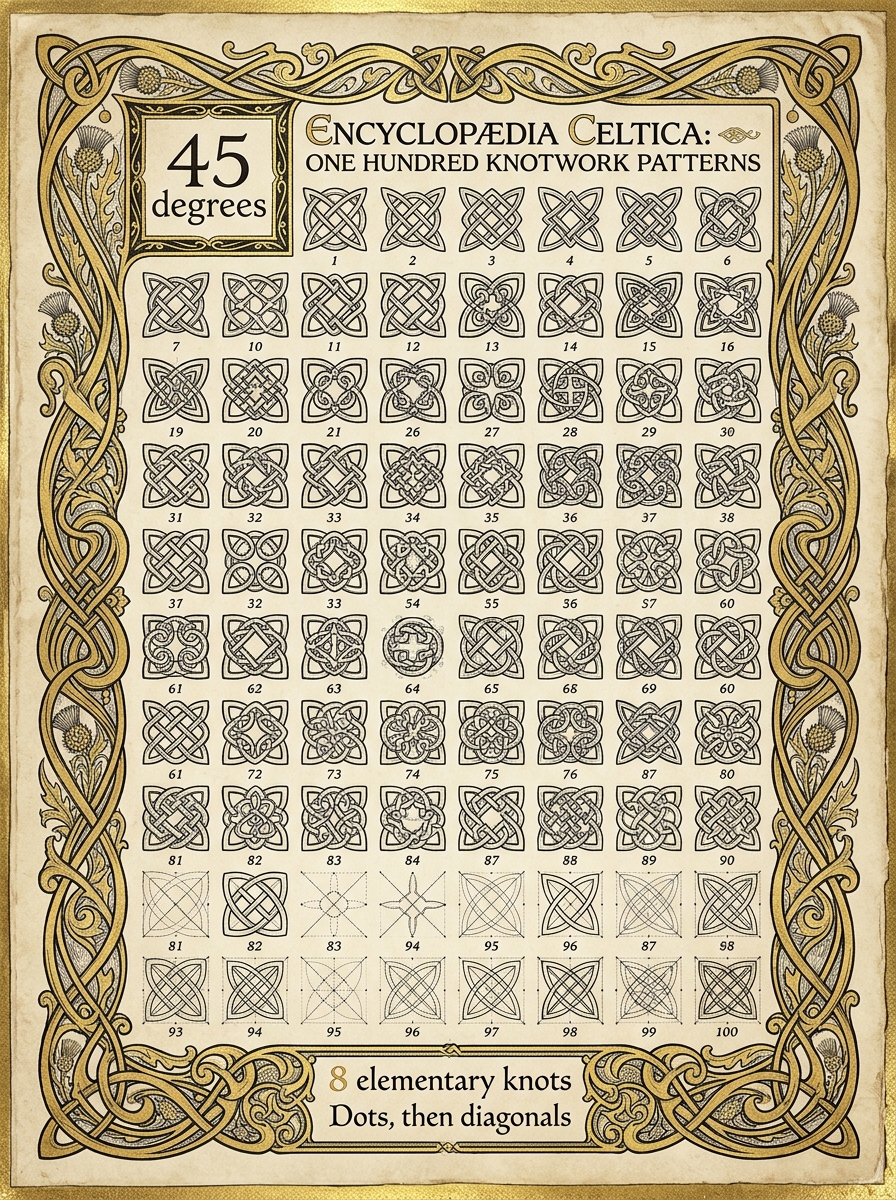
In 1904 J. Romilly Allen — an antiquary who had spent 20 years crawling over Pictish stones with a notebook — published Celtic Art in Pagan and Christian Times and reported something nobody wanted to hear about angels. There were, he wrote, 8 elementary knots which form the basis of nearly all the interlaced patterns in Celtic decorative art.
Eight. Not eight hundred.
The carpet pages, the stone crosses, the metalwork, the whole visual language of a civilisation, running on 8 shapes and a great deal of nerve.
(Allen also established that the pattern was not Irish to start with. The broken plait arrives from northern Italy and southern Gaul, and the oldest true knotwork on record sits in a 7th-century gospel fragment at Durham. Ireland took it and has declined to give it back.)
Allen proved there was a system. He did not print the instructions, which is either scholarly restraint or the single most annoying decision in the history of this craft.
Notice what happened next, because it is the useful part. Nobody learned to draw better.
Somebody found the scaffolding underneath, and after that the drawing was easy. Once you have seen a knot as a grid with obstacles in it, the next question arrives on its own at about 10pm: what else is secretly a grid. Circles are. Rings are. Whole pages are. And every one of them needs scaffolding you have not ruled yet.
The Collection
THE COMPLETE MANDALA CREATION TOOLKIT — compasses, radials, and 8 ways to divide a circle.
The set for the hour when the knot is finished, the house has gone quiet, and you are not remotely ready to stop. 8 master grids, from Classic Geometry to Flower of Life, plus 88 ready elements so the middle of the page is never a blank negotiation. What you get: the scaffolding that makes symmetry stop being a talent, and a stack of pieces that look like they took considerably longer than they did.
Back to the dots, because they take under a minute to rule and that turns out to matter more than anything else in this article.
The man who sat down with a ruler, 47 years later
George Bain was an art teacher from Caithness. He sat down in front of the Book of Kells, the Lindisfarne Gospels and the Pictish stones and reverse-engineered the grid the monks had been building on.
He published it in 1951 as Celtic Art: The Methods of Construction and it landed to near silence. It was reissued in 1971 and that time it took. Same book, same grids, unchanged.
He was 20 years early, which in publishing is difficult to tell apart from being wrong. The second time round it taught a whole generation to do by Thursday what had looked like the work of centuries.
What he found is embarrassingly small. Dots in rows. A rectangle round them. Diagonals only. Every crossing alternates over, under, over, under. That is the complete grammar, and it was cut into stone by people who were not improvising.
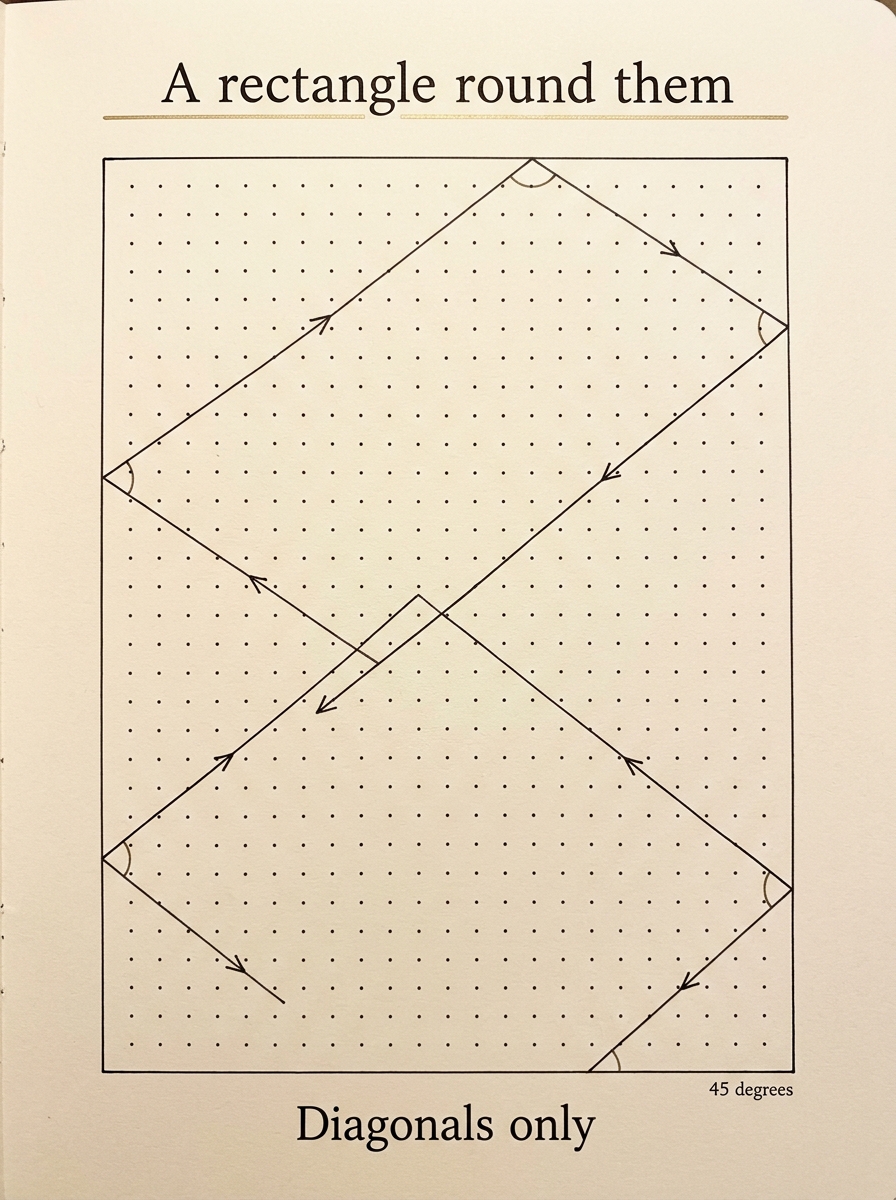
The line leaves the wall at the same angle it arrived. That is the only geometry in the article.
What he found, in the order it makes sense
Draw the diagonals both ways across the whole grid and let them bounce off the outer wall. You now have a plait — an endless woven band, going nowhere, repeating forever, and mildly hypnotic.
The plait is not a knot yet. It is the raw material, and it is the reason one evening is enough. From here you do not learn 8 new patterns. You learn 8 places to put a wall.
A wall is a short bar dropped between two dots. The line cannot cross it, so it bounces early, and everything downstream reorganises into something that looks nothing like its neighbour.
Move the bar one dot to the left and you have a different knot.
That is how a manuscript page carries 40 patterns without repeating itself. Nobody was inventing 40 things. Somebody was moving one bar around. (Which is roughly how I now feel about every recipe I own, and about most of my wardrobe.)
Nobody was memorising patterns. They were placing obstacles, and the obstacle is the design.
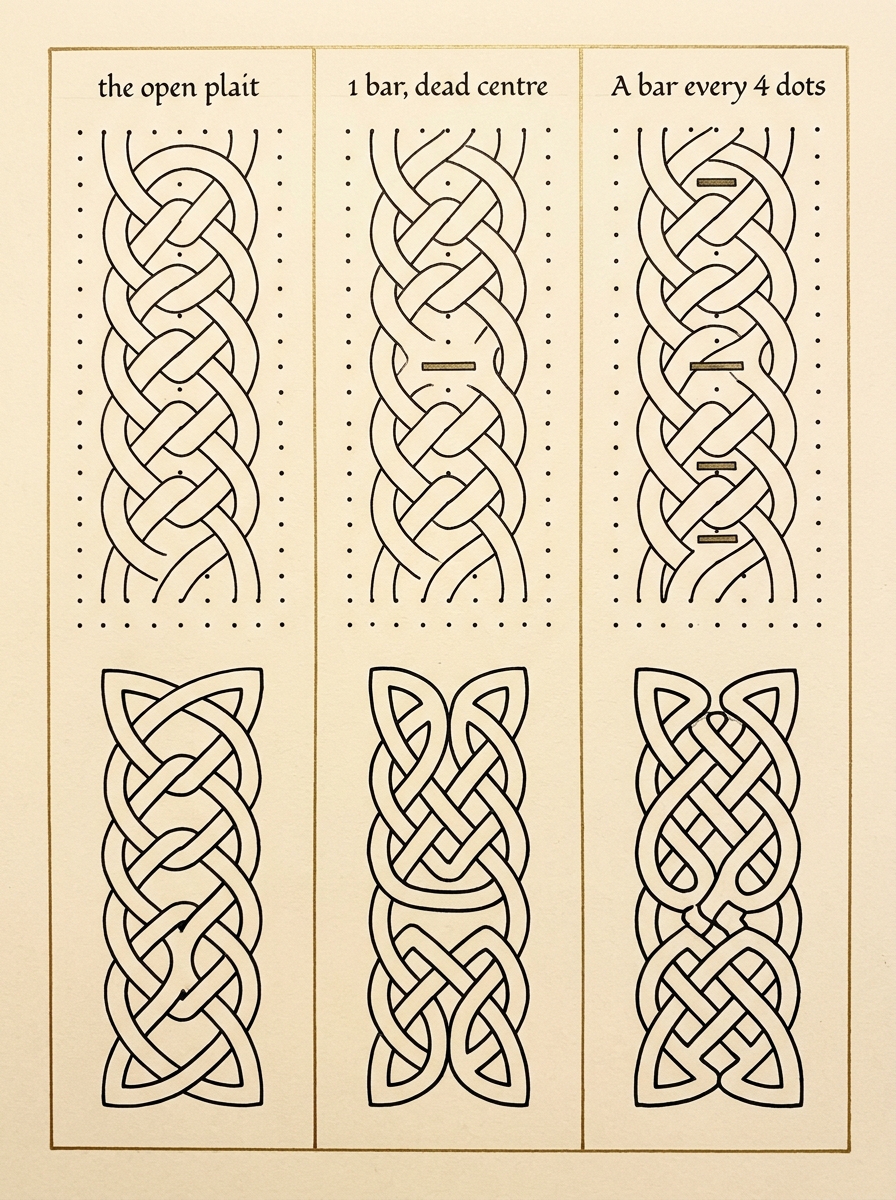
Same plait, three times. The only thing that changed is where the bar sits.
The part that is genuinely, provably exact
Here is the modern receipt Bain never got to see.
In 1999 Andrew Glassner, a computer graphics researcher, ran a three-part series on Celtic knotwork in IEEE Computer Graphics and Applications. He described it as a visual language following mathematically precise rules of construction. Precise enough to write down as an algorithm and hand to a machine.
So it took a computer scientist to settle what a Welshman refused to believe in 1188. Not an angel. Arithmetic.
That is worth holding onto at the moment your hand starts shaking over a crossing. You are not making an aesthetic judgement. There is a right answer and the grid already knows it. (Which is, I appreciate, the single most reassuring thing anybody has ever said about a piece of 8th-century religious art.)
The one rule that kills it, and what I do about it
Every crossing alternates. Over, under, over, under, no exceptions anywhere on the page.
Get one wrong and the knot dies. Not visibly — that is the cruel part. Nothing looks broken. The eye simply slides off it and nobody can tell you why, including you, at midnight, holding a pen.
I ruined a 90-minute panel this way and spent a while blaming the paper.
What I do now is ink every strand that goes over first. All of them, right across the page, before a single under goes down.
The unders are then just the gaps that are left over, and the hand has nothing left to decide.
The old method was to draw each crossing as I arrived at it and hold the alternation in my head. That works beautifully for about 20 crossings and then quietly stops working, usually at the exact moment somebody in the house asks a reasonable question.
Ink every strand that goes over, first. Then the unders are not decisions, they are leftovers.
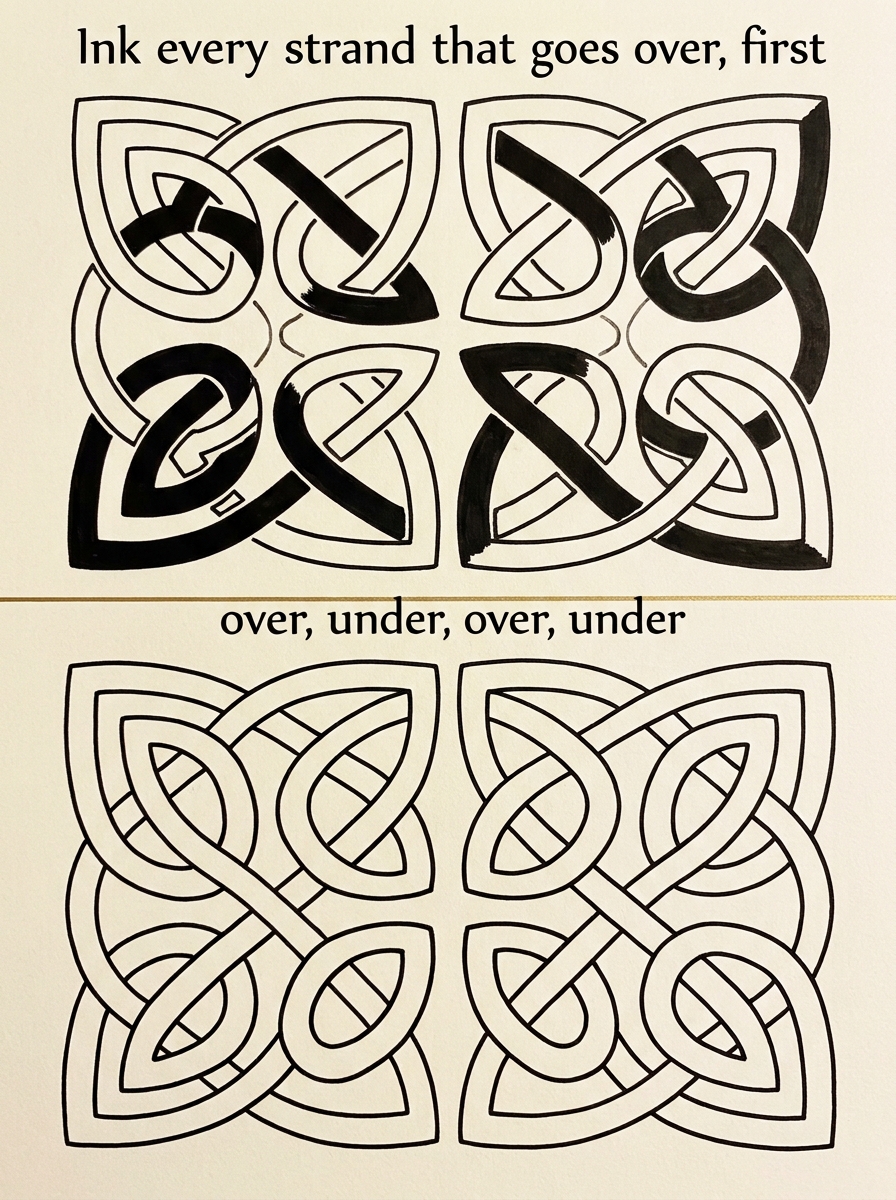
Top: every strand that goes over, inked first. Bottom: the same knot once the leftovers are filled in.
How to draw Celtic knots: 8 placements, one grid, one evening each
This is the payoff and the only list on the page. Everything anybody needs to know about how to draw Celtic knots is in the bar placements, not in the knots themselves. These are 8 bar placements, not Allen’s 8 elementary knots — his were a scholar’s taxonomy, these are 8 evenings. Same grid every time. The dots take under a minute, which is the honest reason to start one at half past 10.
- No bar at all — the open plait. 3 rows of dots, diagonals both ways, over-under all the way along. The one to draw first and the one you will still be drawing in a year.
- One bar, dead centre — the weave splits and rejoins around it, and a plain band becomes a design with a middle.
- A bar every 4 dots — regular interruption reads as rhythm, and rhythm is what makes a border look carved rather than drawn.
- 3 bars around a triangle — the triquetra. The most recognisable knot on earth, and it is 30 dots and a steady nerve at the crossings.
- The same 3 bars, plus a ring drawn last — the circle threads through all 3 loops and changes the whole object. Drawn last, always.
- 4 bars around a square — corners bounced rather than curved. Reads as a shield and takes about 30 minutes.
- One bar exactly on the corner diagonal — this is the border turn. With the bar, the weave turns 90 degrees without breaking. Without it, it snarls, every single time, and you will convince yourself you counted wrong.
- 6 to 8 bars scattered, no two alike — the panel. The carpet-page move. This is the one that eats an entire evening while you fail to notice it happening.
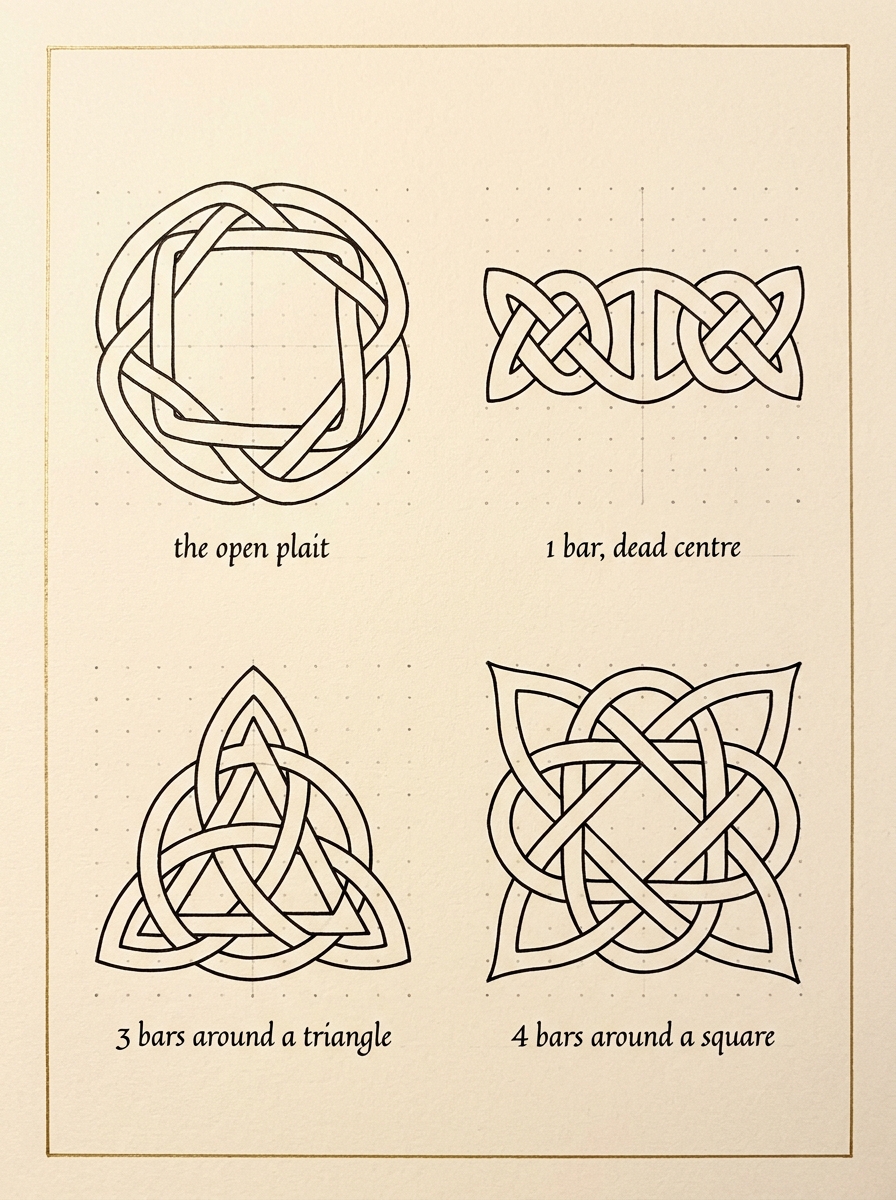
Four of the 8 placements, drawn over the grid that built them.
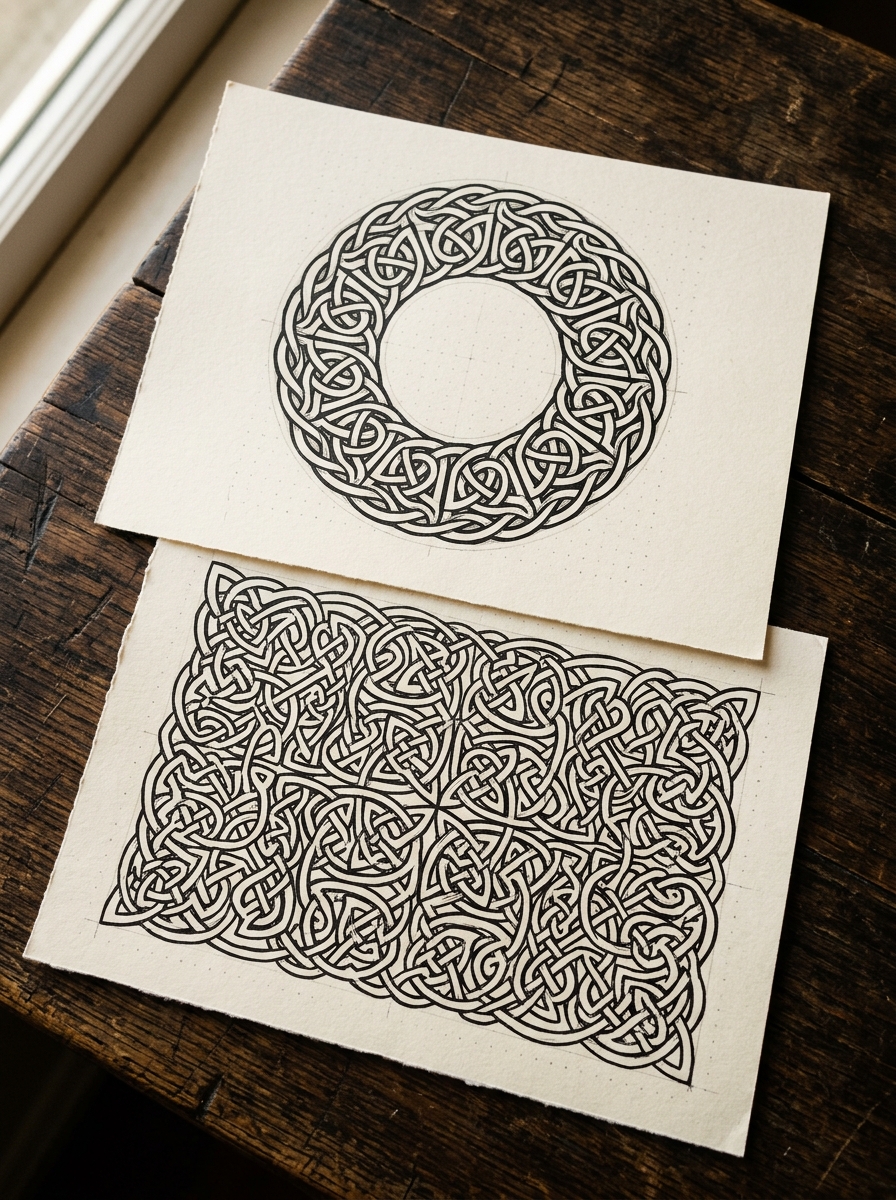
The ring and the panel. One of these is an evening. The other is an evening you do not notice.
Free Starter Pack
10 pattern templates. The fills for the spaces a knot leaves behind.
Sent tonight. Every knot encloses shapes, and every enclosed shape starts asking for something inside it.
Unsubscribe in 1 click, no hard feelings
Every placement above happens inside a rectangle, because a rectangle has four walls and the bounces are obvious.
The moment you want the same weave running around a circle, the dots have to sit on radials instead. A ring, a wheel, a border that closes on itself and hides where it started.
Ruling radials by eye at 11pm is how a good evening turns into a bad one.
8 master grids, 88 elements, every circle already divided
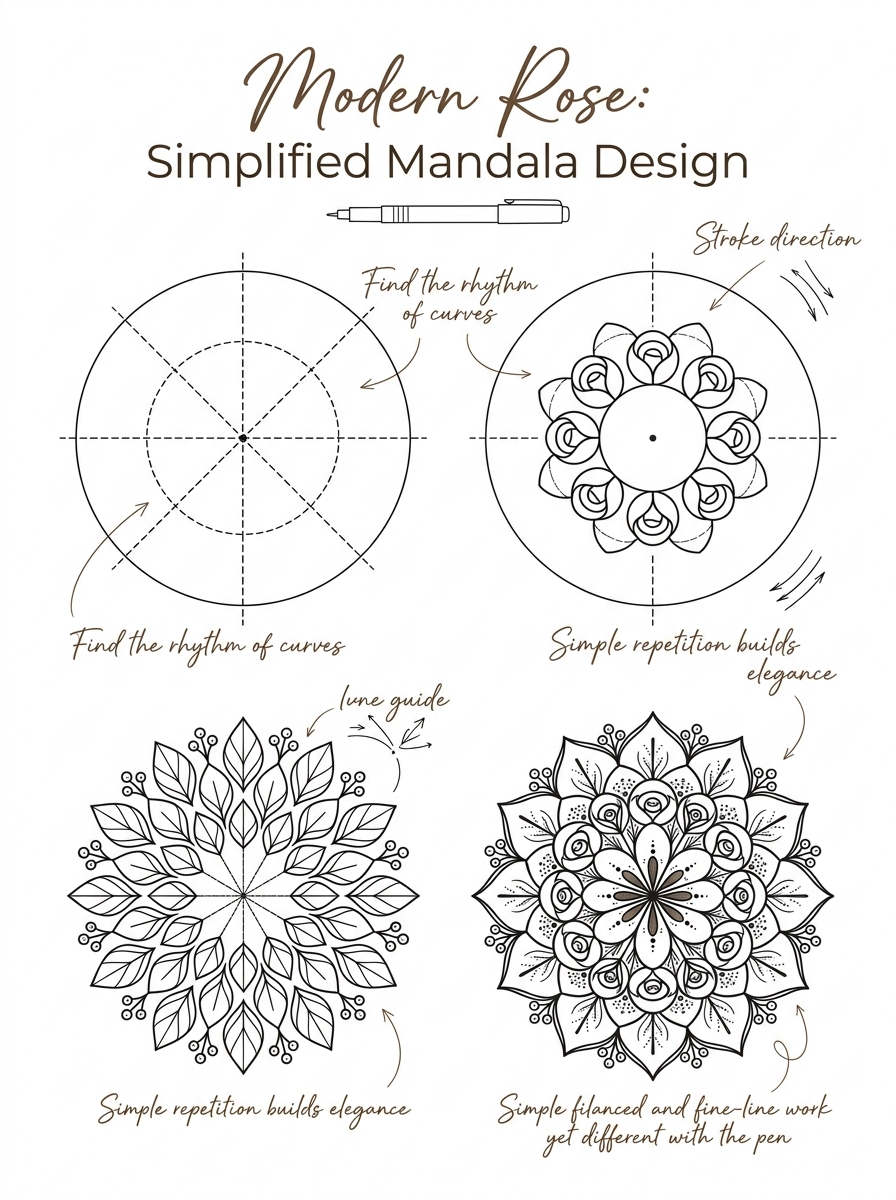
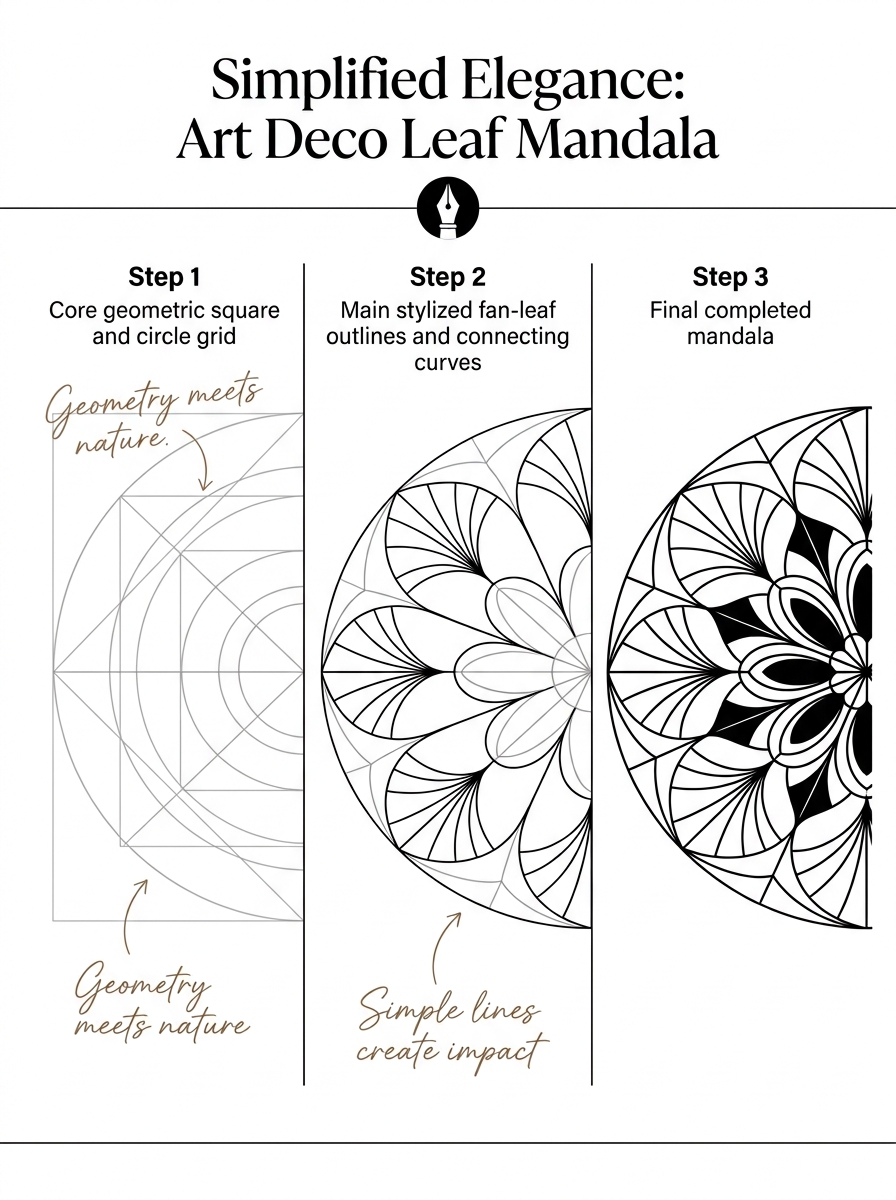
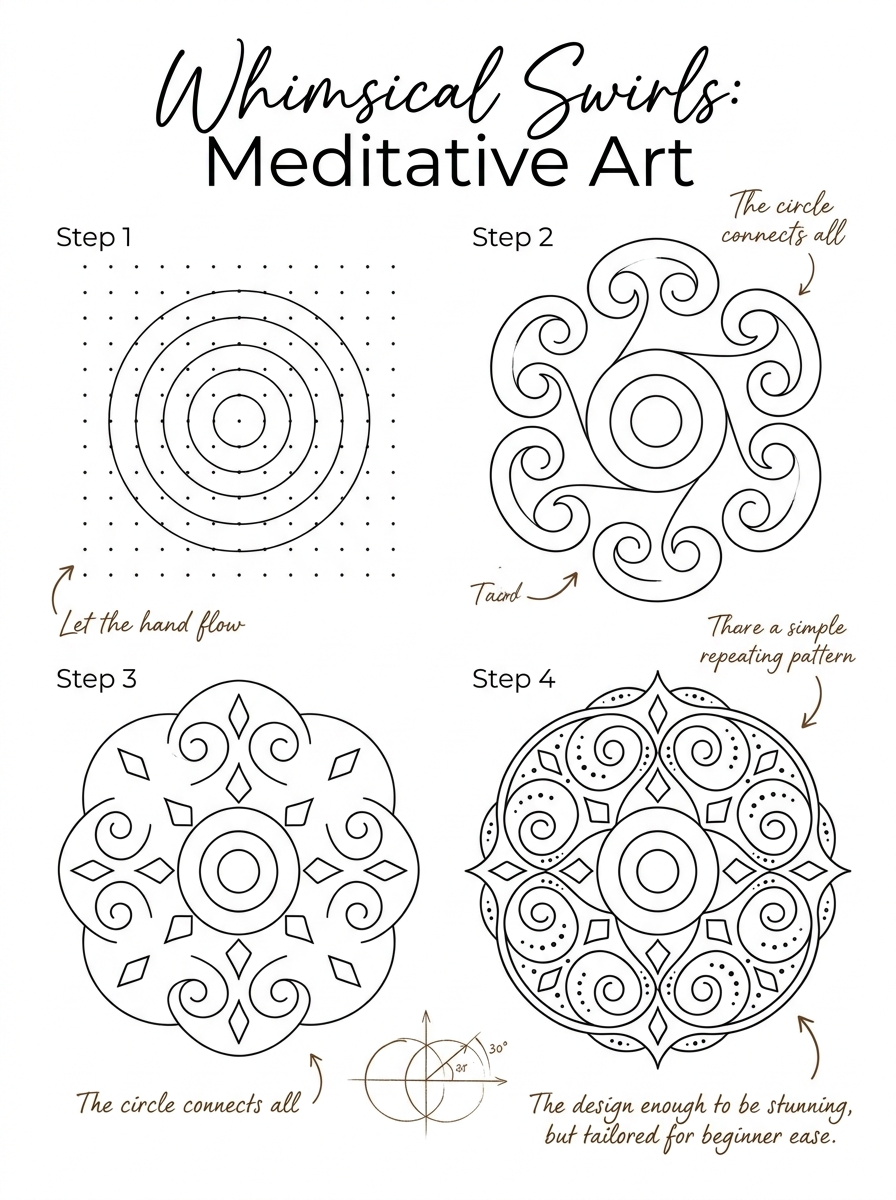
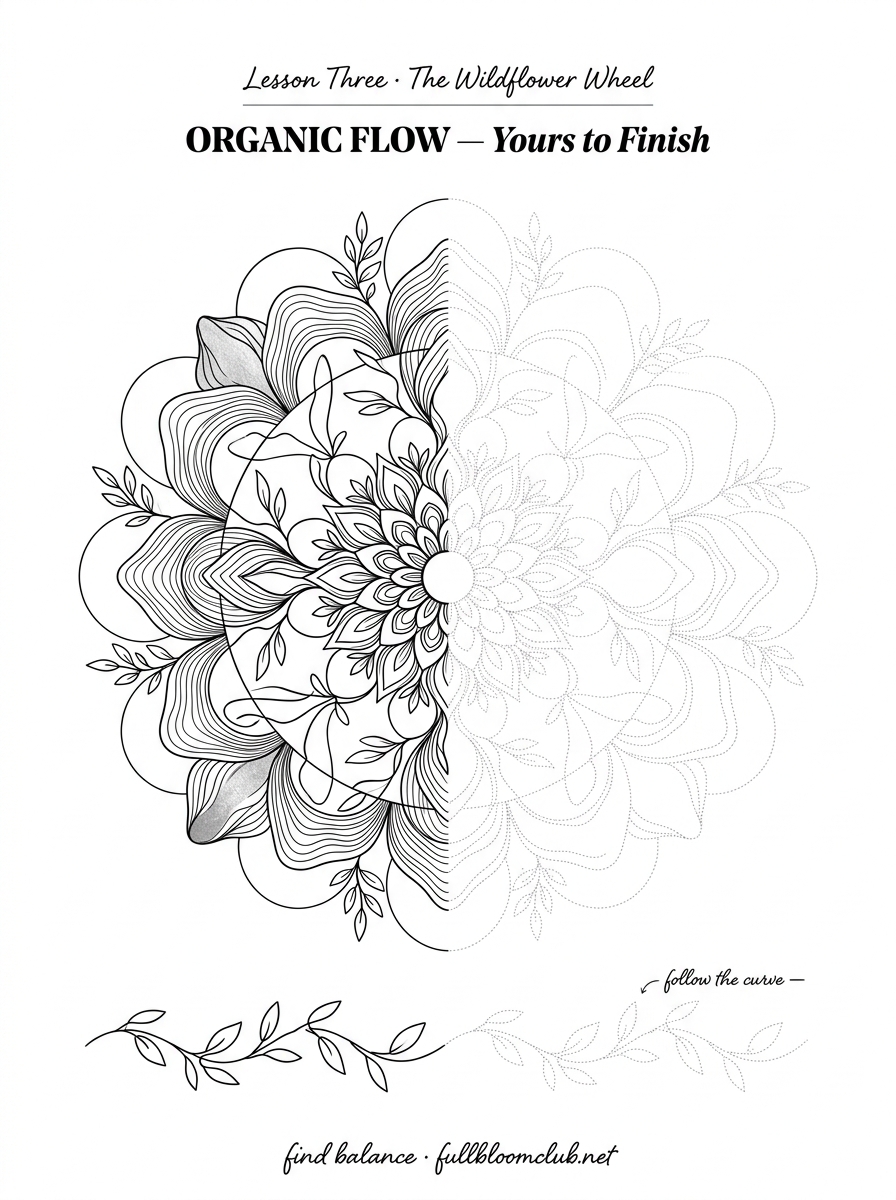
Tonight it is a band of plait down the side of one page. By the weekend it is a wheel with a knot running the whole way round it and no visible beginning. Classic Geometry, Sacred Geometry, Cube, Tribal, Flower of Life — the scaffolding under all of it, ready to print.
Instant download · print as often as you like
The line goes over, and under, and over, and comes home having been nowhere at all. An hour spent following it is not an hour lost, whatever the clock has to say about it.
“…so full of knots and links, with colours so fresh and vivid, that you might say that all this was the work of an angel, and not of a man.”
Gerald of Wales, Topographia Hibernica, 12th century
Mirabelle wrote this. No training, strong opinions, many pens. Peer reviewed by a cat who walked across the grid and considered it improved.