Draw the line first and the wash will test it. Draw it last and the wash cannot help you. Both orders are honest, and ink and watercolor for beginners is mostly choosing between them.
They are not the same picture. What decides it is not the pen. It is what the ink is made of.
Some inks glue themselves down into the paper fibres. Some only sit on top.
Around the 1100s a craftsman writing as Theophilus set down a recipe for the first kind. Thorn bark, cut in April, steeped for days, boiled down, then a little iron stirred in at the desk.
Below: what your ink is made of, how long it needs, and which order costs you what. The free sheet is one small cottage, drawn in the order that never bleeds.
Download the free crisp cottage sheet → Save
One question, asked before you start: is this line glued down, or only resting there?
Set the print box to 100 per cent, which some printers call actual size. (Yours will want to shave a little off. Do not let it.) The sheet is a notebook page: one cottage, with 5 steps taped round it.
Step one is a scrap, crossed at once, at a minute, and much later. Then the cottage goes down in that order, and the red pencil shows the 3 ways a line goes grey.
The rule in the box is the oldest one in ink: very dry before you cross it. I keep mine taped inside the cupboard door, because that is where I actually look.
The sheet gives you one cottage and the order to draw it in. After the cottage, at 9pm, the missing part is never the chemistry. It is the next shape.

The Collection
33 wash sheets with the order already decided, and each one names what goes down first.
MODERN WATERCOLOR. Geodes, horizons, terrazzo and one gradient that behaves. For the evening you want the wash decided before the pen goes near it. Inside: 33 sheets, each printing its colour strip and the order its panels go down. (Every one says what happens wet and what waits.) What you get: an evening that does not run on luck, and lines still sharp inside the mount.
Now the orders, from the line that does not survive to the line nothing can touch.
If the ink is only resting on the paper, the wash lifts it straight off
Carbon ink is soot and water held together with gum. The gum softens when it gets wet again. So the line does not move. It re-dissolves, and the brush carries it sideways.
That grey cloud beside your line is your line. It has simply relocated.
You can check this in 10 seconds. Nothing is at risk. Draw a short stroke on a scrap. Wait a minute. Pull a wet brush across it.
If the water goes grey, the ink is water-soluble. Nothing you do later changes that. (I spent a winter blaming my paper. The paper was blameless and quite expensive.)
A shellac binder behaves differently. It hardens as it dries and stops taking water back. That is what the word waterproof is doing on a bottle. It describes the binder, not the black.
Pigment and dye behave differently too. A dye is dissolved. Water can always take a dissolved thing back into solution.
A pigment is solid particles, held in place by the binder. Once the binder sets, those particles are trapped and the wash slides over them. So the question is never the colour. It is what is holding it down.

Two lines can look identical and belong to different families. The test is never how black it looks. It is what happens the second time it gets wet.
If the ink has bitten into the paper, no wash can get it back
Theophilus is not making a black liquid. He is making a chemical reaction and posting it forward.
Cut the thorn wood in April, before it leafs. Bundle it in shade for two to four weeks. Beat the bark off with wooden mallets. Steep it in water for 8 days. Boil it down to a third.
Dry the concentrate in sewn bags in the sun. Then, at the desk, temper a lump with wine and a little iron. The tannin in the bark and the iron find each other on the paper.
What forms is not sitting on the surface. It is locked into the fibre. This is why medieval pages can be washed and the writing stays.
He also has a fix for a weak batch, and it is my favourite instruction in any manual. Take a piece the thickness of a finger, heat it until it glows, and drop it back in.
(No explanation. No measurements. Just make it angrier.)
An ink that bites cannot be corrected. So you draw the line once, and you draw it where you mean it.

Half of that shape has been crossed by water. Half has not. Look at the crossing, not the colour. The edge either held its shape or it spread.
Ink and watercolor for beginners goes wrong in the waiting, not the painting
In 1607 Henry Peacham published a beginner’s manual on drawing with the pen and colouring in water. He is 400 years early to the exact problem. He says it in one clause. Let your first strokes be very dry, he writes, for fear of blotting, ere you cross them. (His 1607 text is online, spelling and all.)
Very dry. Not nearly. That gap is where most first attempts are lost. An ink line looks finished long before it is finished.
The surface goes matte and the binder underneath is still soft. Cross it then and you do not get a blot. You get a line that has quietly thickened.
(I have watched a perfectly good stem put on weight under a wash and had nowhere to send the complaint.)

How long is not a number I can hand you, because it belongs to your ink and your room. Which is why step one on the sheet is a scrap. Run it once and you own the number for good.
On a cold evening, give it longer than feels reasonable. Ink is slower when the room is.
There is a physical reason the broad line is the slow one. A nib lays a bead of ink that sits proud of the paper. The top of that bead skins over first. Under it the ink is still wet.
A wash arriving then does not meet a line. It meets a lid with wet ink beneath it. (That is the exact moment my stem gained weight.)
If the line goes down first, it has to be finished before the water arrives
Francis Towne drew the same argument twice, in opposite orders, four years apart. On a Swiss sheet dated 2 September 1781 he works faint graphite first. Then pen in black ink. Then grey wash across the finished line. (The catalogue record reads the layers back in that order.)
The line is complete before any water touches it. Everything the drawing says, it has already said. The wash only adds weather.
That order is the confident one, and it has one cost. You cannot change your mind.
Draw everything you want before you wet anything. Then stop. The temptation afterwards is to go back in with the pen and tidy something.
Do not. A fresh line on damp colour spreads in a way no later line will match. (Mine always looks like it arrived from a different drawing, because it did.)

Read the crossings along that line and the choice stops being a matter of taste. It is a matter of what you are willing to risk.
If the wash goes down first, ink and watercolor for beginners gets easier, not harder
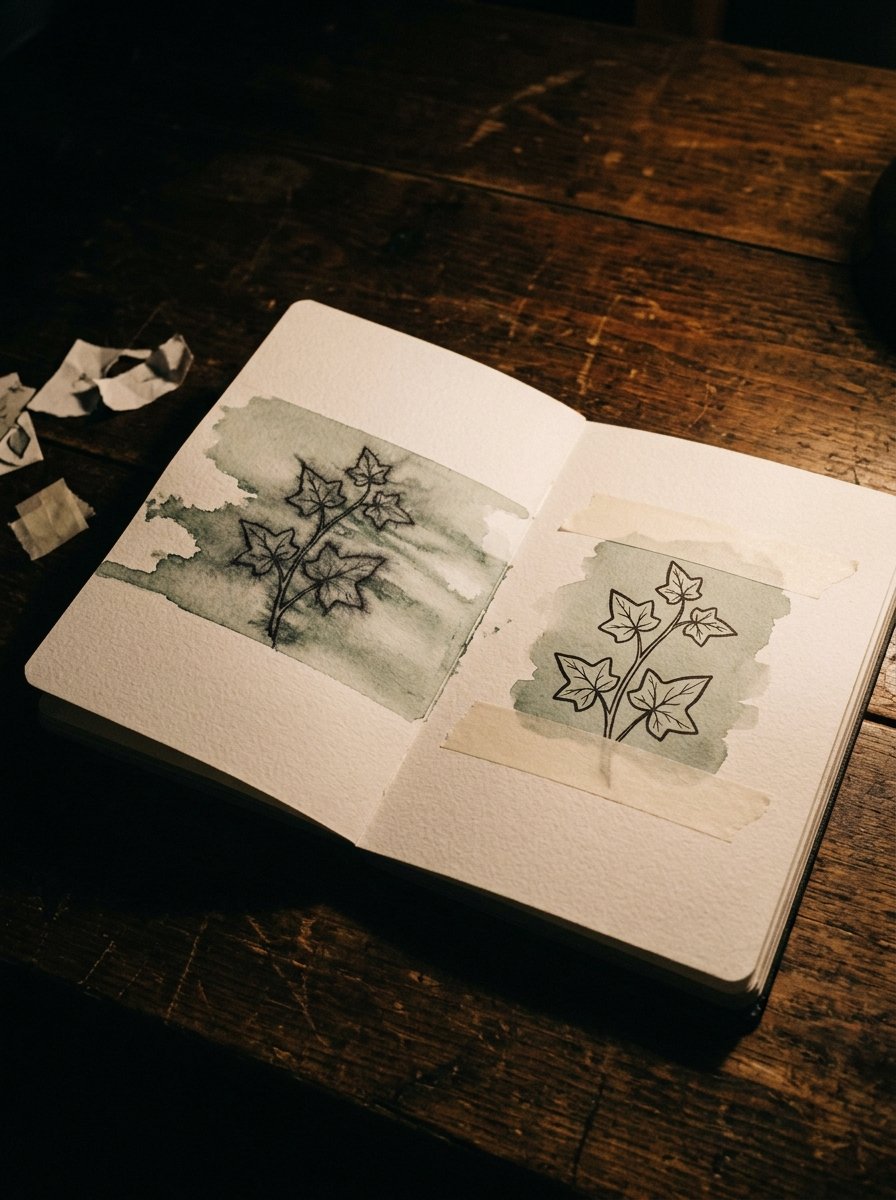
The 1785 Rome sheet is the same hand, built in reverse. Watercolour over graphite first. Then brown ink drawn on top of the dry colour.
Nothing is at risk. The line lands on a surface that has stopped moving. This is the order I would give anyone starting, and it is not the beginner’s version. It is a working order.
Edward Dayes wrote the sequence out in 1805. Finish the outline, then sky, then distance, then middle ground, then foreground. Thin passes, so each can be gone over once or twice afterwards.
His warning is the useful half. Take great caution not to disturb the shadows with colour, he says, or the harmony of the whole is destroyed.
Disturb is the right word. The fault is never the colour you chose. It is dragging it across something not ready. He also insists the outline is done by hand and never with a ruler, or it looks stiff and mechanical.

Read it as a grid and the argument gets simple. Down one side, what the ink is made of. Along the top, how long you waited. Only one row is safe in every column, and it is the row that bit into the paper.
Paper decides part of this as well. Sizing is the coating that stops paper drinking. Heavily sized paper holds ink up on the surface. Soft, absorbent paper pulls it down into the fibre fast.
So the same pen is safe sooner on cheap paper and later on good hard paper. (Which is the one occasion the expensive sheet is working against you.)
If you own one pen, ink and watercolor for beginners still works
Peacham kept 20 or 30 cut quills on the desk at once. Ravens’ quills for fine shadow lines, goose for the bigger and ruder ones.
For a soft broad stroke he cut a broom stalk to the thickness of a spoon handle. Then he chewed it until the end frayed.
(A beginner’s manual whose first instruction is to bite your tools. I think about that more than is reasonable.)
The point underneath the chewing is real. A broad mark and a fine mark are different tools, not different pressures.
A fine steel nib lays almost no ink, so it dries fastest and survives a wash soonest. A broad nib puts down a bead that sits proud of the paper. It needs much longer, and it is the one that thickens.
A frayed stalk gives you a soft edge that a wash blurs further, which is sometimes exactly right. So the order of work follows the nib. Fine lines can be crossed sooner. Broad lines wait.

If you own one pen, use it for everything and learn its single number. Range is a luxury. Knowing your own ink is the thing that actually shows, which is also the whole argument of the line drawing guide for beginners.
A broad line that spreads becomes a shape, and a shape reads as a mistake.
The nib also decides how much spread the line can afford. A fine line that spreads a little still reads as a line. So broad marks want the longest wait of anything on the page.

That is a finished small piece, pinned up, with the line still doing the work. Nothing on it was rescued. It was drawn in the right order and then left alone.
Free Starter Pack
Get 10 free pattern templates for filling a shape once the line is safe.
Sent tonight. Fills for the flat areas, once your line has stopped moving.
Unsubscribe in 1 click, no hard feelings
Those fills sit on dry paper and stay where you put them. Which is the whole of the dry half of this, done small.
If you do one thing before the next wash, make it the scrap
Every sheet in this article is a version of one habit. Test on an offcut first. Not a careful test. A torn corner, the same pen, the same paper, the same room.
Draw three short strokes. Cross the first at once, the second after a minute, the third much later.
You now know your ink, your paper and tonight’s air. It costs one corner. Write the pen on the scrap, not the date.
A date tells you nothing you can act on. The pen and the minute repeat. I have a corner from two winters ago that still governs how I work.
(I own a shoebox of these. My cat sits on the dry ones, which is her contribution to the method.)

Keep the good ones. A scrap that shows you the exact minute your line became safe is worth more than a finished piece. It is the only page in the house that has never lied to me.
33 sheets that name the order before you commit a line


Pick one and read its panels before the pen is uncapped. Each sheet gives the colour strip, which parts go down wet, and where the drawn line belongs. Draw it once in the order printed. Then draw it again and swap the order on purpose. The second one teaches you more.
Open the Modern Watercolor Collection →
Instant download · print as often as you like
A line that has set is a small promise the paper agrees to keep. Water can arrive whenever it likes after that, and it will find nothing left to argue with.
“Let your first strokes be very dry, ere you cross them.”
Henry Peacham, The Art of Drawing with the Pen, 1607
Mirabelle wrote this. No training, strong opinions, many pens. Peer reviewed by a cat who sat on the dry half and declared the experiment over.