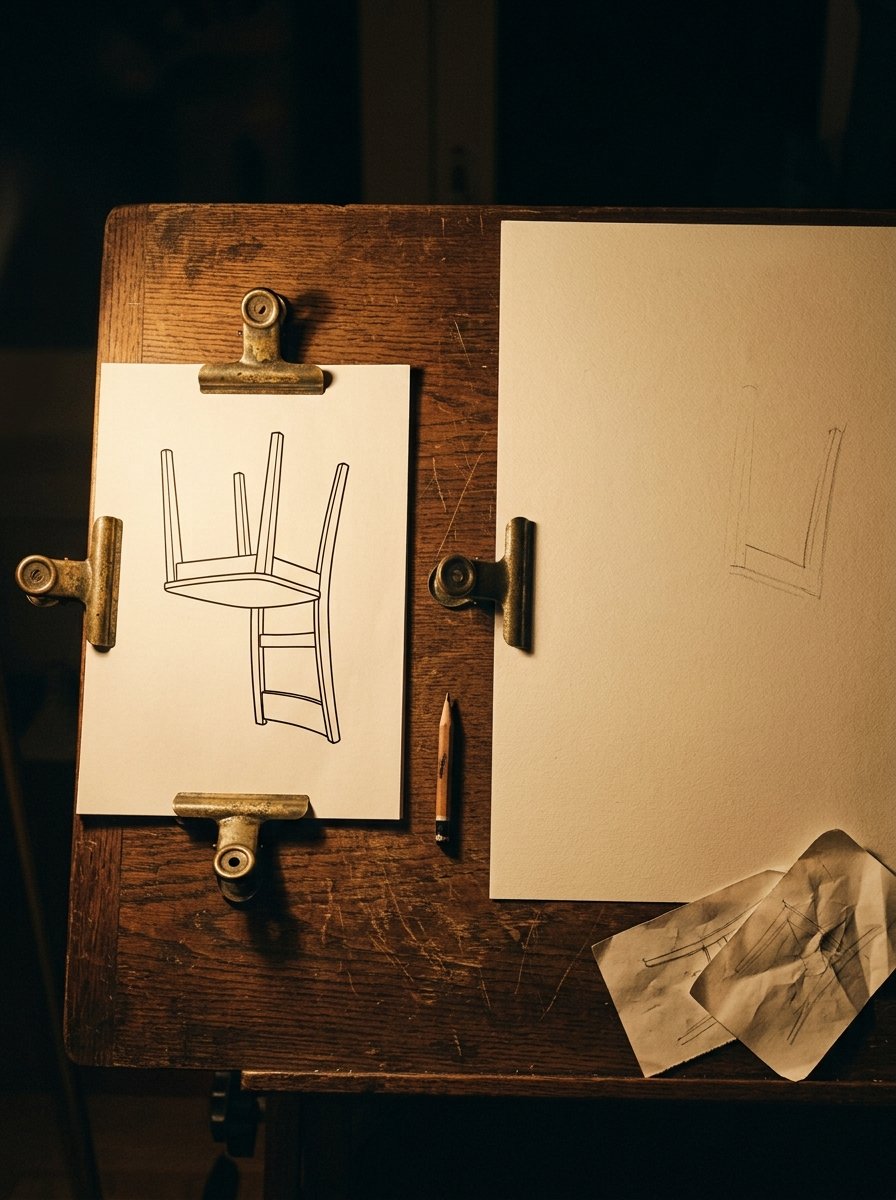
I have been staring at an upside-down photograph for 20 minutes and I still could not tell you what it is. Drawing on the right side of the brain exercises all rest on that one trick.
Almost everyone has heard of it. Almost nobody runs it properly.
The usual version goes like this. Turn it over, copy it, turn it back, feel pleased.
That version teaches nothing at all. The turning back is the part that undoes it.
The exercise only works if you never learn what you are drawing until you have stopped.
(I ran the tidy version for about a year. I still have the drawings. They are fine and they taught me nothing.)
Below: which picture to pick, where the pen goes first, and what to do when you recognise it.
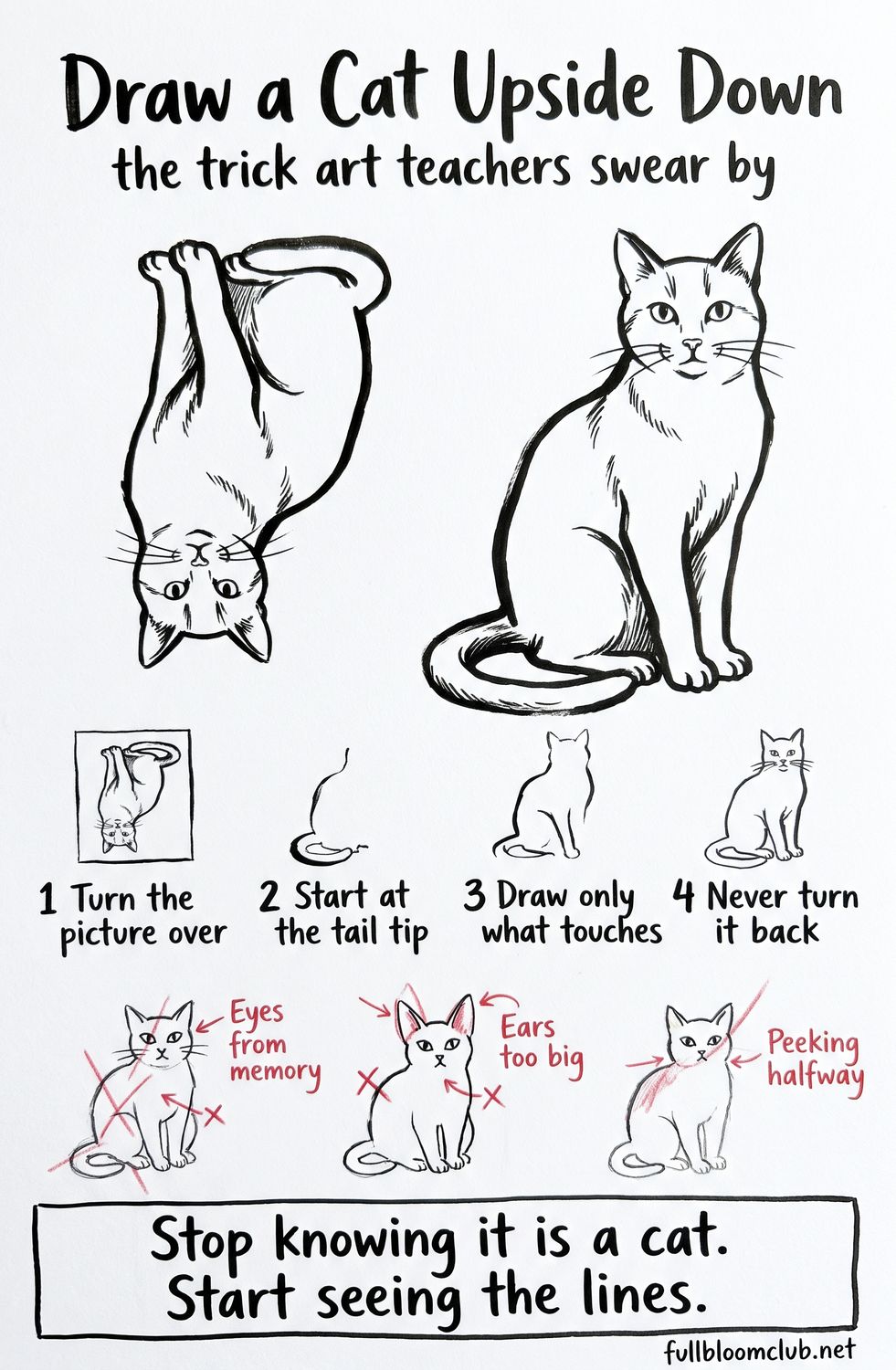
The upside-down cat sheet is first.
Download the free upside-down cat sheet →

Print it at actual size, not fit to page. (The printer will lobby hard for fit to page. Decline.)
One cat, printed upside down for you, with the finished cat beside it so you know where you are going.
4 steps, in the order your hand needs them: turn it over, start at the tail tip, draw only what touches, never turn it back.
Cats are the best subject for this, because your head has a cat on file and it is always wrong.
In red pencil, the 3 mistakes nearly everyone makes: eyes drawn from memory, ears too big, and peeking halfway.
Use pencil, and rub nothing out until the entire shape is down.
Copy it the same size as the printed cat. Scaling is a separate skill, and it has nothing to do with tonight.
Then try the same trick on anything with joints: a chair, a teapot, a ladder.
(My first upside-down cat took 40 minutes. I could not tell you where they went. The real cat watched all 40.)
A sheet can print a picture upside down for you. What it cannot do is hand you a fresh shape every evening, already built in stages. That starts to matter once the cat is done.

The Collection
100 pieces, and each one printed twice, once solid and once as a ghost.
THE 100 COLLECTION. Chairs, cranes, ladders, folded hands. For the evening you would rather copy something properly than invent it. Inside: 100 finished pieces, a faint twin of each, and the build behind it. (I reach for the faint twin on evenings my hand will not settle. It has never once objected.) What you get: one shape done tonight, and the same shape tomorrow with nothing underneath it.
So the rest of this is the sitting itself, in the order it actually goes wrong.
What drawing on the right side of the brain exercises are actually training
Your hand is not the problem. Your hand is extremely good.
The problem is that you name things, and naming is faster than looking.
You glance at a shape, your head says “ear”, and your hand draws the ear it has on file.
That stored ear is a symbol. It is roughly 9 years old and nobody has updated it.
Turn the picture over and the ear stops being an ear. It becomes a curve with a notch in it.
Your hand has no stored version of a curve with a notch in it. So it draws what is there.

The name of all this points at a theory about brain hemispheres. That theory is disputed, and you can cheerfully ignore it.
What is not disputed is what happens to your hand once the shape stops having a name.
(I find this genuinely funny. The fix for drawing badly is to stop knowing what you are drawing.)
Choose a picture you cannot name at a glance
Most people pick a picture they love. That is the first ambush, and it is a kind one.
A face you know is the hardest possible start. You will recognise it within a minute.
Pick a line drawing rather than a photograph. Ink gives you edges to follow.
Pick something with joints and angles. A chair, a bicycle, a pair of scissors, a folded hand.
Avoid anything symmetrical. Symmetry lets you guess the second half, and guessing is the habit we are removing.
Turning away from your subject to see it better is an old idea. There was once a gadget for it.
An 18th-century walker carried a Claude glass: a small mirror, slightly convex, tinted a dark colour.
You held it up and turned your back on the view. The scene appeared in the glass, reversed and darkened.
It worked by “reducing and simplifying the colour and tonal range of scenes and scenery”. That is a polite way of saying it threw away the detail you would have fussed over.
Thomas West’s guide to the Lakes, in 1778, is blunt about the posture. “The person using it ought always to turn his back to the object that he views.”
Thomas Gray carried one around the Lake District and wrote it up in 1775. William Gilpin, who drew constantly, said the mirrors “give the object of nature a soft, mellow tinge”.
Gray was so intent on his glass that he fell backwards into a dirty lane and broke his knuckles. He got up and kept it angled to catch the sun setting.
(A man breaking his hand rather than look straight at a hill is my favourite thing here.)
The Claude glass is your upside-down picture, 250 years early. Both do one job. They stop the view being the thing you already know.
Turning your back on the view was, for 100 years, a respectable way to look at it.

Start at a corner and let the edge of the paper hold you
Now the pen. Almost everyone starts at the top, in the middle, at the biggest feature.
That is the worst place. The biggest feature is the one you can name.
Start at a corner instead. Pick the mark nearest one edge of the picture and begin there.
Then move to whatever touches it. Never jump across the page to another interesting bit.
You are drawing a chain of shared edges. Each new shape has to fit the one beside it.
That fitting is what keeps you honest. A wrong line shows up at once, because the next shape will not sit against it.
If a line runs off the edge of the picture, let it run off the edge of your box too.
(I used to close those off with a neat fourth line. It is the drawing equivalent of tidying before the cleaner arrives.)
Do not measure. The whole point is that you have removed the thing you would have measured against.

Drawing on the right side of the brain exercises break at the moment you recognise the subject
Somewhere around the middle, it will arrive. You will suddenly see that it is a hand.
This is the ambush the whole exercise exists for, and it is worth preparing for.
The instant you name it, your hand switches sources. It stops copying and starts remembering.
You will feel it as relief. Everything gets easier and faster, and the drawing quietly falls apart.
What to do: stop, put the pen down, and look at one small area only.
Cover the rest of the picture with your other hand if you have to. Shrink the world to one square inch.
Then carry on from the shape you were on, not from the thing you now know it is.
Copying exactly what appears in front of you, distortions included, is a respectable old discipline.
Around 1524 Parmigianino painted himself as he appeared in a barber’s convex mirror. He was 21.
He did not correct the bulge. He had a wooden panel prepared as a matching curve and copied the warp exactly.
In the finished picture, held in Vienna, his hand looms enormous in the foreground. His face sits small and calm behind it.
The panel is 24.4cm across. It is a perfect circle, because the mirror was.
He could have slimmed the hand. Every instinct he had must have told him to slim the hand.
(He left it. I think about that hand whenever I am tempted to improve something.)
That self-portrait is this exercise at the highest possible level. Draw the distortion. Do not fix it on the way in.
He could have slimmed the hand. He left it exactly as the glass gave it to him.

Never turn it back to check
You will want to check. The urge usually arrives about two thirds of the way through.
Do not. Turning it back is not a small break, it is the end of the sitting.
Once you have seen it the right way up, you cannot unsee it. Every remaining line comes from memory.
Put the original face down if your hand keeps reaching for it. Weigh it down with a mug.
It is worth knowing that even proper optical help does not rescue the hand. It only removes the guesswork.
In 1806 William Hyde Wollaston patented the camera lucida and gave it its name.
It is a prism on a stalk. You look through it and see the subject apparently lying on your paper.
The camera lucida gives “an optical superimposition of the subject positioned in front of the device over the surface below”. You trace the contours you can see.
So the accuracy problem was solved on paper in 1806. The hand problem was not.
One of the first days of October 1833, a man sat on the shore of Lake Como. He had one of these with him, and he was sketching.
It went badly. He wrote it up 11 years later, in the best sentence ever written about copying.
“The faithless pencil had only left traces on the paper melancholy to behold.”
That man was William Henry Fox Talbot. He was so annoyed by his own tracings that he went home and worked out photography instead.
(An entire medium invented by somebody who could not draw a lake. I find that enormously encouraging at 9pm.)
You can read the account in The Pencil of Nature, published in 1844.
The moral is narrow and useful. A device can hand you the correct outline. It cannot stop you tidying it.

The reveal, and what the wrong bits are telling you
Finish the whole thing first. Only then turn both sheets the right way up.
Something will be wrong, and it will be one specific region rather than the whole drawing.
That region is the information. It is the place your memory overrode your eye.
Almost always it is a part with a strong name attached. An eye, a hand, a wheel, a mouth.
The bits with no name usually come out well. Backgrounds, folds of cloth, the gap under a chair.
Do not fix it tonight. Write down what the wrong region was, in words, on the back.
“The eye is too big and too round” is a job. “I am bad at faces” is just weather.
(Mine is always anything paired. Two wheels, two eyes, two handles. I have made peace with it.)
Drawing on the right side of the brain exercises pay off on the second attempt
Here is the part almost nobody does, and it is where the evening finally pays.
Wait a day. Then draw the same picture again, the right way up, from the original.
You now know the shape as a set of edges rather than as a word. That knowledge survives the flip.
The second drawing usually comes out better than the upside-down one, which surprises people.
It is not because your hand improved overnight. It is because the symbol got overwritten.
You looked at a real ear for 20 minutes without calling it an ear. The stored one has been updated.
Do that with 6 subjects and the effect starts generalising. Do it with one and it does not.
(I did exactly one for the first year, then wondered why nothing transferred. It was not a mystery.)

The other exercises in the book, and what each one removes
Upside-down copying is the famous one. It is not alone, and each of the others removes a different crutch.
Pure contour drawing removes the paper. You look only at the edge of the object and never at your own line.
Your hand crawls along the edge at the speed the eye moves. The result looks peculiar and teaches the hand enormously.
The hand study removes the reference. You draw your own idle hand, held still, because it is the one complicated object always available.
Nobody has a stored symbol for their own knuckles at that angle. That is precisely why it works.
Drawing the gaps rather than the object is the other well-known one, and it has its own post here. I am not going over that ground twice.
The measuring exercises remove your sense of scale. You hold a pencil at arm’s length and compare one length against another.
They are all the same idea wearing different coats. Take away the thing you were guessing with.
(The order I would run them: upside down, then the hand, then contour. The last is the least fun and the most useful.)
Whether any of this counts as cheating is a question I have answered elsewhere, at length, and with feeling.

Half an hour, uninterrupted, is what drawing on the right side of the brain exercises are asking for
Pick your picture before you sit down. Choosing is not part of the sitting.
Turn it upside down and clip it somewhere you cannot idly flip it.
Set a timer for 30 minutes. Not as a target, just so you stop looking at the clock.
Start at a corner. Draw the shape you can see, then the one that touches it.
Do not check. Do not name it out loud. Do not rub anything out.
When the timer goes, finish the shape you are on and stop, whatever state it is in.
Now turn both sheets over together and look for the single worst region.
Name it in words on the back of the sheet, then put it away until tomorrow.
(The putting-away is the part I am worst at. It is also the part that makes the second attempt work.)
Tomorrow: the same picture, the right way up, once. That is the whole method.

Free Starter Pack
10 pattern templates, free
Fills for the shapes you have just spent an evening getting right. Sent tonight, with a starter pack.
Unsubscribe in 1 click, no hard feelings
The upside-down pass leaves you with an updated symbol and a picture you did not plan. What it does not leave you with is the next picture.
100 pictures worth turning over, and the build for every one


Turn one upside down, copy it cold, then meet it the right way up tomorrow. Every piece arrives finished, with its ghost and its order of strokes. So the second attempt has something to correct itself against. I still start my own evenings this way.
Instant download · print as often as you like
What if the upside-down copy still comes out wrong?
It will come out wrong. A copy that came out right would mean you had learned nothing.
The drawing is not the product here. The wrong region is the product.
If the whole thing is wrong rather than one part, you probably started in the middle.
Go back to a corner and build outward. The chain of shared edges is what holds the proportions together.
If it went wrong late, you recognised the subject and carried on anyway. That is the commonest failure by a distance.
(I have a drawing where the top half is careful shapes and the bottom half is a perfectly ordinary horse. I keep it on the wall.)
Nothing here needs special paper. A printed sheet, a pencil and a surface that does not wobble will do it.
A picture turned over is a set of shapes that have not been introduced to you yet. Sit with them for half an hour and get their edges right, without ever catching their names. Let the whole thing surprise you when you finally look. The paper never minds which way up it was held.
“The person using it ought always to turn his back to the object that he views.”
Thomas West · A Guide to the Lakes, 1778
Mirabelle wrote this. No training, strong opinions, many pens. Peer reviewed by a cat who studied the upside-down page and found nothing difficult about it.