A traced line always lands in the right place, which is precisely what makes it useless. Drawing worksheets for adults get judged on the traced pass, and the traced pass tells you nothing.
Lay paper over a faint guide and your line arrives exactly where it should.
So does everybody else’s. The sheet did that part.
Now turn the sheet face down and draw the same shape from nothing.
One part comes back wrong.
It is the same part every time, and it is a different part for every person.
(Mine is anything with two of something. Two loops, two rails, two wings. I have made peace with it.)
That wrong part is the only real lesson in the whole evening, and it costs nothing.
Below: 4 shapes that expose 4 different faults.
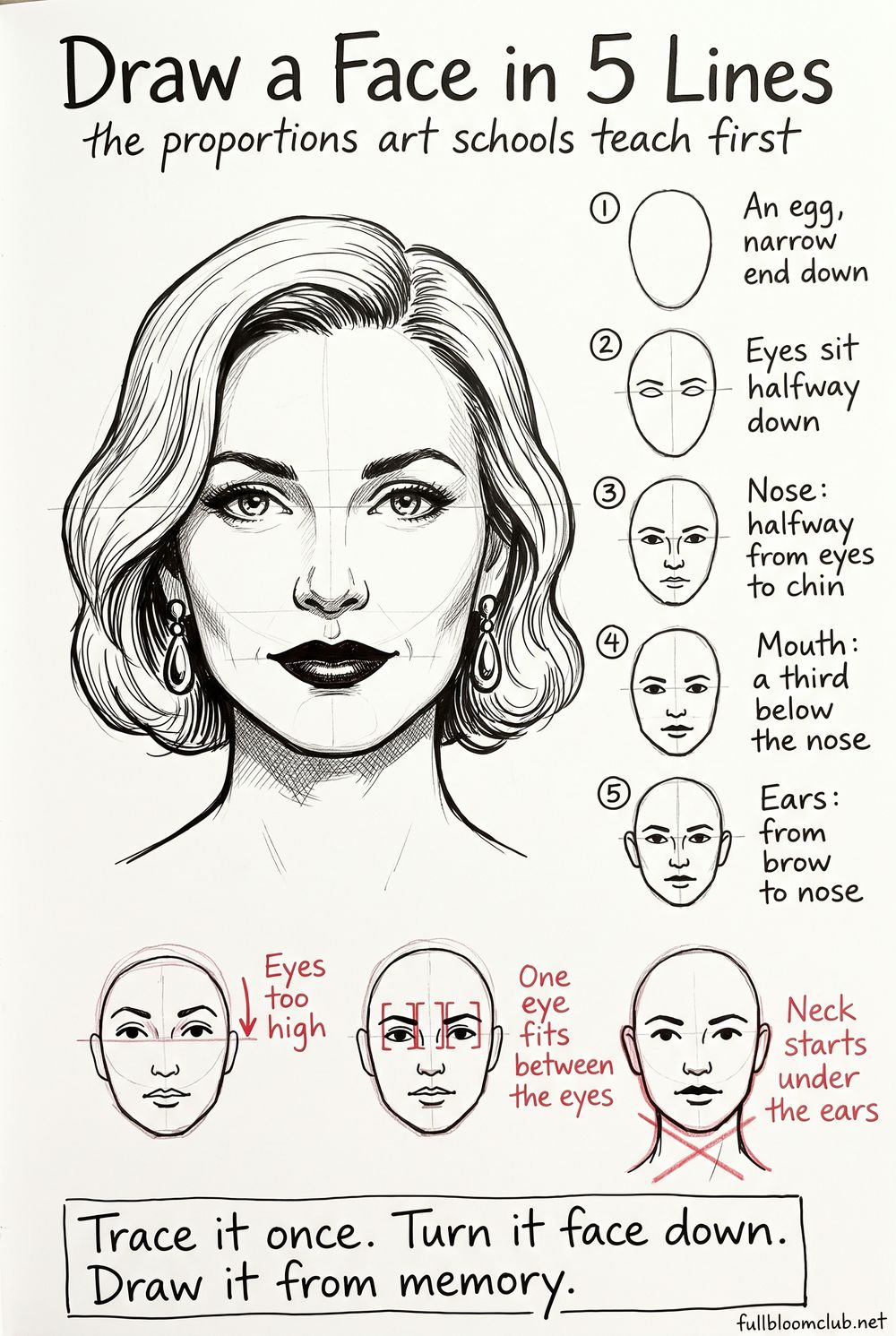
Download the free sheet: draw a face in 5 lines →

Print it at actual size rather than fit to page. (Your printer will lobby hard for fit to page. Ignore it.)
The sheet is one face built in 5 lines: an egg, eyes halfway down, the nose halfway from eyes to chin, the mouth a third below the nose, ears from brow to nose. Underneath, the 3 mistakes nearly everyone makes, marked in red: eyes too high, the wrong gap between the eyes, a neck that starts at the chin. Then the move this whole page is about: trace it once, turn it face down, draw it from memory.
Nothing about that is clever. It is just harder than it sounds.
I ran this on 4 shapes from my own shelf. I got 4 different failures, which surprised me.
I had assumed I was broadly bad at drawing in some general way.
What actually happens is much narrower and much more useful.
Each shape fails at one joint, and the joint has a name.
The naming is what makes it stick. “My rails converge” is a thing you can fix on a scrap.
“I am bad at ladders” is not. One of those is a job and the other is just weather.
A sheet can only hand you the first pass. The second pass needs a shape somebody has already built in stages. Otherwise there is nothing underneath to remember.

The Collection
100 pieces, and every one of them arrives with a faint twin of itself.
THE 100 COLLECTION. Foxes, bows, ladders, ginkgo leaves. For the evening you want to draw something and not invent it. Inside: 100 finished pieces, a faint trace of each, and a 5-step sheet behind it. (I keep the trace guides for evenings my hand is not listening. Nobody has ever been arrested for it.) What you get: one shape finished tonight, and the same shape tomorrow with nothing underneath.
So the two passes are not the same exercise wearing different hats.
Drawing worksheets for adults are two different lessons printed on one page
Drawing worksheets for adults are sold on the first pass. The second pass is the one that changes your hand.
The first pass buys you the picture. The second buys you the skill.
Tracing puts a good line on your paper tonight, and that is a real thing to want.
It is also the part that does not transfer. (I traced the same fox for a week and learned precisely nothing, pleasantly.)
The second pass transfers because your hand has to supply the order of operations.
Where does the line start. What gets drawn before what. Which bit decides the size of everything else.
None of that is visible in a finished drawing.
It is only visible in the gap between your traced one and your face-down one.
The argument about whether tracing counts at all is settled elsewhere. I am not reopening it here.
Drawing worksheets for adults take the faint lines away first, and a curled fox is where you notice
Take a sheet where the animal is built inside one circle.
The tail is half of that circle. Not a third, not a flourish at the end. Half.
Traced, you get that for free, because the guide already spent the space.
Face down, almost everybody draws the tail about a third of the way round.
The circle then cannot close. The nose has nowhere to tuck, and the whole thing reads as a worried cat.
(I produced 6 worried cats before I worked out what the fault actually was.)
The fix is not “draw better”. The fix is: commit half the circle to the tail before you draw anything else.
That is a sentence you can carry to a different animal tomorrow. The traced fox was not.

The fox traced, then face down: the red notes are where the face-down pass went wrong, tail too short and head too big.
In 1847 Lecoq de Boisbaudran started taking the copies back off his pupils
Horace Lecoq de Boisbaudran taught drawing in Paris and published his method in 1847.
Each pupil took a copy home to learn by heart, the way a child learns a verse.
Then came the part that makes him useful to us.
“After giving back the copies, the pupils must go to their places and draw it entirely from memory.”
The copies were collected. The drawing happened with nothing on the desk.
His series started with plain straight lines, to train length and proportion before anything curved.
As the shapes got harder, he cut down the time pupils were allowed to look.
One of his pupils described his first lesson, and it is the least gentle thing in the book.
He copied an engraving, showed it up expecting praise, and Lecoq took out a pen-knife.
He used its point to show where the line of the back had gone wrong. Then the foot.
The pupil redrew it. “Better,” came the verdict, “but still not exact enough.”
He made that drawing 5 times before Lecoq was satisfied. (I find that enormously comforting at 9pm, which is possibly not how it was meant.)
Nobody needs a pen-knife. The sheet face down does the same job, and it never sighs.
The copies were collected. The drawing happened with nothing on the desk.
A bow has two loops and drawing worksheets for adults will not stop you matching them
Ribbon sheets say the same thing in different handwriting: the loops are never twins.
One loop is bigger. The ends go wherever they want. That asymmetry is the whole charm of a bow.
Traced, you copy the uneven one without noticing it was uneven.
Face down, your hand tidies. It makes the second loop match the first, because matching feels like competence.
You end up with a bow tie on a shape that wanted to be a ribbon.
This is the fault I actually have, and it shows up in wings and rails and anything paired.
The instruction that fixes it is small: draw the first loop generously, then make the second one deliberately wrong.
(Deliberately wrong is a horrible thing to ask of anyone. Do it anyway.)

A bow in 4 steps: knot, big loop, small loop, loose tails, and the loops are never twins.
Carletto Caliari’s workshop kept sheets of hands so the whole shop drew one hand
Around 1586 in Venice, Carletto Caliari made a sheet of nothing but hands.
He was the son of Paolo Veronese, and he worked in his father’s studio.
The Cleveland Museum of Art, which holds the sheet, is blunt about what it was for.
Successful Venetian studios ran as workshops, with trained apprentices working under a master on many commissions at once.
Drawings like this one “were used as reference materials to ensure stylistic consistency within the shop”.
So a sheet of hands was not a warm-up. It was a standard, kept where people could copy it.
Every hand leaving that building had to agree with it.
(I enjoy this more than I should. A whole studio quietly checking their hands against the wall.)
Your shelf of sheets is the same object. It is a house style you are copying towards, and then away from.

Hands in 4 steps: mitten, thumb, fingers, ink it.
Rails that agreed on the sheet stop agreeing the moment it is face down
A ladder is 2 long lines and some rungs, which sounds like the easiest thing on any shelf.
The sheet will tell you the rails agree at the top and the rungs are evenly spaced.
Traced, both are true. Face down, the rails converge like a road going away from you.
The rungs drift too, getting wider apart as you go down, because your hand relaxes on the way.
Neither error is a drawing problem. Both are a measuring problem, and measuring is a habit.
So do the rails first, full length, and check they are parallel before a single rung exists.
Then mark the bottom rung and the top rung, and fill the middle in afterwards.
(I did it the other way for months and produced a lot of ladders nobody could safely climb.)
Tsubaki Chinzan copied a copy in 1847, and copied the handwriting with it
In the same year Lecoq published in Paris, a Japanese painter called Tsubaki Chinzan finished an album in Edo.
Its subject is an unusual one. He painted landscapes after Zhai Dakun, a Chinese painter active from about 1730.
Zhai Dakun’s paintings were themselves interpretations of the styles of older masters.
So Chinzan was copying a copy, at two removes, on purpose.
Cleveland records one further detail that I think about a lot.
Besides the compositions, “he also copied the inscriptions on Zhai Dakun’s paintings”.
He copied the handwriting. Not because the words needed reproducing, but because the hand did.
(There is no polite way to say that this is the most relatable thing in this article.)
Copying was not the embarrassing stage before real work. For a great many painters it was the work.
Frederick Bloemaert turned his father’s studies into a book you could buy and copy
Between 1650 and 1656, Frederick Bloemaert engraved plate after plate for a volume the Met simply calls “Drawing Book”.
One of the sheets is titled “Figure Studies”. Another is “The Realm of Neptune”.
The drawings behind them were his father Abraham’s, made in red chalk heightened with white.
One surviving Bloemaert sheet is a seated woman and 5 separate studies of hands, all on the one page.
That is the format the whole trade ran on: a page of hands, so you could copy hands.
Not a finished picture to admire. A page of parts, deliberately unglamorous.
(The modern version arrives as a PDF and is no less a page of parts.)
It works because a part is small enough to attempt from memory. A whole figure is not.

The ginkgo ribs are the honest test, because they all want one point
A ginkgo leaf is a fan of fine ribs that all converge on the stem.
The arc across the top wants to be one confident pass, and the ribs want to ray out evenly.
Traced, the ribs land where the guide put them, so they meet.
Face down, they scatter. Half aim at the stem and half aim near it, and the leaf stops being a fan.
The convergence is the entire identity of the shape, and it is the first thing a hand drops.
So draw the stem first, put a dot where every rib must arrive, and aim at the dot.
Do the outer arc in one movement, even if it wobbles. Several careful passes always read worse than one uneven one.
(My best ginkgo is visibly hurried. My worst is visibly careful. I have stopped arguing with this.)

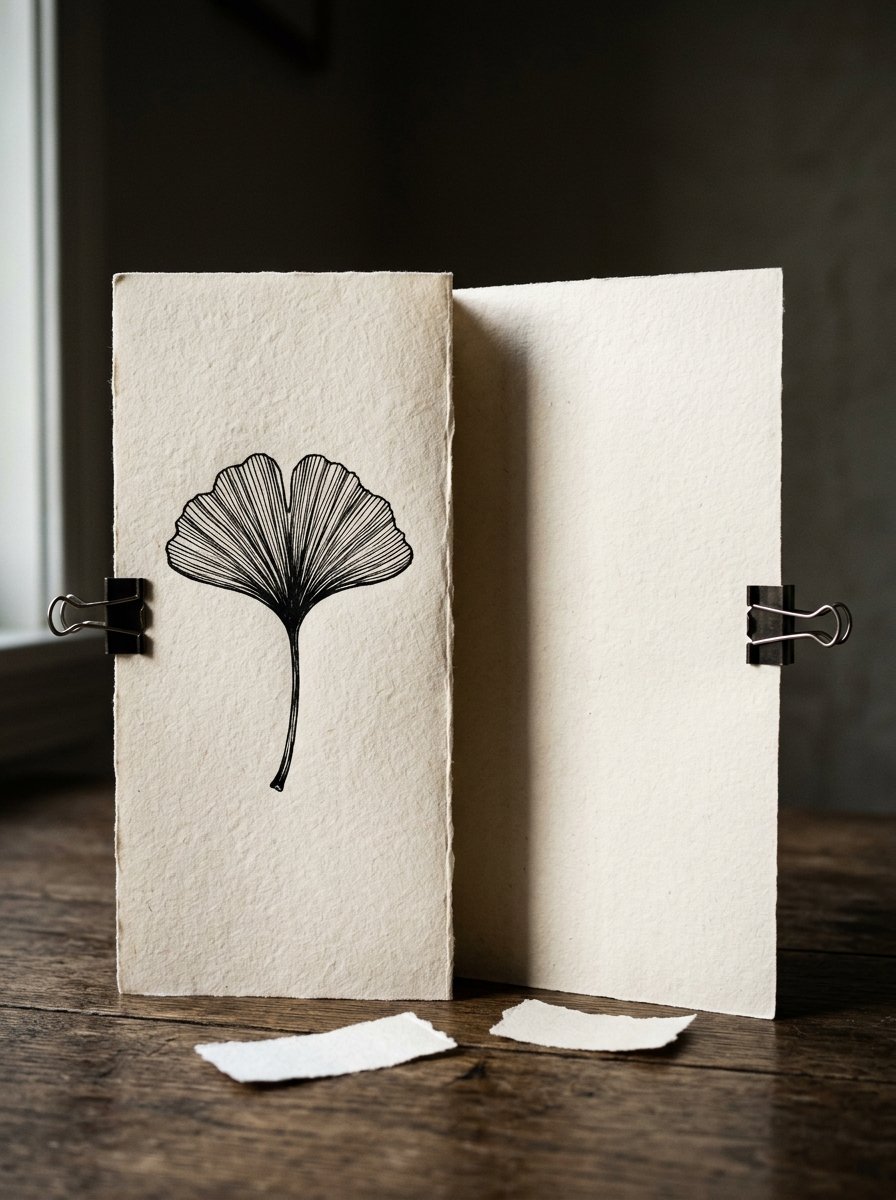
Ginkgo leaf in 4 steps: stem, the fan, ribs to one point, ink it.
One shape, two passes, and the single joint drawing worksheets for adults will find
Pick one shape and trace it once, properly, without rushing it.

The whole evening on one teacup: trace it once, say the order out loud, turn it face down, draw it again.
Look at what the stages told you while you did it. Say the order out loud if nobody is about.
Then turn the sheet face down, take a clean piece of paper, and draw it again.
Do not peek. Peeking turns the secret back into a tracing exercise.
Put the two side by side and find the single worst joint. Only one. Name it in words.
Then draw that joint alone, 8 or 10 times, on a scrap. Not the whole shape. Just the joint.
Draw the shape once more and stop for the night, whatever it looks like.
(The stopping is the part I am worst at, and the part that makes tomorrow’s attempt better.)
Free Starter Pack
10 pattern templates, free
Fills for the middle of a shape you built yourself. Sent tonight, plus a starter pack.
Unsubscribe in 1 click, no hard feelings
The second pass hands you a shape you built yourself. It also hands you a large empty middle.
100 shapes, each with its faint twin and its build


Pick one, trace it, then turn the sheet over and go again. Each piece carries a faint guide and a 5-step build. So the face-down pass has something underneath it to remember. I still work this way when I want to draw and not invent.
Instant download · print as often as you like
Which drawing worksheets for adults should you start with?
Start with a shape built inside one simple container, like a circle or a strong vertical.
A container gives your face-down pass something to check itself against, and checking is the whole mechanism.
Animals curled into a round, a ribbon, a ladder, a leaf with a spine. All of them carry a rule you can say in one sentence.
Avoid anything whose appeal is texture, or fur, or dozens of tiny repeated marks.
Texture hides the fault instead of exposing it, and a hidden fault teaches nobody anything.
(I began with a peacock. I do not recommend beginning with a peacock.)

A cat loaf is a bread loaf with ears, which is the whole point of starting inside one simple shape.
What if the face-down pass comes out worse?
It will come out worse. That is the design, not a setback.
The traced pass is the best your hand can currently look. The face-down pass is where your hand currently is.
The distance between those two is the only honest measurement available to you.
A gap that you can name is a gap you can close in about 20 minutes on a scrap.
A gap you cannot name just becomes a vague feeling that you cannot draw, which is both wrong and unhelpful.
(I have held that vague feeling for years at a time. The sheet took about an evening to replace it with a list.)
A traced line is a loan, and there is nothing wrong with borrowing. The face-down pass is simply the moment you find out which part of the shape you already own. Tomorrow you will own one more joint of it than you did tonight. The paper keeps no record of how long that took.
“Let every pupil take this first copy home with him, and learn it as one learns a lesson by heart.”
Lecoq de Boisbaudran · translated 1911
Mirabelle wrote this. No training, strong opinions, many pens. Peer reviewed by a cat who turned the sheet face down by sitting on it.