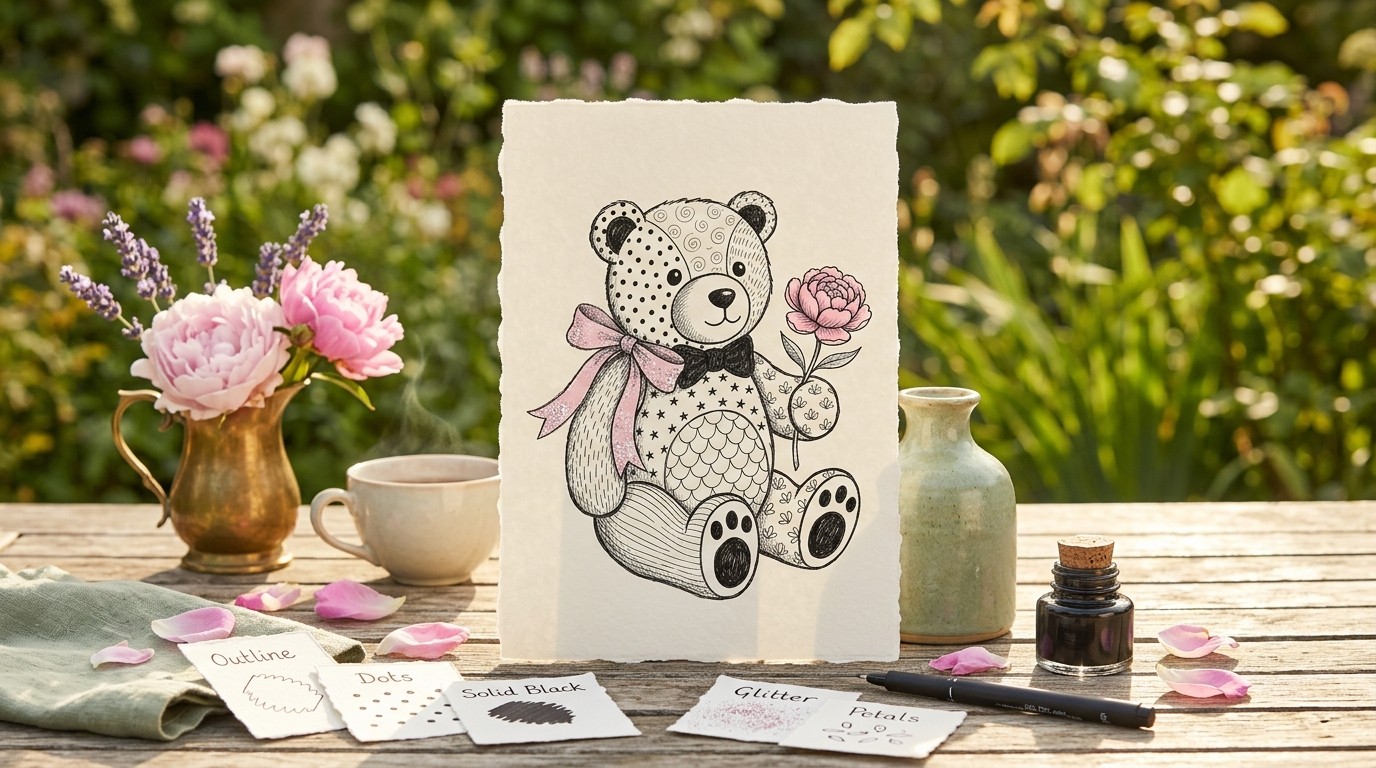
Something might happen when you start.
Your brain quiets. Your breath slows.
Not because you’re trying. Because your hand found something it remembers.
In 1940, four teenagers exploring caves in Lascaux, France, found something that changed archaeology forever.
17,000-year-old paintings. Not crude stick figures. Intricate patterns. Dots arranged in sequences. Lines forming grids. Spirals that still look intentional today.
The patterns weren’t random. They were deliberate. Repeated. Mathematical.
Archaeologists found the same patterns 5,000 miles away in Aboriginal rock art. Then in Neolithic pottery. Then in medieval manuscripts.
Different continents. Different millennia. Same impulse.
When you sit down with a pen and start making dots, you’re not inventing something new.
You’re remembering something old.
Japanese Zen monks call it mushin – “no mind.” The state where your hand moves without your brain narrating.
Islamic mathematicians in 9th century Baghdad spent lifetimes mapping how patterns tessellate. Not for decoration. For meditation.
Celtic scribes in 7th century Ireland filled entire manuscripts with interlaced knots. One unbroken line, folding back on itself for pages.
Why?
Because when your hand repeats a pattern, something in your nervous system recognizes safety. Order. Home.
You’re about to feel what they felt.
Each idea connects to a different cultural lineage.
Try what calls to you.
Draw a large square. Divide it into smaller squares.
Fill each square with a different repeating pattern.
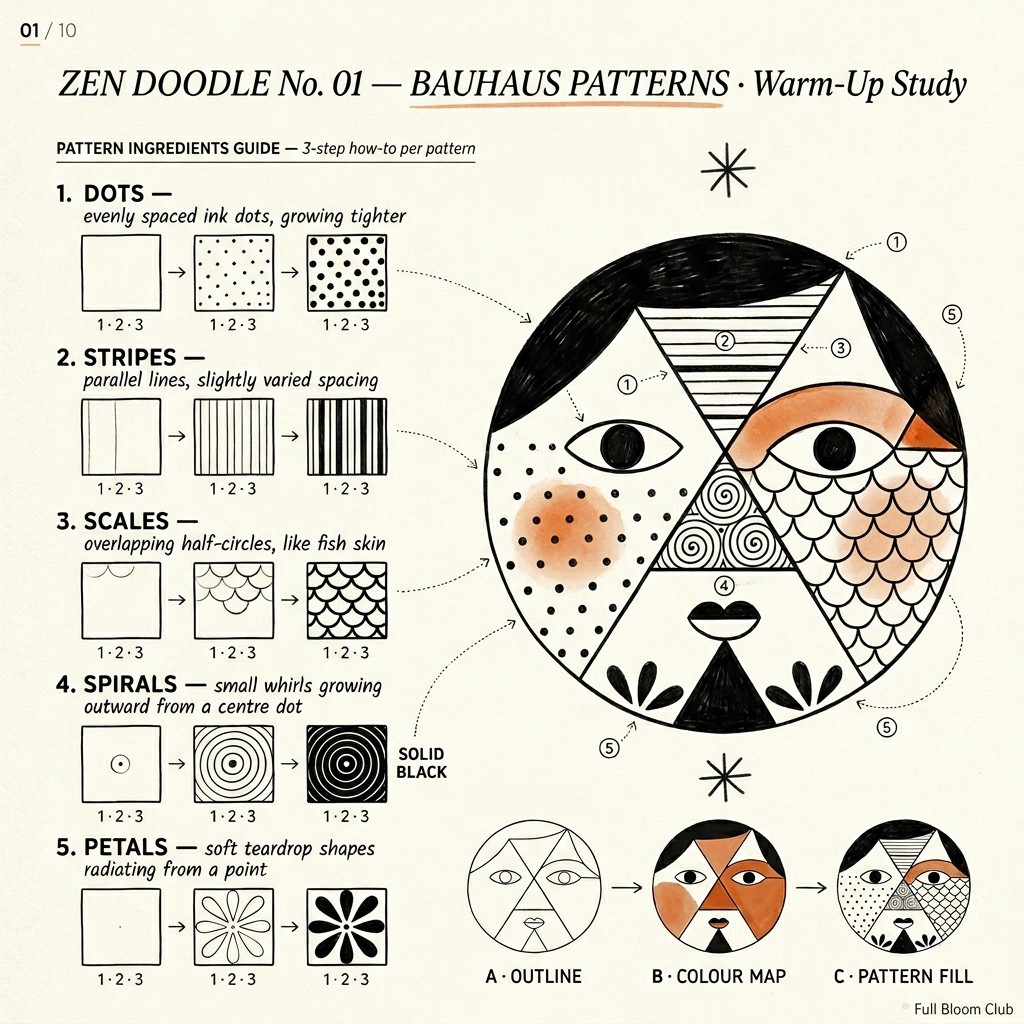
In the 1920s, Paul Klee taught at the Bauhaus in Germany. He had students create “magic squares” – grids where each section held a different visual rhythm.
His most famous painting, Senecio, is just a circle made of geometric sections. It sold for $6.4 million in 2006.
Not because it’s complex. Because it proves something: a grid of simple patterns can hold your attention as powerfully as any Renaissance portrait.
Takes about 12 minutes.
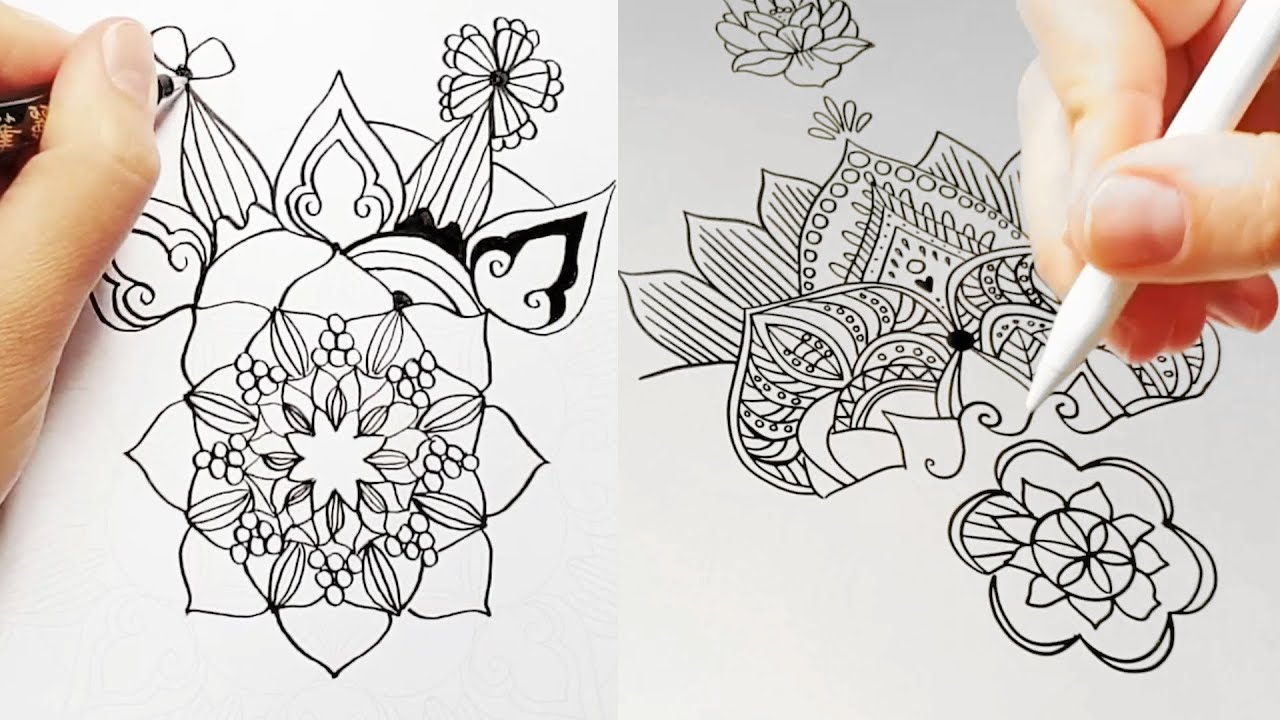
This is our favorite method and you will find the video below on how to do it.
Quick How To Video:
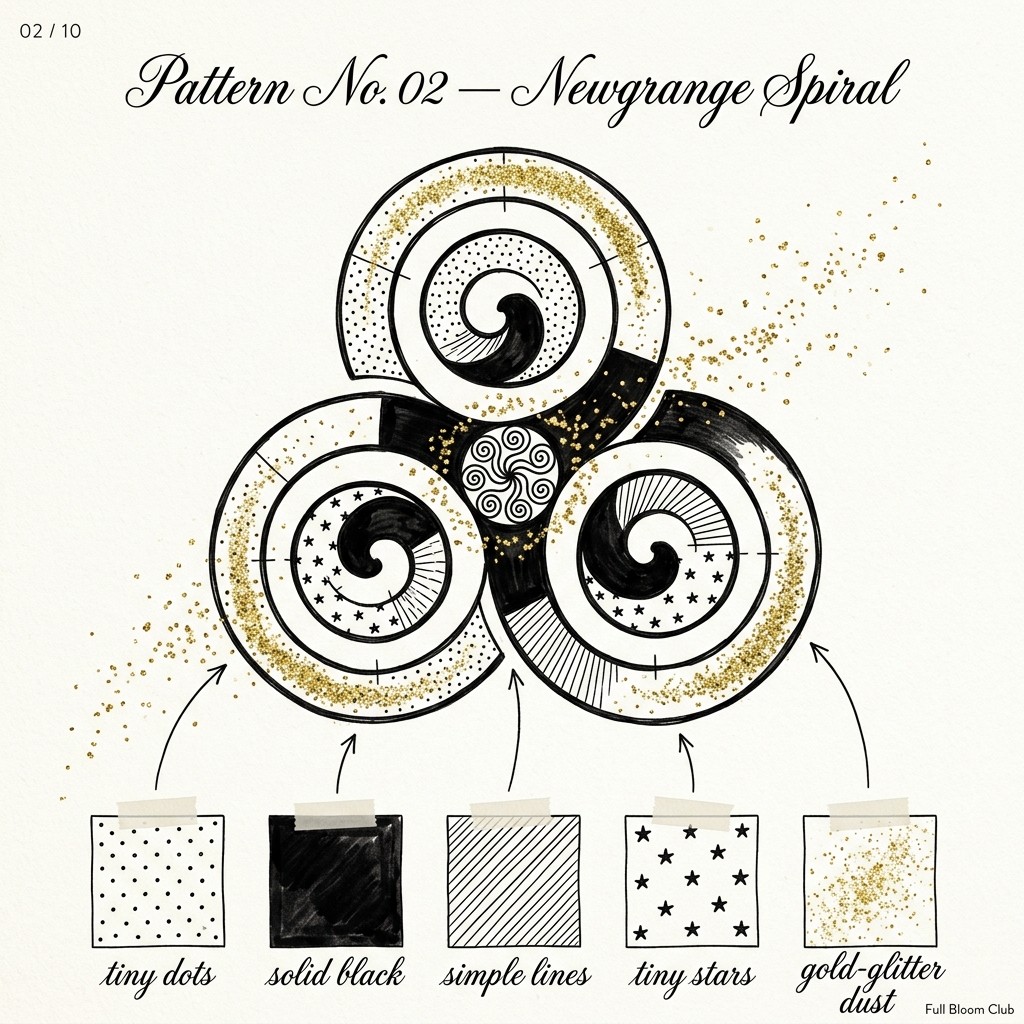
Start with a small circle in center. Draw a spiral outward. One continuous line.
In 3200 BCE, someone carved a triple spiral into a stone at Newgrange, Ireland.
It’s still there. Older than Stonehenge. Older than the Egyptian pyramids.
Archaeologists don’t know what it meant. But they know it mattered – the entrance to the tomb was designed so sunlight hits that exact spiral once a year during winter solstice.
A spiral carved 5,200 years ago still catches light at the darkest time of year.
When you draw your spiral, you’re joining that lineage.
Takes about 8 minutes.
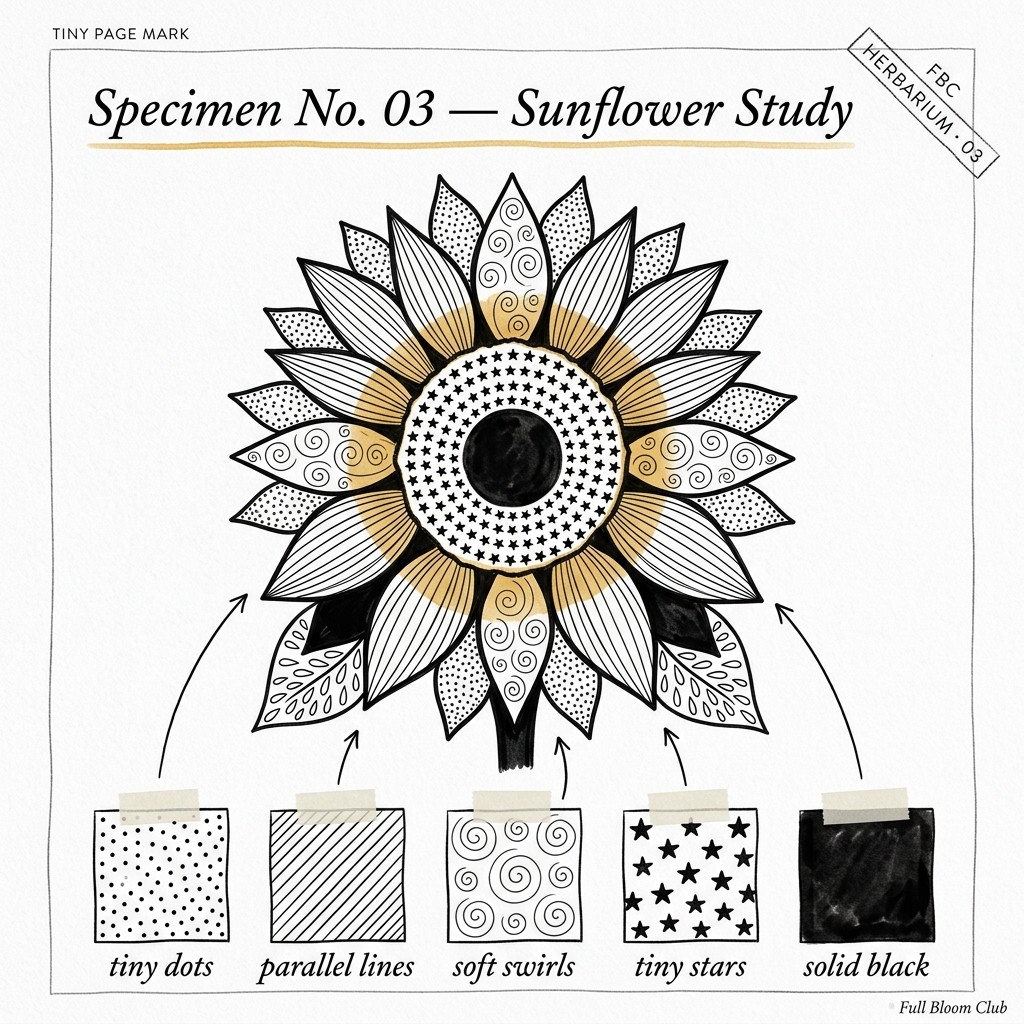
Draw a simple flower. Circle with petals around it. Keep adding layers.
In 1888, Vincent van Gogh painted sunflowers in Arles, France. Not once. Eleven times.
The same flower. Over and over.
“I am working at it every morning from sunrise on,” he wrote to his brother. “The sunflower is mine.”
He wasn’t copying. He was obsessing. Each painting explored a different rhythm in the petals.
Repetition isn’t lack of imagination. It’s devotion to seeing deeper.
Takes about 15 minutes.
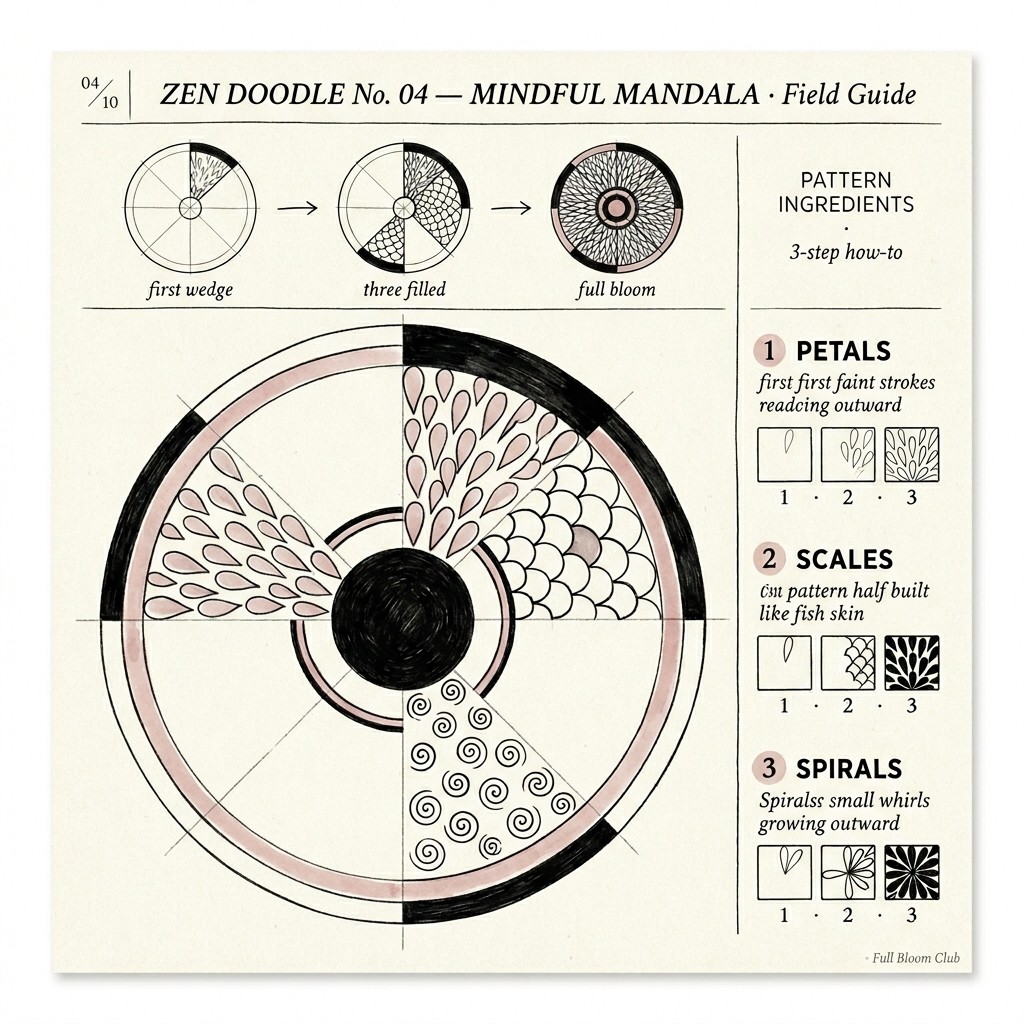
Start with a dot in center. Draw circles around it. Add patterns between the circles.
In 1994, monks from Drepung Monastery in Tibet spent two weeks creating a sand mandala in New York City’s American Museum of Natural History.
Millions of grains of colored sand. Arranged grain by grain using metal funnels.
When they finished, they swept it into the Hudson River.
Why destroy it? Because the Tibetan word for mandala – kyilkor – means “center and circumference of the universe.”
Making it mattered. Keeping it didn’t.
Takes about 14 minutes.
We have a whole toolkit dedicated to unique Mandala creation as this is one of the most wonderful art forms.
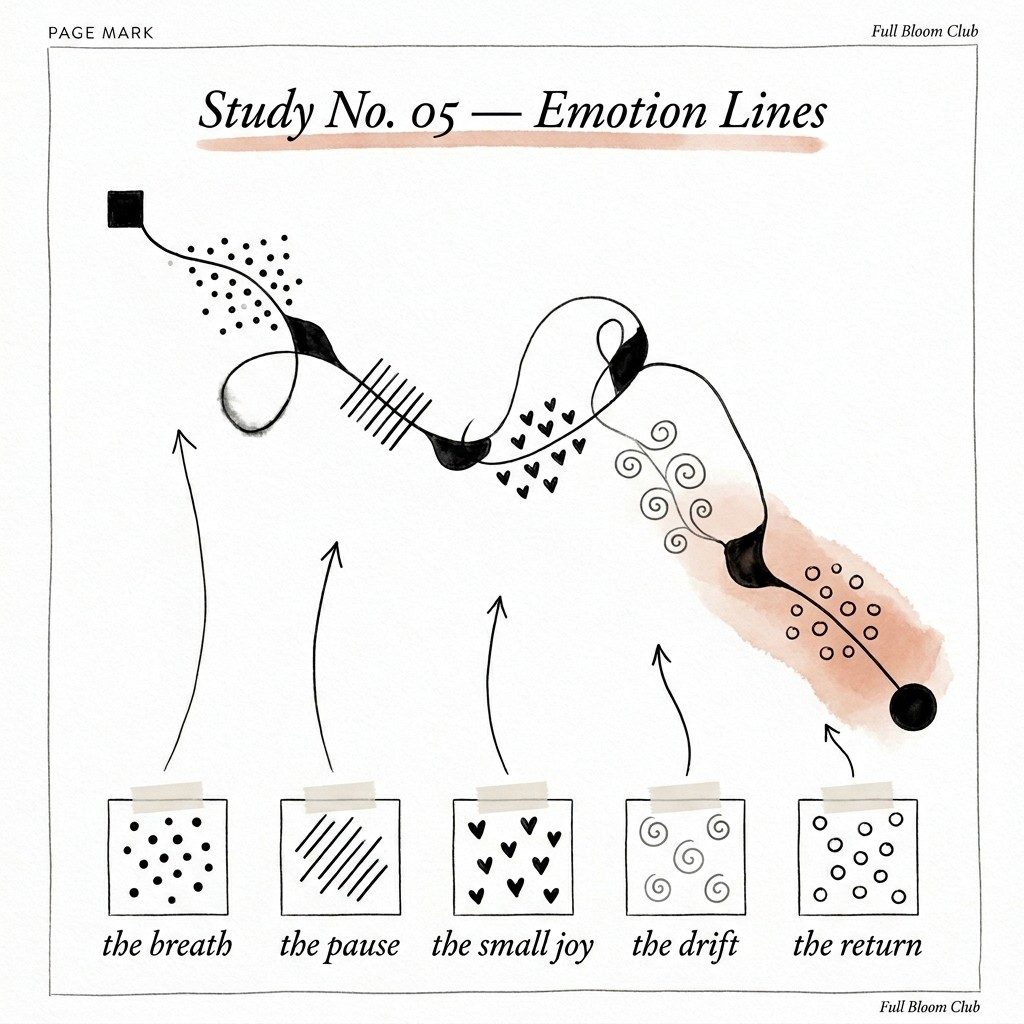
Choose an emotion. Express it through one continuous line.
In 1913, Marcel Duchamp painted Nude Descending a Staircase, No. 2.
Critics called it an explosion in a shingle factory. They meant it as an insult.
But Duchamp understood something: a single figure could be shown in multiple positions at once, creating a line of movement through space.
He wasn’t painting a body. He was painting time itself.
Your emotion line does the same. One continuous mark capturing how feeling moves.
Takes about 5 minutes.
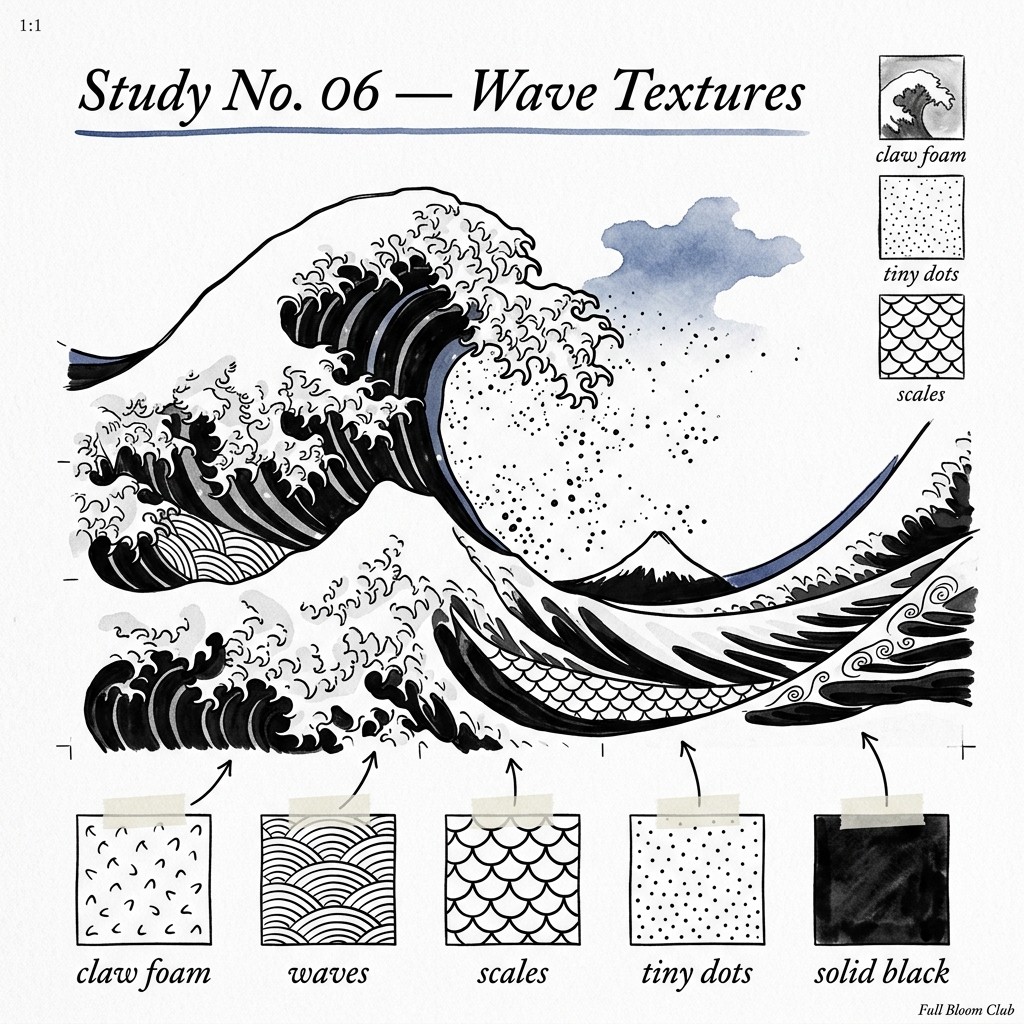
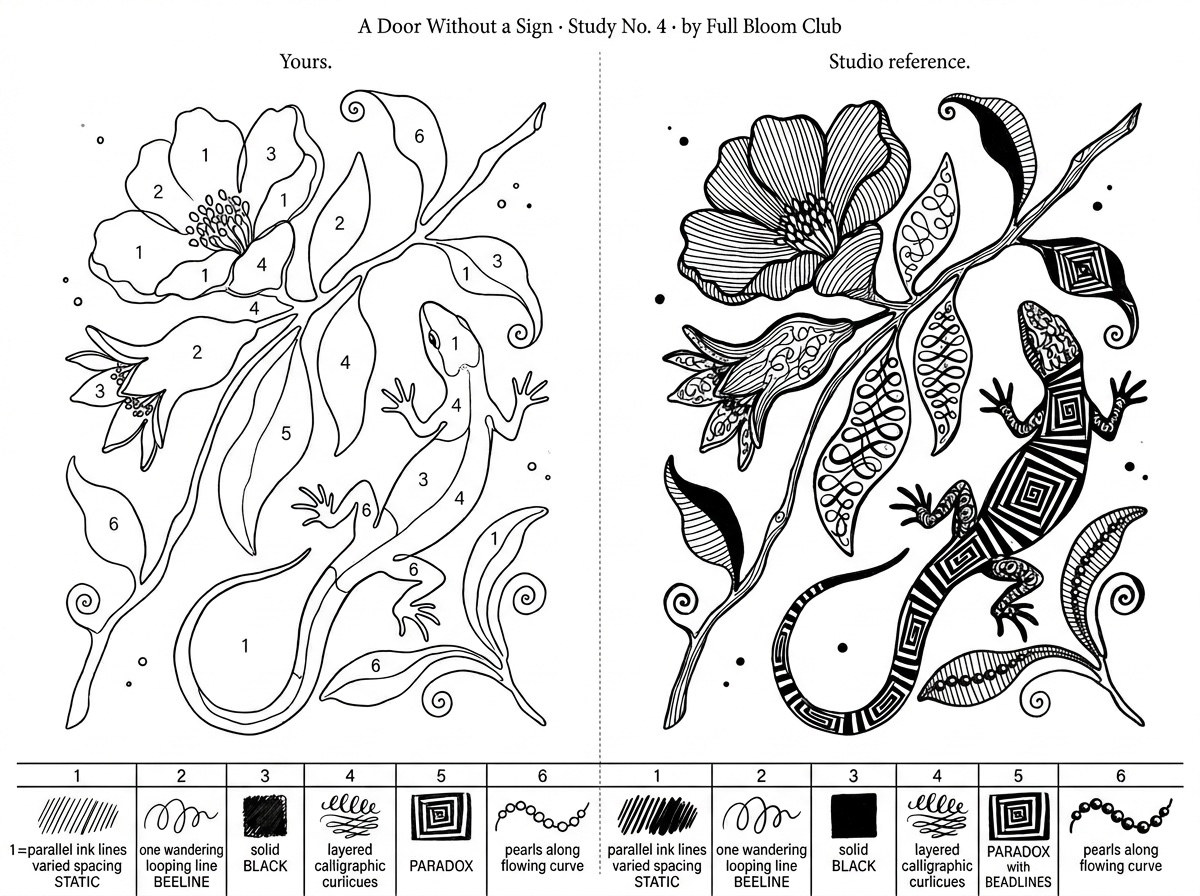
Pick a natural element. Tree bark. Leaves. Clouds. Fill a shape with textures inspired by it.
In 1836, Japanese artist Hokusai created The Great Wave off Kanagawa.
Most people see a wave. But look closer at the foam – it’s not smooth. It’s thousands of tiny claw-like marks. Individual. Directional.
Hokusai was 76 when he made it. He’d spent 60 years learning to draw texture.
“From the age of six I had a mania for drawing,” he wrote. “At 73 I finally understood something of the true quality of nature.”
You’re starting that journey. Observing texture. Translating it into marks.
Takes about 10 minutes.
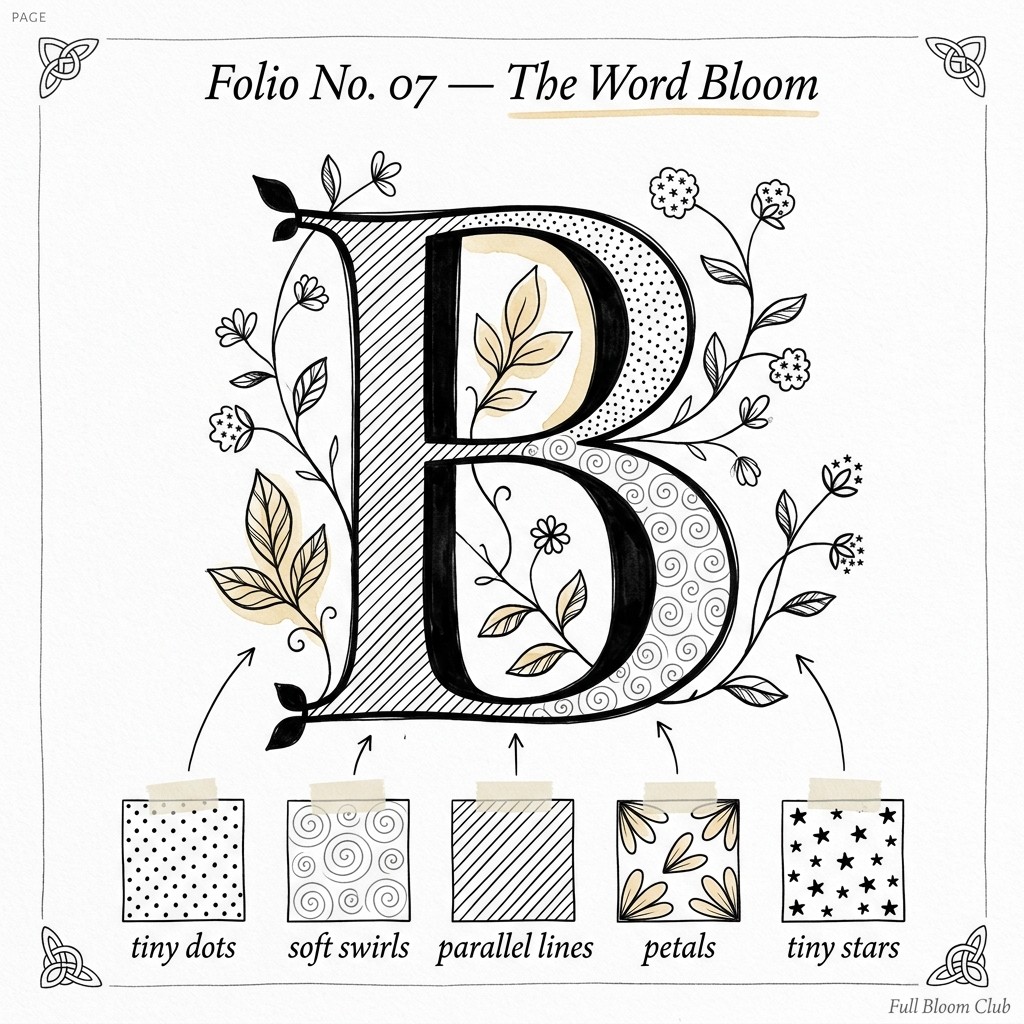
Write a positive word in center. From each letter, draw stems. Add flowers along the stems.
In 800 CE, Irish monks created the Book of Kells – a hand-illuminated manuscript of the four Gospels.
The first letter of each chapter isn’t just a letter. It’s a garden. A zoo. A universe.
The letter Chi (X) on folio 34 takes up an entire page. Vines spiral from it. Animals hide in the curves. Dots form constellations.
It took 30 years to complete.
Your word bloom takes 12 minutes. But the principle is the same: letters can grow things.
Takes about 12 minutes.
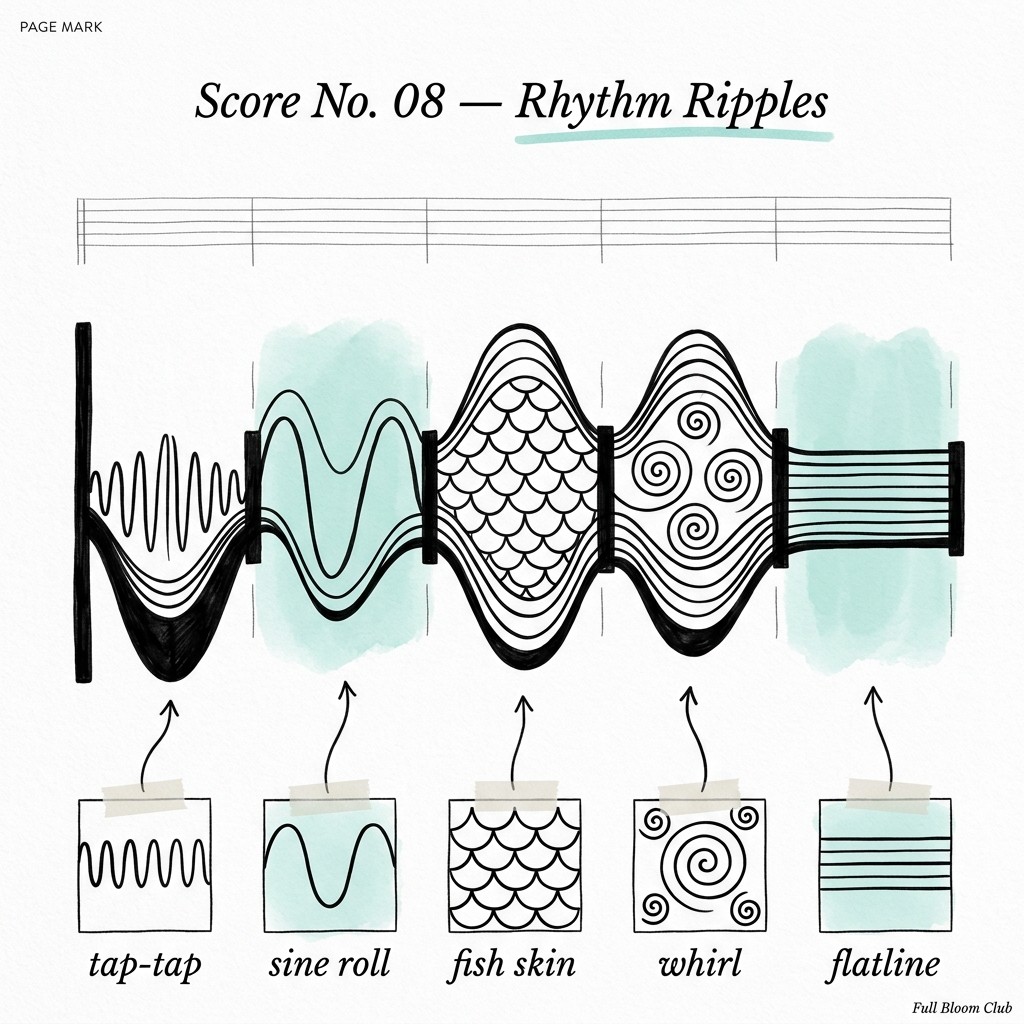
Listen to music. Draw ripples or waves that match its rhythm.
In 1910, Russian artist Wassily Kandinsky went to an exhibition of Claude Monet’s haystack paintings.
He realized Monet wasn’t painting haystacks. He was painting light changing over time. Music made visible.
Three years later, Kandinsky created the first purely abstract painting. No objects. Just colors and shapes responding to an inner rhythm.
“Color is the keyboard,” he wrote. “The eyes are the hammers. The soul is the piano with many strings.”
You’re doing the reverse. Translating sound into visual rhythm.
Takes about 7 minutes.
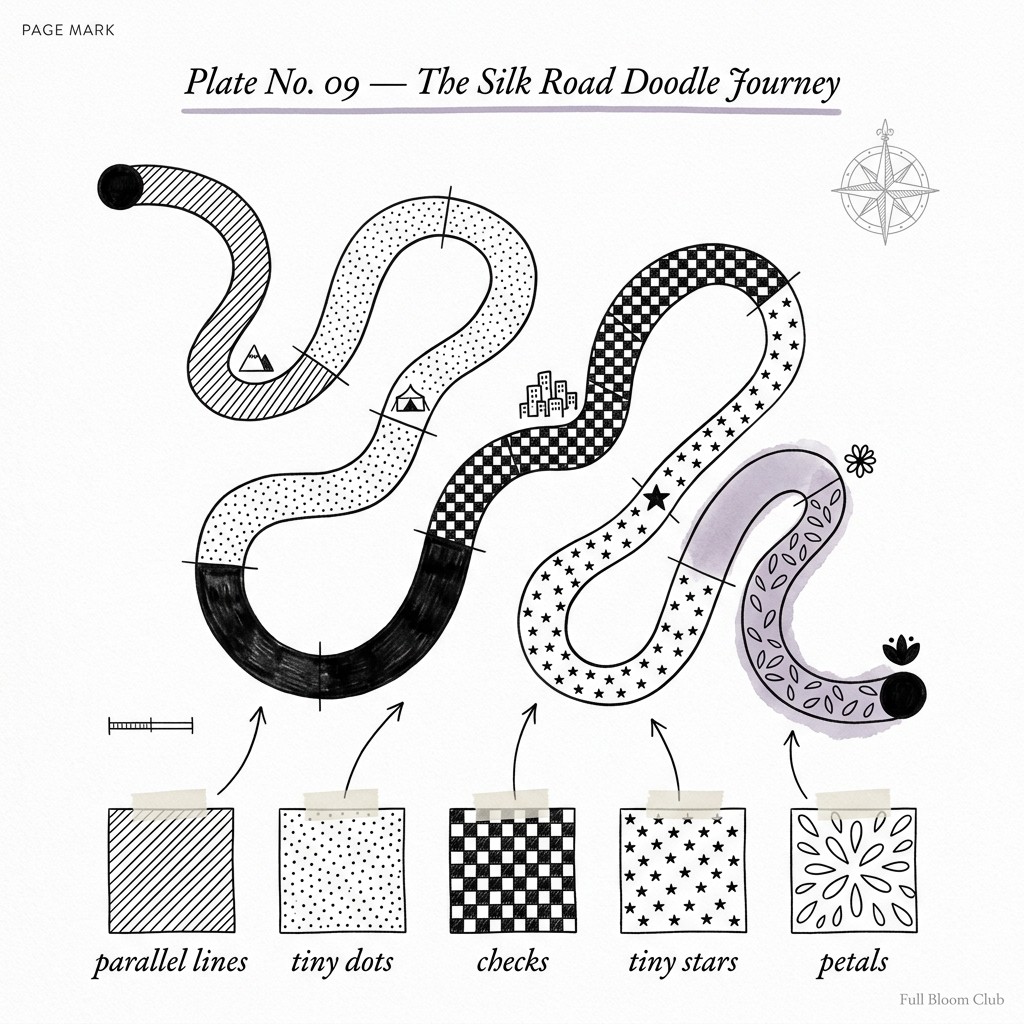
Draw a winding path across your page. Add small objects or symbols along it.
In 1260, Venetian merchant Marco Polo set out on the Silk Road to China.
His journey took 24 years. When he returned, he described it in a book called The Travels.
Cartographers used his descriptions to create “mental maps” – paths with symbols marking key moments. A caravanserai here. A mountain pass there. A city made of jade.
Your doodle journey is that kind of map. Personal. Symbolic. Marking the moments that mattered.
Takes about 10 minutes.
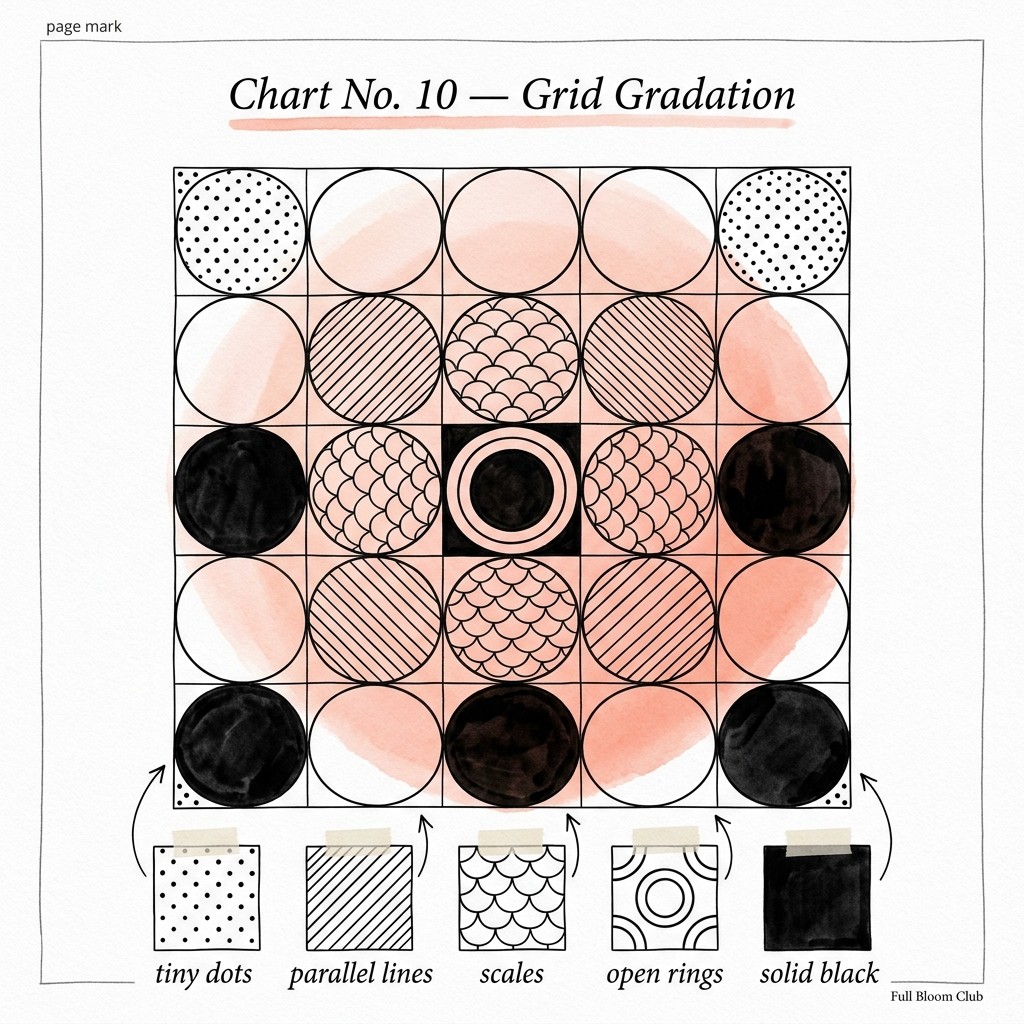
Draw a grid of squares. Fill them with one pattern. Gradually change it across the grid.
In 1963, Hungarian-French artist Victor Vasarely created Vega-Nor – a grid of circles that appear to bulge off the canvas.
Optical illusion. But created purely through gradual size changes. Small circles on the edges. Larger circles in the center.
Nothing three-dimensional. Just pattern evolution creating the illusion of form.
Your grid works the same way. One pattern gradually becomes another. Evolution you can watch happen.
Takes about 15 minutes.
You just read about 17,000-year-old cave paintings. Tibetan monks. Vincent van Gogh’s eleven sunflowers.
Here’s what matters:
None of them were perfect.
The Lascaux caves have handprints where the artist’s palm slipped. Van Gogh’s sunflowers have visible brushstrokes where he changed his mind. The Book of Kells has a page where a monk misspelled a word and just kept going.
They’re in museums anyway.
Because the work was never about perfection. It was about showing up. Putting hand to surface. Making the mark.
Your dots won’t line up perfectly.
Your spiral will wobble.
Your mandala will be asymmetrical.
Good.
That’s how you’ll know it’s yours.
Somewhere right now, there’s a bear in the woods who doesn’t care about your technique. Doesn’t judge your line quality. Doesn’t compare your squares to Paul Klee’s.
That bear just knows:
You picked up the pen.
You made something that didn’t exist before.
You remembered something 17,000 years old.
The bear believes in you.
Not because your patterns are perfect.
Because you drew them anyway.
Now pick one idea. Set a timer. Start.
Let your hands guide you.
Our website uses cookies to improve your experience. Learn more about: privacy policy