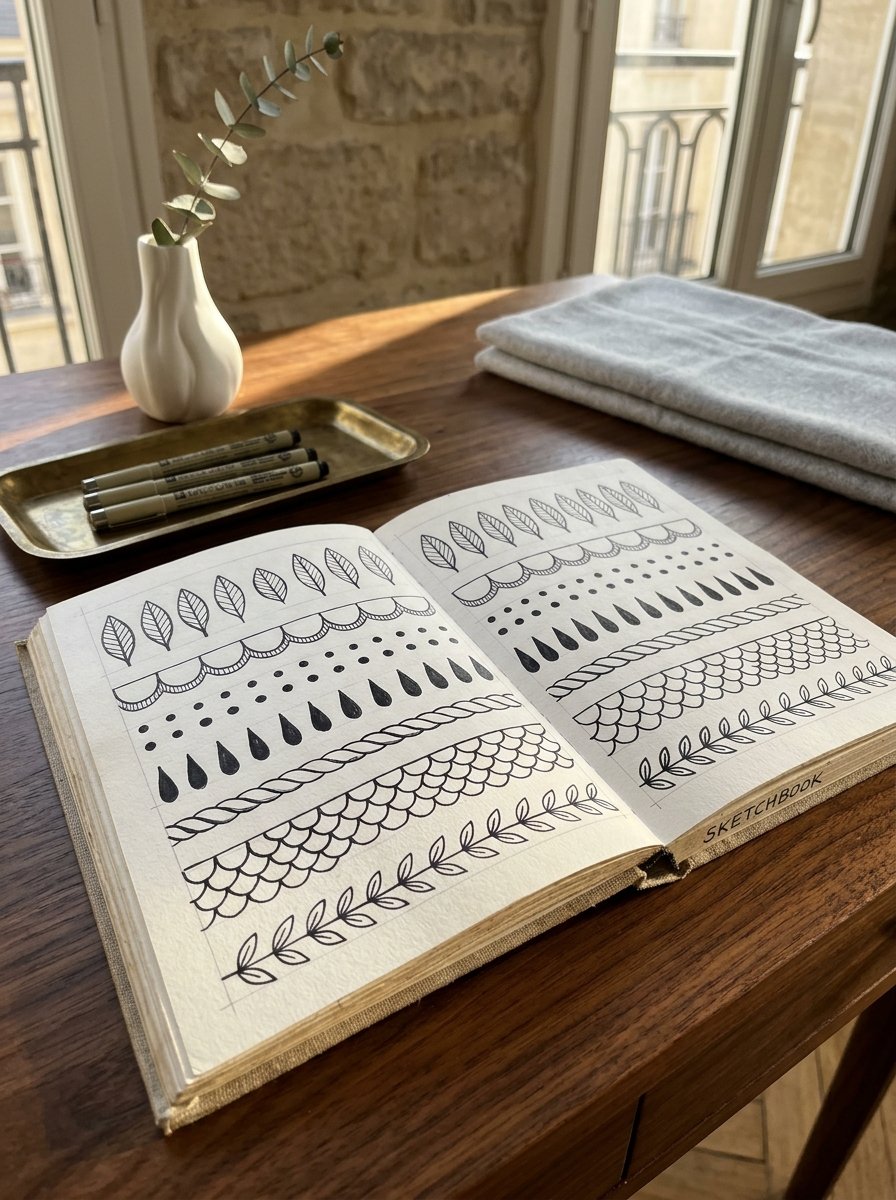
One mark on a page is not a doodle. It is a pen being tested. Doodling for adults goes wrong at the second mark, not the first.
Anybody can put down one good little shape. The page is still fine.
Then a different shape goes beside it. Then a third, also different.
That is what a messy page actually is. It is not a shaky hand.
A mark that appears once reads as an accident. Repeat it, or leave it out. That is the 1 rule.
(I believed for years that my pages looked untidy because my lines wobble. They do wobble. That was never the problem.)
Below: the rule, then 85 doodles sorted by how many times each one repeats.
The garland sheet is first.
Download the free garland sheet →

Print it at actual size, not fit to page. (The printer will lobby for fit to page. Decline.)
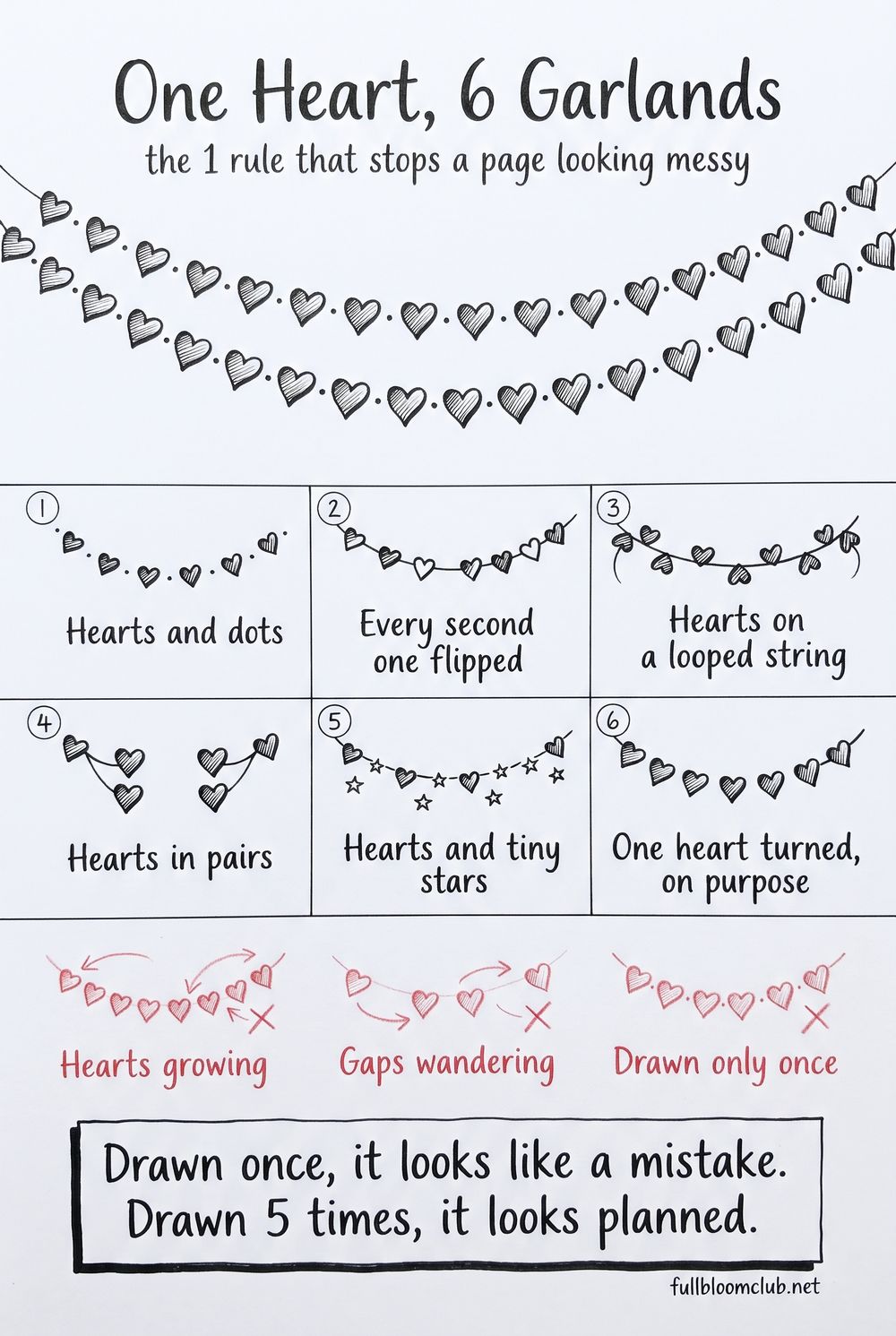
One small heart, 6 garlands. Every garland on the sheet is the same heart, used again.
The numbers show you what changes: a dot, a flip, a pair, a star. The heart never does.
In red pencil, the 3 mistakes that make a page look messy: hearts that grow as you go, gaps that wander, and the shape you drew only once.
Pick one garland tonight and carry it all the way round a birthday card.
Your job is the fifth heart onward, matching the 4 before it.
Matching is the skill. It sounds beneath you. It is not.
I ran the rule across my own sketchbook before writing any of this.
Every page I liked had 2 or 3 shapes on it, used over and over.
Every page I disliked had 11 shapes on it, each used once.
Same pens. Same hand. Same evening, in 2 cases.
A sheet can rule the band for you. It cannot hand you the unit that goes in it, and picking the unit is where most evenings stall.

The Collection
30 daily sheets, and every one of them has already chosen the unit and the band.
ZEN DOODLE MASTERY. Bands, fills, and one shape used again. For the evening you want to draw and not decide. Inside: 30 daily sheets, each handing you the unit and the band it repeats inside. (I still reach for a ruled band when I cannot face choosing.) What you get: a page that reads as deliberate, and a vocabulary that outlasts it.
So the rest of this is units, grouped by how many times each one has to appear.
A mark used once is a pen trial, not a doodle
There is a name for a mark made once and never repeated.
Scribes called it a probatio pennae, a pen trial.
A quill nib was cut by hand with a penknife, so every fresh cut wrote differently.
You tested it by scribbling in whatever space was nearest.
Usually that space was the margin of a book somebody else had written.
One of those scribbles, in the Bodleian, is a few words in Old Dutch.
It sits on folio 169v of MS Bodley 340, dropped into a book of sermons in the late 11th century.
It is now studied as one of the first surviving fragments of Dutch literature.
(A man wiping his pen produced a national treasure. I think about this a lot.)
The point for tonight is duller and more useful.
A single mark on a page is the pen talking, not you.
So treat these 9 as vocabulary, never as finished marks.
Build one properly before you build 40 badly. The page below is the pointed leaf, a page high, in the order the strokes actually go down.

the dot is the one to practise first, because it is the hardest to space evenly. the dash wants to be the same length every time, so draw it toward yourself. the teardrop starts fat and lifts, and the lift is what makes it a teardrop.
the pointed leaf is 2 curves that meet, and they must meet or it reads as a fish. the lens is that leaf lying on its side, and it fills better than it outlines. the comma is a dot with a tail, and the tail goes last.
the hook needs a flat top or it collapses into a scribble. the little flag is a stalk with a triangle, and the stalk sets the height of a row. the open triangle survives being drawn badly, so start there.
Two of anything reads as indecision
A unit used twice is worse than a unit used once.
Once looks like a mark. Twice looks like you thought about it and stopped.
The eye reads a pair as a comparison and starts hunting for a difference.
So a pair only works when the 2 halves are doing opposite jobs.
(My sketchbook is full of hopeful pairs. They all look like they are waiting for a bus.)
These 10 are the pairs that hold, and all of them are mirrored on purpose.
the double dot works only if the gap is smaller than the dots. the twin leaves must come off one stalk, drawn as one movement. the facing commas need their tails pointing away from each other, never in.
the pair of hooks should sit back to back, which makes a spine. the mirrored teardrops want their fat ends touching. the double rule is 2 parallel lines, and the gap has to read as one thing.
the two-stroke cross looks flat unless one stroke is heavier. the paired flags go at different heights or they read as a mistake.
the split leaf is one leaf cut down the middle, filled on one side only. the twinned lens overlaps, and the overlap is the only interesting part.
Draw any of those twice more and it stops being a pair and becomes a rhythm.

Three in a row is a border, and doodling for adults lives there
Three of the same mark, evenly spaced, stops being marks and becomes a band.
The eye gives up counting at 3 and starts predicting instead.
Prediction is the feeling people call deliberate.
Manuscript workshops had this sorted out 700 years ago, and in a strict order.
On a page from the workshop of Jean Pucelle, the border came late, not early.
The documented order of work runs: silverpoint drawing, gold, colour, then outlining the marginal figures, then penning the running border.
The space for all of it was reserved before a single mark went down.
His book of hours for Jeanne d’Evreux was made between 1324 and 1328.
The pages are 9.2cm by 6.2cm. Smaller than a playing card.
Across 209 leaves it carries over 700 images, most of them in the margins.
They are drawn in pen in grey wash, a method the trade called de blanc et noir.
(He had a whole workshop and he still ruled the space first. I did not, for 30 years.)
So rule 2 faint lines, then run the unit between them. Never freehand a band.
the dot row is the test of everything, and it is all about the gaps. the dashed rule wants each dash the same length, so keep your wrist still. the running leaf border leans all one way, and the lean must not drift.
the scallop row is arcs that touch, and touching is harder than overlapping. the bead and reel alternates a dot and a bar, which hides uneven spacing. the zigzag band lives on the angle, so draw the peaks first and join them.
the loop chain needs each loop to sit in the dip of the last one. the arcade is a row of arches on legs, and the legs must match. the rope twist is 2 waves out of step, which is easier than it looks.

the tooth row is triangles sharing a baseline, so rule the baseline. the fringe is short strokes hanging off a rule, and unevenness helps here. the wave band should be drawn in one pass, breathing out.
the picket line is verticals, and verticals expose a tilted page fastest. the stitched line is a dash row with gaps, and it reads as thread. the chevron band wants sharp points, so stop short and then go up.
the diamond chain is 2 tooth rows facing, and they must line up at the tips. the cable is loops that overlap, each crossing the last at the same spot. the barbed rule is a line with small spurs, and 5 spurs beat 15.
Turn the unit as it repeats and the row stops looking printed
A row of identical marks, all facing one way, starts to look mechanical.
Printers solved this before anyone else, because they had no choice.
A printer owned one small metal ornament and needed a whole border from it.
Because the sorts were cast in multiples, printers built borders with repeating patterns of the same ornament.
Robert Granjon pioneered the style, and the specimens survive from 1567.
One shape. Turned, mirrored, stacked, and suddenly it is a page of lace.
(There is something pleasing about a man in 1567 getting 40 patterns out of one piece of metal.)
Your version is cheaper still. Turn the paper, not the pen.
These 14 are all one unit, rotated, and nothing else changes.
the pinwheel is 4 leaves turned a quarter each, and the centre must stay tight. the quatrefoil is those 4 leaves with their points meeting, so draw the cross first. the rosette is 6 or 8 units round a dot, and an even number is more forgiving.
the compass star needs its long points drawn first, short ones after. the turning comma wheel is commas chasing each other, all tails the same way. the fan corner is units spreading from one point, and the spacing opens as it goes.

the mitred corner is where 2 bands meet at 45 degrees. It is the most useful thing on this page. the spun leaf is one leaf drawn at 8 angles down a strip. the alternating flip turns every second unit over, which fixes a boring row.
the half turn row flips every unit, so the band reads as one ribbon. the tumbling block is 3 diamonds that read as a cube, if the shading agrees. the whirl is a spiral built from separate arcs rather than one line.
the crossed lens is 2 lenses at right angles, and it makes a good full stop. the four-way hook is hooks pointing out from a square, and the square stays invisible.
A field is one mark you stopped counting
Past about 30 repeats, a unit stops being a row and becomes a texture.
This is the part of doodling for adults that fills a shape, and most people love it.
It is also where the best documented doodle in mathematics came from.
In 1963 Stanislaw Ulam sat through what was described as a long and very boring paper.
He began writing the whole numbers on paper in a square spiral, in order.
Then he marked which ones were prime, by hand, one at a time.
Diagonal lines appeared in the primes. Nobody had expected that.
Martin Gardner put it on the cover of a magazine in March 1964.
(He was doodling in a meeting. I have never once got a theorem out of it.)
The mechanism is the one on your page. One unit, repeated on a grid, until something appears that you did not draw.
So keep the unit small and the spacing regular, and let the field do the work.
the dot field is the honest one, and the spacing is the whole skill. the scale field is overlapping arcs in rows, each row sitting in the gaps below. the brick field needs every second row shifted by half a brick, and nothing else.
the crosshatch should be 2 angles only, never 3. the parallel field is ruled lines close together, and it wants the page sideways. the ripple field is waves stacked, and each wave copies the one above it.

the pebble field is closed shapes touching, drawn big first and small in the gaps. the honeycomb is easier if you draw rows of Y shapes instead of hexagons. the moss fill is tiny loops crowded together, and it covers a multitude of sins.
the coil field is small spirals, all wound the same direction. the checker wants a ruled grid under it or it drifts within 4 squares. the herringbone is short strokes at alternating angles, in strict rows.
the seed field is teardrops all pointing to one corner. the rain field is dashes at a slight slant, and the slant must never vary. the tile field is squares with one corner filled, turned at random.
the cloud fill is bumpy outlines nested inward, each one smaller. the root fill is branching lines that never cross. the woodgrain is long wavy lines that split around a knot.
the feather fill is short strokes off a spine, angled back. the net is 2 sets of curves crossing, and the curve is what saves it.
That is 20 fills for the middle of a shape. The shape itself is still your problem.
Free Starter Pack
10 pattern templates, free
Fills for the middle of a band you ruled yourself. Sent tonight, with a starter pack.
Unsubscribe in 1 click, no hard feelings
A field is finished when it is even. Which is a strange thing to aim for, so here is the part that rescues it.
The break in the repeat is the part that looks planned
A perfect repeat reads as wallpaper. Pleasant, and a bit airless.
One deliberate break tells the eye a person was in charge.
Most doodling for adults stops one step before this, which is a shame.
The break must be single. Two breaks and it reads as carelessness again.
Put it off centre, roughly a third along, never in the middle.
(I used to put mine in the exact centre, then wonder why the page looked like a logo.)
Draw the full repeat first, then decide. You cannot plan the break in advance.

the one turned tile is a single unit rotated in an otherwise straight row. the gap in the row is one unit left out, and it is the cheapest of all. the one solid black fills a single unit in, and it must be small.
the dropped bead sits one unit below the line, as if it fell. the missing tooth is a triangle left as an outline among filled ones. the knot in the chain tightens one loop of a loop chain.
the shifted centre moves one unit half a step sideways, and half a step is plenty. the one oversize unit is drawn at double scale, and it needs space round it. the stray sits outside the band entirely, and only once a page.
Doodling for adults needs a margin more than it needs another pattern
The most common fault on a full page is not a bad mark. It is no edge.
Marks run to the paper edge, fade out, and the page reads as spillage.
Rule a faint line a thumb width in from every edge before you start.
Then run everything up to that line and stop there.
The empty band around the outside is doing as much work as the drawing.
(Nobody has ever admired a margin out loud. They notice its absence immediately.)
These last 5 are about stopping, the least popular skill in this article.
the ruled margin line is drawn in pencil and left there, because a visible edge is honest. the corner stop squares off where 2 bands meet, so neither runs past the other. the fade-out row shrinks each unit toward the end, and it needs 5 units to read.
the torn edge is a ragged end to a band, and only ever one per page. the empty corner is a corner you leave completely alone, and it is the hardest instruction here.

Rule the margin before anything else, then give doodling for adults exactly 2 units
Rule your margin first, in pencil, before anything else happens.
Pick 2 units from this page. Only 2. Write their names at the top if it helps.
Run the first one as a band along the top, inside the margin.
Count nothing. Just match the gap you used last time.
Then use the second unit as a field, somewhere the first one is not.
Now stop and look. The page should already read as deliberate.
Add the break last, one only, about a third of the way along a band.
(The stopping is the bit I am worst at. I have ruined good pages at 11pm by adding a ninth idea.)
If it looks messy, count your shapes. It will be the count, not the hand.
The pattern side of this is covered separately, and it pairs well with an evening like this one.

An evening of this leaves you with a page and a vocabulary. What it does not leave you with is the next unit, which is the thing that runs out first.
30 sheets where the unit and the band are already decided


Pick a sheet, rule the band, and run the unit until it is full. Each sheet names the shape and shows where the row is meant to stop. So the page is decided before the pen is. I still work this way on evenings when choosing is the hard part.
Instant download · print as often as you like
A page fills the way a room fills, one thing at a time. It is nearly always the last arrival who has to be asked to leave. Rule the edge, choose 2 shapes, and let the hand go round the band. The pen keeps no record of how often you have drawn the same little leaf. It has no opinion either.
“Doodling during the presentation of a long and very boring paper.”
Martin Gardner · Scientific American, 1964
Mirabelle wrote this. No training, strong opinions, many pens. Peer reviewed by a cat who counted the repeats and stopped at 2.